
As it is when we repot plants, these pieces will have changed slightly. There is always something new to learn about every plant. Even the smallest ones.
0:00
-7:42
Africa is believed to be four billion years older than Eurasia or North America. It has been in contact with the winds for all this time. So, while it is laced with rivers and cooled by giant lakes, rippling with ancient lava flows; it is shaped primarily by air and sun. The land from the top of the continent to the bottom has undergone so many climatic transformations, and yet it has remained, all this time, in the air. So those species that have developed on it have learned to work adeptly with wind and sun.
Red oat grass longs for full sun and thick clay soil - with only touches of sand here or there. Clay soil is deadly to many plants, binding nutrients, and becoming easily waterlogged, which suffocates and stagnates root growth. But red oat grass doesn’t mind the water or the compact soil, it just wants that dry heat. Not only does it like the dry heat. It makes it. Red oat grass plunges its roots into the soil to store water and dry what might be a wet water table. They also manage the salinity in the soil, which maintains the health of all the plants around who can’t live with too much salt.
The official name is Themeda Triandra. There are less than thirty species of Themeda grasses of which red oat grass is one, and they extend across a wide range of fields, spanning Afghanistan to Australia. Much of the grasslands in Africa from the Serengeti to the South African Cape are red oat grass, along with good portions of Australia’s grasslands. It is the source of food for a network of foragers and grazers who roam this equatorial range.
These oats are part of the vast Poaceae, or grass, family, the one that nets the open earth on marshlands and drylands alike. This particular grass is related to sorghum, lemongrass, and corn. This tribe of grasses may have adapted during several climate events around the Late Miocene era, a period which heightened carbon dioxide and forced a tribe of grasses to step up their photosynthetic intake. Some developed a third chromosome and many lengthened their leaves. A new kind of grassland began to manifest in the warm climates of the world and grazers began to exist. All of this is a vague story written in the genetics of Themeda and its relatives. But over and over again we find how all of time is written in the DNA of a given life.
The presence of red oat grass signifies a healthy grassland. Red oat grass sustains life, while working as a net to gently hold the soil together. They protect against erosion and burn when they need to, making way for other plants to grow. Meanwhile their dormant seeds awaken as the flames pass through.
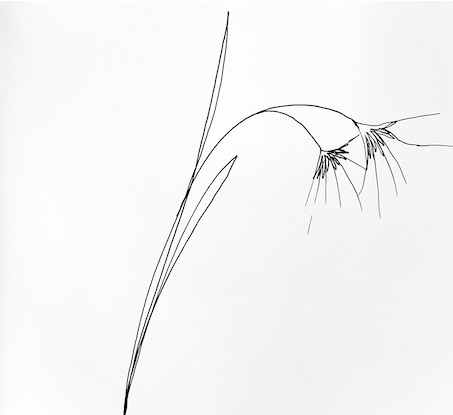
The grasses grow together in bunches which are called tussocks, huddled together rather than spanning an entire field like other grasses might - like blue and Bermuda grass. Some of this adaptation may have to do with how much water is present. The more water there is, the more like a button these tussocks are, the less water, the more they spread out. The grasses extend up to three feet high and along their stem shoot sheaths of narrow leaves that end in sharp points. But their flowers bow down. Know red oat grass by its distinctive inflorescence and seedhead. These flower structures look like upturned crowns. Heavy on a weak stem, the flowers bear the grasses down. Long modified leaves called awns attach to the lemmas, or seedpods. The awns are golden downward rays. Each seed is long for an herbaceous plant; the length of a child’s pinky, from the end to the distal to the top. One joint’s worth.
The rayed look that makes them so unique are the awns that bristle with tiny hairs. These expressive seeds are not meant to reach toward heaven though, they are meant to dig into the earth and ensure a stable base where the seed can begin to germinate. Each spear literally expands and contracts until the seed is nestled into the soil. The awns are responsible for the sustainability of a plant that doesn’t produce many seeds to begin with. They pollinate by wind, bloom from October through July, and their seeds germinate in the rainy season in February and March. But the fire is the key to their survival, tenacity, and seed germination.
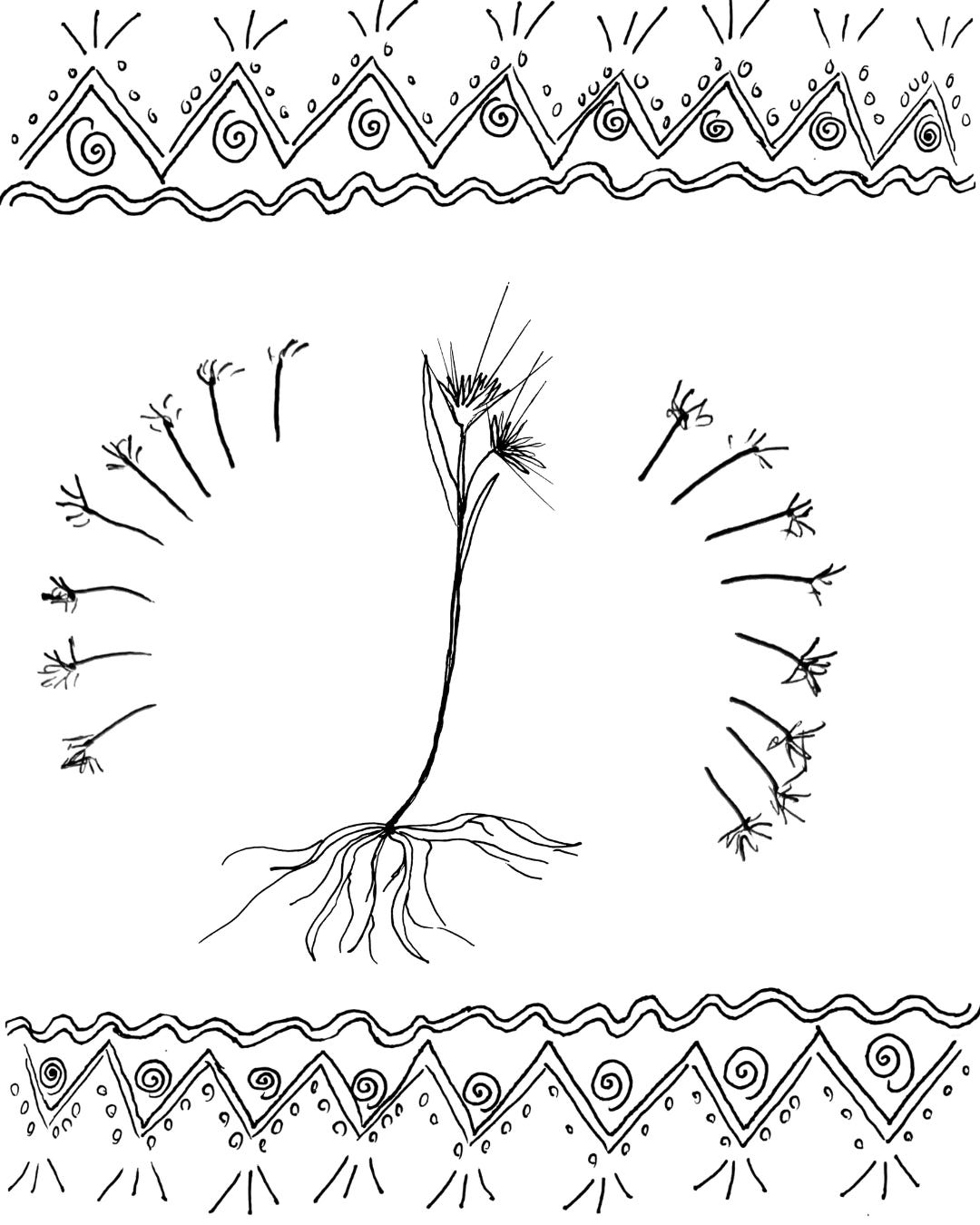
While they wear a predator’s costume, they are veil for the prey. Red oat grass is the perfect height for kangaroos who hide in their sand-colored veils and eat their ripe seeds.
Their lovely tonal shift from turquoise to red mimics a transition that happens in these periodically dry environments as well. As with many grasslands, these plants are adapted to fires. Red oat grass is usually the first to come up after a fire. Their movement also reflects a blanket of flame. They jump like boisterous puppets leaping on green threads. They look like cubism come to life, they are the geometric chaos of futurist paintings, only they go nowhere, but listen to the winds and remember the fire. Memory does seem to be an important factor for the survival of this species because the more fires there are the more resistant this grass becomes, growing back quicker heartier.
If we are to give numbers to this grass of countless years and influence, it might go something like this: they can survive 100 years under proper management. They require a cool, smoldering, fire every five-to-ten years. Triandra refers to the three male spikelets surrounding the interior female spikelets for each flower. There are probably more, but the range and number of this species might be enough for a god to count, or generations of dedicated humans. They built many parts of this ancient land mass and numbers stretch to fill that story.
Red oat grass has been used as food to humans as well as animals, throughout the regions where it is native. In Australia, aboriginal communities made bread, called damper, which is a type of soda bread derived from the flour of red oat grass. Damper is made by wrapping the dough around a stick and cooking it over a fire, like bready marshmallows or hotdogs. In western Africa the roots have been used as a medicine. Pulp from the fibers has been made into paper and its stems have been woven into thatching and baskets.
Look back in time to see the original, the video, and the myth
Sources
https://courses.pdp.albany.edu/courses/HSposttest/mainMenu.cfm
https://pza.sanbi.org/themeda-triandra
https://www.sciencedirect.com/topics/agricultural-and-biological-sciences/andropogoneae
https://www.leafconagro.com/red-oat-grass/
https://garden.org/plants/view/117049/Red-Oat-Grass-Themeda-triandra/
https://www.science.org/doi/10.1126/science.1177216
https://www.botswanaflora.com/speciesdata/species.php?species_id=109100
https://evolution.earthathome.org/grasses/andropogoneae/kangaroo-grass-quick-facts/
How to feel what kind of soil you have!
https://tsammalex.clld.org/parameters/themedatriandra
https://talk.snapshotserengeti.org/boards/BSG000000b/discussions/DSG0001k7d
I hold a botanical writing walk in Prospect Park every last weekend of the month please join me!
If you’re interested, message me on Substack or respond to any of my articles.
This month is a special collaboration with Oreades Press, for which I am a cofounder and editor.
To celebrate our newest book, Earth, an anthology that bridges scientific thought and community action, we will host a second seed bomb workshop on the July 27th from 11am-1:00pm at the Grand Army Plaza Entrance of Prospect Park.
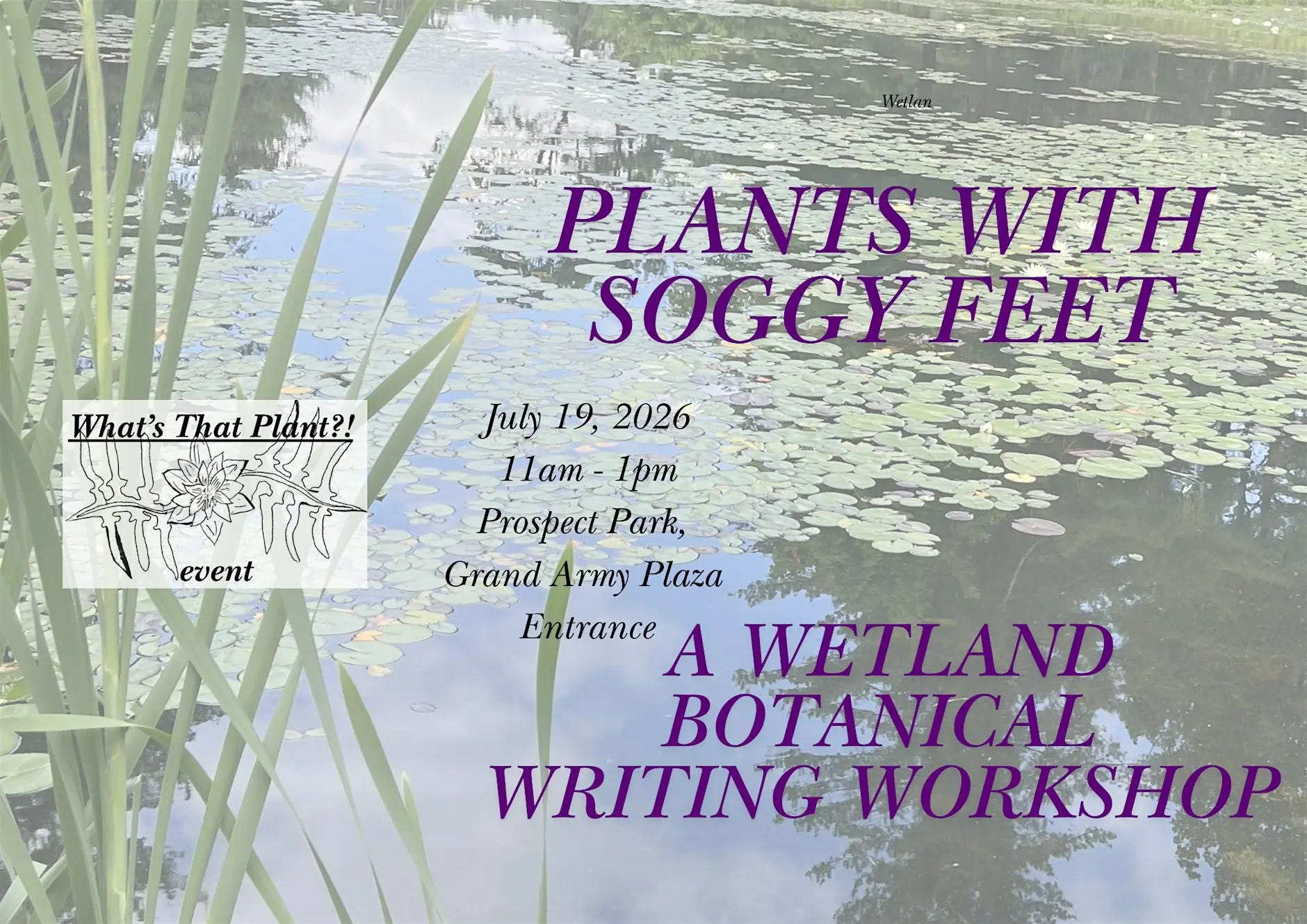
Learn about wetlands and their plants, and develop your writing through wetland inspired prompts.
Have you ever wondered why water plants don’t rot? Do you wonder how many different kinds of water lilies there are? Or do you simply want to know the stories about the plants that love the wetlands? We are going to walk through Prospect Park to learn about plants and their wetland environments there, and participate in three prompted generative writing exercises. Participants also will learn about plant mythology, and they will plant seeds of their own.
No posts
Comments
Nothing yet. Say the first thing.
Sign in to join the conversation.