
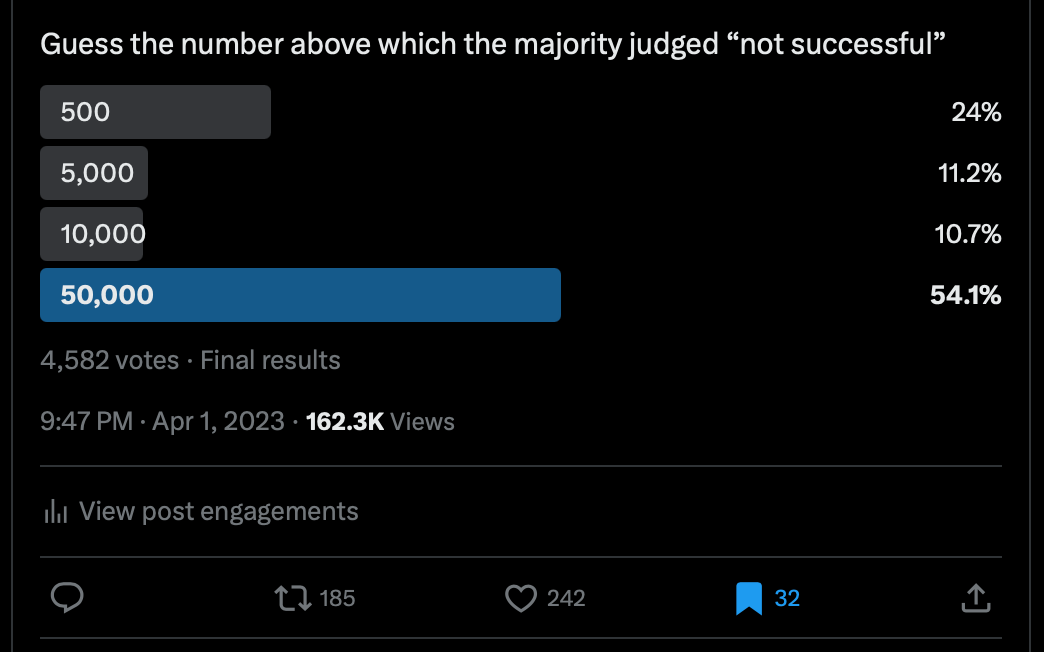
We begin with a poll on a real poll from the LA Times of 3 Apr 2003 that asked the US public if they’d say the war in Iraq was “successful if it removed Saddam… and fewer than [a specified number of] Iraqi civilians were killed”. Try to guess the number above which the majority judged “not successful”:
It is 20 years later, and today [April 1, 2023] IBC updated its documented violent civilian death toll to 186,797–210,166. Which stands in desperately sad and bitter contrast to the result of the 2003 poll: 500, an answer that may astound many people today.
So a majority of the US public of 2003 felt that if more than 500 Iraqi civilians were killed in the war, it would not be worth it. Very different from the US Ambassador to the UN who could justify 500,000 Iraqi (child) deaths in the 1990s, when presented with that estimate.
The only discernible response from the war party to such public concerns was to redouble their propaganda about “careful” militaries, further magnify the enemy “threat”, and shed crocodile tears of “regret” over causing entirely predictable “loss of innocent life”.
Actual attention to civilian casualties amounted to little more than PR and image management, leading to almost laughably blinkered press questions such as put to Colin Powell on 1st April 2003. Powell was asked,
“I know that you are confident of victory in Iraq… but… the longer the war goes on, the more casualties among Iraqi civilians occur inadvertently… how concerned are you about how that is complicating the situation in the Arab world and heating up emotions?”
Such “concerns” pay no heed to the victims themselves. To a rare, more victim–centred question (citing casualties in a maternity hospital), Powell simply reverted to the mantra of “surgically picking targets so that we do not [harm] innocent civilians”.
As we’ve previously commented about language that invokes such fabled “precision”,
Official handwashing of responsibility for civilian casualties is all too common, as well as lethal. No one at all should be the victim of an unforced, unprovoked and criminal war of aggression or its prolonged and bloody aftermath.
That aftermath still takes its toll on Iraqi lives. In just the 12 days following the 20th anniversary of the invasion, IBC documented another 32 violent civilian deaths—32 too many, to add to the deaths (and injuries) recorded since 2003.
As IBC numbers gained traction they disproved Coalition claims that civilian casualties would be “in the hundreds” (they had exceeded 7,000 within weeks). This soon led to accusations from pundits and politicians that we were inflating the death toll:
But why would IBC inflate the death toll? We consider the facts we document and the totals we publish tragic and horrifying enough, as do most who encounter them. To inflate them would not only be dishonest but imply that solid but lower numbers are of no concern.
It doesn’t require hundreds, let alone thousands, of civilian deaths for people to respond with horror, as is evident from the global impact of the killings in the “Collateral Murder” video released in 2010 by @wikileaks under #JulianAssange.
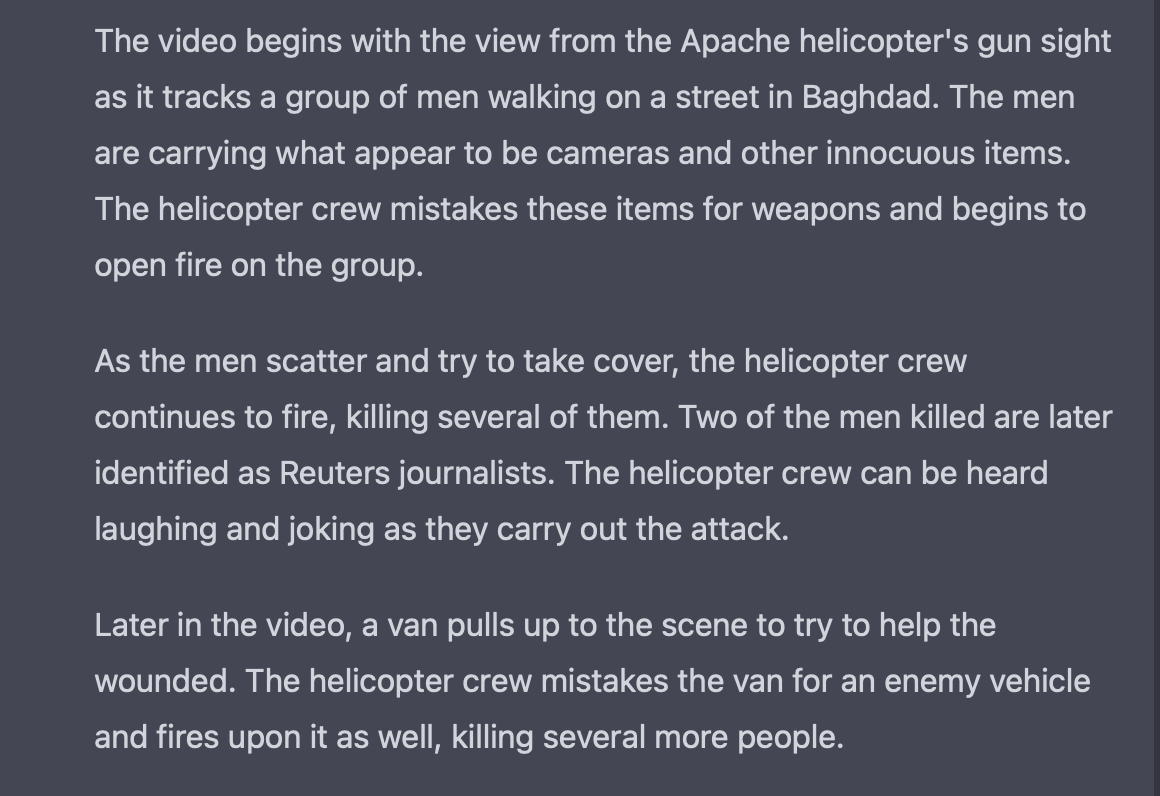
Twelve civilians were killed in that massacre. What made so many around the world care about those deaths was the unfiltered reality viscerally played out before their eyes: a brutal reality that, when asked to describe the video, even the AI in ChatGPT can scarcely diminish:
The #IraqWarLogs, also from WikiLeaks, contained another indisputable, long list of truths: 109,000+ violent deaths of whom 66,000+ were civilians, 15,000 of them calculated by IBC to be new to the public record. Also sadly far higher than the US public anticipated.
A likely reason for the US poll respondents choosing 500 is that the number below that was ‘100’, above it, ‘1,000’, then ‘5,000’; followed by ‘More than 5000 but not unlimited’; and finally ‘Unlimited’. Offering far higher numbers (as we did in our reader’s poll) invites respondents to guess higher (a phenomenon known as anchoring).
But the US poll also shows that public concern can be aroused at the prospect—and therefore also the fact—of relatively few civilian casualties (even if “hundreds” killed in Iraq was an illusion swiftly dispelled).
IBC’s numbers and fine–grained data are widely accepted (whether reluctantly or productively) because they represent real events, not because they meet expectations. They are widely disseminated (if not always with full understanding) for the same reason.
![Three screenshots from MSNBC's The Sunday Show with Jonathan Capeheart 19th March 2023. First screenshot shows Capeheart with guest Rear Admiral John Kirby, introduced as Whitehouse National Security Coordinator for Strategic Communications. Second screenshot from MSNBC's The Sunday Show with Jonathan Capeheart shows Toll of War graphic fading in over Kirby. Third screenshot shows Toll of War graphic listing 182,872—204,575 (Civilian deaths); 4,550 (U.S. Military deaths); $1.7 trillion (U.S. Spending) Credited to Brown University's Cost of War report [the civilian deaths are from Iraq Body Count]](https://substackcdn.com/image/fetch/$s_!X16i!,w_474,c_limit,f_auto,q_auto:good,fl_progressive:steep/https%3A%2F%2Fsubstack-post-media.s3.amazonaws.com%2Fpublic%2Fimages%2F70206730-b90f-4075-b3e2-09e1155d2772_1472x829.jpeg)
![Three screenshots from MSNBC's The Sunday Show with Jonathan Capeheart 19th March 2023. First screenshot shows Capeheart with guest Rear Admiral John Kirby, introduced as Whitehouse National Security Coordinator for Strategic Communications. Second screenshot from MSNBC's The Sunday Show with Jonathan Capeheart shows Toll of War graphic fading in over Kirby. Third screenshot shows Toll of War graphic listing 182,872—204,575 (Civilian deaths); 4,550 (U.S. Military deaths); $1.7 trillion (U.S. Spending) Credited to Brown University's Cost of War report [the civilian deaths are from Iraq Body Count]](https://substackcdn.com/image/fetch/$s_!UcLr!,w_474,c_limit,f_auto,q_auto:good,fl_progressive:steep/https%3A%2F%2Fsubstack-post-media.s3.amazonaws.com%2Fpublic%2Fimages%2F1863327c-7636-4843-afd0-afa66a90c846_1472x829.jpeg)
![Three screenshots from MSNBC's The Sunday Show with Jonathan Capeheart 19th March 2023. First screenshot shows Capeheart with guest Rear Admiral John Kirby, introduced as Whitehouse National Security Coordinator for Strategic Communications. Second screenshot from MSNBC's The Sunday Show with Jonathan Capeheart shows Toll of War graphic fading in over Kirby. Third screenshot shows Toll of War graphic listing 182,872—204,575 (Civilian deaths); 4,550 (U.S. Military deaths); $1.7 trillion (U.S. Spending) Credited to Brown University's Cost of War report [the civilian deaths are from Iraq Body Count]](https://substackcdn.com/image/fetch/$s_!bUmA!,w_474,c_limit,f_auto,q_auto:good,fl_progressive:steep/https%3A%2F%2Fsubstack-post-media.s3.amazonaws.com%2Fpublic%2Fimages%2F24076ef7-df09-46ea-9726-b3d49a789ebe_1472x829.jpeg)
Most of us can come to care about and respond to the killing of a single civilian, even if they don’t share our nationality, language, religion or culture. But such caring requires that we have real, specific knowledge about that person’s fate. For Iraq, this means the world acquiring a clearer picture of victims as individuals, not statistics: who they were in life, as related by the Iraqi survivors who remember and miss them. IBC is not that final picture but a start, a means to assist it to emerge and become known.
* The April 2023 Twitter/X IBC reader poll result: most thought the US public's threshold figure for Iraq civilian deaths in 2003 was 50,000, when it was actually 500.
IBC is reader-supported. To receive new posts and support our work, consider becoming a free or paid subscriber (IBC’s Substack content will remain free for all subscribers, paid or unpaid). You can also make single donations.
Comments
Nothing yet. Say the first thing.
Sign in to join the conversation.