
This is a slightly edited and updated Twitter/X thread first posted on 15 Feb 2023 to mark 20 years since the unprecedented global demonstrations opposing war in Iraq. Unmoved and obdurate, US/UK leaders launched their invasion within weeks. The volunteer project Iraq Body Count (hereafter IBC), had prepared itself to document the terrible consequences, which certainly followed, and continue. This article serves as an introduction to the work of IBC as well as the field of conflict casualty recording, which sadly remains as necessary as ever.
Twenty years ago today, IBC’s UK-based volunteers and founders joined the huge global demonstrations against the looming war. Like others we hoped the war and its cost in civilian and military lives could be averted. Part of our response, should the worst happen, was to prepare to accurately document as many of the civilian casualties as possible. Our website—already online at iraqbodycount.org—had actually recorded its first civilian death on January 1st 2003, a US airstrike killing one Iraqi.
On the eve of the invasion Tony Blair proclaimed to the UK Parliament that Saddam Hussein
“will be responsible for many, many more deaths even in one year than we will be in any conflict.”
This prediction was baseless when made and quickly proven false by IBC’s early work. Even if fewer lives had been destroyed by the US/UK-led invasion of Iraq, even if it were legal rather than illegal, each and every death would still need recording publicly, accurately, accessibly, inclusively, and transparently.
This is the activity we understand as casualty recording. The term barely existed for armed conflict in 2003, but has since been recognised and taken up by international bodies including the ICRC and OHCHR.
The process developed by IBC was enabled by the advent of the Internet, and inspired, encouraged and guided by Marc Herold, who pioneered such work and had been documenting the civilian victims of NATO air attacks on Afghanistan:
Every single day since its inception IBC has tenaciously monitored reports of violent civilian deaths, some reports more obscure than others. Until very recent years, there were almost no days in Iraq without such deaths to uncover and record. IBC’s daily monitoring and data collection has over the past 20 years brought to light some 210,000 civilians killed out of a total of 300,000 deaths including combatants documented by IBC to date.
These casualty totals are the result of subject-focused analysis and systematic extraction of incident and victim information from 160,000+ contemporaneous reports (not including the Iraq War Logs, see below)—on average, 22 reports per day across 7,300 days from March 2003–March 2023. From these reports IBC has amassed 660,000+ data points for incidents in which civilians were killed (time, location, weapons used, perpetrators where known, and more). 300,000+ further details about the victims were also collected—including age, sex, profession, and identity. Such level of detail is a rarely noted feature of the Iraq War Logs published by Wikileaks, and methodically (but to date incompletely) analysed by IBC; see
Iraq War Logs: Context
Iraq War Logs: The truth is in the details
Iraq War Logs: What the numbers reveal
The Logs contain a vast amount of previously hidden, often humanising information: names, circumstances and other details not often mentioned elsewhere. For example a body that was found would be named, allowing that victim to be recorded as an identifiable individual, not just a bare number. By the time analysis of the War Logs is complete, 15,000 previously unreported deaths should be added to the IBC database. (This number is a relatively small proportion of the 66,000 civilian deaths in the Logs only because most were already recorded by IBC from other sources.)
Despite the potentialities of the Internet, we have always asserted that efforts such as IBC’s cannot provide a complete record when depending solely on public or open-source information, even when supplemented by official, semi-official or leaked sources. It is often said that the number of Iraqis killed is “a million” or more. When indirect deaths are taken into account along with violent deaths missed by IBC, estimates in that range may have some plausibility. But this misses a crucial consideration. Estimates only have numbers as their endpoint: you cannot link an estimated number to any identifiable individual or to any specific incident that claimed a particular set of lives. This is in contrast to documentation by IBC, Airwars, B’Tselem, Nigeria Watch, and others.
The vast majority of IBC’s recorded deaths are linked to an incident in our database showing the date, time, location, type of violence and more. Whenever available, the demographics (age, sex, profession, identities) of victims are also recorded.
(1) IBC’s totals are not “estimated” but derived from database entries describing individual incidents or cases of bodies being found (the public database contains 51,000+ freely accessible entries to date);
(2) This specificity and transparency makes every IBC database entry and its details open to direct inspection and challenge, which permits the identification and correction of errors once they are pointed out;
(3) Although IBC relies largely on media reporting, this soon became mainly local and Iraqi, and therefore unaffected by the vagaries of Western media interest;
(3b) [Added in this Substack update:] Moreover, the principal sources that report violent incidents and their death and injury numbers are the same medical, police and related officials as their Western counterparts (often speaking anonymously);
(4) Database entries are predominantly corroborated but when uncorroborated, labelled as such;
5) Over 80% of the entries in the IBC database record incidents in which three or fewer civilians were killed: unlike the foreign media’s reporting, it doesn’t take “major” civil security incidents to generate local media interest.
Such highly-specific and individualised recording is the cultural norm for the West’s military dead and the civilian victims of terrorism (including their names and biographical details). Official incuriousness about non-western victims of our wars is, in contrast, thoroughly shameful.
[Added in this Substack update:] For a fuller description, see IBC’s Rationale, Methods, and About.
Tony Blair, who now pushes digital IDs for global health tracking, has never shown real interest in the number (let alone the identity and health status) of Iraqis killed and injured by the war: like Bush, he is content to leave this to an underfunded NGO.
The one time Blair expressed a desire to investigate Iraqi casualties, it was because “the coalition needed its own figure on civilian casualties to rebut the 'gross overestimate’ circulating via the NGO known as Iraq Body Count” (memo to Bush, May 2004).
IBC’s figures have never been a “gross overestimate” (as Blair & Bush later implicitly accepted), and the proposal to obtain and use casualty figures as a purely political ploy remains as much of a disgrace–-and a dangerous one at that—as the failure to account for them at all. Casualty figures filtered through and subservient to the needs of propaganda—particularly of a warring party—serve only to dehumanise, weaponise, and create yet more victims. (Indeed the UK only began to accept IBC figures when it could blame “most” on “the terrorists”).
Politicians and pundits will often assert that some casualty number is too high or too low, but political and rhetorical utility is no substitute for rigorous investigation. Only those who have put in the detailed and difficult work are qualified to pass such judgements. We would assert that IBC’s work (and that of similar civil society casualty recorders) confers authority to comment on casualty number claims where necessary, including those based on estimates obtained via various sampling methods (which are hardly quantum physics). Our efforts have humanised the victims as much as possible from the often limited public-domain material available. In a few cases, where moving personal details have been obtained, we have published them:
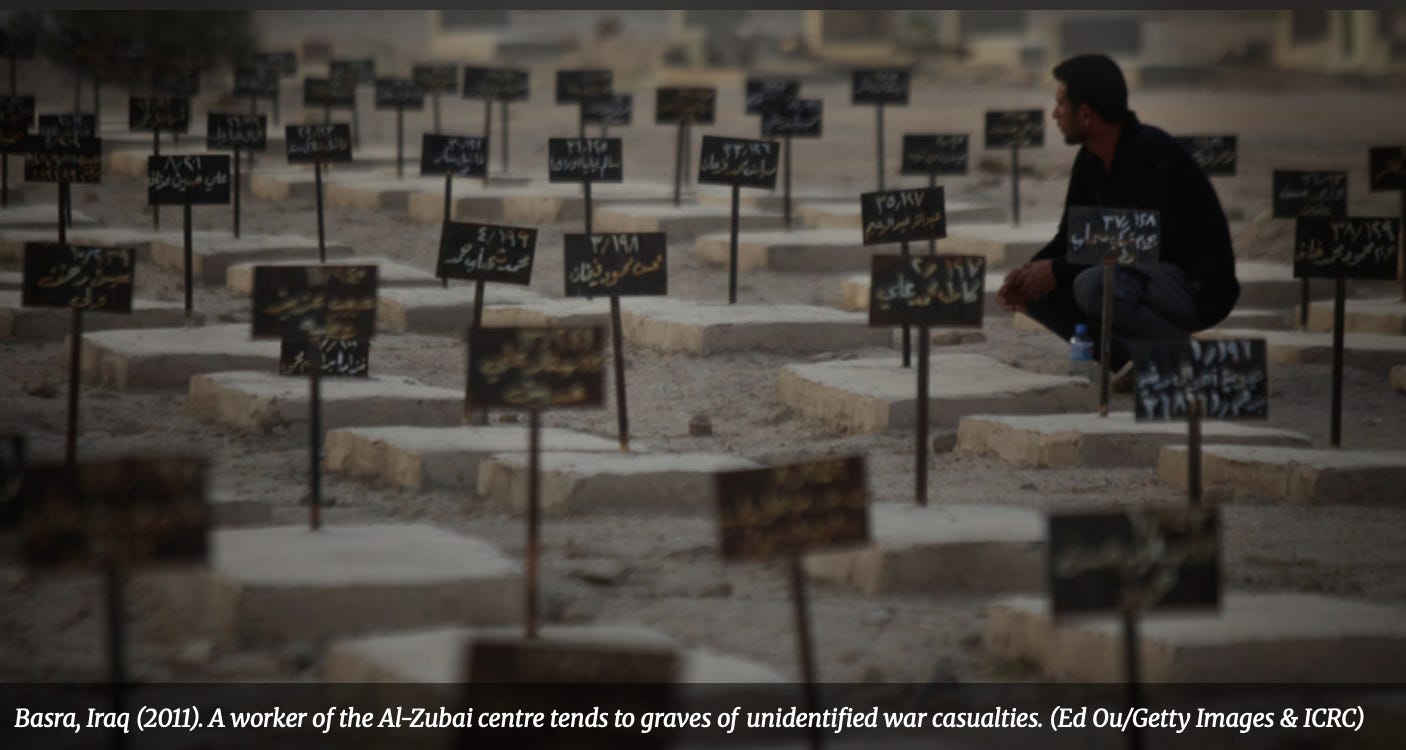
The vast majority of documented violent deaths in Iraq remain only partially documented. For instance, for every identified death in the IBC database, another 13 are recorded without name. A humanly respectful account of all the Iraq War’s dead remains an unfinished task. A fuller accounting of the victims of the Iraq War—and all other wars of our time—will require not only that hitherto unrecorded deaths be duly recorded, but also that they are listed as named, distinguishable individuals: to properly establish who died, not just how many.
Comments
Nothing yet. Say the first thing.
Sign in to join the conversation.