
Listen to the article ☞
0:00
-14:19
A new bill before the Islamic Majles (Parliament) proposes to place vast areas of an ordinary Iranian’s civic, professional and cultural life under the control and supervision of the Regime’s security apparatus.
Lawmakers, who have continued to hold parliamentary sessions virtually in the aftermath of the 39-day war, voted on August 16 to approve the general framework of a bill entitled “Plan for Countering Foreign Influence.”
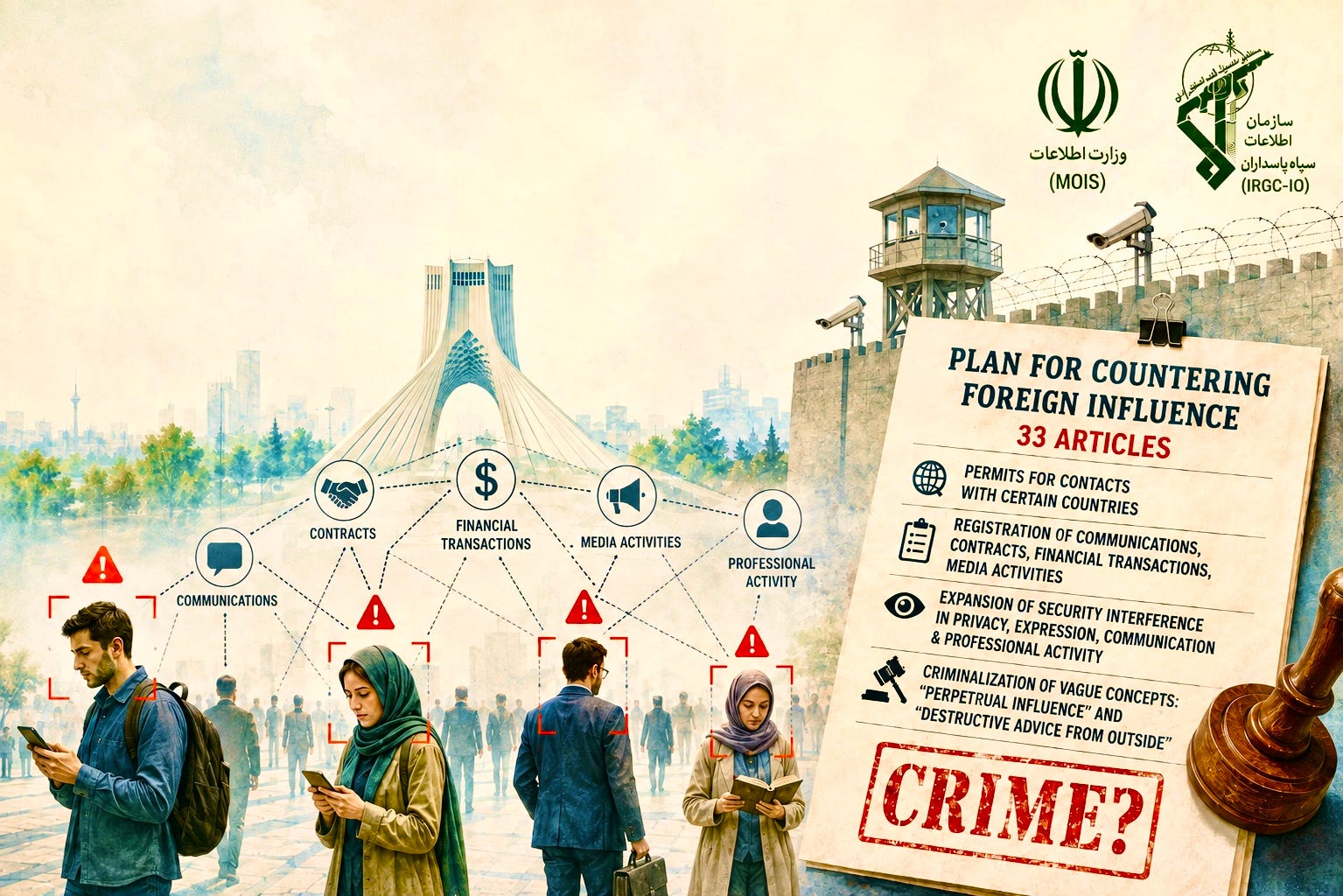
The proposed legislation contains 33 articles and, if ultimately approved by parliament and the Guardian Council, would give extraordinary powers to the Regime’s intelligence and security institutions, particularly the Ministry of Intelligence and the Islamic Revolutionary Guard Corps Intelligence Organization. It would extend their reach to matters far beyond conduct ordinarily associated with espionage.
As Human Rights Activists News Agency describes it, “communication with some countries would require a permit and a range of communications, contracts, financial transactions, media activities, and communications of natural and legal persons with others outside (Iran) would have to be registered in a system supervised by security institutions. The bill also raises concerns about the expansion of security interference in citizens’ privacy, freedom of expression, freedom of communication, and professional activity by criminalizing concepts such as “perceptual influence” and “destructive advice directed from outside” and imposing special surveillance on journalists, researchers, elites, and economic activists.
For Regime critics, this is precisely what makes the legislation so frightening.
The bill is currently receiving pushback from within and without Iran. Nour News, an outlet close to the Supreme National Security Council, has raised worries that it would prove disruptive in execution and only further inflame public anger: “Its title suggests protection and security, but its content and dimensions are so complex, vague, and sometimes surprising that the reader cannot help but ask: Who was the author of this plan and what was his intention? Did national security concerns really lead to the drafting of this plan, or did the designers want to damage the reputation of the parliament with this dramatic action and generate anger and distrust in social groups?”
Reformist-adjacent news outlet IranWire quoted Iranian lawyer Mohammad Olyaeifard as saying the bill essentially codifies repression: “This is oppression that they are turning into law,” he said.
Although parliament has so far approved only the bill’s general framework rather than its individual provisions, the draft under consideration offers a troubling indication of how broadly the concept of “foreign influence” could ultimately be defined.
Article 1 of the draft states that the activities and communications of both natural and legal persons with foreign persons or agents must take place within the framework established by the law.
It prohibits activities or contacts deemed as undermining Iran’s independence, national unity, Islamic principles, national sovereignty or “Iranian-Islamic culture,” or facilitating foreign influence over the political, economic, social or cultural interests of the Islamic Republic.
Aside from the fact that the above starkly conflicts with international human rights standards, the vagueness of those terms above increases the scope of potential repression.
Concepts such as weakening Iranian-Islamic culture – a loaded concept in and of itself - damaging national interests or facilitating influence are not defined with the precision normally required of criminal law. In several areas, the bill instead leaves definitions and classifications to the Ministry of Intelligence and the IRGC Intelligence Organization, subject to approval by the Supreme National Security Council, all organizations without any popular oversight.
The draft also divides foreign governments into three categories. The first consists of “hostile governments.” The second includes states considered to have planned or carried out actions intended to harm or weaken the Islamic Republic’s national interests. The third encompasses states that fall into neither category. The intelligence agencies themselves would help determine which countries belong on which list.
This delegation of authority is one of the principal objections raised by legal experts, who argue that parliament is effectively allowing security agencies not simply to enforce the law but to help define it.
Article 2 illustrates just how extensive the proposed system could become.
Numerous forms of international interaction that are presently legal would have to be recorded through an online government system to be established by the Ministry of Communications.
These include transfers of money, goods and services; financial assistance; legal services and legal consultation; writing or publishing books, magazines and articles; providing reports, statistics or information; obtaining scholarships, research grants and academic fellowships; and other forms of scientific or university cooperation.
Media activity is also included, including interviews, consultation with media organizations and the provision of information or analysis.
The legislation reaches into scientific research as well, covering the exchange of medical, genetic, veterinary, soil, mineral and agricultural samples.
Cultural activity receives similarly broad treatment. Participation in in-person or online workshops, educational courses, artistic residencies, academic conferences and festivals, as well as the production or presentation of documentaries, theater, music and visual art, could all become subject to reporting or regulatory requirements.
Olyaeifard raised one of the most striking consequences: ordinary efforts to study or travel abroad could potentially become entangled in the new system.
“A person simply trying to obtain a visa could face problems if it is not reported,” he says. “That visa might be for medical treatment, education, visiting family or tourism.”
Applications to foreign universities, communication with professors abroad, academic funding, embassy appointments, recommendation letters, submitting research to international journals or conferences and receiving foreign qualifications could likewise become subject to registration requirements.
The film and cultural sectors have expressed particular alarm.
Article 27 states that cultural or online activity — including producing or directing films, television series, documentaries, theater, music or books — may lead to six months to five years of deprivation of social rights if authorities determine that the work was conducted under the support, supervision, guidance or training of a foreign agent.
Additional penalties are contemplated when authorities conclude that a work questions religious rules, presents what they consider a false or improper image of “Iranian society” or the achievements of the Islamic Revolution, opposes the political system, promotes “anti-Islamic culture,” or was produced with the intention of damaging the country’s independence or security.
Those involved could face permanent restrictions on their social or professional rights as well as financial penalties tied to production costs.
Iran’s House of Cinema has warned that the legislation relies on vague concepts that can easily be used against critical or socially realistic art.
At the center of its concern is the familiar accusation of “blackening” Iran’s image — a phrase frequently used against filmmakers, writers and journalists whose work depicts poverty, repression, discrimination or other social problems.
The organization argues that there is no precise legal definition of what constitutes presenting a “dark image” of the country. As a result, determining whether a film is legitimate criticism or a criminal act could be left largely to the discretion of security and regulatory bodies.
Experience, it warned, demonstrates how easily the term can be extended to encompass almost any critical representation of Iranian society.
The bill has not emerged in isolation. Olyaeifard sees it as part of a broader legislative pattern in which the Islamic Regime has increasingly attempted to codify coercive practices inside formal statutory frameworks; he mentioned the controversial Hijab and Chastity Law as well as legislation increasing punishments for alleged espionage and cooperation with hostile states.
The latter followed an earlier period of conflict with the U.S. and Israel and expanded the government’s legal powers against people accused of collaboration with foreign governments. Human-rights lawyers have criticized the expansive definitions contained in such legislation and the severe sentences that can follow, including lengthy imprisonment and, in some cases, execution.
What distinguishes the new influence bill, however, is the extent to which it moves beyond conventional national-security offenses.
“This has nothing to do with the security of the country or genuine infiltration,” Olyaeifard argues.
Terms such as damaging public confidence or presenting a negative image of the country, he says, are inherently open to interpretation.
From the content of speech to the act of speaking
For lawyers who have worked inside Iran, the proposal also represents the closing of legal spaces that citizens previously used to defend themselves.
Olyaeifard recalled being questioned by Tehran’s prosecutor about interviews he had given to foreign media; his response at the time was straightforward: there was no law prohibiting the interview itself. The prosecutor acknowledged that point, he said, while insisting that the authorities were concerned about what he had said.
Under the new approach, Olyaeifard argues, the distinction would disappear: “Once, they focused on what you said in the interview. Now the interview itself is being called into question.”
That change is significant. The remaining gaps citizens once relied upon — the absence of an explicit prohibition, the ability to point to constitutional protections or the requirement that prosecutors identify a recognizable offense — could progressively be eliminated.
“Every time we find a legal route to protect our civil rights,” he says, “they close that route.”
Hossein Raeesi, an Iranian lawyer and professor at Carleton University in Ottawa, has described the proposal in even broader terms: “the universal presumption of criminality.”
He argues that the bill could criminalize interviews or information-sharing with certain foreign-funded media organizations, unauthorized contact with embassies or non-Iranian organizations, and forms of scientific cooperation not approved by the Ministry of Intelligence or IRGC Intelligence Organization.
According to his analysis of the draft, some such offenses could carry prison terms ranging from six months to two years.
Civil-society organizations, associations and political groups receiving foreign funding or entering into contracts with foreign governmental or nongovernmental institutions could face prison sentences for those involved and potentially dissolution of the organization itself.
Cultural workers may face even harsher professional consequences. Filmmakers, musicians, writers and theater practitioners accused of promoting “anti-Islamic culture” or portraying the country negatively could face permanent exclusion from their professions.
The draft also contemplates severe penalties for organizers of certain educational courses or workshops deemed incompatible with officially defined Iranian cultural values.
For Olyaeifard, the ultimate significance of the bill lies in the model of government it creates: “It moves Iran toward systems in which your entire private life must be visible to the state,”
A conversation about cinema, a legal critique, an academic exchange or a discussion about sports could potentially be reframed as a national-security issue depending on who participated, where the information went, and how Regime authorities interpreted it.
A law is supposed to tell citizens clearly what conduct is prohibited. It should not leave the meaning of an offense to the institutions responsible for investigating and prosecuting it.
The Islamic Regime’s constitution contains provisions concerning expression, assembly, economic activity and other civil freedoms. Although these provisions have long been only platitudes under a system where Islamic doctrine overrides all else, Olyaeifard argued that legislation cannot simply erase those protections by transferring sweeping interpretive authority to intelligence organizations.
A measure presented as protection against espionage and foreign infiltration is actually proposing something far broader: a legal architecture in which contact with the outside world becomes presumptively suspicious, cultural criticism becomes a security matter and citizens must account to the state for activities once considered part of ordinary life. Some officials evidently hope they could isolate Iranians from the rest of the world, much as residents of North Korea are.
The central question raised by this bill is therefore not how the Khomeiniist regime should combat espionage; it is whether the rulers intend to redefine citizenship itself — transforming the Iranian citizen from a person possessing nominal rights into a person perpetually forced to prove that ordinary life is not a crime.
Some observers have noted comparisons between this plan and China’s Social Credit System. This connection is not arbitrary because, just as China and the Khomeiniist Regime have close economic relations, Tehran has also learned from Beijing how to improve its infrastructure of mass surveillance. In a society where Iranians have often accused their overlords of being “East-toxified,” it is thus not surprising that the Regime would copy its allies as it continues to perfect methods of making Iran a model totalitarian system.

Comments
Nothing yet. Say the first thing.
Sign in to join the conversation.