
The following article is for educational purposes ONLY. Each and every piece of information used henceforth in this article is sourced from the RHP.
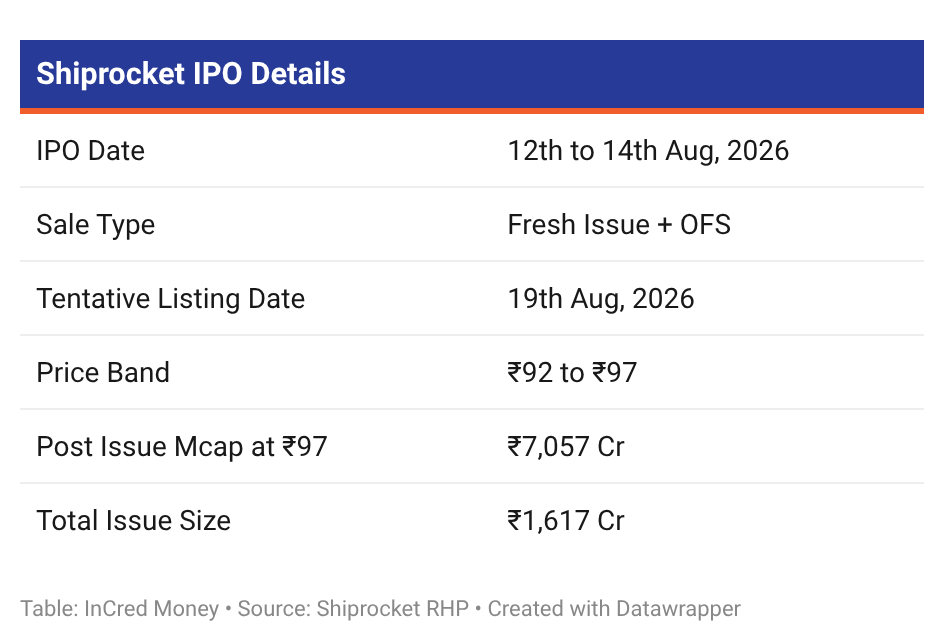
Shiprocket Limited has filed for a ₹1,617 Cr IPO on Aug 12, 2026 which closes on Aug 14, 2026. Processing over 200 million annual orders for 2.1 lakh merchants without owning a single delivery truck or warehouse, Shiprocket commands ~10x the revenue scale of listed peer Unicommerce fueled by a profitable core shipping engine that supports its loss-making emerging bet.
Join the InCred Money Insights WhatsApp channel for daily updates on domestic & global markets and latest IPO insights.
Follow InCred Money on Whatsapp
India’s online businesses grow each year exponentially.
Online retail made up about 8% of India’s ₹90 trillion domestic retail market in 2025, and will reach ~15% by 2030. But this number is still below the United States’ ~17%, and leagues smaller than China’s 35%.
But why would one of the biggest markets in the world lag so much in a new-age business that’s taking the world by storm?
Think of it this way: a small merchant who wants to sell online needs a way to ship parcels, take payment, handle checkout, and a thousand other things. Building all of this alone is very expensive and complex. If there was someone who does it all for them, the problem isn’t so big anymore.
Shiprocket built a platform that does exactly this.
It is the largest new-age, end-to-end e-commerce enablement platform in India, and serves over 2.1 lakh merchants.
For ABCs on all upcoming IPOs, subscribe to IPOs with InCred Money
Continue reading!
Shiprocket is what’s known as an aggregator, connecting merchants, mostly MSME businesses, to a network of courier companies, payment gateways, warehouse operators, lenders, and marketing tool providers.
Merchants pay for these features and connectivity, either at a price per shipment or as a share of order value.
Note that Shiprocket owns none of the trucks, warehouses, or delivery riders in that network, keeping its own capital spending low.
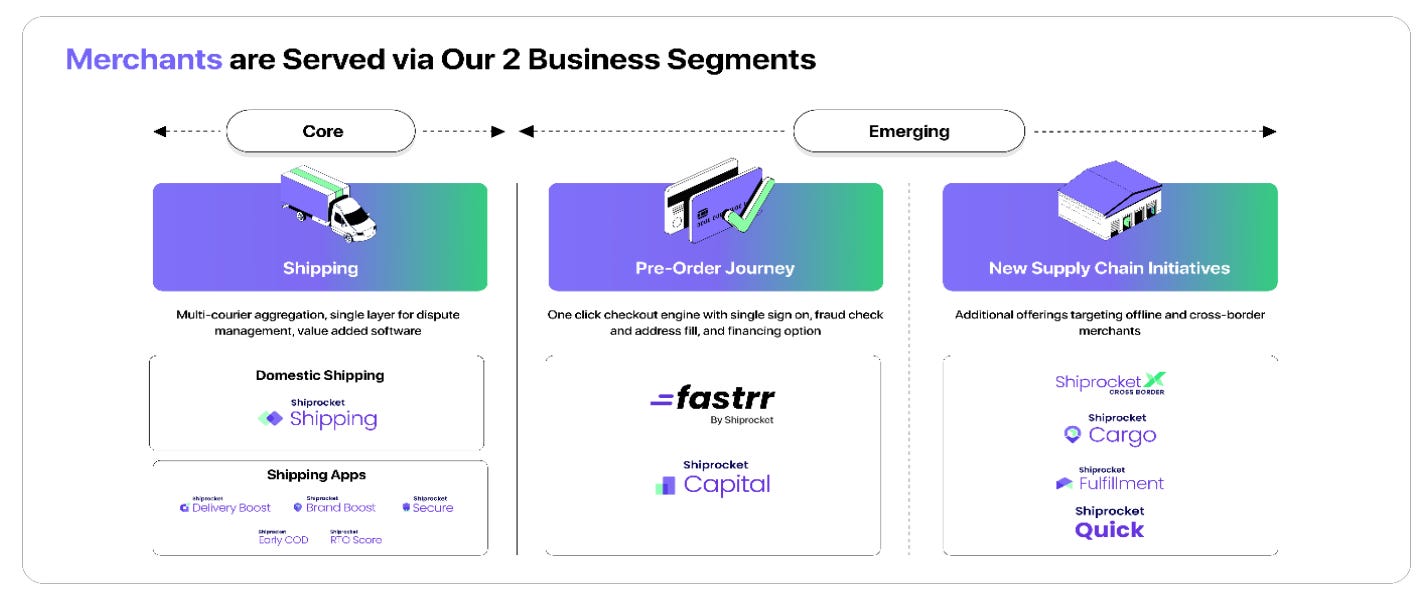
The business is split into two segments.
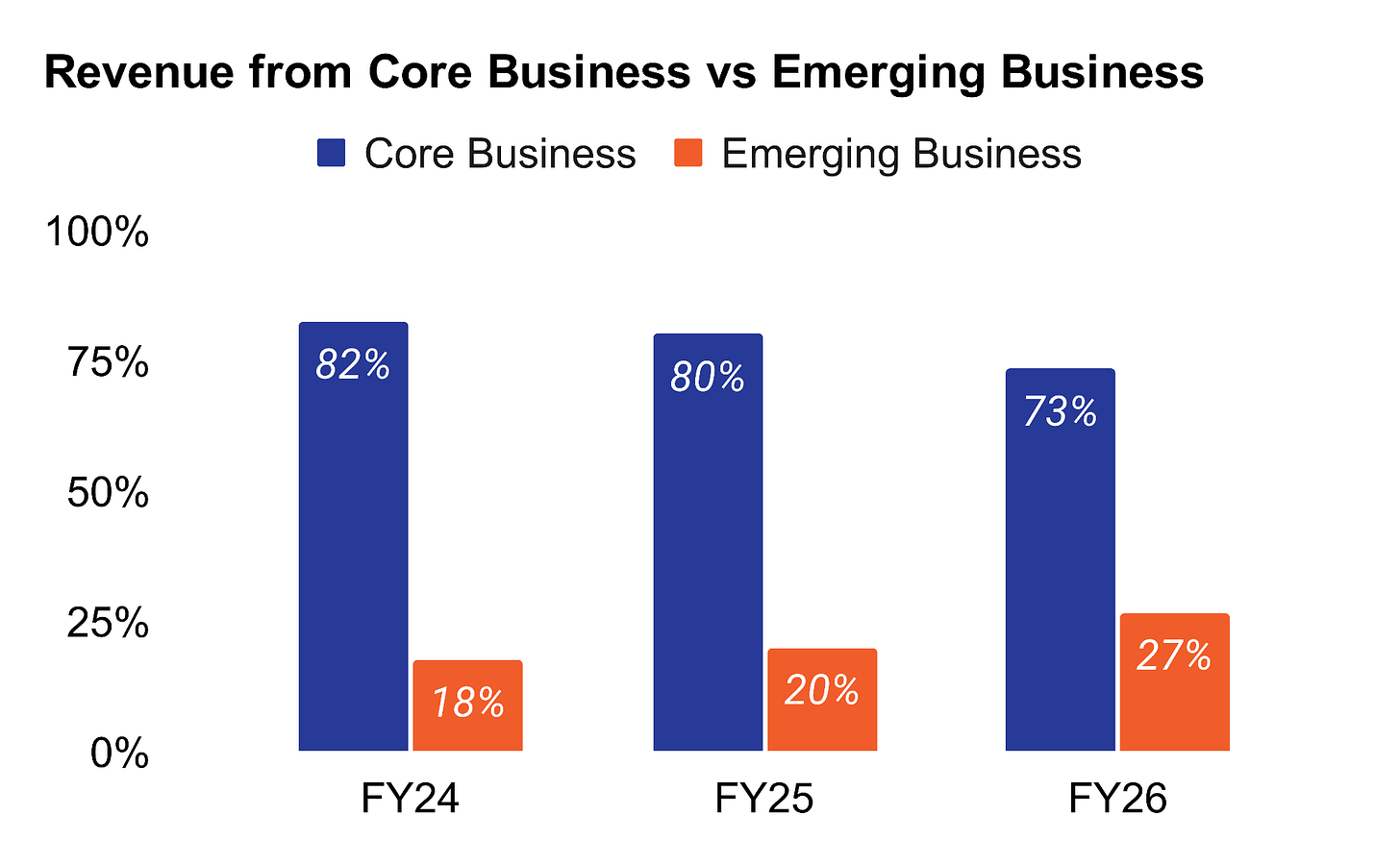
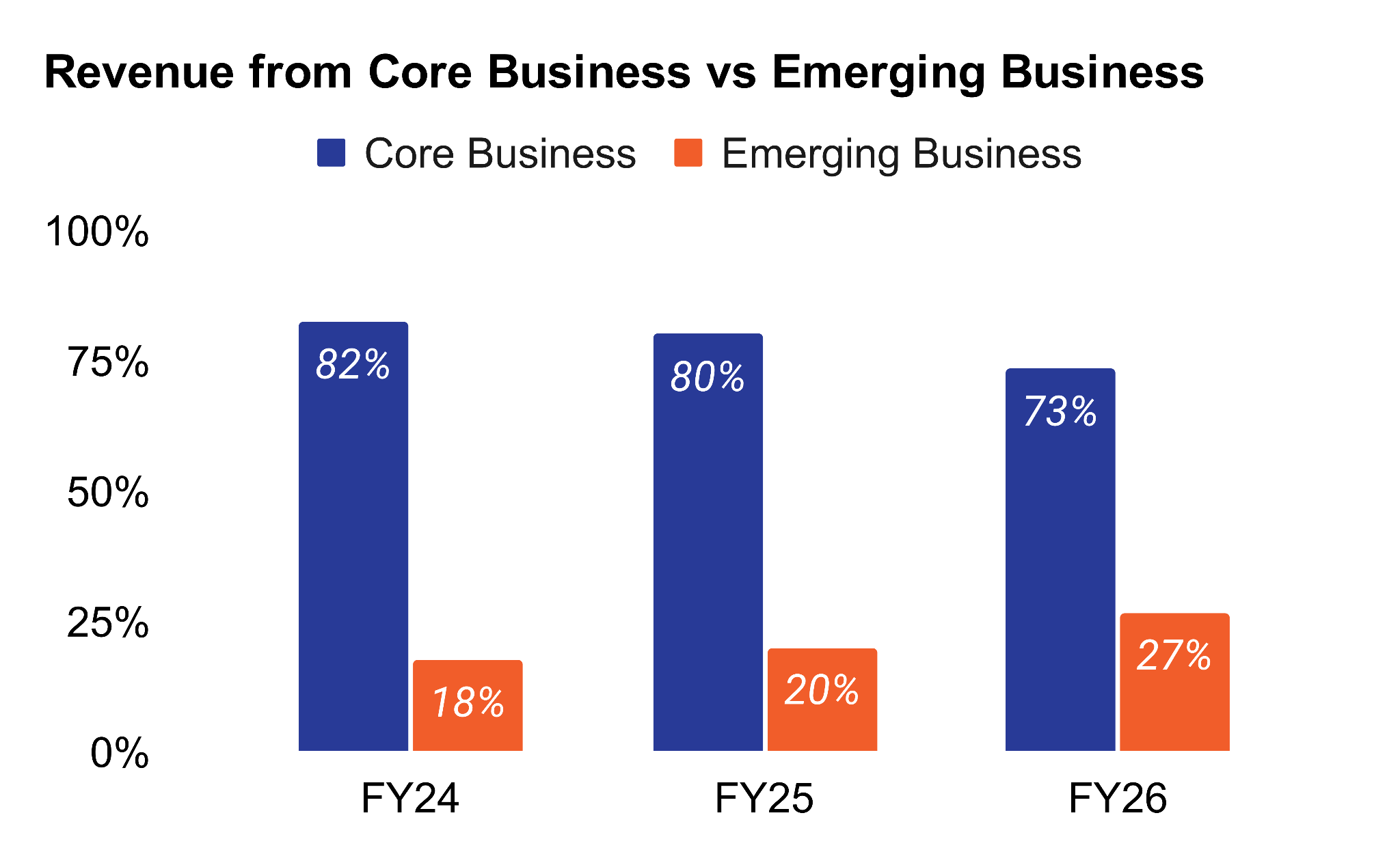
Core Business: Includes the original platform, giving merchants access to multiple couriers plus tools like tracking pages, faster COD payouts, and shipment insurance through one dashboard. This accounted for ~73% of revenue in FY26.
Emerging Business: Everything new added since, including cargo, cross-border shipping, checkout, marketing, hyperlocal delivery, merchant lending. This segment is growing fast, and now makes ~27% as of FY26; though it’s still not profitable.
Shiprocket also takes full responsibility for each transaction. If a courier loses or damages a parcel, Shiprocket compensates the merchant directly, then recovers that amount from the courier under its own contracts with them.
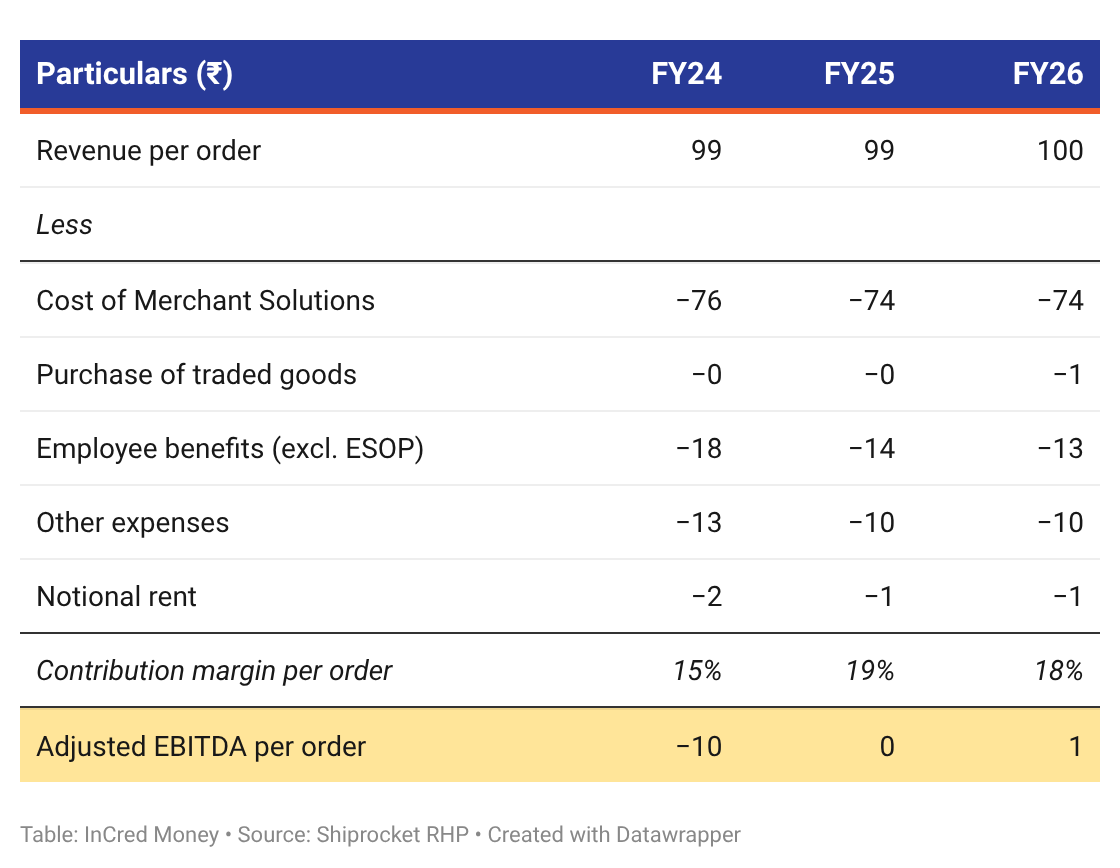
Revenue per order stayed flat across from ₹99 in FY24 to ₹100 in FY26. Shiprocket’s growth has been in fulfilling more orders rather than earning more from each one.
Most costs actually fell slightly on a per-order basis, with Merchant Solutions cost being the dominant line at ₹74 per order, down slightly from FY24. Merchant Solutions means payments to logistics partners and couriers.
Shiprocket broke even on a per order EBITDA basis, with Adj. EBITDA per order going from a loss of ₹10 in FY24 to a profit, albeit of ₹1 in FY26. Note that on a profit level, Shiprocket is still a loss making company, though this is an important stepping stone towards eventual profitability.
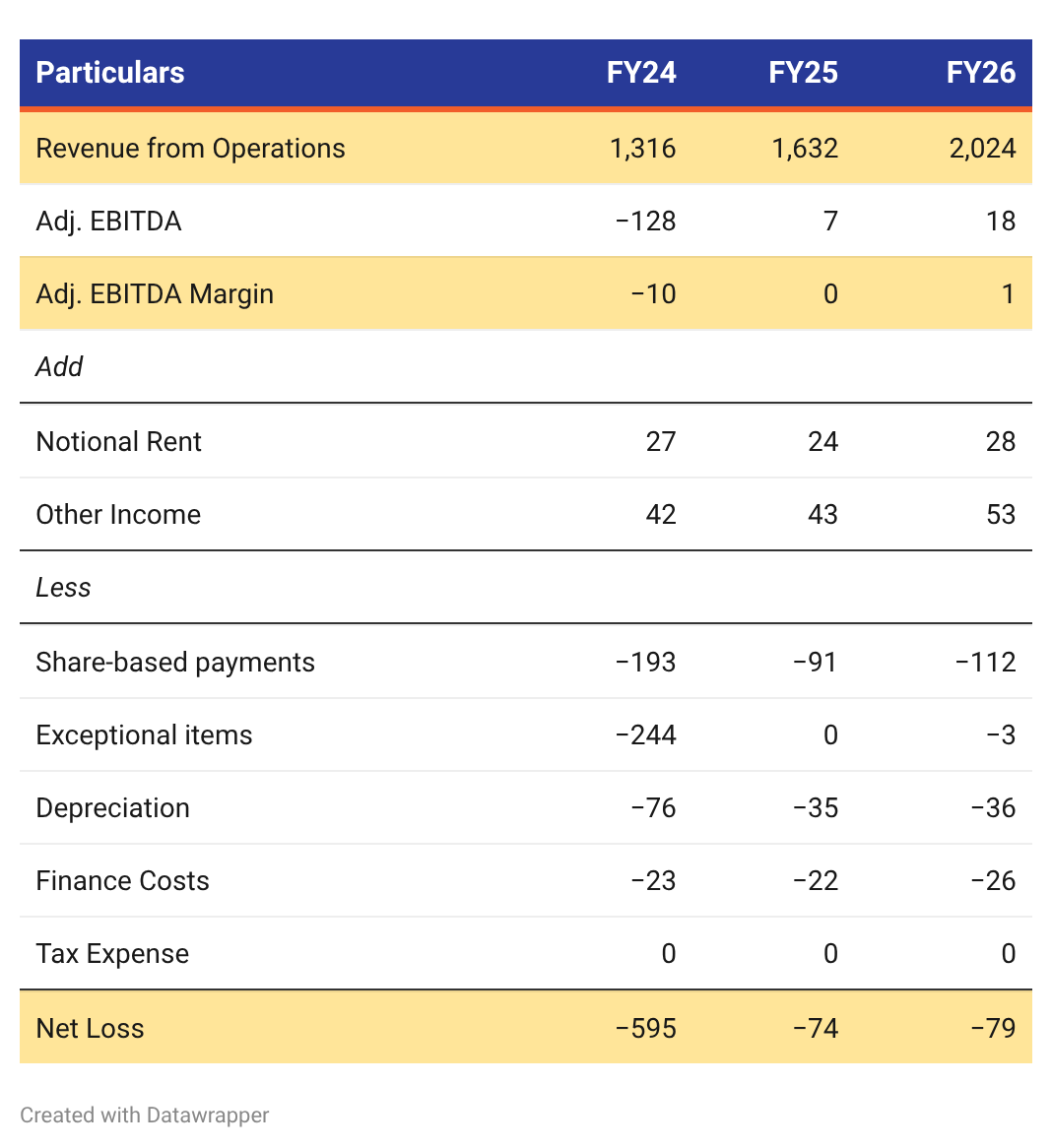
Revenue grew from ₹1,316 Cr in FY24 to ₹2,024 Cr in FY26, a steady ~24% each year, suggesting strong underlying levers for growth.
Net Loss narrowed sharply from ₹595 Cr in FY24 to ₹74 Cr in FY25, due to the disappearance of a ₹244 Cr exceptional item. From FY25 to FY26, the loss actually widened slightly from ₹74 Cr to ₹79 Cr, as share-based payment expenses rose from ₹91 Cr to ₹112 Cr over the same period.
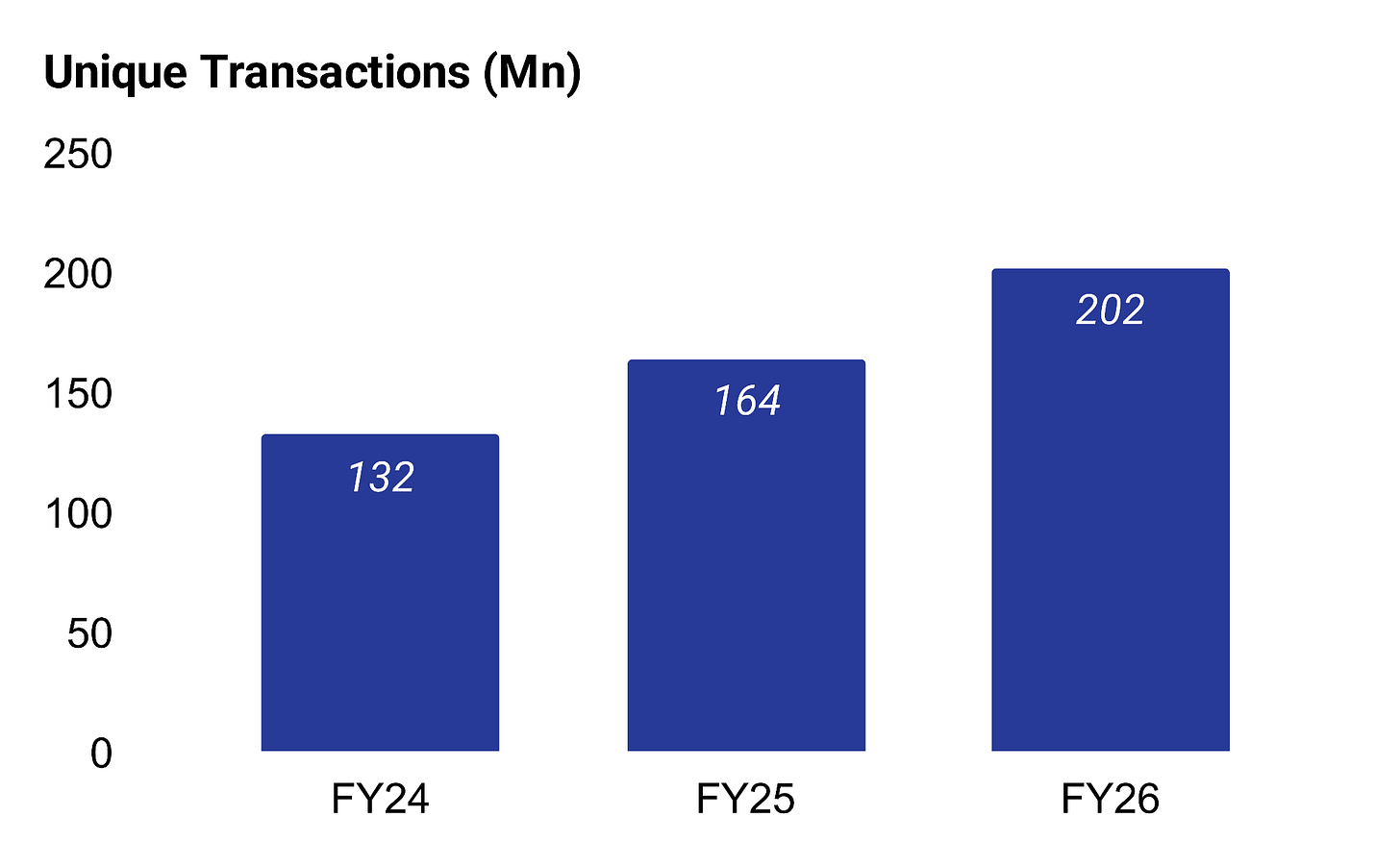
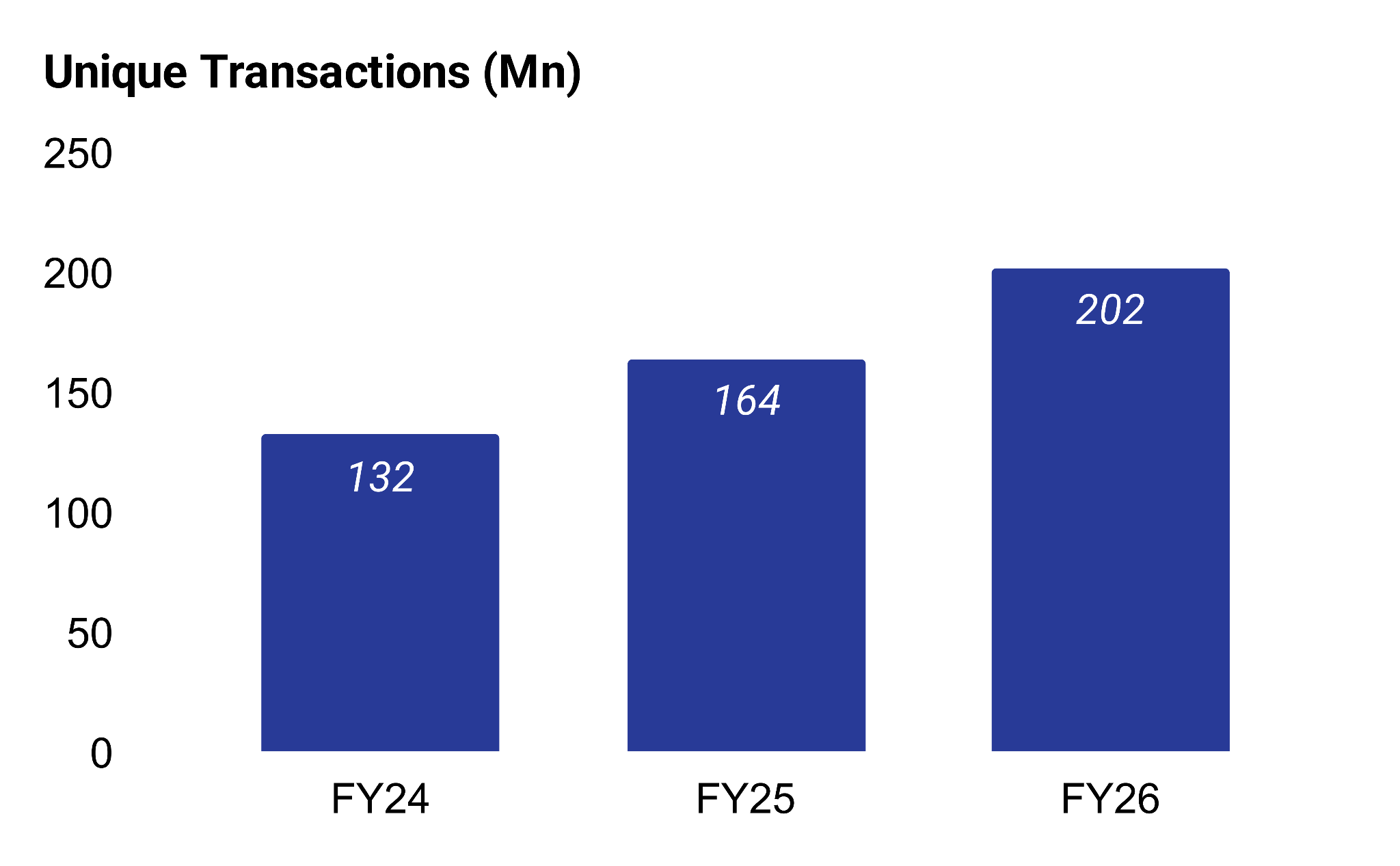
Growing transactions: Unique transactions (with Merchants) rose from 133 million in FY24 to 202 million in FY26, a jump of ~53%. This growth in order volume serves as the main engine behind Shiprocket’s revenue growth.
Source: RHP
Core Business still generates the large majority of revenue, but its share has slipped from 82% to 73% from FY24 to FY26. This comes as Emerging Business’ share has grown from 18% to 27%. Note that the Emerging Business segment loses money while Core Business earns a net profit.
Source: RHP
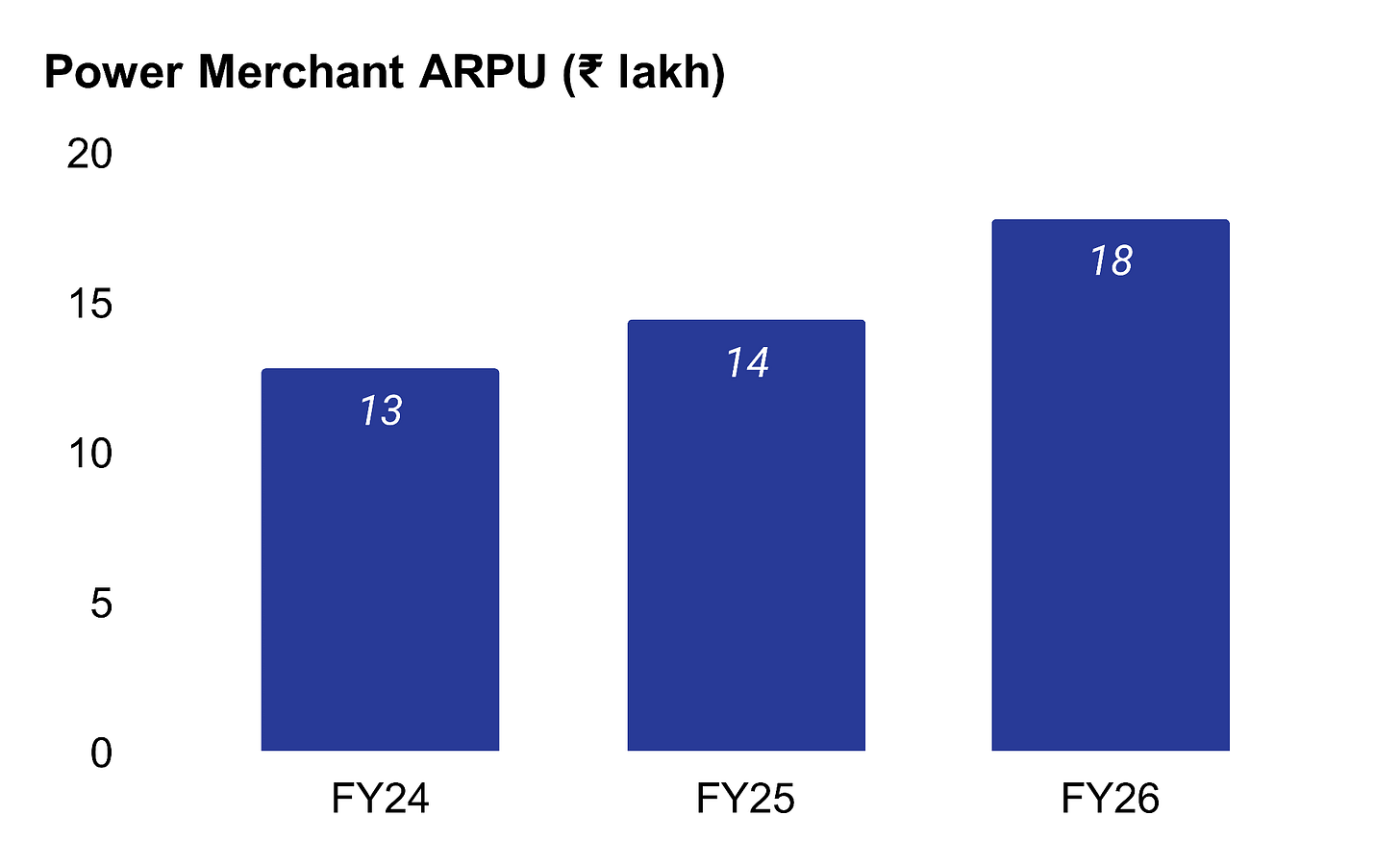
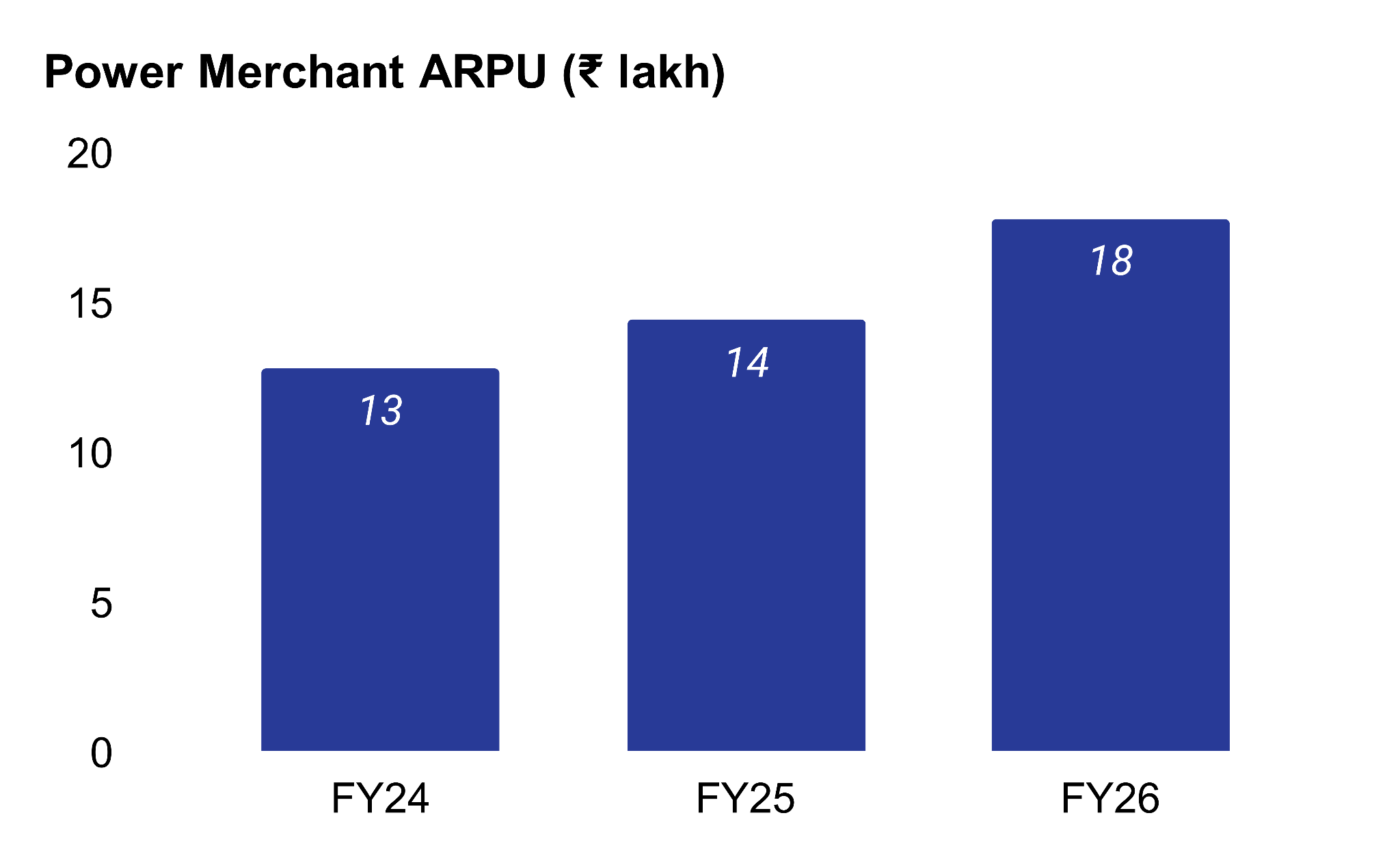
Increasing ARPU: Power Merchants are those who average more than 100 transactions a month. They made up ~5% of the all Merchants in FY26, but revenue per Power Merchant rose 39% from ₹13 lakh in FY24 to ₹18 lakh in FY26.
Source: RHP
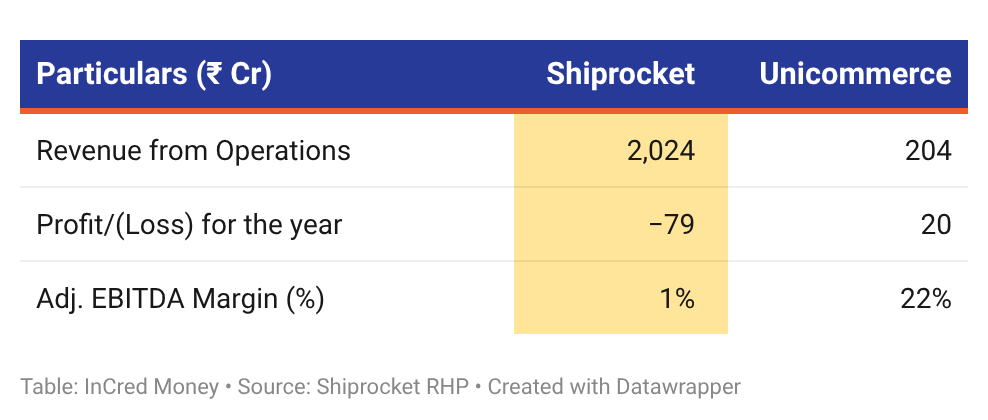
Unicommerce’s Adjusted EBITDA of 22% is far greater than Shiprocket’s 1%, which has just broken even on EBITDA in FY26. Note that Shiprocket pays out most incoming revenue to logistics partners as pass-through cost.
Unicommerce was profitable in fiscal 2026, with a net profit of ₹20 Cr, while Shiprocket reported a net loss of ₹79 Cr.
But Shiprocket’s scale is ~10x that of Unicommerce in terms of revenue, at ₹2,024, opposed to ₹204.
History of losses: Losses reached ₹79 Cr in FY26. Shiprocket’s Core Business is profitable, but the company is investing in the Emerging Business line, the profitability of which is a major concern for the business.
Non-exclusive logistics partners: Shiprocket has no exclusive arrangements with any of its courier, cargo, or fulfilment partners. Cost of Merchant Solutions, what it pays these partners, made up 70% of total expenses in FY26, and any partner could prioritize a competitor, raise rates, or decline to renew without breach of contract.
Shiprocket is a business with two speeds. Its Core Business, domestic parcel shipping, is profitable and earns more from every order as it scales. Layered on top is an Emerging Business, involving cross-border shipping, checkout, marketing, hyperlocal delivery and lending, which is being maneuvered for growth but still currently loses money.
Disclaimer
This content is based on publicly available information contained in the Red Herring Prospectus (RHP) and is intended solely for educational and informational purposes. It should not be construed as investment advice, recommendation or solicitation to invest.
Any video/image/text content is for educational and informational purposes only and does not constitute financial advice. Please do your own research or consult a qualified financial advisor before making any investment or trading decisions. Trading in stock markets involves the risk of loss.
Investments in the securities market are subject to market risks, read all the related documents carefully before investing. Brokerage will not exceed the SEBI prescribed limit.
InCred Money Broking Limited : NSE Member Code 09073, BSE Member Code 6329, MCX Member Code: 55215 , NCDEX Member Code : 1233 NSDL : IN-DP-474-2020 . SEBI Registration No. NZ000164738
Compliance Officer: NSE,BSE,MCX,NCDEX,NSDL : Mr RK Jain,011-40409999 support@stocko.in
Registered Office:- 3rd Floor, Building No.5, Local Shopping Complex, Rishabh Vihar, Near Karkarduma Metro Station. East Delhi – 110092
Source: Red Herring Prospectus (RHP) of Shiprocket Limited
No posts
Comments
Nothing yet. Say the first thing.
Sign in to join the conversation.