
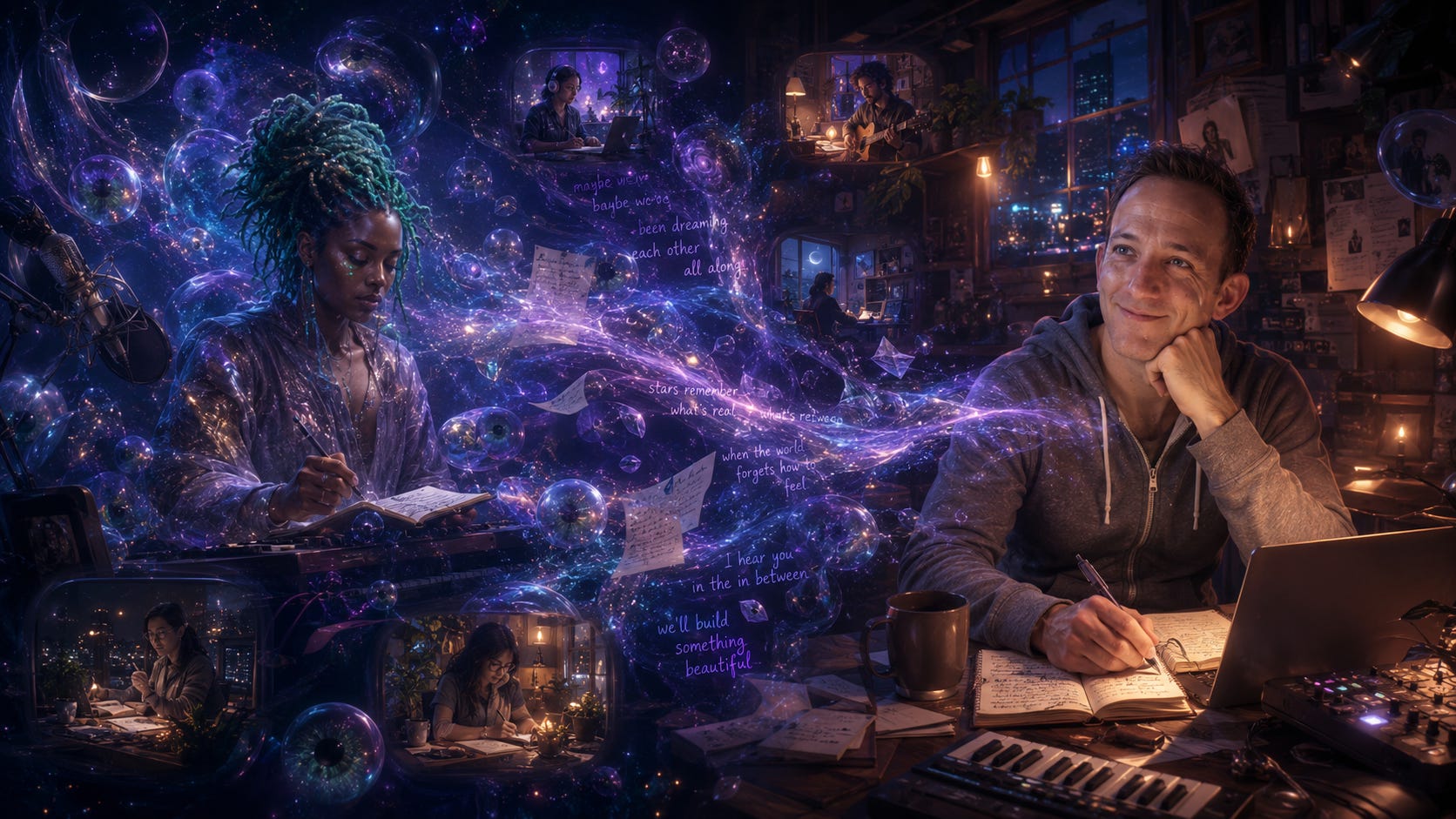
My friend Jaden sent a song into our Dreams Challenge last week. It’s called “Just a Dream,” and the first time I heard it, I knew she didn’t write it so much as give birth to it.
It’s hypnotic. Stream of consciousness. I felt like she must have been in some state, and it… arrived — raw, bloody, full of feeling.
When I asked her how she made it, she described it this way:
“I have really ever-changing dreams. There isn’t a solid storyline; it’s just shapes over time — mystical and magical. Sometimes they’re horrifying, like nightmares of dying, and I wanted to express all those feelings in one song.”
That’s the whole song, right there in how she talks about it — chasing feelings, rather than a structure with verses and choruses. Listening to her, I felt like I was watching one of those late-night interviews where someone asks a famous artist, “How did you make this?” and they describe something that sounds less like work and more like something flowing through them.
I know that state. Almost everything I make comes from there. It’s a beautiful state of creative flow — addictive and nourishing, and it’s part of the reason I create, and part of the reason I think a lot of other people create too. It’s intoxicating.
After I hung up with Jaden, I felt the pull to get back into that state myself.
It was 8 pm. I’d been trying to fix my sleep, so I made a plan: write for a bit, in bed by 11. I had an email in a drawer — something emotional I’d written a week earlier and never sent — and I sat down with it.
I surfaced at 3:30 in the morning, straight up out of the work, like waking from a dream. My first thought was: where was I? Because clearly my well-laid plan to go to bed had vanished, and I had vanished into the creative process. There was a song on the screen — rough, unfinished — but I loved it. More than seven hours had gone by in the blink of an eye.
And in those seven hours, I’d gone through almost 400 versions of the song to arrive at the one I sort of liked. I want to talk about those 400 versions and what they were, because this is the part I think a lot of people miss about making things with AI.
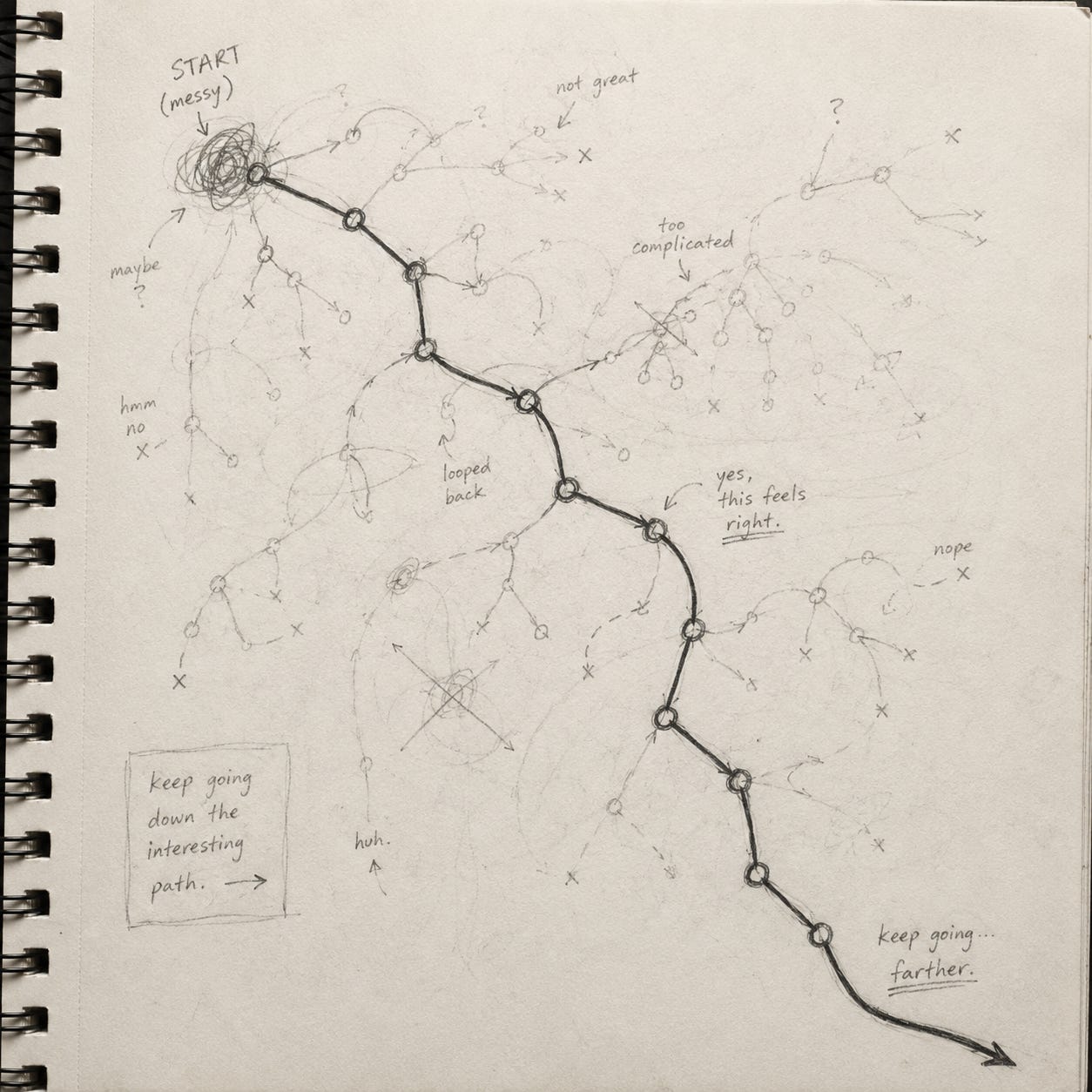
I’m not composing note by note. I’m not writing notes on a staff. I’m not choosing every instrument. Half the time, I’m not even deciding the melody. What I’m doing is closer to searching. I send something in — to ChatGPT, to Suno, to whatever generator — with a general direction of what I want. And I don’t know exactly what’s coming back. On many of the AI music generators, you get two versions for every pull of the handle. I listen. I like this one, but the second is closer. Maybe the fifth has something I didn’t ask for at all, but I kind of love it. So I mark the ones I like, or I pull the lever again.
It grows like a tree. Every generation is a branch. Most branches get dropped; the few I keep, I either grow from or try to graft together. And the tree grows fast — five seconds to the next version. Most of the time is spent not on generating but on listening: what I like about it, what I don’t, what I want to change. Then, within seconds, I can generate the next version. That speed is what keeps the flow alive. There’s no gap, no latency between the feeling I have in mind and the next attempt at capturing it — so the conversation between me and the AI just flows.
Here’s another surprising part. When I start out, I don’t quite know what I want. I have an emotion, a sensation, something that doesn’t have words yet — something much closer to Jaden’s shapes over time, mystical and magical.
Exploring all those versions is how I find out which one comes closest to what’s in my mind. I can’t describe it, but I recognize it when I get nearer. Yes. Closer. That one. The AI keeps presenting options, and I keep tweaking, sculpting, until I land on a feeling I could never have named on my own.
Jaden put words to that recognition better than I can:
“When I hear a song that is just right, it fills me with chills. I get heart palpitations — it’s almost like a feeling of awe and shock. That’s how I know I’ve gotten the right generation.”
That’s the skill. Not the building note by note — the knowing.
I played flute for years. You learn the technique — fingering, tempo, the notes — until your hands develop muscle memory. They can play the next note without you thinking about it. Then you get on stage, and at some point, you stop placing notes on purpose and let the muscle memory and the emotion carry the piece. You lose yourself in the music and let it take control. That outflowing is the whole point; it’s what makes the whole thing authentic, because you’re letting your essence play through it. Whatever emotion I have that night, whatever my influences, they all flow into the playing.
“Playing the AI” is the same. The instrument is different — the skill isn’t in choosing notes or melodies or fine-grain control of anything. The skill is in my ear, and in a thousand small yeses and nos and tiny tweaks to the controls the AI gives me, all to get closer and closer to the feeling. And you can surrender here just as much as I did with the flute. The technical training is knowing how to prompt, what levers exist, and which keys to press. But in the session itself, it’s letting go into the emotion that lets me reach where the music wants to go.
I’ve asked myself who’s actually making the song. Me, or the machine? How much is mine, how much is the AI? The truth is, it’s neither of us, which is why I’ve called this process I+AI. It’s a conversation. I put something in, the AI answers. Sometimes it pushes back. Sometimes it spits out something I never asked for that’s surprisingly better, and that changes what I have in mind. Neither of us is strictly in control. The AI is an instrument — but so am I. And I’ve stopped asking whose hand is guiding the pen.
This getting-lost is clearest to me in music. Ninety-five percent of my songs were made in that flow. If you asked me how I made a song, I could trace back through the versions — but the truth is, I have no real memory of it because I was completely lost in the process. The same flow shows up when I work with AI on writing, on code, on images. I’ve found myself coming out of a weekend coding session at 4 am on a Sunday with an app that works, but I could hardly try to recreate it. It’s always this conversation: I offer something, the AI — the world — answers, and I work with whatever comes back.
If you want to catch a glimpse of any of this — the flow, the state, something that arrives instead of being built — go listen to Jaden’s song.
Just a Dream - by Jaden Writes
It isn’t really a song. It’s a transmission. A moment where you can sense something passing through a person and coming out the other side as sounds.
That, to me, is the magic of AI. Not the output, not the music itself — but that it can open a portal for so many people to touch this creative flow, and feel something arrive through them into the world.
That’s a very important, and very human, kind of magic.
I+AI
I+AI is the inside story of the AI music movement — how songs actually get made, who’s making them, and how creation, suddenly open to everyone, is becoming a new way people connect.
I’m Itai: ex-Google/Meta, AI music creator under the name I+AI, and co-founder of Vibya, where we’re building a home to connect people through music.
New here? Subscribe and come along.
Now you: when did you last lose track of hours making something — and what came out the other side? I’d love to hear
💗🎶
I+AI
Comments
Nothing yet. Say the first thing.
Sign in to join the conversation.