
Knowledge is power. The more knowledge you have about your business, both internally and externally, will be the difference between success and failure. If you want your startup to successfully launch into a thriving business, you need to start collecting a lot of information before you even make things official with an LLC or C-corporation filing. This can be a daunting task if you’re not prepared, but being prepared doesn’t require expensive software or equipment – just a solid road map.
Your first step should always involve a quick search on the Web to see if your idea has already been implemented. Google queries are always a great way to kick off the search, but generative AI has made great strides in deeper Web searches in the past few months. The best use that I’ve found for Google’s Gemini is actually searching Google for answers that may not come up using the traditional Web-based search. Grok and Claude also do a great job of citing sources, so you can see whether or not these services found the correct answer.
Use of generative AI shouldn’t be limited to mere Web searches. Utilize these tools for further research into your potential product, your potential market, and other aspects of your business model. However, don’t take whatever artificial intelligence spits out at face value – make sure you dive into the sources that each service cites, and use at least a couple of different AI service providers to get a full picture of your market landscape. As I’ve written on generative AI usage in the past, models change over time and the answers generated for the same query will evolve with them. Different providers’ models pull from different data sets, so running the same query on two or more services will give you a broader look at the answer and can give different primary sources to investigate.
Once you have completed your cursory Web search and generative AI queries, it’s time to sit down and model the relationship between your proposed customer and your business idea. Your business needs to match the needs and wants of the people to whom you want to sell. When somebody comes to me with an idea, I pull out a copy of the Value Proposition Canvas – a different document from the Business Model Canvas but is designed to work in tandem with the latter.
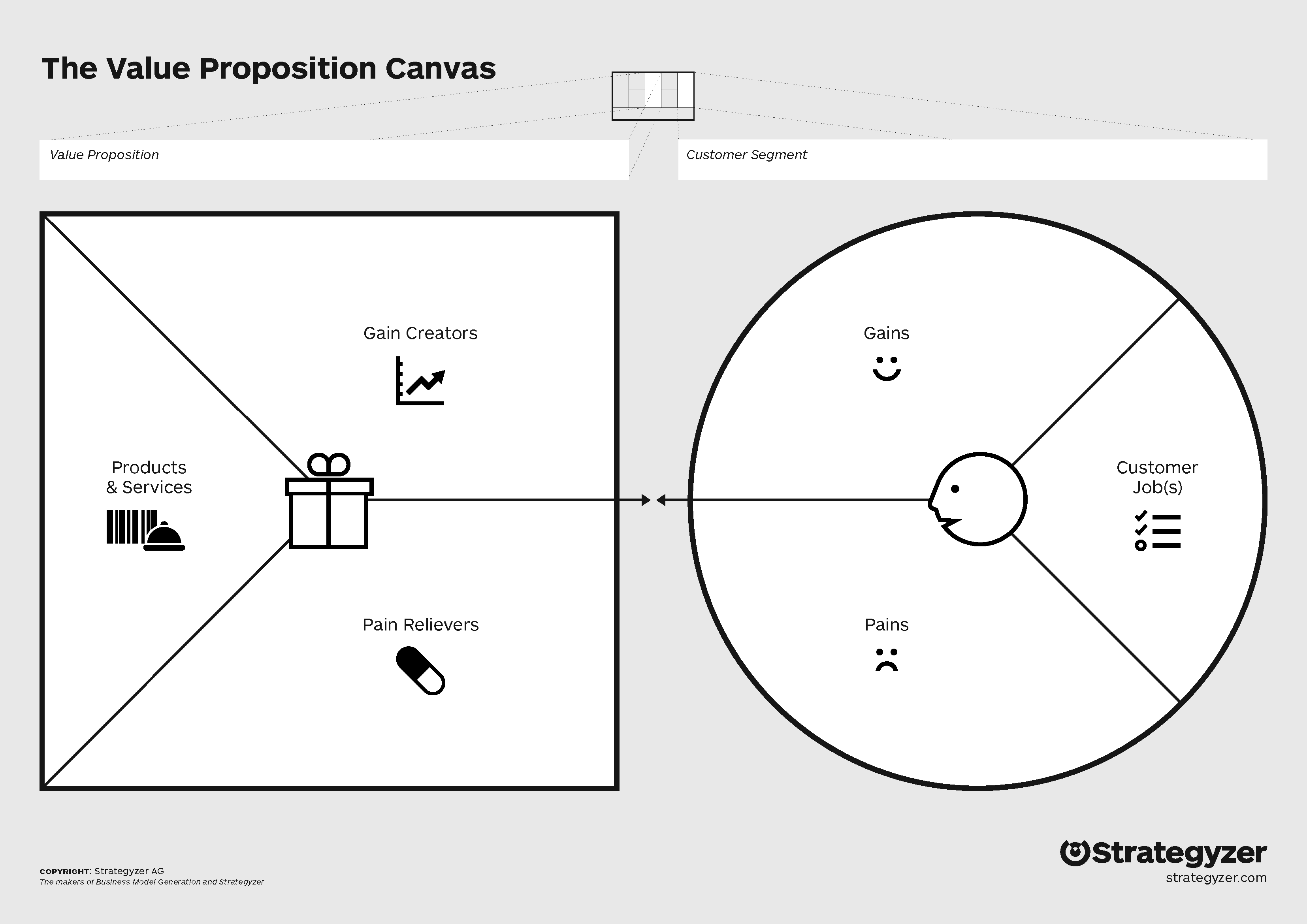
On this document, you’ll notice both a square and a circle: the square signifies your business, and the circle signifies your proposed customer segment. Your business produces goods and services that are “pain relievers” or “gain creators” – either they solve a major problem in someone’s life, or they add a benefit to someone’s life. Many products do both. On the customer side, they have pains that need to be relieved and gains that need to be created, along with specific “jobs” that the customer needs to do in order to have a healthy, productive life. The things mentioned in the three blanks on the business side should line up with the things in equivalent places on the customer side. You don’t need to know specifics about your customer archetype, or how the solution will be delivered to the customer. This worksheet gets you dialed in on your Value Proposition Statement.
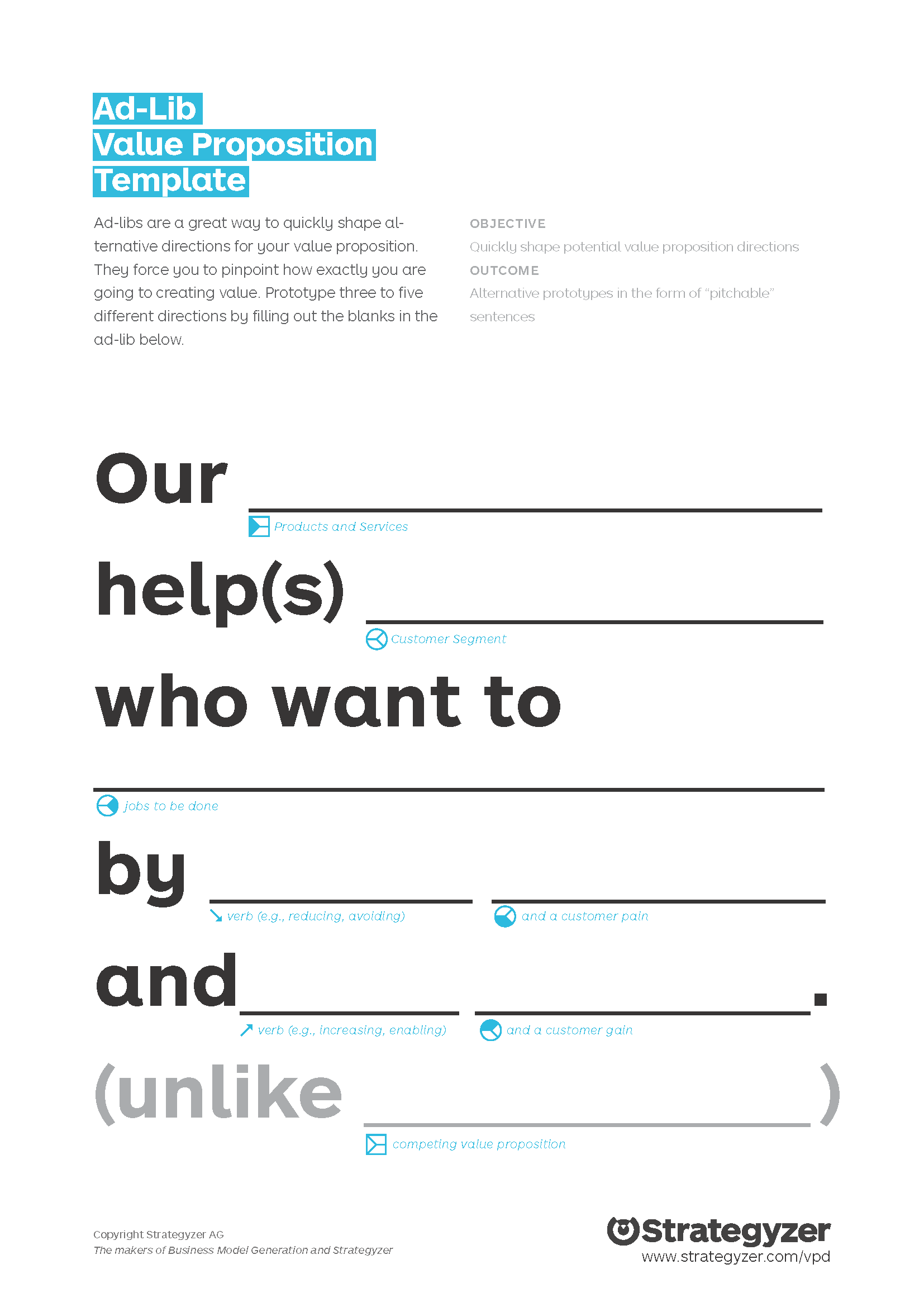
The Value Proposition Ad-Lib Template is the best way that I’ve found to create a coherent Value Proposition Statement – a one or two sentence summary of the value your business will provide to its customers. The blanks on this template are drawn directly from the Value Proposition Canvas – complete the canvas before moving on to the statement template.
Once you have the first version of both documents completed, it’s time to start formulating your Customer Discovery questions. Customer Discovery is the best way to find out about the problems your potential customers are facing, what they are using or purchasing in order to attempt solving the problem, the severity of the problem, and potentially what they are willing to spend in order to solve the problem. I usually suggest breaking Customer Discovery into 10 cohorts of 10 people each – 100 interviews total is the ultimate goal. Try to formulate 5-7 open-ended questions plus no more than 3 yes-no questions used as filters prior to conducting a full interview.
You’re looking to collect as much information as possible in the 15 minutes you have with your potential customer. Open-ended questions are the best way to get this information, along with strategic silence on your end. Let the interviewee continue to talk as long as possible. Sometimes the best information you can collect is buried in a follow-up to a question. Make sure you ask the interviewee if there is anything else they wish you had asked and always collect contact information in case you need to follow up with them in the future. Also, it’s never a bad idea to collect one or two new contacts from your interviewee, to create a Customer Discovery chain. The secondary contacts do not necessarily need to have the same demographics as your original interviewee. A diverse collection of interviewees should be considered if you are still unsure as to your exact customer archetype. Finally, always make sure you’re recording the interview – either interview potential customers in pairs where one person is asking questions while the other is writing down the answers, or use an audio or video recording device with the interviewee’s permission.
Remember – you can do all of these things prior to filing for an LLC in your local jurisdiction. Also, utilize your local library if you are running into any barriers. Librarians are a vital resource in business creation and might be able to point you to paid resources to which the library subscribes and offers to the public for free. Business experts, like the EntrePartners Braintrust, are also available to answer questions and help you along in your journey. There are plenty of opportunities out there and plenty of unmet needs. Let your imagination run wild!
No posts
Comments
Nothing yet. Say the first thing.
Sign in to join the conversation.