
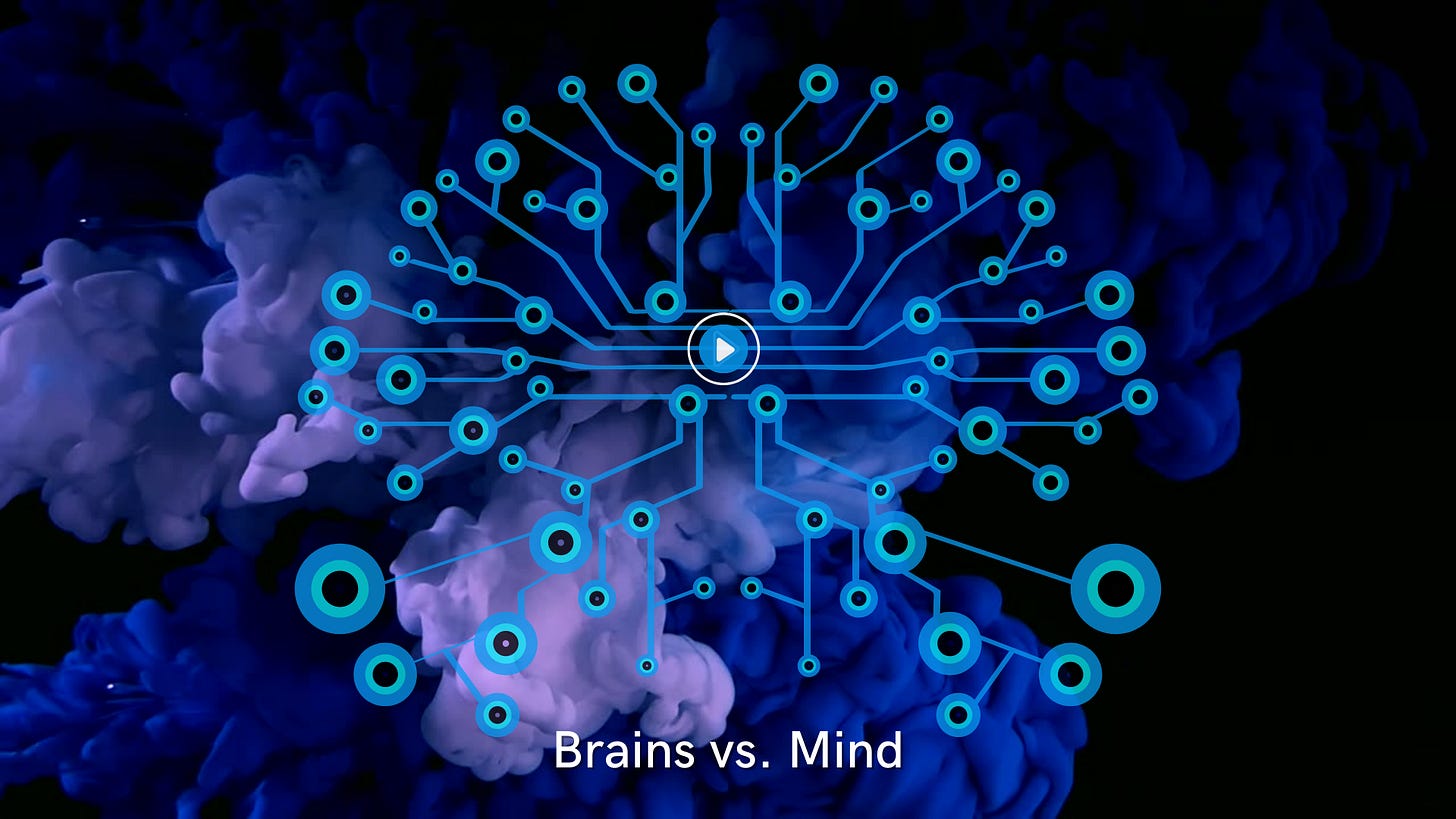
“Biology gives you a brain. Life turns it into a mind.” ― Jeffrey Eugenides
Everyone working in Artificial Intelligence (AI) seems to sidestep what to me is an obvious question - a question that has been plaguing scientists and philosophers alike for centuries. What is the difference between the physical brain (made up of cells, blood vessels, nerves, etc.) and the mind which, though clearly connected to the brain, seems to boil down to several equally difficult-to-define words such as consciousness, personality, and Self with a capital “S.”
Advances in neuroscience have allowed us to understand how the brain processes and stores input from the senses and the mind. We now know, for example, that each experience is stored - both factual and emotional - as neuro pathways in the brain, and that the body responds when those experiences are recalled (remembered). The brain can also adjust and change itself in response to input - a phenomenon known as neuroplasticity.
Lisa Feldman Barrett does a brilliant job of explaining all this in her book, How Emotions are Made, and her video simulation below explains how our brains collect, store, synthesize, respond to, and adapt to both factual and emotional input.
EMOTIONAL REALITY
As captivating as Barrett’s work is, we are still left to wonder what emotions are, how they originate, and how they define us as human beings. Because it seems to me that the whole debate about AI is not whether a computer can be designed to function as a physical brain (see this podcast entitled, “Human and AI Collaboration” by Intel), but whether or not AI is capable of consciousness - i.e. emotional intelligence (EQ). Can AI make decisions based on emotions as opposed to relying solely on logic? Because we’ve all been in situations where what seemed like the most logical choice was not the best one because it felt wrong.
Rather than launch into a philosophical discussion about brain versus body and whether or not AI is capable of consciousness and feelings, I am going to suggest that we watch a series of movies and videos. These will give us a look at how our perceptions, assumptions, and understanding of AI have evolved over time and raise some interesting questions.
Let’s begin with an extraordinary story and video by an extraordinary scientist, Dr. Jill Bolte Taylor. In 1996, at the age of 37, Dr. Jill experienced a severe hemorrhage in the left hemisphere of her brain. As a result of the stroke, she could not walk, talk, read, write, or recall any of her life. It took eight years for Dr. Jill to completely rebuild her brain to recover all her physical, emotional, and thinking abilities. What she discovered in the process may change how you think and feel about the brain-body and the brain-mind connection.
The book Dr. Jill wrote about her experience is called, My Stroke of Insight, and is well worth the read. You can learn more about Dr. Jill and her remarkable journey here: https://www.drjilltaylor.com/
Questions
What did you make of Dr. Jill’s description of energy?
Do you agree that we are energy beings all connected to one another through the consciousness of our right hemispheres as one human family?
What did you make of Dr. Jill’s description of the left hemisphere’s calculating intelligence - the little voice that says, “I am?”
Next, we’ll be talking about how robots became synonymous with AI and why we have felt the need to make robots look so much like ourselves.
Thoughts, questions, suggestions? Email me at JenaBall@CritterKin.com
Copyright 2022 by Jena Ball. All Rights Reserved.
No posts
Comments
Nothing yet. Say the first thing.
Sign in to join the conversation.