
Every week, before Tuesday’s essay, I ask myself what I should write about. What happened over the past few days? What was meaningful, unusual, or relevant enough to be turned into an essay?
The days slipped by, one after another, looking almost identical at first glance. Writing, training, emails, short walks, a few conversations, constantly changing weather. At first glance, nothing memorable. And yet, no two days were really the same.
Here in Scandinavia, nature has its own way of changing the scenery almost every day. The sky never stays the same for long. The light shifts from one hour to the next. Wind, rain, sunshine, the sea... everything seems to redraw the landscape over and over again. A morning can begin in bright sunshine, turn into rain by lunchtime, and end with the sea a completely different colour.
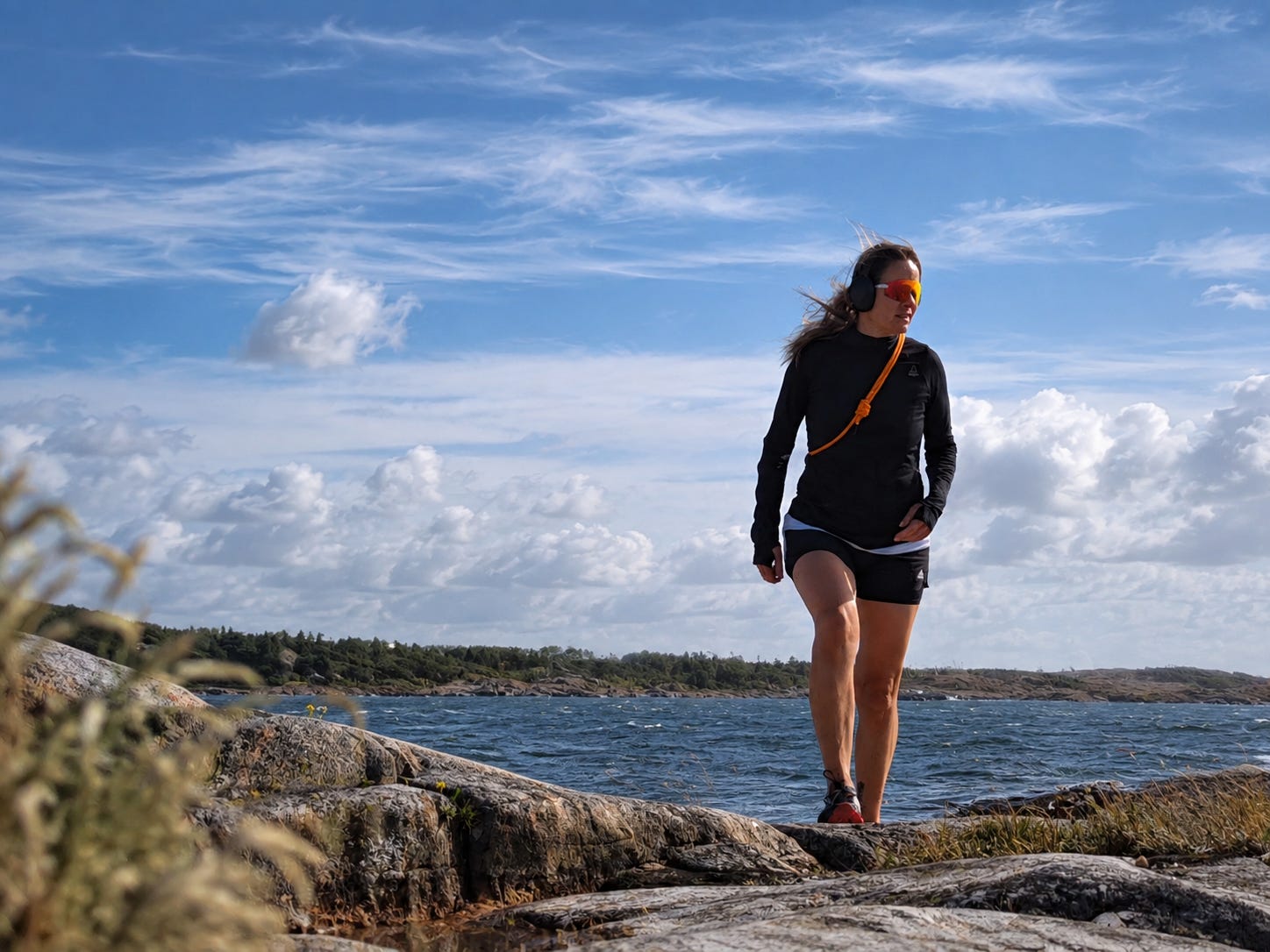
The beauty of this place isn’t the landscape itself. It’s the fact that it never stays the same. I think that’s exactly what keeps me so present.
Time feels different here: slower and more settled. I never have the feeling that I’m chasing it.
And, paradoxically, that’s when I get the most done. By the end of the day, I’ve usually finished almost everything I planned to do. Things happen at a steadier pace, and effort feels different too. I don’t have that familiar sense of a day so crowded that every new task pushes the previous one aside until, by evening, you can barely remember what you’ve actually done.
Here, the days have more space.
Maybe that’s why STIGEN finally started moving again.
Part Two had been stuck since spring. I had scenes, ideas, characters, but the story refused to come together. Every time I tried to move it forward, I felt as if I was forcing something that simply wasn’t ready yet.
Not long after arriving in Sweden, things began to shift. Or perhaps, more accurately, they began to settle.
This isn’t the first time stories have been born here. In an earlier essay about the place where Jo Svend came to life, I wrote that she emerged from a state of mind rather than from a plan, from the silence, the light, and the rhythm of a morning on Sweden’s west coast.
It doesn’t feel like a coincidence that this is where the story found its direction once again.
Almost without noticing, everything started flowing. Within three weeks, the story opened up again. The ideas came one after another, and I found myself writing every day.
And when I write, I do it in a way that surprises even the people closest to me. When I enter that state, I write intensely. Sometimes compulsively. I barely manage anything beyond the work that absolutely has to be done and my training sessions. Everything else becomes secondary. I forget to reply to messages, postpone simple tasks, and realise in the evening that I’ve spent almost the entire day inside the same world.
One morning I realised it had been almost a week since I’d dusted, vacuumed, or changed the bed linen. Another morning, I noticed the fridge was nearly empty. It certainly wasn’t chaos. But my usual routine of looking after the van had quietly been postponed, one day at a time. And ever since moving into twelve square metres, I’ve realised just how important that routine is. In a space that small, anything neglected makes itself known almost immediately.
Training stays because it helps me write. It’s not a break from the manuscript. It’s where I continue working on it without opening my laptop. While I’m running or cycling, scenes fall into place, dialogue becomes clearer, or I suddenly realise that a character would never do what I’d been making them do. Sometimes I come back from a workout with the solution to a problem I’d spent hours trying to solve.
In this Scandinavian rhythm, almost without noticing, I finished the first draft of STIGEN Part Two.
The manuscript is now closed. I’ve deliberately put it aside so I can step away from the world and the characters I’ve lived with over the past few weeks. I need that distance before beginning the slower, more meticulous stage: revising, editing and proofreading.
While I’m writing a first draft, I’m simply too close to the text. Sometimes I reread a scene a few weeks later and it feels as though someone else wrote it. That’s how deeply I enter the story while I’m working on it. That’s why every manuscript needs time to rest.
The timing couldn’t have been better.
This coming week will be dedicated to preparing for HUB Trail, a 40-kilometre race on Sweden’s west coast. I’m incredibly excited, but also a little nervous, mostly because I’m not a trail runner and, in general, I have a love-hate relationship with running. I don’t know the course at all. All I know is that it will include beaches, forests, climbs, mud and, possibly, even a short swim. I also know that the race is organised by Robert Rundqvist, the same person behind UltraTri Sweden, which is reason enough to expect that this won’t be an ordinary race.
The entire event is self-supported. I’ll have to manage my own nutrition, hydration and equipment. And the adventure starts long before the starting line: I’ll cycle from my campervan to the start, from the finish to my accommodation, and then back to the van the following day.
That’s exactly why I like the idea. It’s a new challenge. Something that keeps me curious. A different kind of effort, a different rhythm, and a different kind of logistics.
If everything goes well and I cross the finish line with enough thoughts, and enough energy, to turn them into an essay, chances are we’ll be talking about HUB Trail next Tuesday.
So when I asked myself what noteworthy thing had happened over the past week, “nothing” wasn’t really the right answer.
I finished the first draft of a book I’ve been working on for months, trained for HUB Trail, ticked off my daily tasks (including, eventually, cleaning the van and restocking the fridge), and followed my routine at a pace that felt right.
Sometimes the most important things happen quietly. That doesn’t make them any less important.
If these words resonated with you, subscribe.
And if you think they might help someone, share them.
See you on the road.
— Ioana
triathlete. nomad. writer. on the road.
Comments
Nothing yet. Say the first thing.
Sign in to join the conversation.