
We looked at the IMF’s 2025 global unemployment data and something peculiar really stood out.
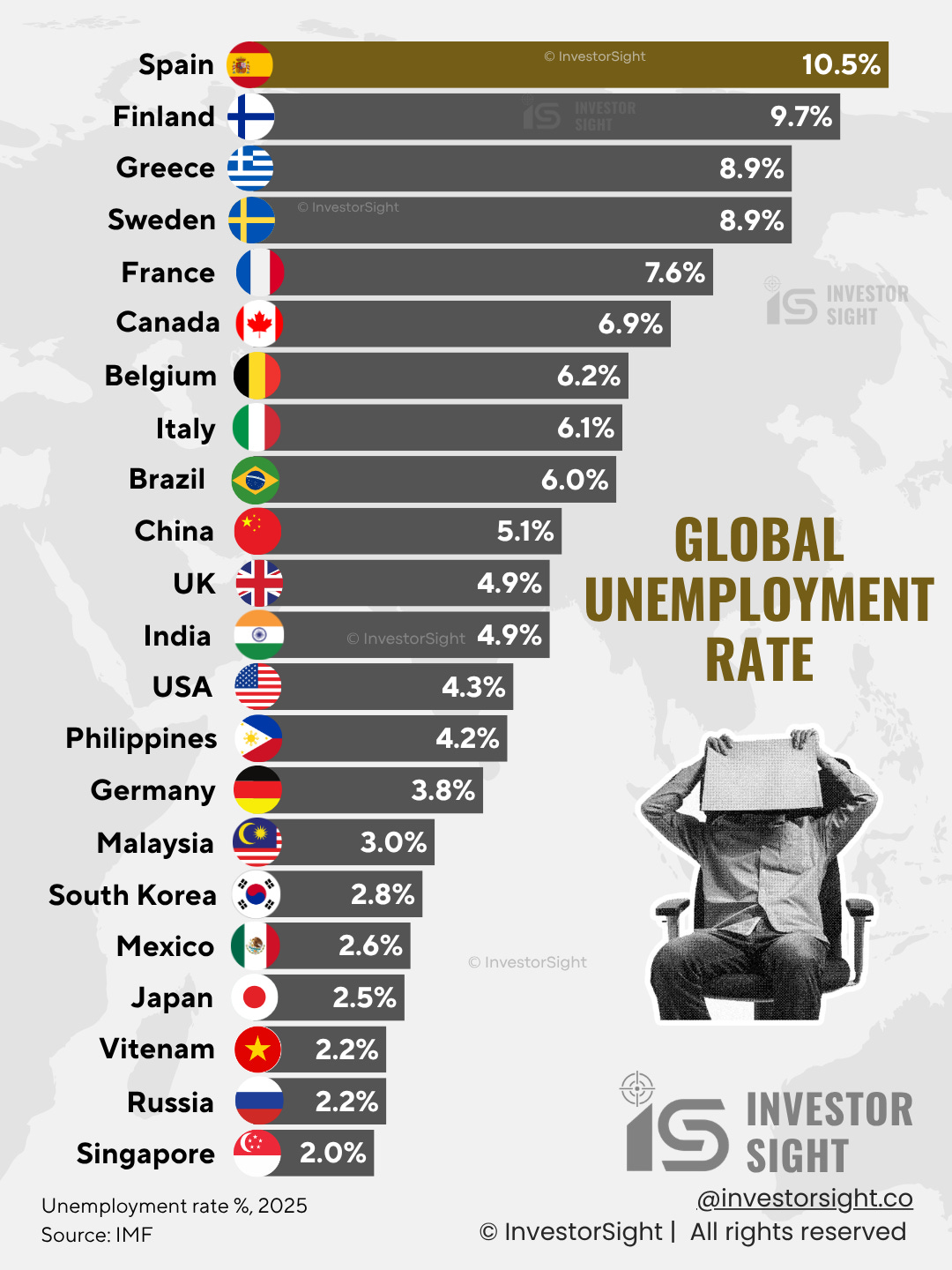
Among some of the world’s leading economies, Spain leads the table at 10.5% unemployment, while Finland follows at 9.7%. Additionally, Greece and Sweden both sit at 8.9%, while France is at 7.6%.
Now by our conventional economic logic, these nations should be in distress. Their citizens should be anxious and politics fractured as people grow in insecurity. And yet, it doesn’t.
As per the World Happiness Report, Finland has topped rankings since 2018 and Sweden, Denmark and Netherlands also find themselves in the top 10.
Meanwhile, Spain (at 10.5% unemployment) scores substantially higher on “happiness” than high employment countries like Japan (2.5%).
So then, what’s going on? Is unemployment actually good?
No, but the answer is actually more interesting than that.
The most important difference to understand is that unemployment in Finland is not the same experience as unemployment in India, USA or Brazil.
When a worker loses her job in Helsinki, she does not lose her health insurance, or access to her children’s education or her housing. In fact, the state absorbs the shock completely and without humiliation.
OCED’s Social Expenditure data reveals that Finland spends ~31% of GDP on social protection. Sweden spends 26% and France 30%. On the other hand, USA spends 19% and India ‘s safety net it nascent.
Being unemployed in a Nordic country is more dignified than being employed at a low wage, no benefits job in country that has weak labour protections. The well being data reflects this perfectly.
Being unemployed in Finland can be more secure than being employed in Mexico. The unemployment rate measures the label, not the suffering.
Share this with someone that might find it interesting!
When fear of unemployment is removed, people search for work differently and this further raises the measured rate. A Finnish worker who loses a manufacturing job can afford to wait, search and essentially hold out for a role that matches their skills. At a societal level, this raises numbers while simultaneously improving job-match quality, long run productivity and also “happiness”.
Consequently, workers in countries with weak safety nets accept poor (non-matching) jobs out of desperation. This reduces unemployment rates, but not the misery of being in an unsuitable job with no benefits. A person in this category would statistically be “employed” but the exhaustion shows up in lower “happiness”.
Universal healthcare removes health security from employment
In Finland & Sweden, you don’t lose medical care when you lose your job. Meanwhile, the CommonWealth Fund highlights how American workers stay in unsuitable jobs specially because employer sponsored healthcare makes it a survival need.
Generous Benefits lead to quality job matching
Nordic countries cover between 60-80% of prior wages upto two years. Thus, the short-term cost of higher measured unemployment is outweighed by optimal labour allocation that leads to increased productivity in the long run.
Strong employment protection creates fewer but better jobs
Europe’s labour laws make firing expensive, which raises average job quality. This is also why OECD’s employment protection index ranks these countries pretty high.
High-Employment countries have their own invisible costs
Japan’s 2.5% unemployment rate is commendable. However, they have a word “karoshi”, that literally translates to “overwork death”. In 2021, ILO estimated almost 745,000 deaths globally due to overwork, while stating that Japan and South Korea suffer from cultural overwork crises. These numbers however, never show up on the unemployment statistics.
Spain singularly complicates our Nordic narrative. The country’s 10.5% unemployment rate isn’t just smart policy but has a darker side. Spain’s job market is deeply unequal to the older and younger. While the older, established workers are well protected, the younger workers struggle to get their foot in. In 2013, Spain’s youth unemployment (under 25 years olds) reached 55% and even the IMF has called it one of the most “unequal job markets”.
And yet, people in Spain report high life satisfaction and social connections with one of the world’s highest life expectancies. The country’s quality of life such as long meals, genuine leisure and public spaces reflect a well being not reported in the unemployment numbers.
Spain is a reminder that well being is not just about a “safety net”, but what you do with the hours you’re not working.
The unemployment rate is one the most cited statistics and closely looked by politicians, economists and investors globally. And while it captures something real about a country’s labour market, it’s not the most accurate about human welfare.
Here’s a fun way to think about all of this. Instead of looking at who has the most or least unemployment, let’s plot countries on two axes. Happiness and Employment.
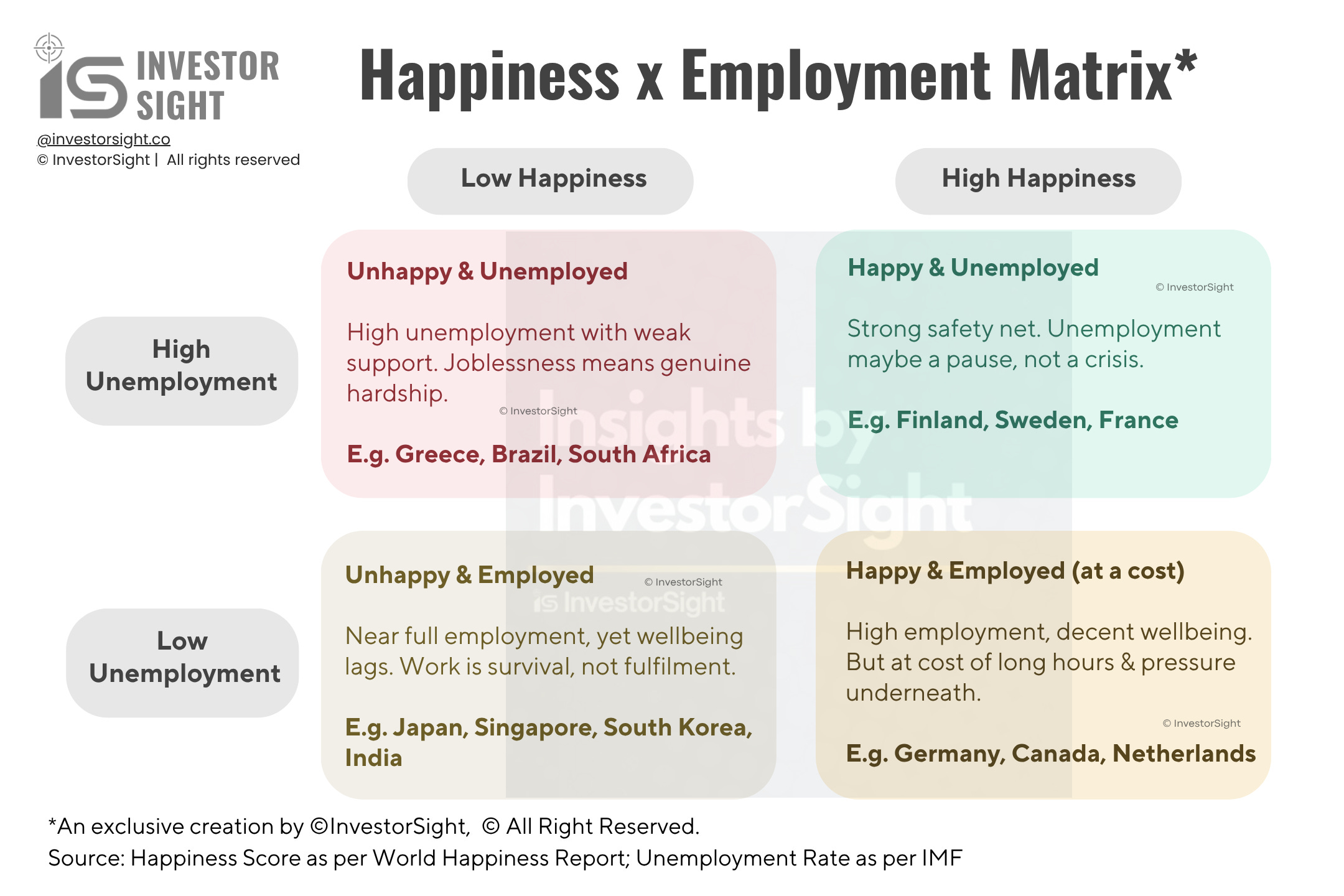
Can you guess where Spain fits in this matrix? Let’s see what you think.
Hope this was an interesting read for you.
At InvestorSight, our analysis is trusted by thousands of global investors and reached millions around the world. We transform data into easy to understand visual insights by breaking down the numbers and connecting the dots to understand what’s really happening in the world of business and finance.
If you want to dive deeper into stories like this, follow and subscribe to never miss an update.
Written by: Team InvestorSight & Ishita Shah, CFA
No posts
Comments
Nothing yet. Say the first thing.
Sign in to join the conversation.