
Global demand for U.S. treasuries is quietly reshaping itself and the latest data on holdings tells a striking story about the shifting economic relationships. In this article, we deep dive into the story behind the number understand what has shifted in the last one year and why this matters more than you think.
In the most simple words, U.S. Treasuries are the debt securities issued by the U.S. government to finance operations. When you purchase a treasury bond, note , or bill, you’re essentially lending money to the government, in return for regular interest payments and the principal back at maturity.
The U.S. treasuries are sold to investors such as foreign governments, central banks, pension fund and individual investors like us.
Treasuries are considered as one of the world’s safest investments as they are back by the full faith and credit of the U.S. Government and are seen as “risk-free”. For context, these treasuries are the foundation of global finance, acting as a benchmark against which all debt (and equity) is priced.
So when you see movements in U.S. Treasuries, it’s only important to understand why.
Top 5 countries holding the largest U.S. treasuries as of November 2025 are:
Japan: $1.2 tn
UK: $888.5 bn
China: $682.6 bn
Belgium: $481.0 bn
Canada: $472.2 bn
The chart below shows net changes in U.S. Treasury holdings by country over the last 12 months. Let’s take United Kingdom as an example. As of November 2024, the UK held $766.9 bn, compared to $888.5 bn in November 2025. This represents as increase of $121.6 bn, as shown below.
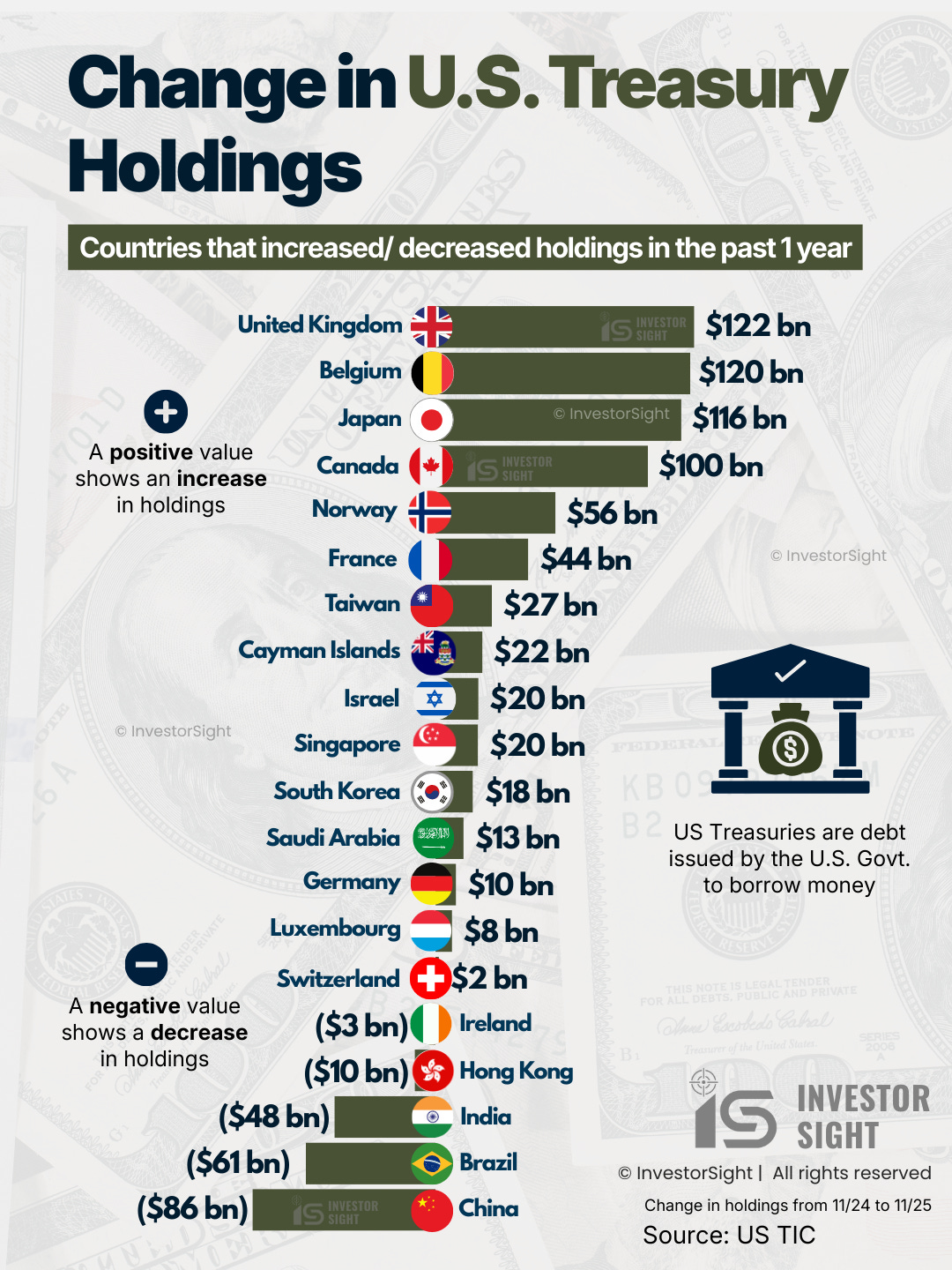
At the top are UK (+$122bn) and Belgium (+$120bn) standing out. If this looks surprising, its because these countries act as custodian and clearing hubs, particularly Belgium, which reflects holdings linked to Euroclear. But the message is clear in that institutional demand for treasuries remains strong.
Notable increases:
Japan (+$116bn): The largest foreign holder of US treasuries
Canada (+$100bn)
Norway (+$56bn)
France (+$44bn)
The tier of buyers that don’t grab headlines but still matter.
Israel (+$20bn)
Singapore (+$20bn)
South Korea (+$18bn)
Saudi Arabia (+$13bn)
Countries that have reduced treasury holdings are:
China (-$86bn)
Brazil (-$61bn)
India (-$48bn)
Hong Kong (-$10bn)
Ireland (-$3bn)
These numbers aren’t just financial flows but reflect profound geopolitical realignments. While China is still a major holder of US treasuries, its continued exit serves multiples purposes.
Reduces exposure to potential sanctions (Russia’s foreign reserves frozer after Ukraine invasion)
Supports internationalisation of Yuan
Decreasing faith in the US-China economic interdependence (remember, China is still US’ highest tariffed nation at 37%)
Now while China’s reduction is the highest, Brazil and India are not far off. Cumulatively, the 3 countries have reduced holdings by $194bn in one year.
This may not necessarily be a “dump” but signs of reverse diversification (probably to gold), local liquidity needs or higher domestic yields being more attractive. However, this comes at an interesting time as the BRICS nation focus on gradually de-dollarizing and reducing their exposure to U.S. policies.
Remember, they’re essentially moving out of a “risk-free” asset.
Share this with someone who might find it interesting!
Despite the shift from U.S. treasuries by these 5 nations, treasury yields haven’t spiked. The demand has swiftly shifted to the U.S.’ allied nations.
However, U.S. borrowings have increased over $1.5 trillion annually and as the buyers become more and more concentrated, America’s fiscal policy will work more tightly to maintain these alliances. The dependency runs both ways, afterall.
If there was an overall rejection, we’d see rising yields without buyers (higher yields are more attractive and risky), reduction in overall foreign participation and rush in alternative assets.
While the trend seems unlikely to reverse, emerging markets may following China’s suit and reduce exposure to U.S. policy decisions. On the other hand, allies in Europe and Asia will probably continue increasing treasury positions as long as the current security architecture holds true. A very important “as long as”.
At InvestorSight, our analysis is trusted by thousands of global investors and reaches millions around the world. We transform complex data into easy to understand insights by breaking down the numbers and connecting the dots to understand what’s really happening in the world of business and finance.
If you want to dive deeper into stories like this, follow and subscribe to never miss an update.
No posts
Comments
Nothing yet. Say the first thing.
Sign in to join the conversation.