
Disclaimer: This newsletter is not financial advice it is for educational purposes only. Please DO NOT take this newsletter as a buy or sell signal.
Below is a checklist I normally use when analysing a company’s fundamental health. If the company meets my criteria it will be colour-coded in green and if it fails to meet my criteria it will be colour-coded in red which means I need to investigate further and ask myself why this is the case.
As you can see below there are 3 red boxes and I am going to explain them:
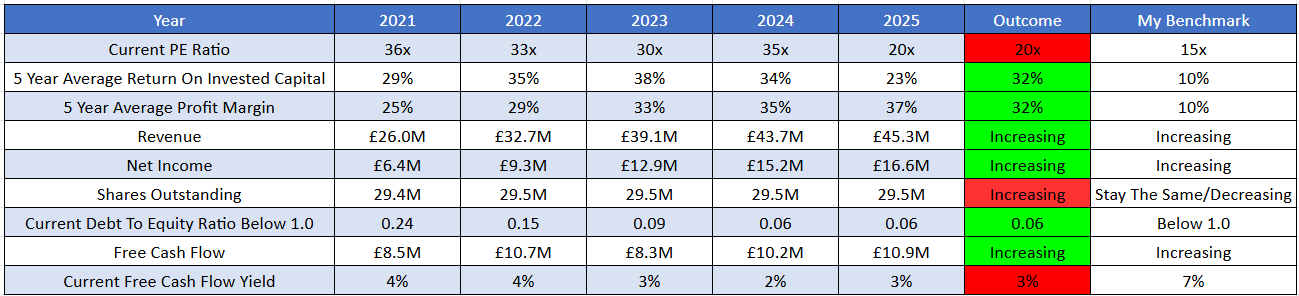
Current PE Ratio- Cerillion currently has a PE ratio of 20x which might indicate that this company is trading at a premium to the market since the average stock market PE ratio is 15x. One thing to remember is that if a company can grow 20% from now until judgment day and sustain that growth then the current valuation will look cheap. This goes for the opposite side of the spectrum where if a company was trading at 15x earnings and only grows by 3% a year that might seem expensive because the company can’t justify its valuation.
Shares Outstanding- When analysing a company I prefer the number of shares outstanding to remain stable or decrease over time. In the case of Cerillion their shares outstanding have increased by 0.34% over the last five years. This level of dilution is minimal and I am not particularly concerned about it.
Free Cash Flow Yield- Free Cash Flow Yield gives investors another way to assess a company’s value. Free cash flow yield provides a better measure of a company’s performance than the P/E ratio because earnings can be manipulated based on accounting rules. The most common way to calculate free cash flow yield is free cash flow divided by the company’s market cap. The lower the yield the less attractive a company is as an investment because investors are putting money into the company but not receiving an excellent return. A high free cash flow yield implies that a company generates enough cash to quickly satisfy its debt and other obligations including dividend payout. Cerillion's free cash flow yield is 3% which is below my 7% threshold and below the risk-free rate which is currently 4.3%. It is important to remember that according to the Intelligent Investor when the treasury yield is higher than a company’s earnings or cash flow you are NOT being compensated for the extra risk you are taking with an individual business which shows there is no margin of safety.
Founded in 1999 by Louis Hall, Cerillion is a British company headquartered in London. Cerillion specialises in providing software for billing, charging, and customer relationship management in the telecommunications sector. Its key product segments include Cerillion Unify, Enterprise, Engage, Skyline, and Metro with operations in the UK, Europe, the Middle East, Africa, the Americas, and the Asia Pacific.
Software- The Software segment is the primary source of Cerillion’s intellectual property. The company generates revenue by charging a substantial upfront fee for its main Enterprise system, collecting monthly subscriptions for the Skyline cloud platform, and implementing annual fees for ongoing updates and support. Since these systems manage essential functions such as billing and customer management they provide a high-margin revenue stream that is stable over the long term and creates significant barriers to entry for competitors once a client is integrated into the ecosystem.
Services - The Services segment includes the personnel needed to set up and maintain complex technology systems. This division manages the entire implementation process which involves moving data and setting up systems. It also provides managed services in which Cerillion staff manage billing cycles for their clients. While much of this revenue is one-time and tied to specific project milestones growth in this segment is an important indicator of new contract wins and the scale of ongoing global deployments. It acts as the link that turns software licenses into practical business solutions.
Others- The Other segment acts as a supporting category for revenue that falls outside of core software and professional services. This typically involves reselling third-party hardware or specialised software tools to meet a client’s specific infrastructure needs. Although it is the smallest and most transactional part of the business its double-digit growth in the most recent fiscal year demonstrates its role in providing a comprehensive one-stop-shop experience for telecommunications and utility providers during major digital transformations.
When evaluating management I like to judge the CEO based on several factors such as experience, capital allocation skills, and Incentives. In this section I will discuss whether management incentives are aligned with shareholders' interests.
Experience- Louis Hall is the Founder and Chief Executive Officer (CEO) of Cerillion a position he has held since leading the management buyout of the business from Logica in 1999. He has served as an Executive Director of the company since March 2015 following its transition to a public entity. Before starting Cerillion he built his career in the enterprise software industry where he held various senior roles in product development, sales, and general management at Logica. Under his leadership Cerillion has evolved from a spin-off venture into a global provider of billing, charging, and customer management solutions. His extensive industry experience and long-term vision for the company's product suite provide the strategic continuity and stability necessary to maintain Cerillion’s competitive position in the telecommunications and utilities sectors.
Below is an image illustrating the current experience of Cerillion board members:
Capital Allocation- Capital allocation is very important when judging management because I want them to create value for shareholders not destroy it.
Louis Hall’s capital allocation strategy at Cerillion is characterised by a strong commitment to organic growth and financial discipline. Under his guidance the company has consistently prioritised maintaining a debt-free and cash-rich balance sheet which reached a record £34.4 million at the end of the 2025 fiscal year. Louis Hall primarily allocates this capital to reinvest in the business. He has ensured that the company’s expansion is driven by its own operational excellence and high-margin software licensing rather than by external debt or shareholder dilution. In addition to reinvestment Louis Hall has established a predictable and progressive dividend policy that serves as a core component of his capital allocation framework. In the 2025 fiscal year he increased Cerillion's dividend by 17% to 15.4p per share continuing a multi-year trend of aggressive payout growth that aligns with the company’s rising profitability. Despite this steady return of cash to shareholders Louis Hall remains cautious ensuring that the dividend is always well covered by earnings to protect the company.
Cerillion currently pays a dividend with a yield of 1.45%. This dividend is sustainable because it only covers 42% of the company’s free cash flow.
Incentive- This is important because if the current board is buying shares of their own business it indicates that management believes the stock is undervalued and is confident in the company’s long-term prospects.
As you can see below we have zero buy and sell orders.
Bull Case - The first bull case is founder-led. Founder and CEO Louis Hall remains the largest shareholder with a 20.1% stake. This high skin in the game ensures that capital allocation remains disciplined and that he has shareholders' best interests at heart.
Bull Case- The second bull case is their balance sheet. Operating with zero debt and £34.4 million in net cash the company possesses a fortress balance sheet. This financial strength is a critical selling point during long-term contract tenders with risk-averse global telcos.
Bull Case- The third bull case is their moat. An incredible 93% of revenue is generated from existing customers. Once a client is integrated the Evergreen software program ensures they stay on the latest version which creates a sticky relationship with virtually zero churn.
Bull Case- The Fourth bull case is a long runway for growth. Global telecommunications providers are in a forced replacement cycle. Legacy systems cannot handle the high-speed data and complex pricing of 5G and full-fibre broadband making Cerillion’s modern BSS/OSS suite a structural necessity.
Bear Case- The first bear case is Revenue Concentration. A significant portion of Cerillion's income comes from a small number of large contracts. For example in 2025 a single European customer accounted for roughly 29% of group revenue which creates a key client risk where the loss or delay of one project would have an impact on the company.
Bear Case- The second bear case is competition. Cerillion moves upmarket to chase larger Tier-1 contracts but it faces direct competition from global giants like Amdocs, Ericsson, and Netcracker. These competitors have vastly larger R&D budgets and longer-standing relationships with the world’s biggest telcos.
Bear Case- The third bear case is dependency on the Telecom Sector. Cerillion is heavily weighted toward the telecommunications industry. If global telcos reduce capital expenditure due to high debt loads or economic downturns Cerillion’s sales pipeline currently its biggest strength could dry up rapidly.
Bear Case- The fourth bear case is Slowing EPS Growth Forecasts: While historical growth has been excellent some analysts forecast that EPS growth may slow to around 7-8% per year through 2027. If the market continues to price in 20%+ growth while the reality is in the single digits the stock is vulnerable.
In this section I will discuss valuation. Using some basic metrics I will compare Cerillion to its industry rivals and determine whether the company is cheap relative to its peers. Then I will value Cerillion using a discounted cash flow model to determine a price I am willing to pay based on its expected growth rate and my desired return of 15%.
As shown below when compared to its peers Cerillion scores 1/5 while Amdocs scores 4/5. Below I am going to highlight the key differences between the companies:
Business Model - Cerillion uses a product-focused, pre-integrated business model that is designed for flexibility and to reduce overall ownership costs. They aim to provide a complete out-of-the-box suite that reduces the need for heavy customisation. Their services are available through SaaS, managed services, or on-premise installations.
Amdocs operates a large-scale service-oriented business model with managed services and long-term strategic outsourcing as its primary revenue sources. Amdocs as a strategic integrator often takes charge of the entire operations and results for its clients through multi-year contracts.
Market Reach- Cerillion primarily targets mid-tier telecommunications providers, high-growth challenger brands, and non-telecom sectors such as utilities and financial services across more than 45 countries. The company excels in markets that prioritise speed to market and simplicity over massive scale.
Amdocs dominates the Tier-1 global market by serving the world’s largest telecommunications and media companies. Their presence is truly global and extensive supporting organisations that manage billions of transactions daily. Amdocs provides an ecosystem capable of handling extreme complexity across multiple continents.
Product Offering- Cerillion’s product offering is built around its flagship BSS/OSS suite which is a modular yet unified platform covering CRM, billing, charging, and inventory management. Their focus is on headless architecture and TM Forum standards to ensure their software is easy to integrate and upgrade.
Amdocs has a broader and more complex system recently highlighted by their aOS (Agentic Operating System) which brings generative AI into the BSS/OSS stack. Their services go beyond basic billing and include 5G monetisation, cloud-based network automation, and advanced media and digital experience platforms. These are made for providers who need to manage a wide range of old and new technologies.

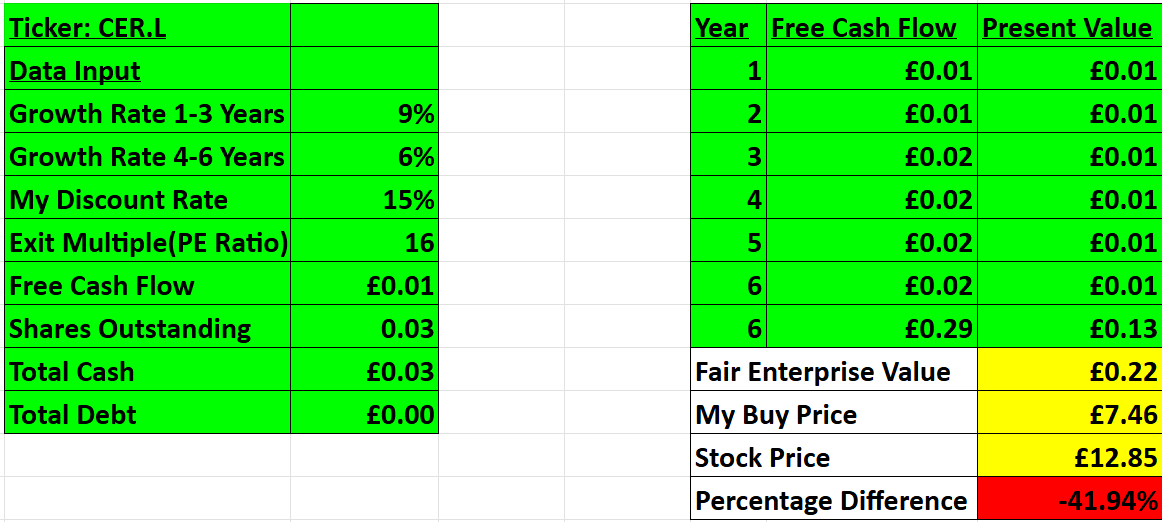
As you can see based on my conservative assumption Cerillion is looking to grow 11% over the long run so I went conservative and assumed a 9% growth in the first 1-3 years then the growth will slow down to 6% 4-6 years out. In my assumption I also went with an exit multiple of 16x earnings which is below the historical average at which Cerillion has traded. Based on my assumption I have come to a buy price of £7.46p compared to the current stock price of £12.85 which means right now Cerillion is trading above its intrinsic value.
Thanks for reading my newsletter on Cerillion.
Disclaimer: This newsletter is not financial advice. This is for educational purposes only, so please DO NOT take this as a buy or sell signal.
Remember to subscribe, share, and comment below if you find this newsletter insightful. Your support helps me continue my work.
No posts
Comments
Nothing yet. Say the first thing.
Sign in to join the conversation.