
August 12th, 2026
Greetings!
Today, I want to return to the original intent of the INTREP360 Intelligence Report and do a global sweep of the top stories impacting U.S. national security. For new readers, our goal here is to build a mosaic – one that will never be done – so that as security threats break through to the headlines, we will have been documenting them in the making.
Ukraine and Iran have dominated much of our recent coverage. However, global threats come at the U.S. on a 360° basis and across a wide variety of domains.
AI image credit: Grok. INTREP360 Intelligence Report graphic depicted as an unfinished mosaic.
Let’s get started updating the mosaic.
***
NORTH AMERICA
Iran, on an increasing basis, has been attacking water desalination plants – that are often combined with power generation facilities – across the Gulf states, including an attack on the Subiya Power and Water Desalination Plant in Kuwait on July 18th. Now according to the Cybersecurity and Infrastructure Security Agency (CISA), FBI, and U.S. intelligence services, Iran via IRGC-linked groups including CyberAv3ngers and Handala, is attempting to weaponize civilian water supplies in the continental U.S.
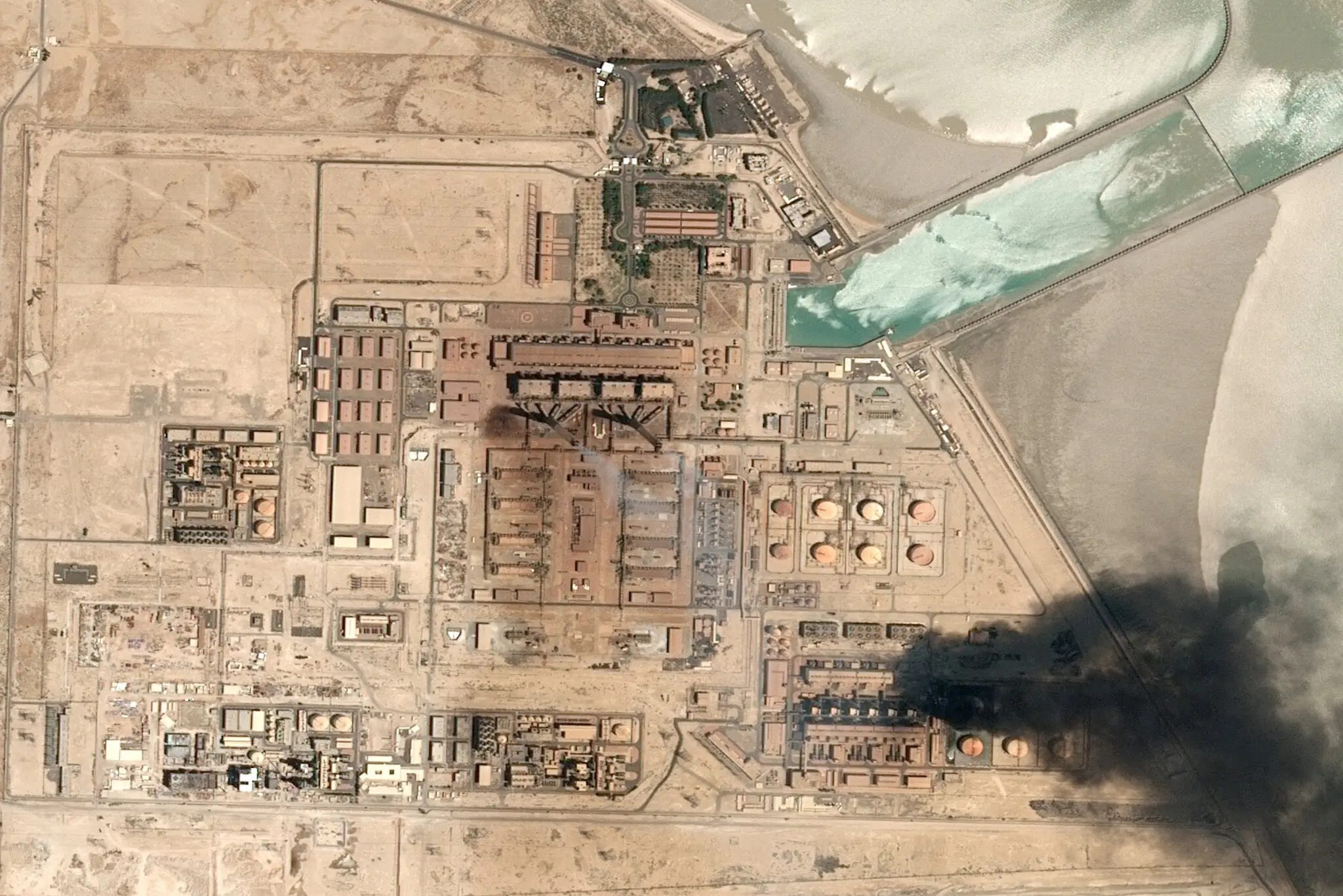
Photo credit: Airbus. Smoke rising from the Subiya Power and Water Desalination Plant that was attacked on July 18th by Iran.
Twelve states, including Michigan, Minnesota, Georgia, South Dakota, New Jersey, Alabama, and Arkansas, reported that some of their water utilities were hit by cyberattacks originating in Iran or at its behest. Alarmingly, there were more than thirty such attacks alone in Minnesota. The Iranian hackers – or attackers, since we are at war – targeted the control systems of water and wastewater facilities.

Photo credit: Ellen Schmidt / AP. Picture of a Plymouth, Minnesota water tower, which is part of a water system that experienced a cyberattack in July.
The software and hardware systems, known as Supervisory Control and Data Acquisition (SCADA), collect data on pumps, valves, tanks, chemical injectors, pressure gauges, and flow meters that are necessary to safely monitor and manage the systems. SCADA then communicates on a two-way basis with Programmable Logic Controllers (PLCs) or Remote Terminal Units (RTUs).
Iran targeted the PLCs and RTUs. They are essential in controlling water treatment plants, distribution networks, pump stations, storage tanks, and wastewater processing. Ditto managing the use of chemicals.
President Donald Trump often refers to the U.S. being protected by oceans; however, these attacks on U.S. domestic water supply facilities are a good reminder that in a connected global world, the enemy can be as close as U.S. targets that are tied to the internet.
***
CARIBBEAN
The U.S. is maintaining maximum pressure on Cuba. On Saturday, Secretary of State Marco Rubio told Axios that there is “no escape” for the Cuban regime from ongoing crippling U.S. sanctions. He stated that “Every time they create a new mechanism in which they try to get out of the noose, we just close it off. They certainly can’t wait us out. Certainly, this isn’t going to go away for the next 2½ years.”
According to Axios, the U.S. is “sanctioning 40 entities, from foreign companies operating on the island to Cuba’s state-run fuel, banking, and mining conglomerates.” In many ways, as Marc Caputo notes, “Cuba is now a de facto renegade colony of the U.S., upon which it now relies for most of its food, fuel, medicine, and currency.”
***
CENTRAL AMERICA
Pete Hegseth, the Secretary of Defense, traveled to Panama today to address the Americas Counter Cartel Coalition (A3C) forum that is meeting. The U.S.-led multinational group is aimed at coordinating security and military actions to deter transnational criminal organizations – especially drug cartels – operating in Central and South America.
Also known as the Shield of the America, A3C – a Trump Administration initiative – is also aimed at deterring China interfering with Latin America. Last year, Hegseth noted that “The Panama Canal is key terrain that must be secured by Panama, with America, and not China.”
18 nations, including Argentina, Belize, Brazil, Chile, Colombia, Costa Rica, the Dominican Republic, Ecuador, El Salvador, Guatemala, Honduras and Jamaica, are participating in this year’s A3C.
Equally notably, earlier this month, U.S. Southern Command (SOUTHCOM) at the direction of its commander, Gen. Francis L. Donovan, activated Joint Task Force Western Hemisphere (JTF-WHEM). According to SOUTHCOM, the purpose of JTF-WHEM is to “synchronize U.S. military operations with allies and partners to counter threats, strengthen regional security, and respond rapidly to crises across the Western Hemisphere.”
JTF-WHEM was designed to coordinate closely with A3C member-states, especially in areas of “intelligence, surveillance and reconnaissance, operational planning and multinational coordination to increase pressure on nefarious organizations operating throughout the Western Hemisphere.”
***
SOUTH AMERICA
Earlier this week, on August 7th, Abelardo de la Espriella, was sworn in as the new president of Colombia. De la Espriella, who refers to himself as “El Tigre” or “The Tiger,” has vowed to take on illegal drug cartels operating in the country.
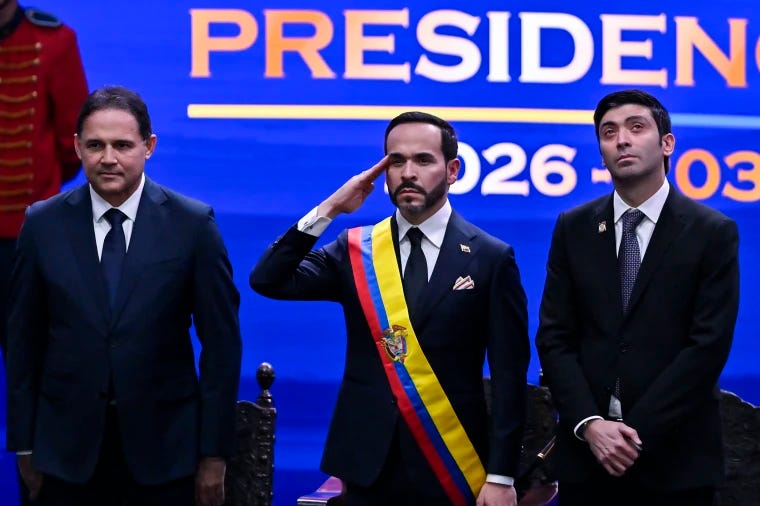
Photo credit: NBC News. Abelardo de la Espriella (center) during his swearing in ceremony in Cali on August 7th as the new president of Colombia.
He has also vowed to stop negotiating with the drug cartels, which represents a major departure from his predecessor, Gustavo Petro. After his inauguration, he visited an army base in Cali and told “armed groups operating in the area that they must surrender or face being declared “military targets.”
Earlier but equally significantly, acting in part against the cartels, but also against Chinese designs on Latin America, Gen. Donovan in April established SOUTHCOM’s Autonomous Warfare Command (SAWC).
At the time, the SOUTHCOM commander stated that, “From the seafloor to space and across the cyber domain, we fully intend to leverage the clear superiority of the American defensive ecosystem by deploying cutting-edge innovation and working ever closer with our enduring partners in the region to outmatch those who threaten our collective peace and security.”
The command, once fully functional, will deploy “autonomous, semi-autonomous, and unmanned platforms and systems to counter threats and challenges across domains, linking tactical missions to long-term strategic effects.”
The war on the drug cartels is about to evolve fast.
***
EUROPE
Earlier today, the North Atlantic Council met to address recent Russian airspace violations in Poland and Romania. The NATO member-states made it clear that Moscow is solely responsible for the illegal aerial incursions. The NATO allies also reaffirmed their support for Ukraine “in defending its freedom, sovereignty, and territorial integrity.”
The meeting came at a time of increased Russian hybrid warfare across the eastern front in Europe. The most recent incidents, including breaches of Romanian airspace, the armed drone found near the Ukrainian transport in Leipzig, Germany, as well as another Russian cruise missile landing in Poland, are twofold in design.
One is to test NATO’s resolve to continue funding and arming Ukraine. The second one is to test NATO’s military responses.
NATO’s response is quickening. Between July 24th and 26th, “Romania shot down three suspected Russian drones on three consecutive days.” Gone are the days where eastern NATO states simply allowed Russian missiles and drones to fall where they may.
CEPA has compiled a map charting Russia’s hybrid warfare against the West, including cyberattacks, sabotage, espionage, assassinations, and airspace incursions. Ukraine is the frontline; however, Russia is also fighting a deep fight against Europe.
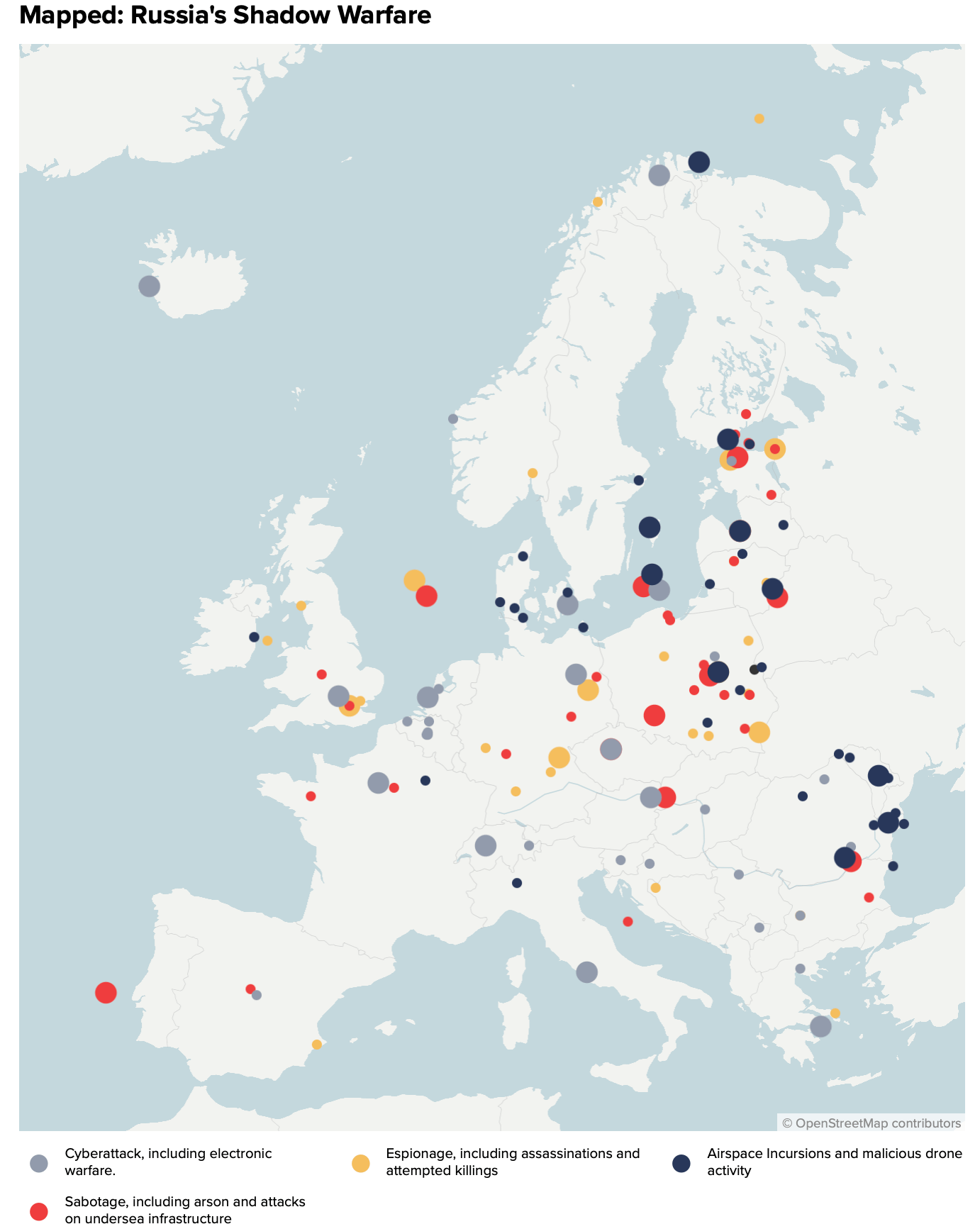
Map credit: Michael Newton, Isabella Nieminen, and Katelynn Henics / CEPA. Chart showing Russian hybrid warfare against Western Europe.
Notably, these accelerated Russian attacks come on the heels of a report in The Telegraph that western intelligence agencies are warning that Putin might attempt a more overt act against Europe in the next three years to test NATO’s resolve. Russia is down, but not yet out and Moscow as a result remains a long-term threat to NATO.
***
AFRICA
JNIM, which is al Qaeda affiliated, and the ISSP, which is tied to the Islamic State, continue to commit attacks across the Sahel in Africa. Burkina Faso, Mali, and Nigeria are the hotspots for militant action; however, Somalia, Lake Chad and Mozambique are also impacted.
For the fourth year in a row, the Africa Center for Strategic Studies has assessed that Islamic militants operating across Africa have accounted for more than 20,000 deaths. They also have produced a chart detailing the attacks broken out by terrorist group.
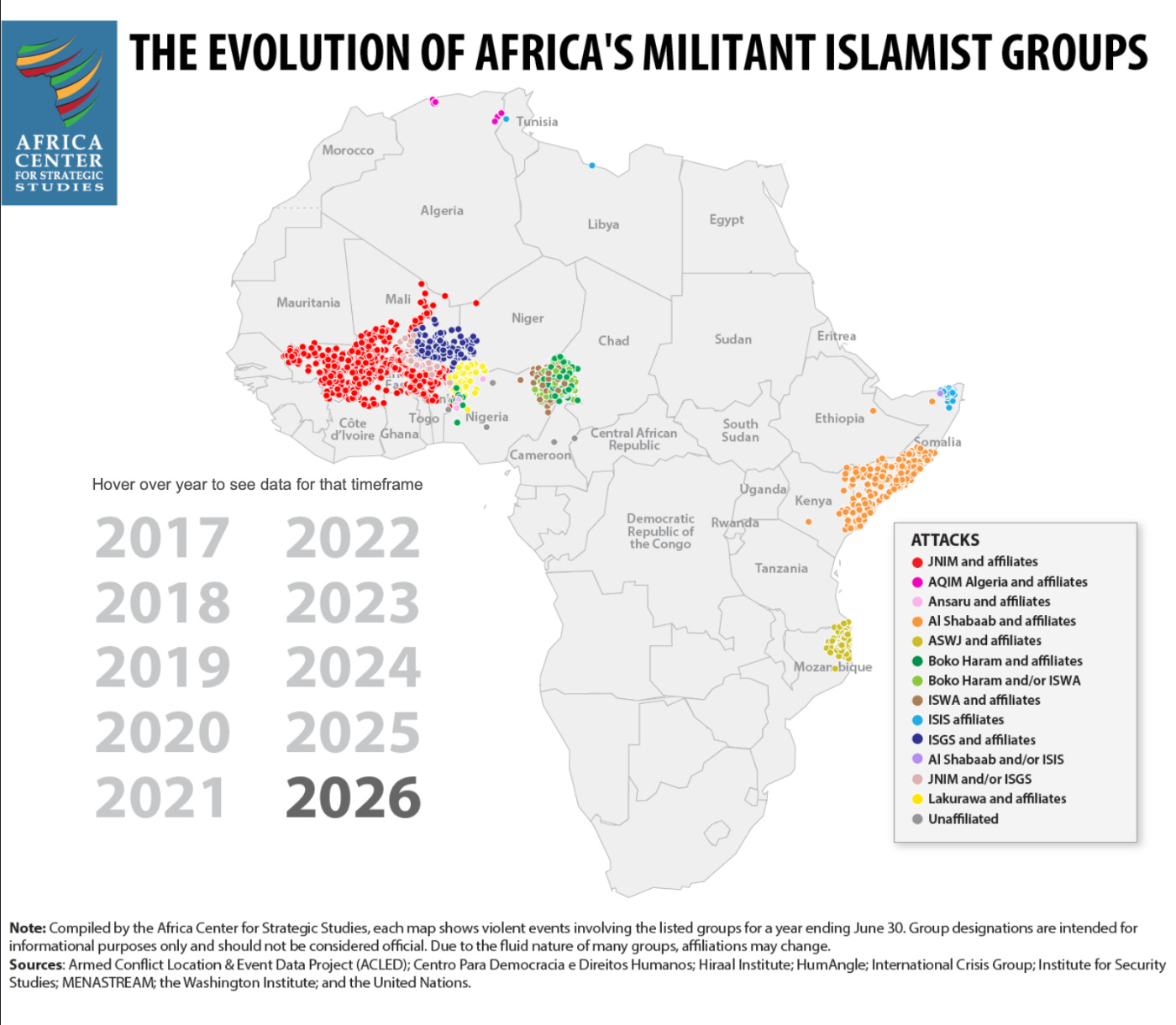
The map is interactive and you can find it here.
Consequently, U.S. Africa Command (AFRICOM) is also under increasing pressure by Islamic militants. However, it is challenging as AFRICOM is forced to compete for U.S. military assets and soldiers needed elsewhere in the Middle East, Europe, and Indo-Pacific.
***
MIDDLE EAST
Earlier this morning, Trump claimed in a Truth Social post that the U.S. “has total control over the Strait of Hormuz.” He also asserted that the ongoing blockade of Iran is akin to a “WALL OF STEEL.” He further asserted that Iran is suffering from “300% INFLATION.”
Maybe so, but the reality is that by the Trump Administration’s own admission, only 8 to 9 million barrels of oil are passing through the Strait of Hormuz a day. Compare that to a prewar level of 20 million barrels a day on average.
We will have more to say on Trump’s failed strategy tomorrow at 7 AM ET in The Hill. It really is running on empty.
***
INDO-PACIFIC
Elbridge Colby once again enters the chat. Colby, the Undersecretary of Defense for Policy, which in effect makes him the number three person at the Pentagon, is on a tour across the Pacific shoring up allied support.
Notably, he denied reports of U.S. munitions shortages. That in itself is interesting given that many in Washington, D.C. believe he – or underlings acting on his behalf – are the ones leaking it to deter Trump from further military action in Iran.
While in Manila he said, “There’s been a lot of news about the United States military being stretched. Please don’t be misinformed.”
Colby also argued for a U.S. change in tone with Beijing. He claimed the U.S. is no longer going to berate the communist country, but rather employ a “policy of respect toward the People’s Republic [of China].”
Channeling Teddy Roosevelt and his ‘Speak quietly while carrying a big stick’ approach to diplomacy, Colby said the new U.S. approach is a “strategy of strong, clear, but quiet” measures for the sake of regional stability.
Maybe so; however, Chinese President Xi Jinping did not get the message. China announced yet another People’s Liberation Army drill to take place in Taiwan’s eastern waters. Beijing is intent on speaking loudly and carrying a big stick.
***
PROGRAMMING NOTE
Tomorrow, in our weekly 7 AM ET Thursday national security column at The Hill, we examine how the Trump Administration’s approach to Iran – especially the Islamic Revolutionary Guard Corps - is running on empty.
The White House must change direction. This haphazard approach, as led by Steve Witkoff and Jared Kushner, is not working.
You can read it here when it goes live.
***
ICYMI #1
Earlier today, I appeared on Al Qahera News in Cairo, Egypt. In all candor, it was akin to being caught up in an episode of the classic TV series The Twilight Zone.
The topic was supposed to about advancing peace in Lebanon and Gaza. However, the panel save me began pummeling Israel.
Perhaps most alarming was that the others on the panel – despite the host’s best efforts to question their views – kept arguing that Hezbollah and Hamas were “domestic problems” and of no concern of Israel’s.
I pushed back hard arguing that both IRGC-backed groups have attacked a country outside of its borders and at the behest of Iran.
They did not want to hear it. I spent most of the episode shaking my head in disgust. Why? Their stances, if yielded to, will only lead to forever war.
You can watch a clip here or you can watch the entire news program here. Both YouTube videos are in Arabic.
***
ICYMI #2
Yesterday, I had the honor of appearing on Al Qahera News with Patrick Theros, the former U.S. ambassador to Qatar under President Bill Clinton. We both agreed that the U.S. and Iran are fighting two fundamentally different wars against each other and, as a result, that makes reaching a peace deal virtually impossible.
Especially given that both sides define victory differently.
You can watch a clip here or you can watch the entire news program here. Both YouTube videos are in Arabic.
***
Thank you for reading. We will both see you tomorrow as Jon and his wife are winging their way back today from an extended stay in Hawaii.
Please subscribe, comment & share. We truly appreciate it!
Mark
Postscript: Zeppelin is back to normal. Thank you to everyone who expressed concern for him. He has been right next to me sitting in his usual spot while I penned today’s INTREP360 Intelligence Report.
Follow Jon on X at @JESweet2022 or on Bluesky at @JonSweet.bsky.social. Follow Mark on X at @MCTothSTL or on Bluesky at @MarkToth.bsky.social.
No posts
Comments
Nothing yet. Say the first thing.
Sign in to join the conversation.