
Welcome to the Midweek edition of The Long and the Short — a show where you can expect an honest take on trading, something you won’t hear elsewhere.
What if buying a stock and buying a player at the IPL auction worked in surprisingly similar ways?
Think about how the IPL auction works. Every player walks in with a base price, a floor or minimum price set in advance that nobody can bid below. Then the franchises go at it. The one willing to pay the most gets the player. If two teams want the same guy, they bid each other up until one gives up. And the moment the hammer falls, and it’s “sold”, that’s it. The deal is done.
Each of those ideas- the minimum price, the highest bidder winning, competition pushing the price up, and the deal becoming final the instant it’s struck- also has a parallel in how the stock market works.
When you buy a share, you’re essentially standing at an auction. You just don’t see the others in the room.
There is one fundamental difference, though. Unlike the IPL, where only buyers compete for players, in the stock market both buyers and sellers compete for a given share. And that interaction is continuous. In a way, millions of little auctions happen every second the market is open.
So how does this auction work specifically in the stock market? What happens when you place a limit buy or sell order, or a market order? How does it move the price of a stock? And then there is this term “order flow” that gets thrown around all the time. What does it actually mean? Some even claim to trade off it.
More importantly, as a trader or an investor, why should you even know any of this?
Let’s start with the absolute basics and understand what an auction actually means.
Say you’re a seller. You have one share of a company called X. You bought it at ₹90, and today you want to sell it at ₹100. If you want to sell at ₹100, there has to be a buyer willing to pay ₹100. For any trade to happen, you need a buyer and a seller. That’s exactly why this is called a two-sided auction.
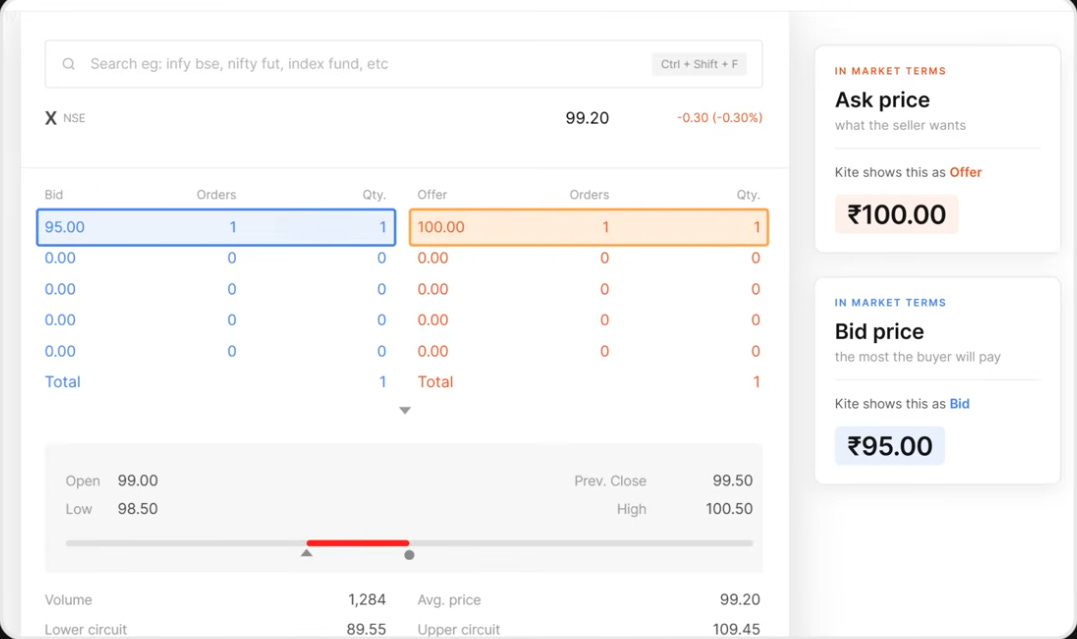
Now let’s extend that. Say you want to sell at ₹100, but the buyer isn’t willing to pay more than ₹95. In market terms, the ask price, what the seller wants, is ₹100. You will see this as the Offer price on Kite. The bid price, the maximum price at which the buyer wants to buy, is ₹95. This shows up as Bid on Kite.
For this trade to go through, one of two things has to give. Either you, the seller, drop your expected price a bit, or the buyer has to raise theirs. Until both sides agree on a number, that trade cannot go through.
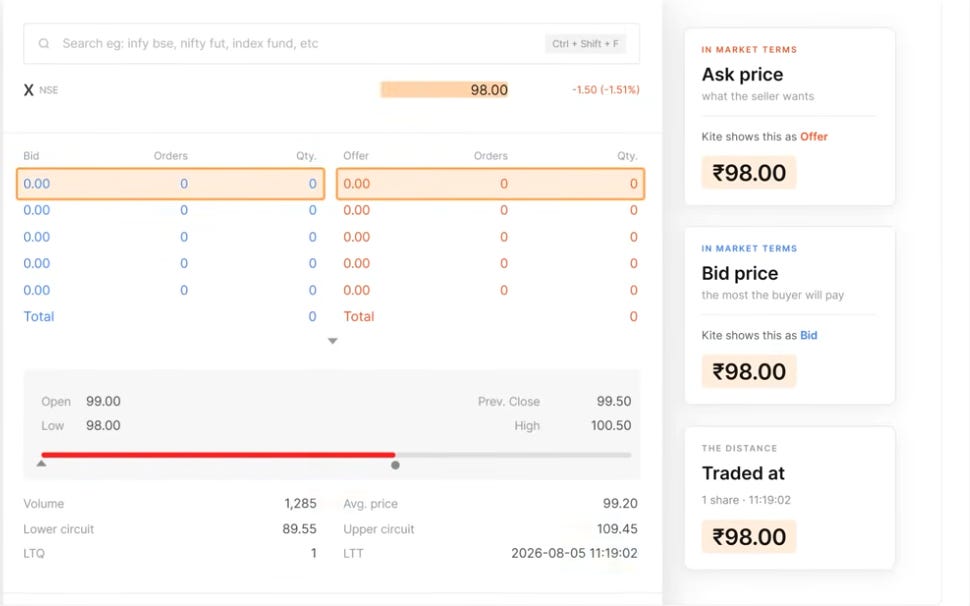
Let’s say you agree to sell at ₹98 and the buyer also ups the price to ₹98. This number, ₹98 in our case, is the price at which the trade gets executed.
This brings us to the idea of the bid-ask spread. Remember, the seller wanted ₹100, so the ask or offer price is ₹100. The buyer was only willing to pay ₹95, so the bid price is ₹95. That gap, ₹100 minus ₹95, is the bid-ask spread. Here, it’s ₹5.
So we now know three things: what a bid is, what an ask is, and what the bid-ask spread is.
Now let’s assume we have multiple buyers and sellers at different prices. To keep it simple, consider two sellers and one buyer.
One seller is offering one share at ₹100, while another is offering two shares at ₹105. On the other side, there’s a single buyer bidding ₹95 and wanting two shares. So we’ve got one bid and two offers sitting there.
Each of these is a limit order because everyone has named their limit. The buyer is saying, “I’ll buy only at ₹95, not a rupee more.” The sellers are saying, “We’ll sell at ₹100 or ₹105, and not a rupee less.”
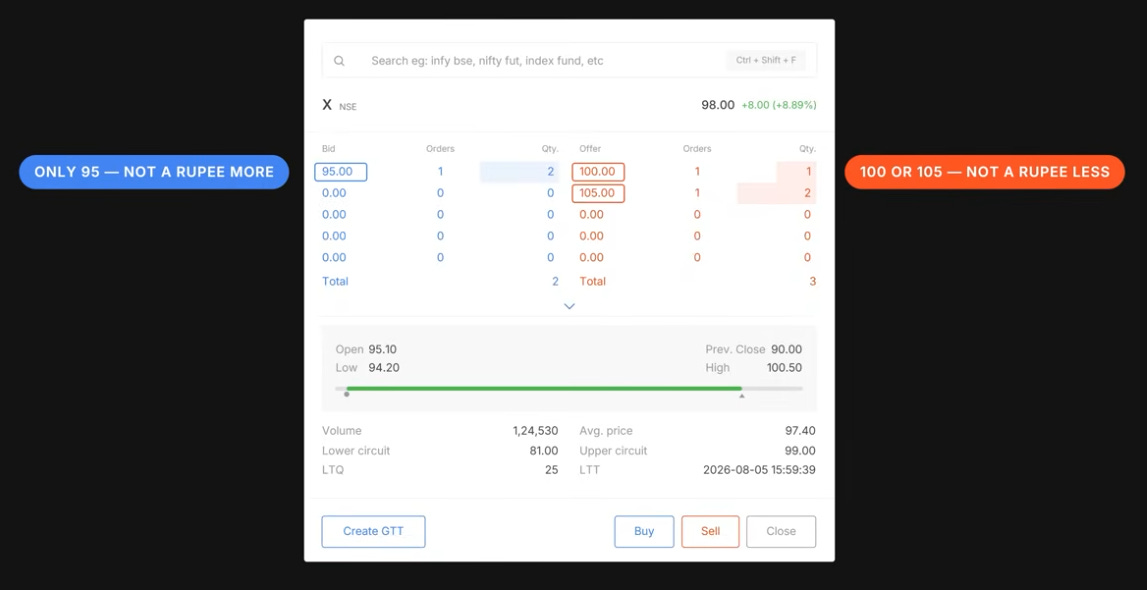
These are also called resting orders, or sitting orders, because they sit in the limit order book until a match happens. Think of the limit order book as a dynamic ledger at the exchange where bids and offers keep arriving and get stacked based on their price.
The best bid is ₹95, and the best offer is ₹100, so the bid-ask spread is ₹5. Nothing has matched yet because until a buyer and a seller land on the same price, no trade goes through.
Now imagine the seller who was offering at ₹105 gets a little impatient and lowers their offer to ₹98. They’ve dropped their expectations. It’s still a limit order. We now have two limit orders on the offer side, ₹98 and ₹100, while the buyer is still bidding ₹95.
Let’s say the seller drops further to ₹97, with two shares sitting there at ₹97. The buyer, who wanted in, raises their bid to ₹97 and takes it. Two shares change hands at ₹97. The seller posted ₹97 and waited, and the buyer reached across and accepted it.
That’s how limit orders work.
There’s another possibility. What if the buyer badly wanted those shares and didn’t care about the exact price, but simply wanted in?
Remember, the two offers were sitting at ₹100 for one share and ₹105 for two shares, while the buyer wanted two shares. The buyer could skip the waiting entirely and place a market order.
With a market order, the buyer is essentially saying, “I’ll take it at whatever’s the available price, just get me in.”
The market first looks for the lowest offer. That’s one share at ₹100, so the buyer gets that. But the buyer wanted two shares, so the market goes to the next-best offer at ₹105. The buyer gets the second share there.
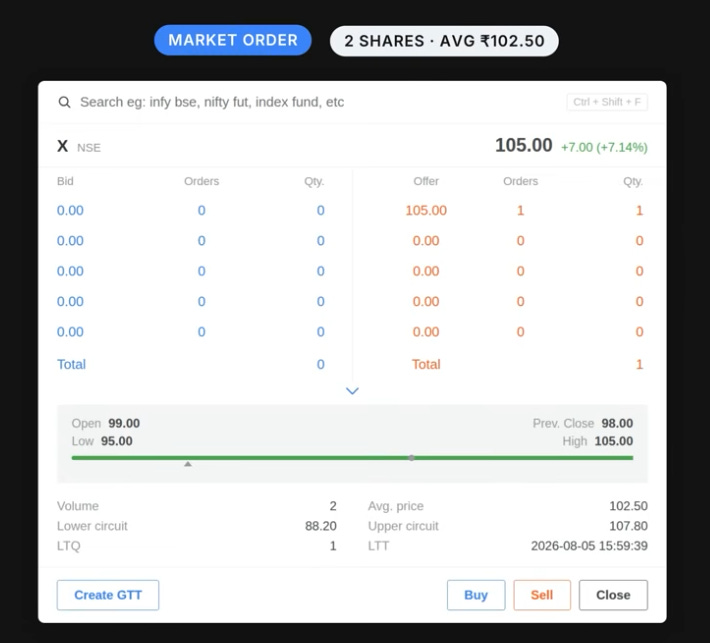
The buyer walks away with two shares, one at ₹100 and one at ₹105, at an average of ₹102.50. That’s a market order. It’s a bit like handing over a blank cheque: get it done, at whatever price it takes.
We now know what a bid is, what an ask or offer is, what the bid-ask spread is, and how market and limit orders work inside the limit order book.
One thing worth noticing is that when you look at market depth on your screen, you don’t actually see market orders. What you see are resting limit orders, the ones sitting and waiting. Market orders barely appear at all.
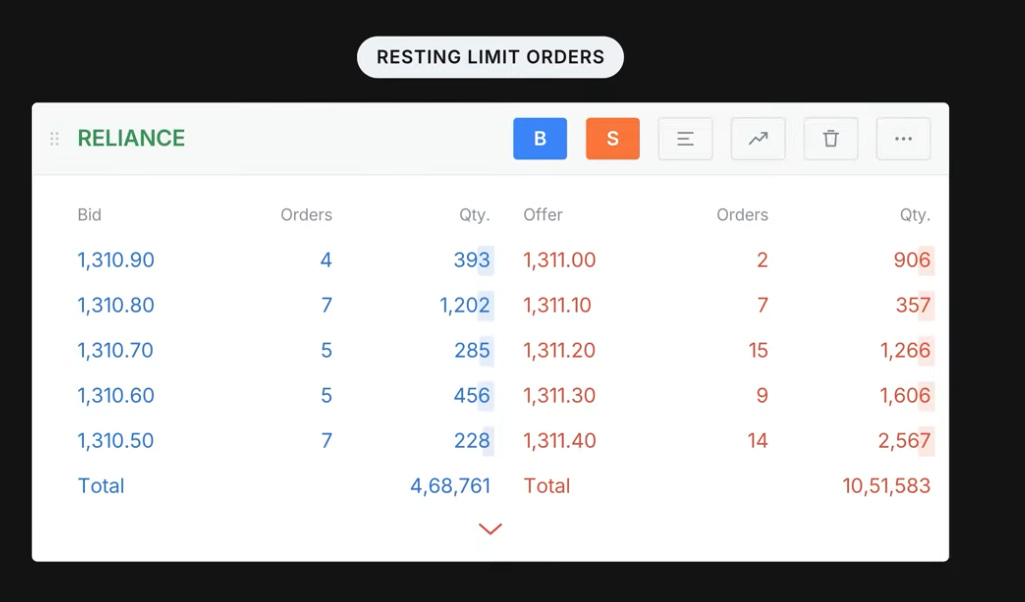
They happen in a flash. They come in, take the liquidity that’s resting there, and they’re gone. There’s nothing left to display because a market order doesn’t sit. It consumes.
That’s exactly why a market order is said to take liquidity, while a limit order is said to provide liquidity.
If you’ve traded stocks, you’ll have seen some of them hit what’s called a circuit. It could be an upper circuit, when there’s a flood of buying pressure, or a lower circuit, when there’s a flood of selling pressure.
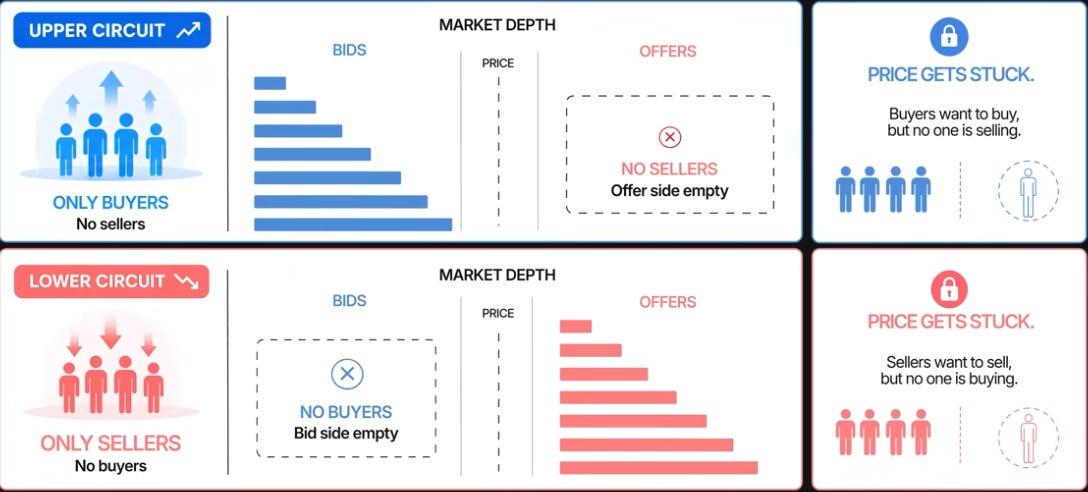
What actually happens in a circuit is that one side of the book goes completely lopsided. Take an upper circuit. There are no sellers left, only buyers. If you pull up the market depth, you’ll see bid after bid stacked up, with plenty of people wanting to buy, but the offer side is empty. Nobody’s willing to sell.
A lower circuit is the mirror image: offers stacked up, everyone trying to sell, and no bids. No one is willing to buy.
That’s why the price gets stuck. With buyers but no sellers, or sellers but no buyers, there’s simply no one on the other side to trade with. A trade needs both. One side alone can’t make it happen.
But there’s a second reason it gets stuck, and this is where the exchange steps in. The exchange sets limits on how far the price can move in a single day. Once the price hits that level, it can’t go any further. It sits there, frozen.
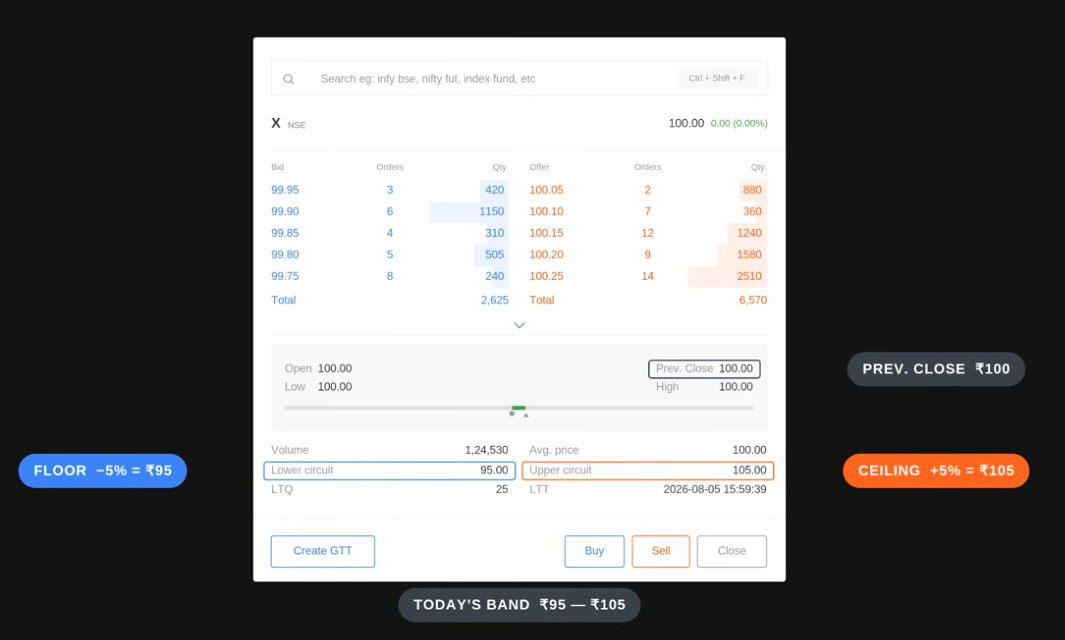
Say a stock has a 5% circuit limit, and yesterday it closed at ₹100. That 5% sets the band for today: the price can only go as high as ₹105 and fall as low as ₹95.
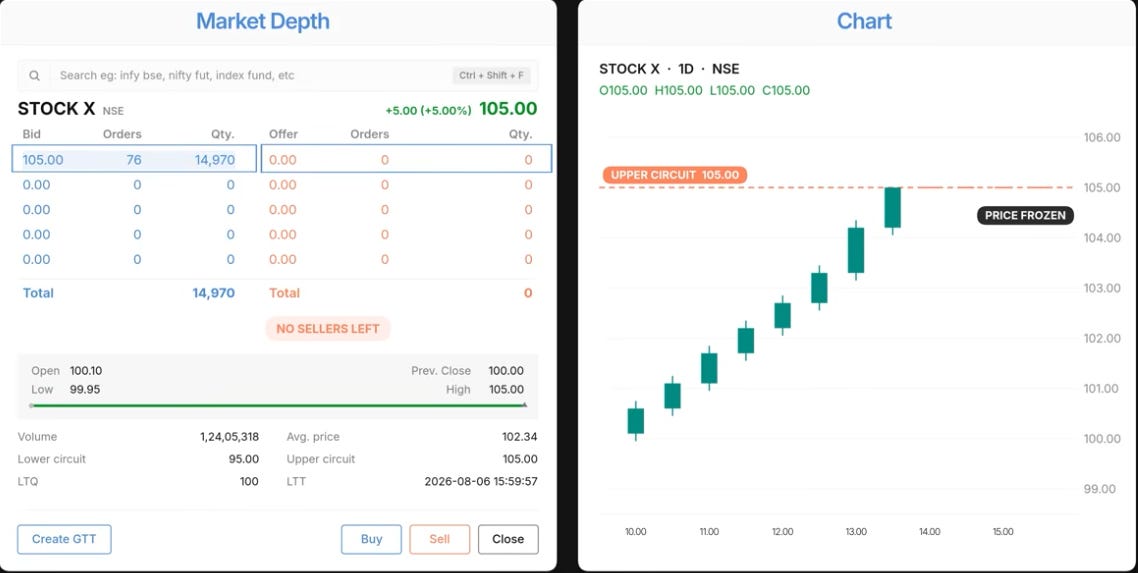
Now imagine great news breaks about the company. Everyone wants in. Buyers keep bidding the price up, ₹101, ₹102, ₹103, until it reaches ₹105, the ceiling. At ₹105, the buyers are still coming, but no seller is willing to let go because everyone’s convinced it’s headed higher.
You’ve now got a wall of bids at ₹105 and not a single offer. There’s nobody to sell to the buyers. The stock is locked in its upper circuit. You want to buy, but you simply can’t because no trade can happen without a seller.
This can continue for days together, with the price jumping each day but remaining locked in a circuit. No trades happen, but the price keeps moving.
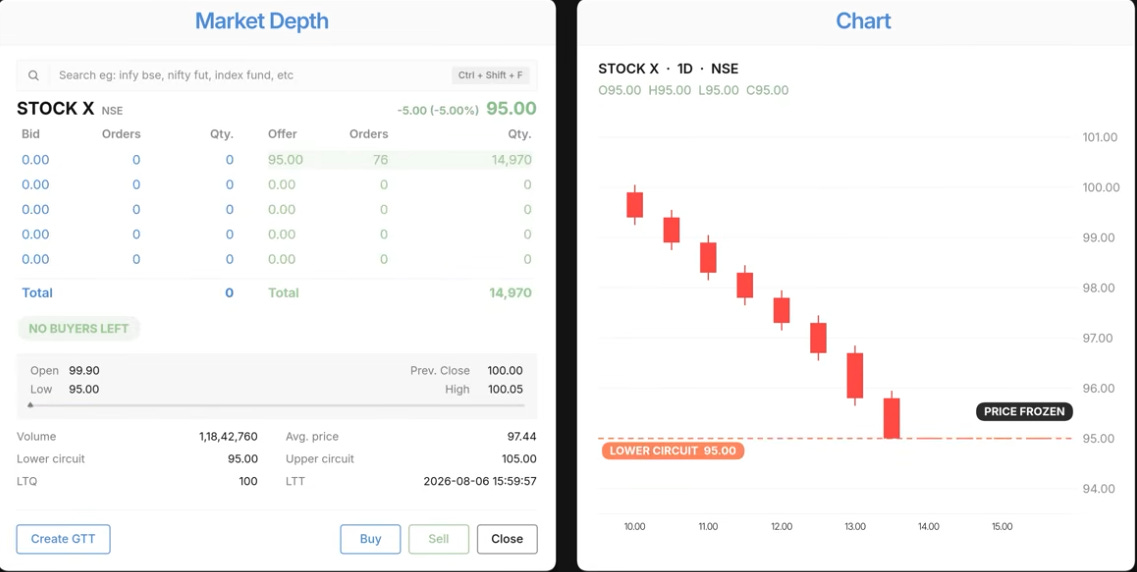
The lower circuit works exactly the same way in reverse. The price falls to ₹95, the floor, and there it stops for the day. This too can continue for days, with the price going lower each day without any buyers.
A circuit, in a way, is just the most extreme version of everything we’ve been talking about. A trade needs two sides, a buyer and a seller, meeting at a price point. A circuit is what happens when one of those sides simply vanishes while the auction is still running. It has become one-sided for the time being.
Do note that circuits work a bit differently for F&O segment stocks, but we’ll keep that for later.
We’ve mentioned the limit order book several times: the ledger where all the resting orders sit and wait. If you’ve ever opened market depth on Kite, you’ve already seen it.
When you tap on a stock and pull up market depth, that panel is the order book.
The first thing you’ll notice is that it’s split down the middle. On the left is the Bid side, every buyer and the price they’re willing to pay. On the right is the Offer side, every seller and the price they want. It’s the two-sided auction we’ve been describing, laid out on a screen.
Each side is sorted by price. On the bid side, the highest bid sits right at the top. Say our company X has a best bid of ₹98. On the offer side, the lowest offer sits at the top, say ₹98.05.
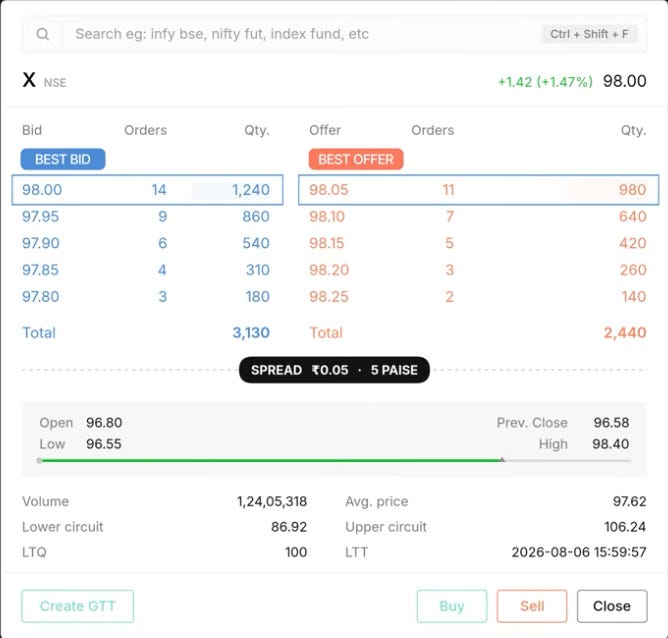
The best buyer and the best seller end up staring at each other across the middle, and the little gap between them, five paise here, is the spread. In a liquid stock, the spread is typically tiny, just a few paise, rather than the big ₹5 gaps we used earlier to keep the maths simple.
That smallest possible move, the five paise, isn’t random either. The exchange defines the minimum amount a price can move, and that’s called the tick size. A stock can’t move by less than one tick.
For a deeper explanation of tick size:
Look at the columns in market depth. Next to each price, you’ve got two numbers: Orders and Quantity.
Quantity is the easy one. It’s the total number of shares people want to trade at that price. At ₹98, for example, maybe there are 100 shares being bid for.
The Orders column is more interesting. Those 100 shares aren’t always one person. It might be twelve different people, twelve separate orders, all bidding ₹98, that happen to add up to 100 shares. That number, twelve, is telling you how many orders are standing in the queue at that exact price.
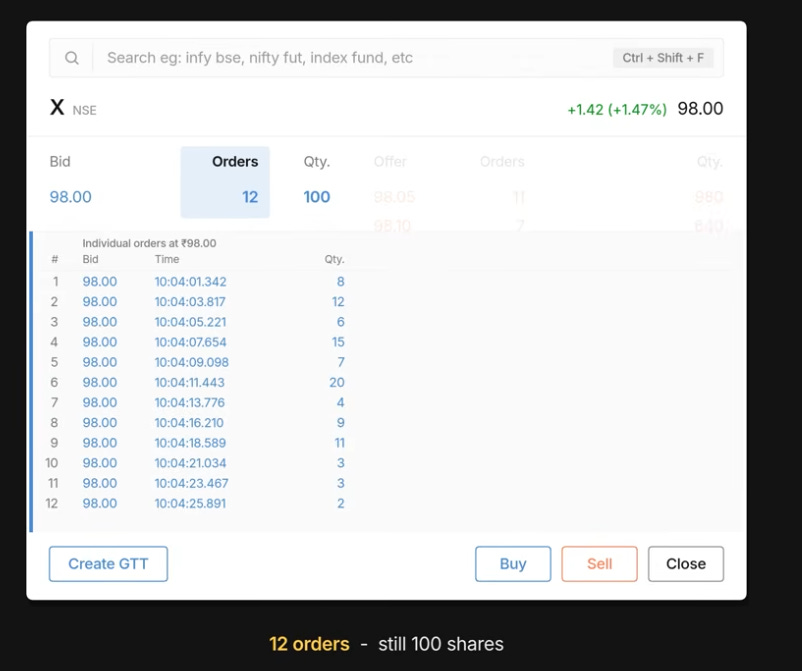
The rule that runs the order book is called price-time priority, two fundamental ideas, in that order.
Price comes first. The best price goes to the front. Bid ₹98 while everyone else is at ₹97.95, and you get served first. But when twelve people are all bidding the same ₹98, time comes in. It’s first come, first served. Whoever placed their order earliest sits at the front of the queue; whoever showed up last is at the back.
You actually can’t see on your screen who joined the queue and when. There’s a reason for that, which we’ll get to in Part 2.
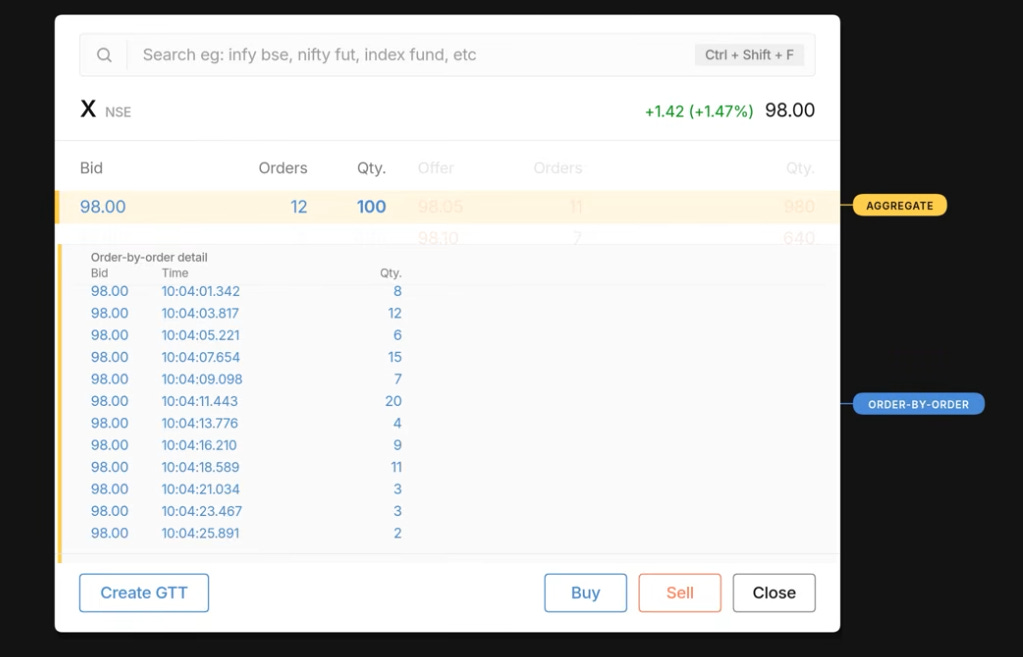
For now, just hold onto this: what you’re seeing in market depth is aggregate information, twelve orders and 100 shares, not the order-by-order detail underneath it.
So far, we’ve covered the basic concepts related to orders and the limit order book. But there is one key aspect we still need to understand, and that’s the idea of an “Aggressor.” Because without that, nothing moves. Literally nothing.
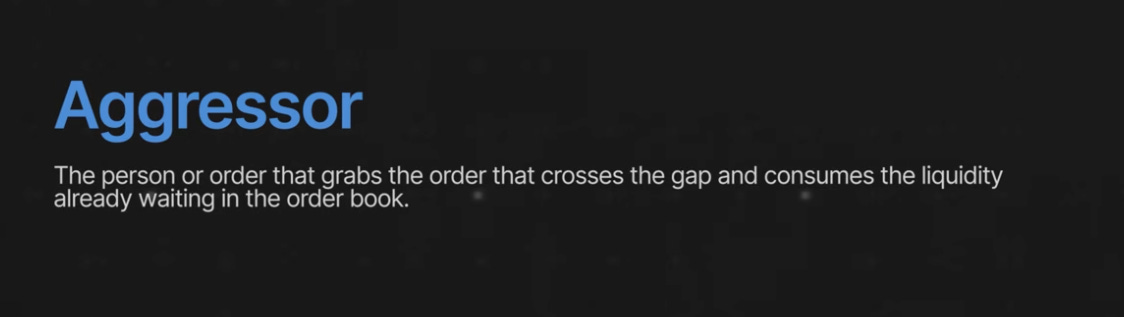
Imagine the limit order book full of orders, all waiting. Buyers are stacked up on one side and sellers on the other. But waiting doesn’t make a trade. For anything to actually happen, somebody has to stop waiting and move.
Somebody has to look at the best offer sitting there at ₹98.05 and say, “Fine, I’ll take it.” Someone has to cross the gap and grab what’s resting there.
That person or order is called the aggressor. They’re reaching across the spread and taking the resting orders.
Remember, a limit order provides liquidity because it sits there, offering. A market order takes that liquidity. The aggressor is the taker.
When you place a market order, essentially saying, “Get me in now, at whatever price is available”, you are the aggressor. You cross the spread, hit the best resting order, and a trade happens instantly. You made it happen.
You can activate that aggression through limit orders as well by updating a limit order to close the spread. It’s called a marketable limit order.
So the aggressor is simply whoever crosses the spread and takes a resting order. Market order or marketable limit order, it doesn’t matter. What makes you the aggressor isn’t the type of order. It’s the fact that you chose not to wait.
And that choice, to stop waiting and take the resting orders, is the single most important thing that drives every price move in any market.
Everything we’ve been describing so far, the bids arriving, the offers arriving, the market orders coming in and taking the resting orders, and that constant stream of orders hitting the market moment after moment- is what people mean when they say order flow.
It’s just that: the flow of orders and everything that goes into the process.
So the next time someone uses the term order flow, you know what they mean.
We’ve now understood all the building blocks that go into what everyone calls order flow. But let’s end where we started, with the idea of an auction.
Because underneath every single thing we’ve discussed, that’s all this ever was. This whole process, buyers and sellers coming together, is at its heart exactly that: an auction.
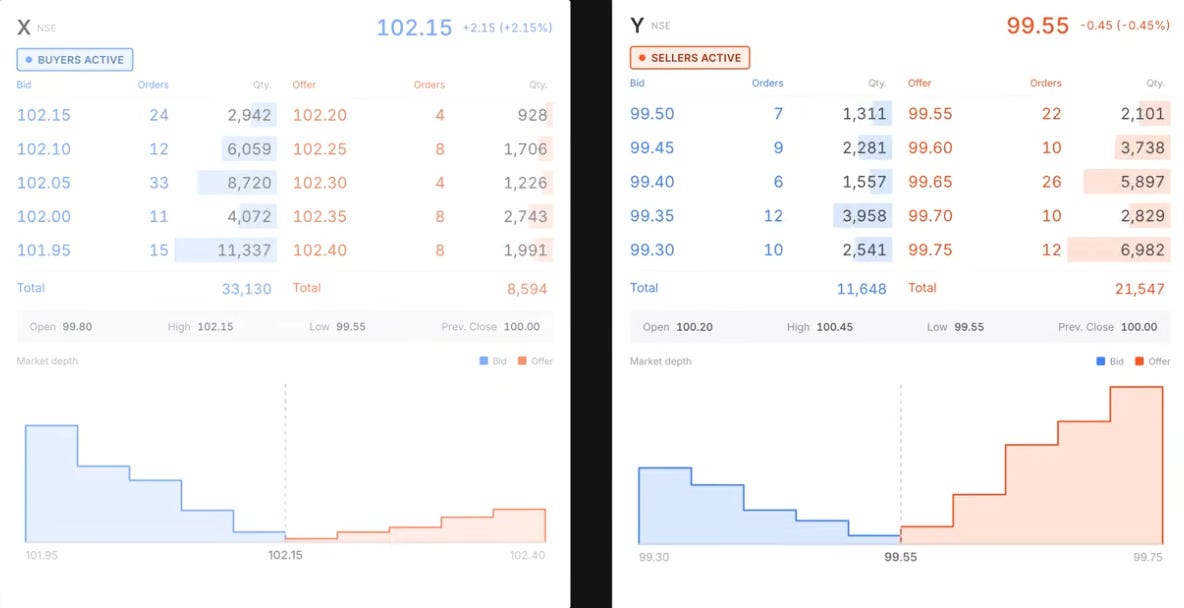
The dynamics shift from moment to moment. Sometimes there’s buying pressure, sometimes selling pressure, and sometimes it turns extreme, with a wall of buyers and no sellers, resulting in a circuit.
But whatever the conditions, underneath it all, it’s still the same thing. It’s still an auction. A two-sided, continuous auction, more dynamic than the IPL auction and far more complex in how it works.
And that’s really what an exchange is for. The exchange, and all the rules that govern it, exist to do one job: to make that auction as fair and as orderly as it can possibly be.
So that’s the foundation: order flow, and the auction underneath it.
In Part 2, we’ll take this further. Because knowing all this is one thing. Seeing it is another.
Remember, the exchange or your broker, any broker for that matter, doesn’t show you everything. What we as retail traders or investors get to see on our screens, market depth and the “order flow” charts people sell you, is only a slice of the real picture.
In the next part, we’ll look at exactly how much of it we’re actually seeing, and how much is hidden from us.
If you have any questions, feel free to ask them in the comments — we’ll be happy to answer.
Till then — take care and trade safe.
No posts
Comments
Nothing yet. Say the first thing.
Sign in to join the conversation.