
Apply to the Co-Build Fellowship
There is a category of machines that did not exist in commercial form three years ago. It does not predict the next word. It predicts the next moment of a physical system — how a fluid will flow through a pipe, how a material will crystallise under a given pressure, how a gravitational field will vary across a landmass, how a battery will age in heat, and how a stress wave will propagate through a weld. It learns the grammar of force.
I have been watching the edge of this shift for some time, across a career that has moved between venture, product, and heavy industry. What has kept pulling me back is a single observation. The intelligence layer that governs physical assets — refineries, grids, data centers, utilities, ports, buildings, and fabs — has been built almost entirely on the wrong substrate. Text. Documents. Structured records. Spreadsheets. The machines were reading the symbolic description of the asset. They were not reading the asset.
That is the constraint that is now breaking.
The point of this essay is not a career retrospective. It is a map. Five fields where the physics is now learnable. Named breakthroughs, exact numbers, open gaps. And, at the end, a call to the engineers, physicists, operators, and software builders who sit at the seam between physical reality and a new generation of models. The companies that own this category will not be built by a single discipline. They will be built by small teams that can speak all three.
If you are one of those people, this is a letter written to you.
Every decade or so the bottom layer of what machines can do shifts, and a whole category of work bends around it. The current shift has a name most people have not learned yet.
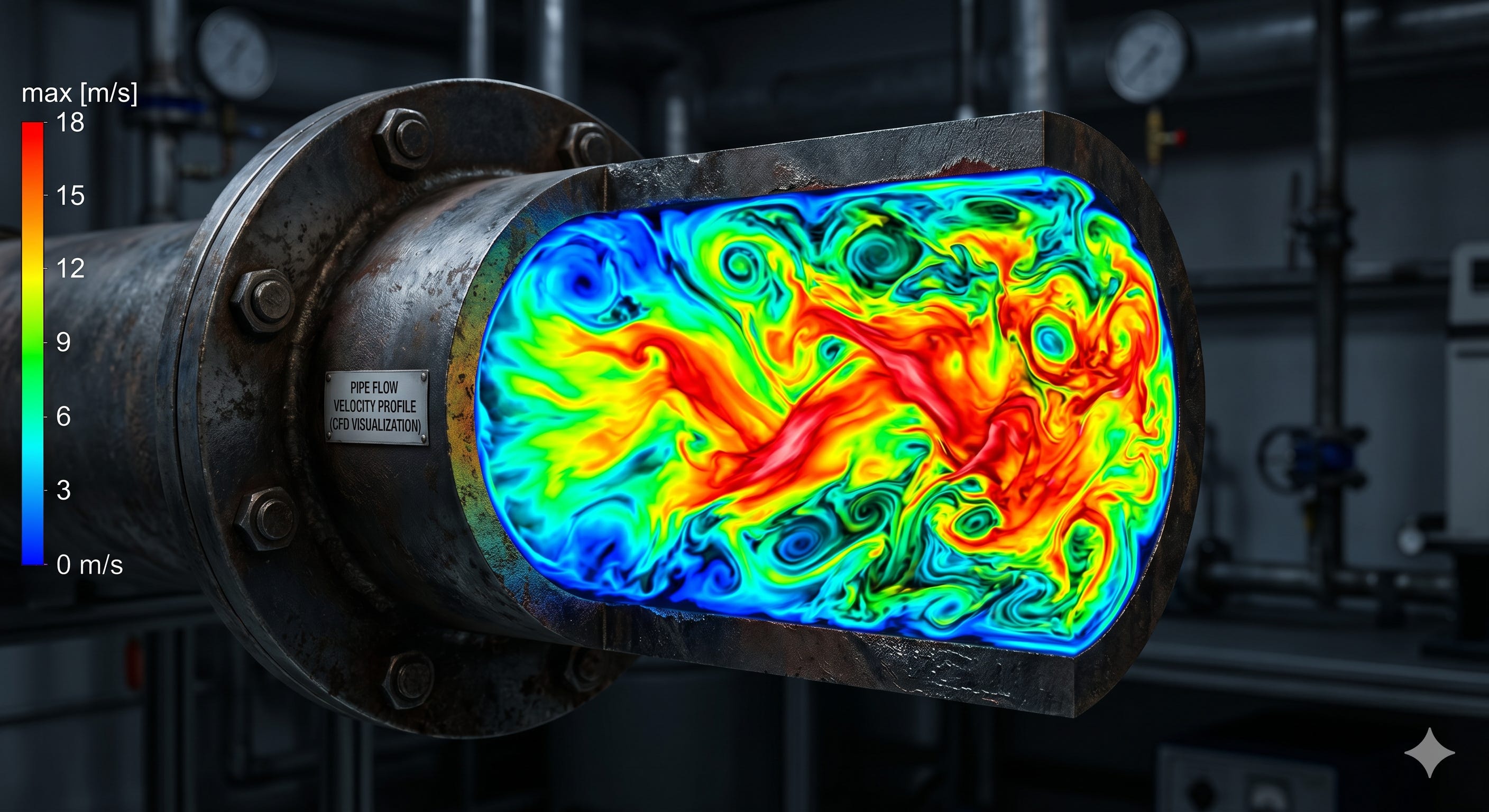
Language models learned the grammar of text. The next generation is learning the grammar of force.
A large language model, stripped to its mechanics, is a function that predicts the next token given the previous ones. It works because natural language has statistical structure — words depend on words, phrases on phrases — and scale across a big enough corpus yields a machine that can generate plausible continuations. It was a narrow insight that turned into a civilisational one the moment the substrate got big enough.
The physical world has its own statistical structure. A fluid flowing through a pipe obeys Navier-Stokes. A field propagating through space obeys Maxwell. A material deforming under load obeys constitutive equations calibrated by a century of mechanical testing. A battery ageing in heat obeys electrochemistry governed by Arrhenius kinetics and diffusion equations. None of that structure is in the written corpus in any recoverable form. It is in simulations, sensor streams, experiments, telemetry. The corpus that describes the physical world is not a library. It is a million years of compute time burned against the partial differential equations that govern how the universe actually behaves.
A physics language model — I'll use the term loosely to cover physics-informed neural networks, neural operators, and the foundation models that have started appearing across weather, materials, and fluid dynamics — is a machine trained on that corpus. It learns the grammar of force. And because force is universal in a way language is not, the implications ripple into every industry whose economics turn on what happens when materials meet the world.
This is the break. Not better chatbots. Not smarter search. Machines that know what the pipe is actually doing.
What follows is how far that break has already travelled.
The sensor stack of the twentieth century was, overwhelmingly, optical. Cameras, satellites, LiDAR, spectrometers, fibre. It worked because light is easy to manipulate, cheap to deploy, and reaches a lot of places. It also has a fundamental limit. Light does not pass through rock, water, concrete, or steel at useful resolution. Most of what matters in an industrial asset is behind something opaque.
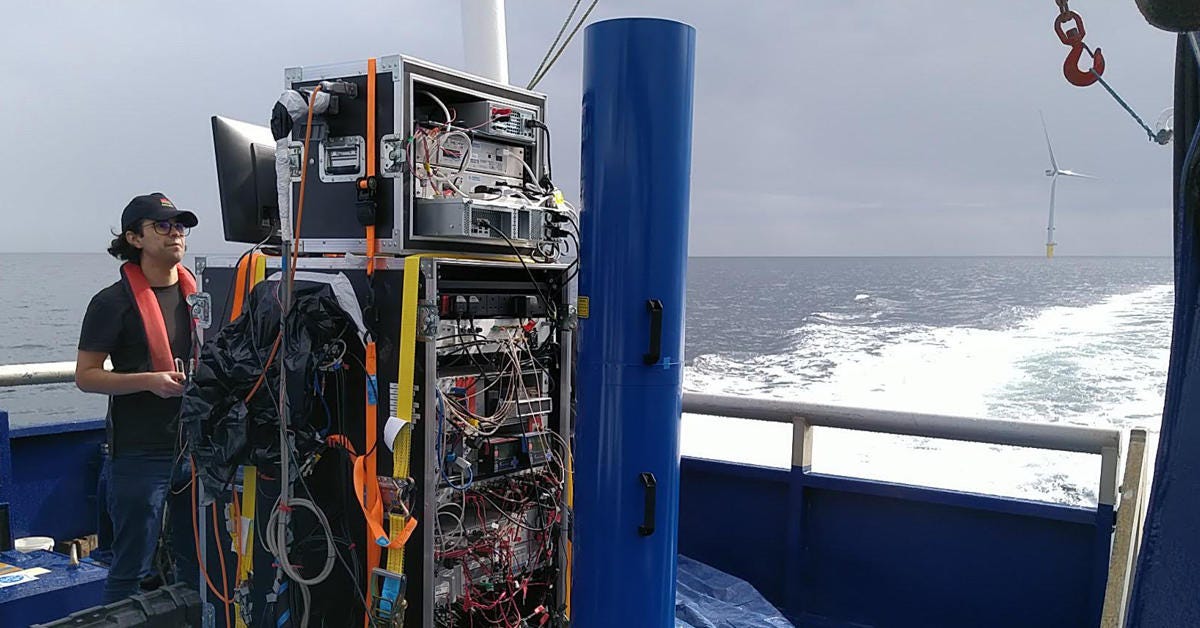
The physics that travels through opacity is gravity and the cosmic muon flux, and both are finally becoming tractable as sensing substrates.
In February 2022 a team at the University of Birmingham's UK National Quantum Technology Hub, led by Kai Bongs and Michael Holynski, published in Nature the first demonstration of a quantum gravity gradiometer operating outside laboratory conditions [1]. They detected a two-metre tunnel half a metre below the surface from ground level, with a signal-to-noise ratio of eight and a sensitivity of around twenty eötvös. They suppressed micro-seismic noise, laser phase noise, thermal drift, and magnetic field variation — all of which had kept the technology in the lab for thirty years. Their result cut gravity survey time from a month to a few days, a tenfold speed-up against a category of work that has barely moved since the 1960s.
NASA JPL is now building the first quantum gravity gradiometer designed to operate from space, backed by the Earth Science Technology Office [2]. If it flies, the same physics that let Birmingham find a tunnel will let us measure groundwater, mineral deposits, hydrocarbon reservoirs, and carbon storage sites at continental scale without drilling anything.
The second opacity-piercing technology is muon tomography. Cosmic rays generate a continuous flux of high-energy muons that travel through kilometres of rock. Differential absorption tells you about density. The Khufu pyramid void was famously mapped this way in 2023 [3]. The commercial application is mining, not archaeology. Ideon Technologies activated the world's first in-mine muon tomography system at Evolution Mining's Northparkes site in Australia in December 2024, and deployed at Rio Tinto's Bingham Canyon — the largest surface mine in the United States — in September 2024, for live four-dimensional monitoring of ore bodies [4]. The value unlock at Rio Tinto scale is material. The technology is not a lab curiosity. It is a platform for the category of physical intelligence I'll call geodetic sensing — the ability to see forces and densities, not surfaces.
Combine quantum gravimetry with muon tomography with physics-informed inversion, and the entire subsurface — groundwater, ore bodies, pipes, tunnels, faults, CO₂ plumes in storage formations — becomes legible at a resolution and speed that the industries built around ignorance of those things have not started to price.
When the blindness lifts, the pricing of every project they underwrite moves.
That last point is the one that will move capital. The mining industry, the oil and gas industry, the water utility, the civil engineering firm, the carbon storage developer — all of them operate against a subsurface they cannot see. Their risk models are built on that blindness. When the blindness lifts, the pricing of every project they underwrite moves. Companies that own the translation layer between the new sensors and the existing capital stack will be the MSCI of a sensing category that did not exist in commercial form before 2024.
We are exploring the insurance-and-capital-markets wrapper around this in our Infrastructure Intelligence pod. Subsurface sensing is a sensor-hardware business at the point of origin. It becomes a category-defining software business at the point of translation into underwriting, reserve certification, and development finance. The hardware is coming from Birmingham, NASA, and Ideon. The translation layer is unbuilt.
Chemistry has, since its founding, been a search problem. The periodic table is small. The combinatorial space of how those elements can arrange themselves into ordered solids is astronomical. For most of the twentieth century, finding a new useful material — a battery cathode, a catalyst, a superconductor, a coating — took a decade of graduate students and kilogrammes of precursor.
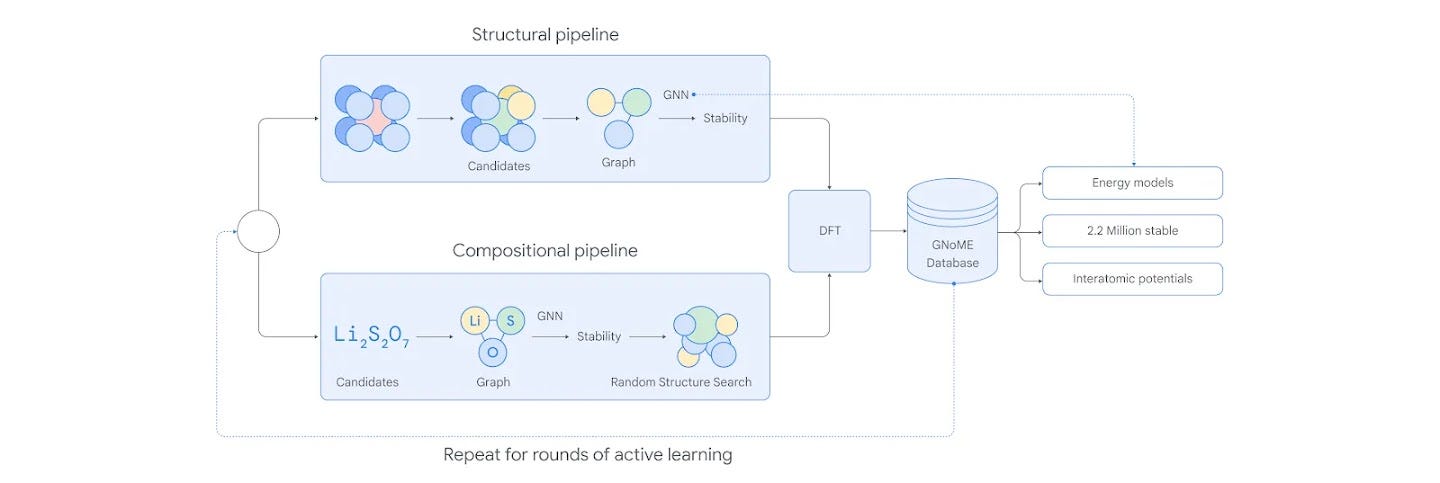
That clock is breaking.
In November 2023, Amil Merchant and colleagues at Google DeepMind published in Nature results from GNoME, a graph neural network trained on materials data that predicted 2.2 million stable crystal structures — the equivalent of about 800 years of prior experimental knowledge — of which 381,000 were novel materials below the convex hull of known stability [5]. Of those, 736 have now been experimentally synthesised and verified by independent laboratories. Among them are fifty-two thousand layered compounds with the structural fingerprints of superconductors.
A month later, the Lawrence Berkeley A-Lab, directed by Gerbrand Ceder, published in the same issue of Nature a robotic laboratory that synthesised forty-one novel materials from fifty-eight GNoME-predicted targets in seventeen days [6]. Seventy-one percent success rate. Twenty-one experiments a day. This is the industrial equivalent of the moment when DNA synthesis stopped being a two-year PhD project and became a service you order online.
Microsoft Research followed with MatterGen in 2025, a diffusion-based generative model that produces novel crystalline structures conditioned on target properties — chemistry, symmetry, mechanical response, magnetism, electronic behaviour — published in Nature [7]. Orbital Materials, founded by Jonathan Godwin out of DeepMind, launched its Orb foundation model for advanced materials in late 2024 and signed a multi-year strategic agreement with AWS focused on data-centre cooling and CO₂ capture [8]. Separately, a National University of Singapore group announced in 2025 the first copper-free high-temperature superconductor operating above 30 K at ambient pressure — a category-breaking result that ended a thirty-plus-year presumption about where superconductivity could exist [9].
The model is not predicting the next word. It is predicting the next crystal.
This is the second grammar in its most visceral form. The model is not predicting the next word. It is predicting the next crystal. And the crystal is a battery that holds more energy, a catalyst that drops the cost of hydrogen, a membrane that makes desalination thirty percent cheaper, a thermal interface material that lets a GPU run ten degrees cooler.
The venture opportunity is not in building another foundation model. The foundation models exist. The opportunity is in the last mile — taking a GNoME-predicted material from Nature supplementary figure to commercial product. The A-Lab is doing it inside a national lab. Orbital is doing it inside AWS. Neither is a company structure that scales across the industries that will consume these materials. That is a gap we are mapping specifically for desalination, district cooling, battery storage, and carbon capture, where the incumbents run on materials chemistry set in the 1980s and the uplift from a single generation of new compounds is billions per sector.
The chip industry has been on a single vector — more transistors per square millimetre — for sixty years. The next five years it will fragment. Security is one of the fragments, and it is the one where physics is entering the substrate most directly.
Three lines are converging.
The first is the physical unclonable function. A PUF exploits the atomic-scale manufacturing variation that makes every silicon die slightly different and turns that variation into a cryptographic key that cannot be cloned because it was never stored. Silicon photonic PUFs demonstrated in Nature Communications in 2024 achieved a cloning probability below 10⁻³⁰ with zero false-positive authentication rate across their test runs [10]. For comparison, no conventional secret-storage scheme can claim cloning probabilities below the probability that the silicon vendor itself is compromised.
The second is photonic chaos. A patterned silicon photonic chip that emits chaotic light waves, covered by SciTechDaily in 2024, produces cryptographic keys from a process that is deterministic to the chip owner and statistically indistinguishable from noise to any attacker [11]. This is not quantum key distribution with its fibre-and-detector infrastructure. It is a chip that, installed in a device, issues one-time pads at line rate.
The third is post-quantum cryptography hardware. NIST finalised ML-KEM, ML-DSA, and SLH-DSA in August 2024 [12]. The lattice mathematics those standards rely on is computationally heavy; software implementations are slow. Dedicated silicon acceleration for these algorithms is a hardware category that did not exist three years ago and will be in every network card, every HSM, every TPM within five. Separately, IonQ has published a roadmap targeting around twenty thousand physical qubits by 2028, and PsiQuantum was selected into the final phase of DARPA's Underexplored Systems for Utility-Scale Quantum Computing programme in February 2025 on a million-qubit photonic architecture targeted for 2033 [13].
Put those three together. Every authenticating device in the world — every phone, every car, every industrial sensor, every card reader — will, by 2030, carry a chip whose security posture is grounded in a physical process rather than a stored secret. And the chips that underpin the banking and defence stacks will need to resist an adversary with several thousand logical qubits at their disposal.
This is a market that did not have a sales call five years ago. Today it has a procurement line in every Tier 1 bank, every defence ministry, and every hyperscaler. The GCC is disproportionate in this category because sovereign systems are a core pod for us and because the region's cybersecurity budgets have grown double digits year on year since 2022. A chip company that owns the physics-grounded security layer for regional critical infrastructure is one of the clearest category bets we are watching.
The most under-discussed development in AI over the last eighteen months is that the simulation stack has moved.
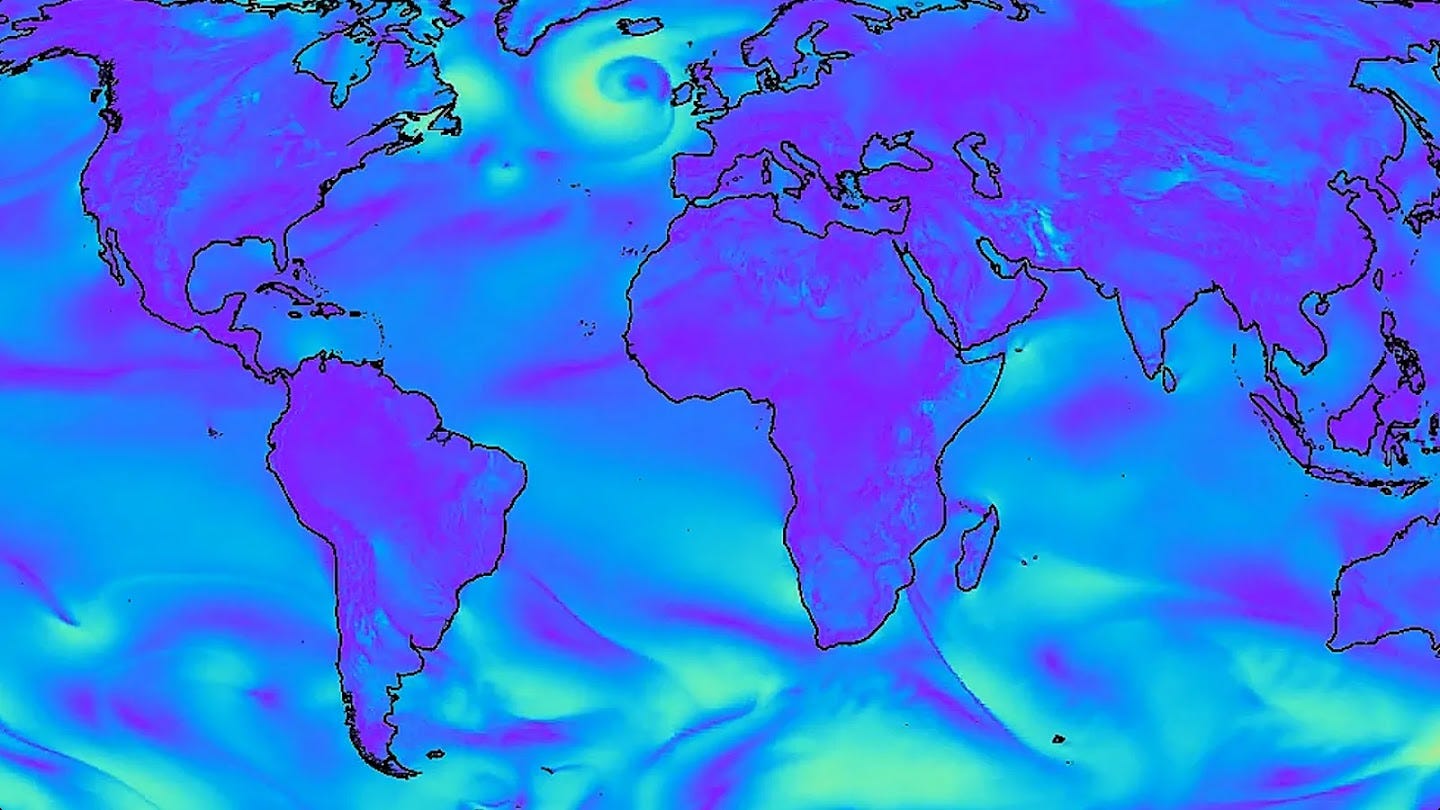
For forty years, computational physics — the workhorse of every industrial sector from aerospace to oil and gas to civil engineering to weather forecasting — ran on finite-element and finite-volume solvers on clusters of CPUs. A single high-fidelity simulation of a turbine blade, a data-centre cooling volume, or a regional weather pattern took hours to days. Pricing any decision that depended on that simulation was bottlenecked by the simulation itself.
In 2023, Google DeepMind published GraphCast in Science [14]. A graph neural network, trained on forty years of ECMWF reanalysis data, produced ten-day global weather forecasts at 0.25-degree resolution in under a minute, outperforming the ECMWF High-Resolution Forecast on over ninety-nine percent of tropospheric variables. In 2024 Microsoft Research released Aurora [15], an atmospheric foundation model achieving approximately five-thousand-times speed-up against the Integrated Forecasting System at equivalent or better accuracy, with variants now shipping for high-resolution weather, air pollution, and ocean waves.
Weather is the canary because weather modellers are the most rigorous, the most adversarial, and the most data-rich community in applied physics. If the foundation-model approach works against ECMWF — the gold standard — it works against every less-rigorous simulation domain in the world. And that is what is now happening. NVIDIA's PhysicsNeMo framework, formerly Modulus, hit production v2.0 in March 2026, with enterprise support shipping inside NVIDIA AI Enterprise [16]. It is the operational substrate for physics-informed neural networks across thermal, structural, electromagnetic, and fluid domains — the same domains that sit under every heavy industry asset class we track.
What was a two-day simulation becomes a two-second query. The implications are severe.
Combine foundation-model inference speed with physics-informed constraints, and what was a two-day simulation becomes a two-second query. The implications are severe. A corrosion model that used to be run quarterly by a consulting firm becomes a continuously updating field. A flood assessment that used to be a twelve-week engineering study becomes a real-time overlay. A seismic inversion — Shell and SparkCognition reported a ninety-nine-percent reduction in the number of physical seismic shots required per survey through generative-AI techniques — stops being a multi-million-dollar campaign and becomes a weekly refresh [17].
The digital twin, after a decade of disappointment, finally earns the name. The twin matches the plant because the twin runs at the speed of the plant.
That reshapes every vertical. The refining base. The LNG train. The grid dispatch desk. The water utility. The municipal flood manager. The building energy optimiser. Each of them has been running on static physics and quarterly consultancy refreshes. Each of them is about to have a live model instead. The gap between who has that live model in production and who does not will be the primary competitive axis in industrial operations by the end of the decade.
A pattern has repeated across every decade of attempts to close the gap between the drawing and the asset. Two rooms, each of which cannot hear the other. In one room, financial models and consultancy reports assume the asset behaves the way its specification says it does. In the other, the operator knows what the asset is actually doing and long ago gave up trying to explain it, because the last three software vendors did not listen.
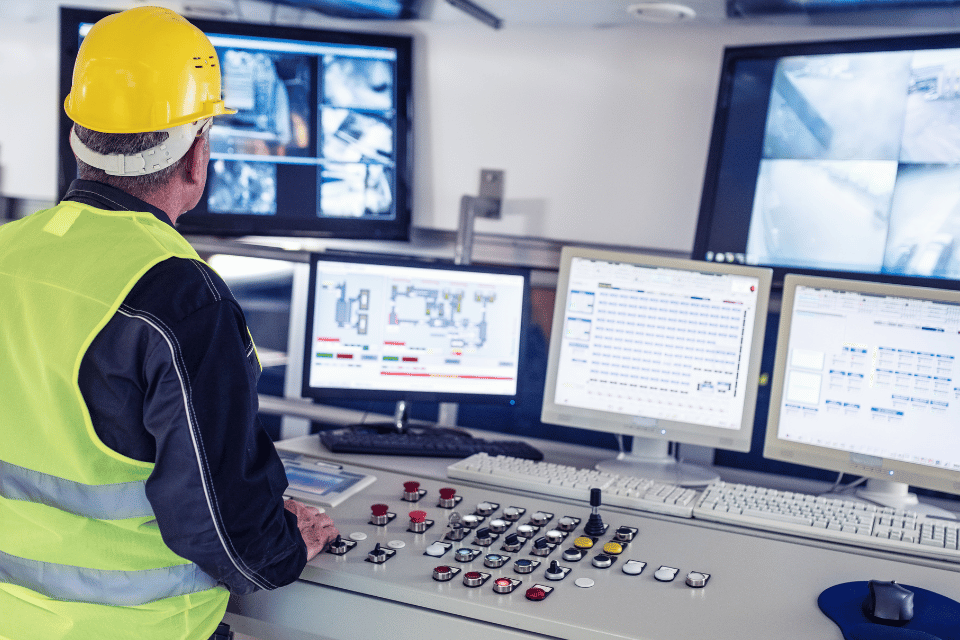
Every previous attempt to close that gap failed on the same reef. GE Predix consumed around seven billion dollars — four billion in direct spend over six years — before being written down, because it was built top-down by a conglomerate that had sold turbines for a century and thought software was another SKU [18]. Siemens MindSphere pivoted three times. Honeywell Forge survived by narrowing scope to vertical deployments on Microsoft Cloud. The pattern was the same each time. Outside-in product teams building horizontal platforms and asking operators to come to the tool.
The physics LM inverts that failure mode.
For the first time, the operator can be the founder.
The reason is mechanical. A large language model can read a plant's documentation, SCADA logs, turnaround history, and handover notes the way a new hire reads their predecessor's binder, absorbing the institutional knowledge in hours. A physics foundation model can take that context and run the relevant multi-physics simulation at inference speed. The tacit knowledge that used to live in a maintenance director's head can now leverage the same scale of compute that previously required a team of twenty-five PhDs and an SAP contract.
The operator does not need to learn Python. They need to encode their judgment into the model. Which, with the current generation of tooling, is a several-week exercise, not a several-year one.
That is why the interesting founder profile for the next decade is the fifteen-to-twenty-year operator paired with a software builder who has done production ML. Not because the operator understands AI. Because they carry the physics of their asset in a way no outside researcher can reconstruct from public data, and the researcher's tools have finally caught up to what the operator always knew.
ERP era (1995–2015) — Intelligence substrate: Relational records. Founder profile: Software vendor. Canonical outcome: GE Predix, Target Canada, Lidl SAP.
First-wave IIoT (2010–2020) — Intelligence substrate: Sensor telemetry. Founder profile: Conglomerate spin-out. Canonical outcome: MindSphere pivots, Predix write-down.
AI-native infrastructure (2022–) — Intelligence substrate: Physics + language models. Founder profile: Operator-founder. Canonical outcome: Azraq, Barrier Intelligence, the next ten.
If the physics is learnable, a class of company becomes obvious. Each of the five fields above maps to a venture shape that did not exist two years ago. These are the categories the studio is actively mapping, and the ones we think most need builders from the intersection.
Subsurface sensing, productised. Quantum gravimetry and muon tomography are hardware businesses at the point of origin. They become category-defining software businesses at the point of translation into carbon storage certification, mineral reserve verification, groundwater accounting, and civil-engineering-grade subsurface mapping. The hardware is coming from Birmingham, NASA JPL, and Ideon. The translation layer — the MSCI of the sensing category — is unbuilt.
Materials, as a service. A GNoME-predicted material is useless until someone takes it from supplementary figure to commercial product. The A-Lab is doing that inside a national lab. Orbital is doing it inside AWS. Neither is a company structure that scales across the verticals — desalination membranes, battery cathodes, thermal interface materials, catalysts for low-carbon hydrogen — that will consume these compounds. Each vertical is a billion-dollar uplift sitting on a chemistry set in the 1980s.
Physics-grounded chip security. PUFs, photonic chaos sources, and post-quantum accelerators are a hardware category that did not have a sales call five years ago and will be in every network card within five more. Regional demand is disproportionate because sovereign cybersecurity budgets have compounded since 2022. The domestic product does not yet exist.
Live twins, not reports. The corrosion model that is a PDF. The cooling loop without a twin. The hydraulic network that gets a consultancy refresh every quarter. Each of these becomes a live, physics-grounded model the moment someone does the integration work. The horizontal platform era failed. The vertical, operator-led, physics-LM-native era is beginning.
The underwriting layer. Every live physics model is a new input to the capital stack. Insurance, project finance, development credit, and reserve certification are priced on assumptions that were set before any of this sensing or simulation existed. Companies that translate physics into underwriting language will set the price of the next generation of infrastructure.
This is the map the studio is building against. Azraq and Barrier Intelligence are the first two fellows in production. The next ten are the point of this essay.
Most breakthroughs in a technology category look obvious in hindsight and invisible while they are happening. The physics LM is one of the invisible ones. The papers are in Nature and Science. The foundation models are shipping in NVIDIA, Microsoft, and Google stacks. The hardware is deploying at Rio Tinto and through NASA. And almost none of the people who will use it day-to-day — the reliability engineer on a refinery, the chief metallurgist at a desalination plant, the civil engineer mapping a carbon storage reservoir, the chip architect securing a sovereign network — have been told that the substrate underneath their work is changing.
The people who will build the category-defining companies of the next decade will be curious across an unusual number of domains. They will read a graph neural network paper and immediately think about a corrosion inspection dataset they have seen. They will read an earnings call from a mining major and think about how a muon detector array would reprice the reserve. They will read the NIST post-quantum specification and think about the TPM in a sovereign identity card. They will refuse to accept that their discipline is the only one that matters.
If you are one of those people, there are a small number of questions worth asking yourself.
You are a computational physicist, applied mathematician, or climate modeller. The tools you use every day — PINNs, neural operators, reanalysis datasets — are one commercial translation layer away from a company. What industrial problem, that you have watched people fail to model properly, could you take on if you were building the product rather than writing the paper?
You are a materials scientist or computational chemist. GNoME, MatterGen, and Orb have compressed a decade of your field into a usable corpus. Which specific vertical — desalination, cathodes, catalysts, thermal interface, carbon capture sorbents — sits on a chemistry your models can now outperform? The commercialisation path is the company.
You are a reliability engineer, metallurgist, or operations chief with fifteen or more years on critical plants. You have lived the problems the physics LM was built to solve. You have the domain knowledge no outside researcher can reconstruct. The missing piece is a small software team that can translate what you know into a model that holds and a product that sells. We can help assemble it.
You are a chip architect, photonic engineer, or cryptographer who has watched post-quantum and PUF research migrate from paper to silicon. Every authenticating device in a sovereign system needs to change in the next five years. The sales calls do not yet exist. The product does not yet exist. The category is a greenfield.
You are a builder — a product person, a full-stack engineer, an ML researcher — who has been watching the edge of this and wondering where the non-obvious problems live. They live where the physics meets the operator meets the capital stack. Find a computational physicist and a reliability engineer and start asking what they would build if someone removed the obstacles.
The studio exists to remove the obstacles. The co-build model is designed to get a boiler-suit founder to a contracted pilot in under six months. The capital is there. The pilots are in the region. The map is incomplete on purpose — it expects to be redrawn by the people who walk onto it.
The digital economy runs on forces. The forces are finally learnable.
The companies that will own the next decade will be built, at the intersection, by the people who are curious enough to stand in all three rooms at once.
If you are one of them, write to us.
[1] B. Stray, A. Lamb, A. Kaushik, J. Vovrosh, A. Rodgers, J. Winch, F. Hayati, D. Boddice, A. Stabrawa, A. Niggebaum, M. Langlois, Y.-H. Lien, S. Lellouch, S. Roshanmanesh, K. Ridley, G. de Villiers, G. Brown, T. Cross, G. Tuckwell, A. Faramarzi, N. Metje, K. Bongs, M. Holynski, "Quantum sensing for gravity cartography," Nature 602, 590–594 (2022). https://www.nature.com/articles/s41586-021-04315-3
[2] NASA JPL press materials on the Quantum Gravity Gradiometer Pathfinder, Earth Science Technology Office, 2025. SciTechDaily coverage: NASA's Quantum Sensor Could Revolutionize Gravity Mapping. https://scitechdaily.com/nasas-quantum-sensor-could-revolutionize-gravity-mapping/
[3] S. Procureur et al., "Precise characterization of a corridor-shaped structure in Khufu's Pyramid by observation of cosmic-ray muons," Nature Communications 14, 1144 (2023).
[4] Ideon Technologies announcements: Evolution Mining Northparkes (December 2024), Rio Tinto Bingham Canyon (September 2024). https://ideon.ai
[5] A. Merchant, S. Batzner, S. S. Schoenholz, M. Aykol, G. Cheon, E. D. Cubuk, "Scaling deep learning for materials discovery," Nature 624, 80–85 (2023). https://www.nature.com/articles/s41586-023-06735-9
[6] N. J. Szymanski, B. Rendy, Y. Fei, R. E. Kumar, T. He, D. Milsted, M. J. McDermott, M. Gallant, E. D. Cubuk, A. Merchant, H. Kim, A. Jain, C. J. Bartel, K. Persson, Y. Zeng, G. Ceder, "An autonomous laboratory for the accelerated synthesis of novel materials," Nature 624, 86–91 (2023). https://www.nature.com/articles/s41586-023-06734-w
[7] C. Zeni et al., "A generative model for inorganic materials design" (MatterGen), Nature (2025). https://www.nature.com/articles/s41586-025-08628-5
[8] Orbital Materials Orb launch (Sep 2024); AWS strategic partnership announcement (Dec 2024). Globe Newswire press release.
[9] NUS copper-free superconductor above 30 K at ambient pressure, covered by SciTechDaily: 40-Year Barrier Broken: Scientists Discover New High-Temperature Superconductor. https://scitechdaily.com/40-year-barrier-broken-scientists-discover-new-high-temperature-superconductor/
[10] Silicon photonic PUF with 10⁻³⁰ cloning probability, Nature Communications (2024). https://www.nature.com/articles/s41467-024-47479-y
[11] SciTechDaily, Patterned Optical Chips That Emit Chaotic Light Waves Keep Secrets Perfectly Safe. https://scitechdaily.com/patterned-optical-chips-that-emit-chaotic-light-waves-keep-secrets-perfectly-safe/
[12] NIST Post-Quantum Cryptography Standardization, FIPS 203/204/205 finalised August 2024.
[13] IonQ publicly published roadmap targeting ~20,000 physical qubits by 2028. PsiQuantum selected into Phase C of DARPA's Underexplored Systems for Utility-Scale Quantum Computing (US2QC) programme, February 2025.
[14] R. Lam et al., "Learning skillful medium-range global weather forecasting," Science 382, 1416–1421 (2023). https://www.science.org/doi/10.1126/science.adi2336
[15] C. Bodnar et al., "Aurora: A foundation model of the atmosphere," Microsoft Research blog and arXiv preprint, 2024; GitHub open source release 2025. https://www.microsoft.com/en-us/research/blog/introducing-aurora-the-first-large-scale-foundation-model-of-the-atmosphere/
[16] NVIDIA PhysicsNeMo v2.0 release notes, March 2026. https://developer.nvidia.com/physicsnemo
[17] SparkCognition–Shell announcement of deep-sea exploration acceleration via generative AI, reporting 99% reduction in required seismic shots. Offshore Magazine (2023).
[18] Platform Engineering analysis, How General Electric Burned $7 Billion on Their Platform. https://platformengineering.org/blog/how-general-electric-burned-7-billion-on-their-platform
oliver@utopia-studio.co
No posts
Comments
Nothing yet. Say the first thing.
Sign in to join the conversation.