
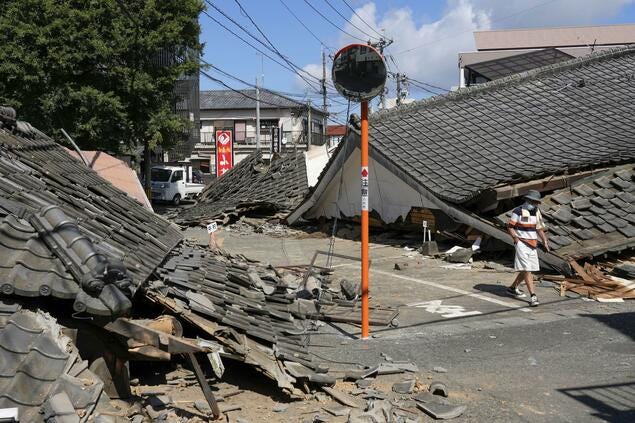
A powerful 7.1-magnitude earthquake struck Japan’s southern Kumamoto Prefecture on 28 July, killing at least 38 people and damaging 12,276 homes across the region, while temperatures were rising up to 40°C (104.0°F).
As of 3 August, over 8,200 people were still living in 150 evacuation shelters, and 45,280 households were without water, according to NHK.
Numerous roads and bridges were severely damaged, while vital infrastructure, such as hospitals, are running amid power outages.
“People are coming in with burns and fractures from being trapped under objects due to the earthquake, and ambulances are constantly bringing in injured people,” a hospital employee told NHK. “Inside the hospital there are water leaks and electrical system failures.”
On Monday, many parts of the prefecture recorded temperatures of 35°C (95.0°F) or higher, with some areas experiencing temperatures of 40°C (104.0°F) for the first time ever. Power outages sometimes leave evacuation centres without air conditioning.
“When I went to the vending machines last night, everything was sold out. There was no tea, no water, nothing left,” one resident told News On Japan at a community centre in Yatsushiro, where drinking water is restricted to two litres per person.
“Fluid intake is severely restricted,” Jun Kanda of the Japanese Association for Acute Medicine said at an emergency online news conference on 3 August (via The Japan Times). “Some are sleeping in their cars, and because of problems such as fuel (shortages), they cannot use air conditioning, making the severe heat even worse.”
A woman in her 70s was found dead in her vehicle on July 30, becoming “the first evacuation-related fatality confirmed”, writes The Asahi Shimbun.
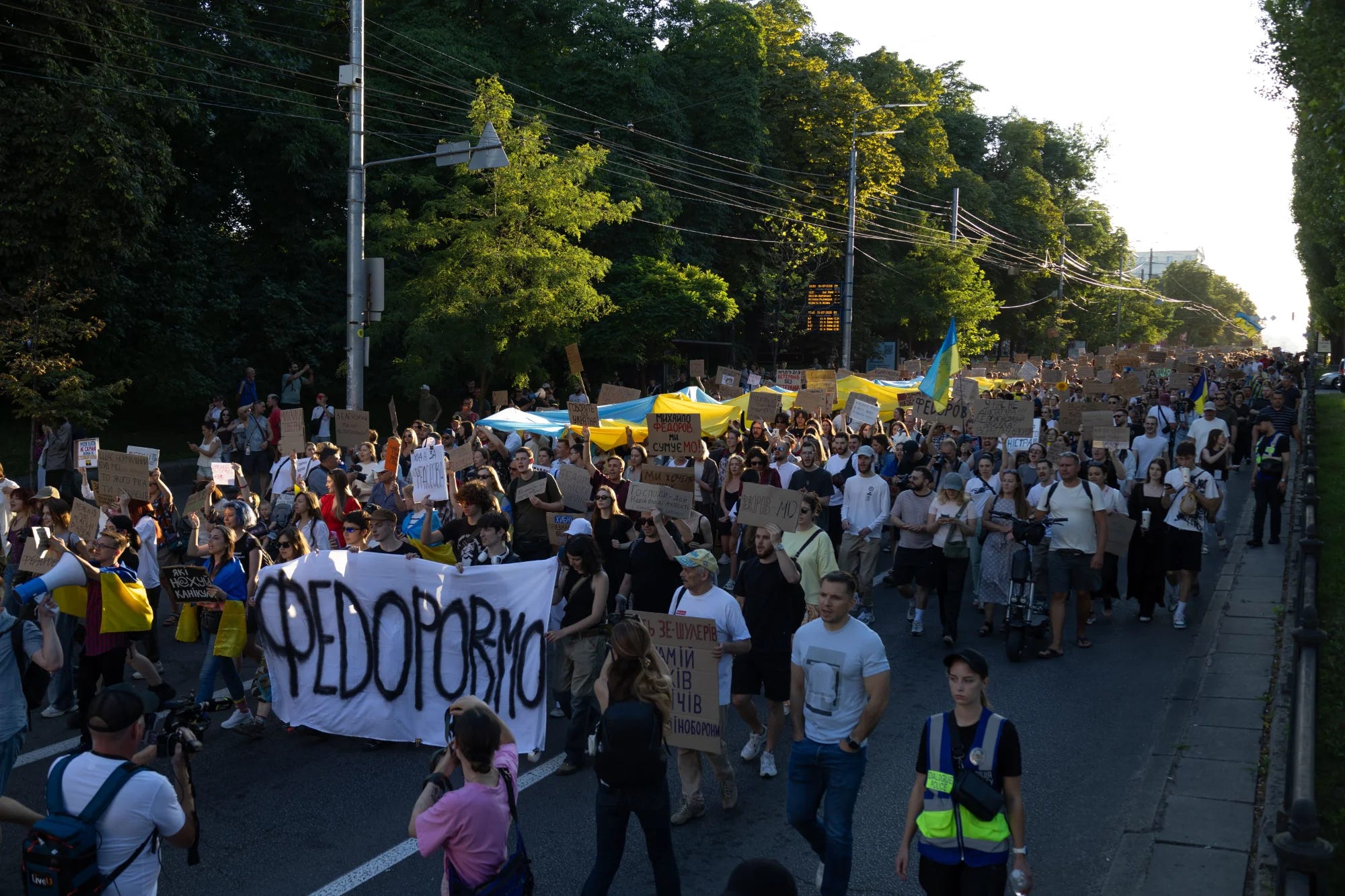
Thousands march in Kyiv demanding Fedorov’s return: Over 10,000 demonstrators filled Kyiv’s main Khreshchatyk Street on 31 July, entering the 16th day of protests across 30 Ukrainian cities, reports The Kyiv Independent. Protesters are demanding President Volodymyr Zelenskyy reinstate ousted Defense Minister Mykhailo Fedorov, who was dismissed on 15 July and is considered to be the architect behind Ukraine’s drone and robotic warfare. “We will come out every day and stand for as many days as necessary for the authorities to hear us,” said Dmytro Koziatynskyi, a veteran and the initiator of the protests, in an interview with NV. Demonstrators continued the march despite an air raid alert due to the threat of a Russian drone attack, with organisers urging participants to move to shelters.
Ceuta’s migrants left as fast as they arrived: Most of the estimated 60,000 migrants who rushed into the Spanish North African enclave of Ceuta from Morocco returned home within 48 hours, having found no food or shelter in the autonomous city of 84,000 people. The unprecedented border crossing sparked an international crisis alongside tragic casualties. “The latest figure that we have is 72,” Spanish government delegate Miguel Ángel Pérez Triano told reporters, according to AFP (via France24). He noted that the victims had either drowned or died in stampedes. However, Morocco’s Interior Ministry reported a significantly lower toll of 11 deaths, blaming social media misinformation for the sudden surge. This event is reminiscent of one that occurred in 2021, when approximately 8,000 migrants crossed into Ceuta after Morocco relaxed border controls.
DR Congo Ebola outbreak kills over 1,500 people: The Democratic Republic of Congo has reported 3,532 confirmed cases of Ebola and 1,556 deaths, making this the second-largest outbreak on record. Declared in mid-May, the epidemic has killed five times as many people as previous outbreaks at the same stage, the Africa Centres for Disease Control and Prevention (Africa CDC) shared during a press conference. “It is the fastest-spreading Ebola epidemic that we have ever seen,” UN World Food Programme director Carl Skau told Reuters. “The world needs to pay much more attention.” The death rate is very high at 44%. “If we do not stop it today, this will become the worst outbreak the world has ever documented”, Africa CDC Director-General Jean Kaseya declared on X.
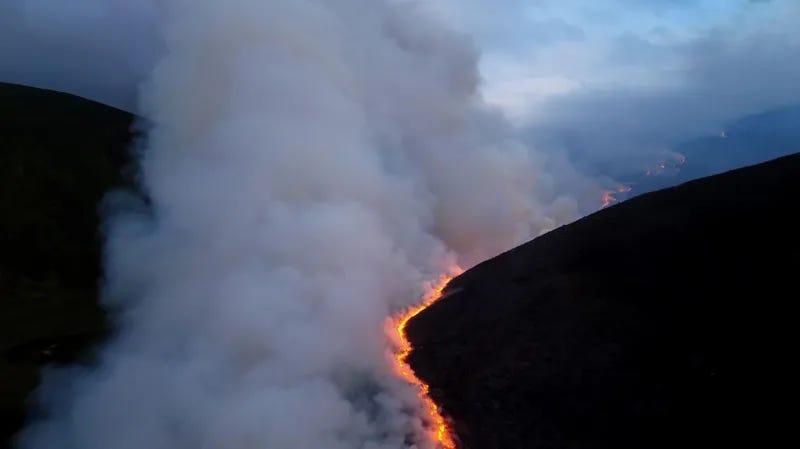
Scotland battles “apocalyptic” wildfire: A major wildfire is raging in the Cairngorms National Park in Scotland, having already burned over 2,500 hectares (6,177 acres) of native Caledonian forest and moorland. Around 700 people have been evacuated and a total of 500 firefighters and local volunteers had been tackling the blaze since 15 July, which has so far devastated “an estimated 25 square kilometres of land since it started”, reports The Herald, following weeks of dry weather. “You are passing through just bare forest now and birds flying about looking for their nests,” Malcolm Smith, farming advisor to the Cairngorms National Park Authority, told the BBC. Although recent rainfall has slowed the spread of the fire and brought some relief, emergency crews warn that peat fires continue to smoulder underground.
South Korea records highest temperature in modern history: On 2 August, the southeastern city of Yangsan recorded a scorching 42.5°C (108.5°F), marking the highest temperature ever recorded in South Korea since modern weather observations began 122 years ago. The city experienced temperatures above 40°C (104.0°F) for five consecutive days. “It is too hot to be outside doing anything,” Seoul resident Ju Dong-yeol told the AFP (via The Straight Times) from a Starbucks where he had taken refuge with his parents. The Korean Meteorological Administration (KMA) issued emergency alerts in more than 20 localities, warning people to “immediately stop all outdoor activities,” as “indoor spaces without air conditioning are dangerous.” A rare combination of large-scale weather patterns and local geographical conditions is driving the extreme heat, the KMA said.
Five firefighters dead as wildfires rage across Greece: The death toll from Greece’s relentless wildfires has risen to five, following the deaths of two firefighting pilots in a mid-air helicopter collision west of Athens on 2 August. On 29 July, two firefighters lost their lives while battling a major fire in Crete, which has since been brought under control. On the same day, a 27-year-old firefighter was found dead near the southern Peloponnese port town of Gythio. Flames have been raging for a fifth consecutive day, consuming an estimated 13,290 hectares (32,840 acres) in Attica and Viotia. “A pristine forest, a paradise, was surrendered to the hands of the fire,” local farmer Minas Tzortzanis told the Associated Press on 1 August. “There are no words to explain what has happened. Destruction. Total destruction.” As the time of writing this newsletter, there were 133 active wildfires in Greece, including 81 critical ones, amid gale-force winds and extreme heat.

Polish swimmer Bartłomiej Kubkowski became the first person in history to swim across the Baltic Sea on 3 August.
Bartłomiej swam the 160 kilometres that separate the Swedish town of Kaseberga to the Polish coast in Dziwnów in 55 hours, without sleeping and only eating food given to him from a lifeboat that he was forbidden to lean against.
This was Kubkowski’s fifth attempt to cross the Baltic Sea. Last year, he was forced to stop just 11 kilometres from the finish line after 52 hours of swimming. Extreme exhaustion and deteriorating weather got the better of him.
The swim was livestreamed to raise funds for the Cancer Fighters Foundation. So far, Bartek has raised 853,000 złoty (€197,981 / $227,921).
Speaking of sports, I was saddened to learn that Nirmal Purja, a legendary Nepalese mountaineer, died alongside 9 other climbers in an avalanche at Broad Peak in Pakistan on 30 July.
Nimsdai was such an inspiration. If you haven’t yet, I would recommend watching his movie 14 Peaks: Nothing is Impossible (on Netflix).
Thank you for reading and take care.
No posts
Comments
Nothing yet. Say the first thing.
Sign in to join the conversation.