
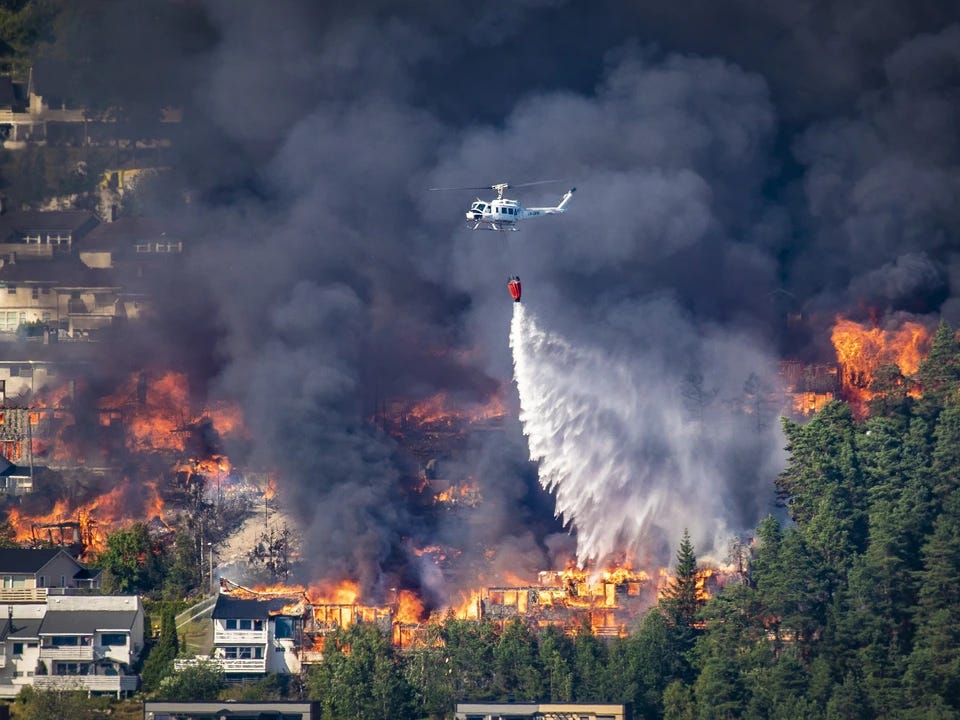
A catastrophic fire swept through Krokstadelva in the municipality of Drammen on 17 July, destroying over 100 homes in what the Norwegian newspaper Aftenposten describes as “Norway’s largest fire since the war.”
The fire started in a terraced housing complex and spread rapidly through the neighbourhood and into nearby forests, fuelled by strong winds and a prolonged drought. The cause of the fire is not yet known.
“I’m sad. It is completely surreal that we have experienced. The biggest fire in recent times in Norway,” says an embossed mayor Kjell Arne Hermansen to NRK.
Over 400 residents were evacuated, with emergency crews deploying helicopters, military units and firefighters from across the region.
“It’s indescribable what I felt last night. I stood in front of the house, and leaned my head back. I looked up the hill. It looked absolutely terrible”, Øivind Lønne, who has returned to see the house he had lived in for three years, told Verdens Gang.
“This was a very cozy place to live, but it’s unrecognizable now.”
Remarkably, there were no fatalities, though 11 people suffered minor injuries.
The fire was brought under control after four days, causing estimated damages exceeding 1 billion Norwegian kroner (€90 million / $100 million).
Indian Cockroach Party marches to Parliament: “Chaos, clashes, confusion and cries echoed in the streets of Central Delhi” on 20 June, as thousands joined the Cockroach Janta Party’s (CJP) “mega protest”, reports the Hindustan Times. The student-led protest defied police barricades, tear gas and baton charges to march towards Parliament in New Delhi, during which “several confrontations broke out between protesters and the police”, according to Indian newspaper Mint. The youth movement, created after the cancellation of the national medical entrance exam scandal in May, was further galvanised after Delhi police forcibly hospitalised activist Sonam Wangchuk on his 20th day of hunger strike. Protesters from the CJP are demanding the immediate resignation of Union Education Minister Dharmendra Pradhan and reforms to the examination system.
The King of the North takes over Downing Street: Former Mayor of Greater Manchester, Andy Burnham, also known as the “King of the North”, officially entered 10 Downing Street on 20 July, becoming Larry the Cat’s (and Britain’s) seventh Prime Minister in a decade. He succeeded Keir Starmer, who resigned due to declining approval ratings and worrying defeats in regional elections. “Labour is still behind Reform UK in the opinion polls, but the gap has narrowed”, reports the BBC. “Reform UK is averaging 25%, down from a peak of 32% last October.” Labour, for its part, is hovering at 21%. In his opening address, Burnham promised a “circuit breaker” moment for the country, pledging a 10-year plan focused on regional empowerment, stronger public control over essential services, and immediate action to address the cost of living crisis and homelessness.
Winter hack on Poland’s infrastructure attributed to Russia: The December 2025 cyberattack on Poland’s energy grid was the work of Russia’s Federal Security Service (FSB) and its Centre 16 division, the European Union declared on 13 July. “For years, the FSB has conducted a wide range of malicious cyber activities with growing severity,” writes the EU in the press release. “These activities have included infiltration of governmental networks and sabotage of critical infrastructure” in its member states and allies, citing recent examples including France, Germany, Poland, Cyprus, the Netherlands, Austria, Slovakia, Romania, Finland and Ukraine. In Poland, the coordinated attacks in December targeted electric and heat facilities, in an attempt to disrupt heat supply and cut electricity to 500,000 people in the middle of winter. For the first time, Western allies have announced sanctions targeting Russian cyber threat actors, including those behind the Lumma Stealer malware, which is one of the world’s most widely used tools for stealing information.
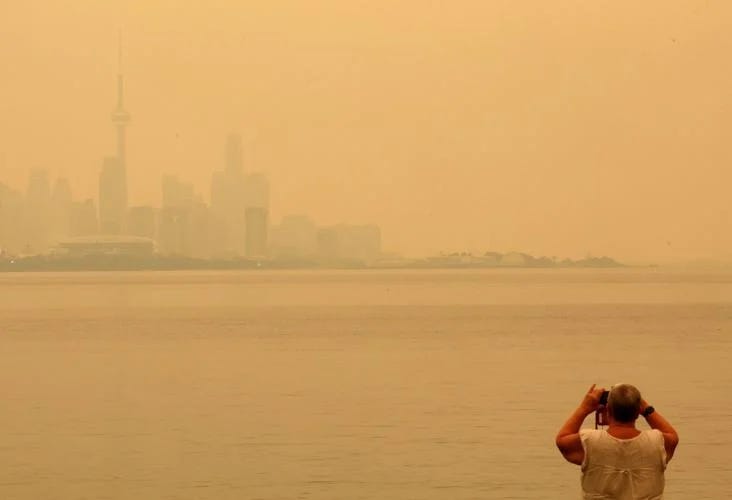
Wildfire smoke plunges Toronto into world’s worst air quality ranking: Toronto recorded the world’s worst air quality among major cities on IQAir’s global index on 15 July, as thick smoke from over 140 active wildfires in northwestern Ontario turned the skies orange with a “very poor air quality”, reports the CBC. On 17 July, exposure to the air for a 24-hour period “carried roughly the same mortality risk as smoking 4.1 cigarettes”, explains the Toronto Star, using data from the website How Many Smokes? In the long run, breathing in this smoke could increase the risk of heart disease, cardiovascular disease, certain cancers and reduced lung function, as well as developmental issues in children. Across Canada, more than 950 wildfires “are scorching Canada from coast to coast”, according to CTV, including 241 considered out of control. The map showing the current wildfire situation is terrifying.
Severe storm system batters Chile, leaving 10 dead: “An extremely complex situation is unfolding” in the Coquimbo Region, one of 10 of Chile’s 16 regions severely hit by a winter storm, states local newspaper Diario El Día. “What normally rains in a month fell in an hour,” Interior Undersecretary Maximo Pavez said (via Xinhua), coupled with winds reaching up to 160 km/h (99mph). The rainfall has killed at least ten people, damaged more than 1,100 homes and prompted a state of emergency. Described as “historic” by local authorities, the rain “has caused rivers to overflow, ravines to become massively activated, and numerous roads to be cut off, leaving many rural areas completely isolated”, reports Diario El Día. The storm has displaced hundreds of residents and cut power to roughly 150,000 Chileans, with Valparaíso and Biobío among the hardest-hit central and southern areas.
A flooded Chinese city has a snake problem: In an unexpected turn of events, the torrential rain from last week’s Typhoon Maysak flooded a snake breeding farm in a village near Hengzhou in the China’s Guangxi region, releasing around 900 snakes into the city’s floodwaters. “Due to the breaches at Liulan Reservoir and Yunbiao Reservoir, low-lying areas were inundated, and snakes from some small-scale farms have escaped into surrounding areas”, the Chinese state-run newspaper Global Times explains. The snakes are farmed for use in traditional medicine, for their meat, and for anti-venom. Videos circulating on Chinese social media show the escaped reptiles, a majority of non-venomous water snakes but also venomous cobras and king rat snakes, swimming in the floodwaters. A team has since been organised to recapture them using fishing tools and stun guns.
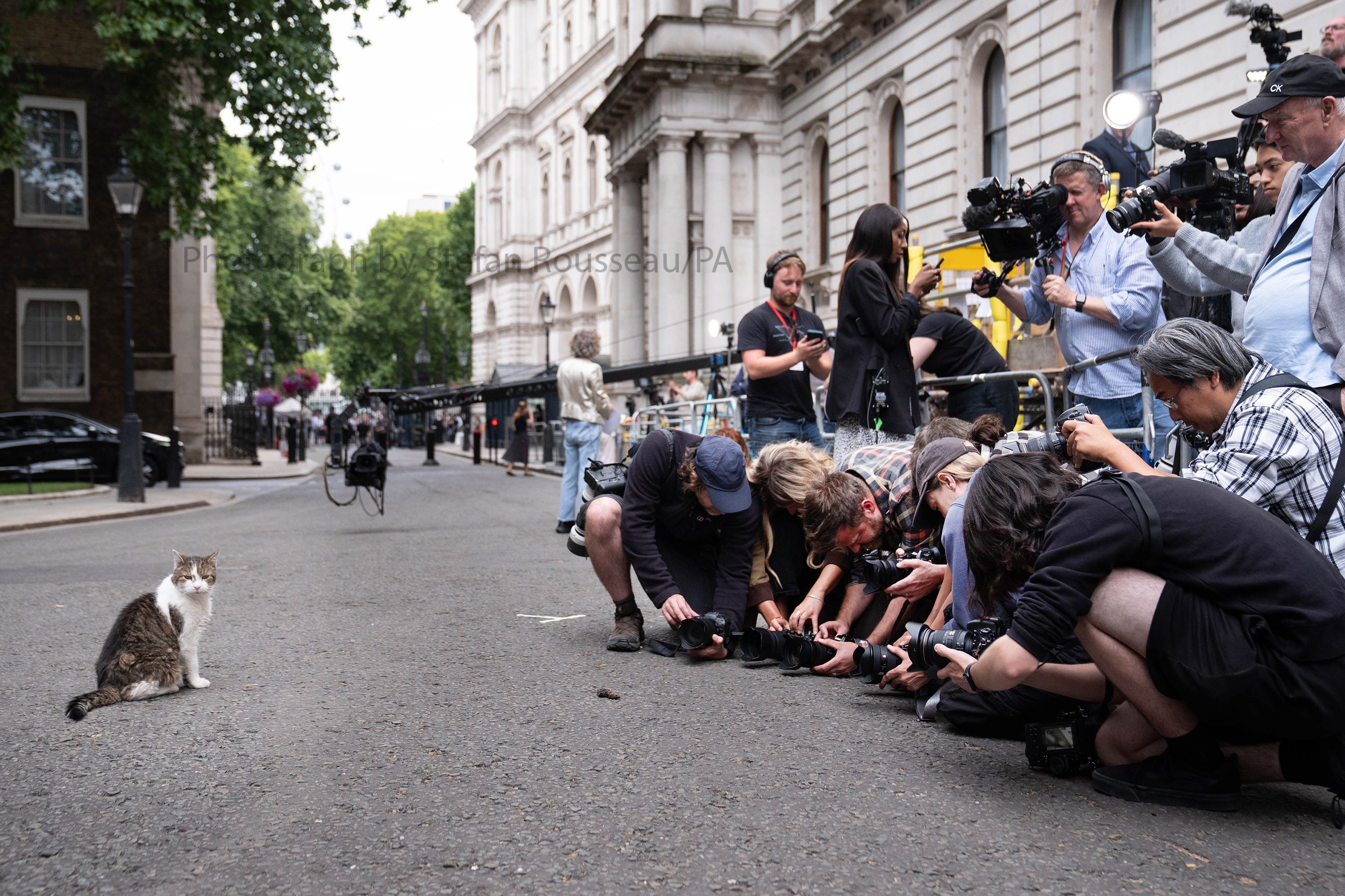
I couldn’t leave you without showing you Larry, the 19-year-old “Chief Mouser to the Cabinet Office.”
This picture, taken by Stefan Rousseau on 20 July in Downing Street, shows members of the press photographing a dead mouse caught by Larry. Chief Mouser, indeed.
Thank you for reading this week’s newsletter! There won’t be an issue next week as I’m going on holiday.
See you for week 31! Take care.
No posts
Comments
Nothing yet. Say the first thing.
Sign in to join the conversation.