
There are certain things you don’t think about until you’re forced to. Time is one of them. So is your body. So is the rather strange assumption that the person you are today will be more or less the person you are five years from now, wearing the same size, making the same plans, moving toward the future you have already started mentally furnishing.
For most of us, our relationship with clothing is built around that assumption. We buy for the body we have, the life we are living, and the occasions we are anticipating. We get dressed and move on. But what happens when your body becomes the least predictable thing in your life? What happens to the idea of dressing for the future when the future itself suddenly feels less certain?
It is a question that sits underneath the story of Doze, the clothing brand founded by Neridah Twist and Katie Lewis after both women went through their own cancer journeys in their twenties. It would be easy to assume that their experience with cancer is what led them to think differently about clothing, but the story is more intimate than that. Doze came from something much more immediate: two young women whose bodies were changing dramatically still had lives to live, and they wanted clothes that could accommodate those lives without making them feel like patients first and themselves second.
“From the get go, we were always more focused on building our community than the product offering,” Neridah tells me. “We just felt strongly, at the time of our launch, that there was a community missing, one connecting with young women like us who were going through real shit but still had their very full lives around them and wanted perfectly fitting clothes to aid in the ease of our lives at that time.” There is something revealing about starting a clothing brand at a time when so much else has become uncertain. Most of us dress with an almost unconscious belief in continuity. We buy a coat expecting to wear it next winter, a dress expecting another occasion will eventually present itself, a pair of jeans assuming our body will remain sufficiently familiar to fit into them. Even the idea of a wardrobe depends on the expectation that there will be a future version of ourselves to inherit what we buy today.
But permanence becomes a different proposition when you have already learned that the future is not something you can simply assume. The things we choose to keep begin to carry a different kind of significance. They are no longer just objects that have survived a few seasons; they are objects that have remained useful, desirable, or meaningful as the person wearing them has changed.
“We started the brand because we wanted clothing for ourselves that felt good on our bodies while they were changing dramatically through chemotherapy,” they tell me. The need was simple, even if the circumstances were anything but: to get dressed and still feel like yourself.
“We try to make things that make the customer feel good in every season of their life,” they say. “Our customer demographic ranges dramatically, so we’re really focused on pieces that work in as many ways as possible.” There is something important in that idea. A woman can change in ways she never anticipated and still want to open her wardrobe and find something that feels like hers. Perhaps that is what it means for a piece to last: not that it remains exactly right, but that it remains relevant to a life that no longer looks the way it did when she bought it.
“Honestly, our fabric,” they say. “It’s a beautiful cotton-silk blend that feels so light and airy on the skin.” Their priority, for now, is “creating a product you want to keep wearing over and over again.” That desire is harder to manufacture than it sounds. Fashion has become very good at creating the feeling that what we already own is somehow less interesting simply because something newer has arrived. Doze has had to resist that impulse from the beginning, even while acknowledging how difficult it is to ignore. “Comparison, for sure,” they say when I ask about the hardest part of building a slower brand. “It’s so easy to look around, see more, more, more from other brands, and get caught up feeling like you’re not doing enough.”
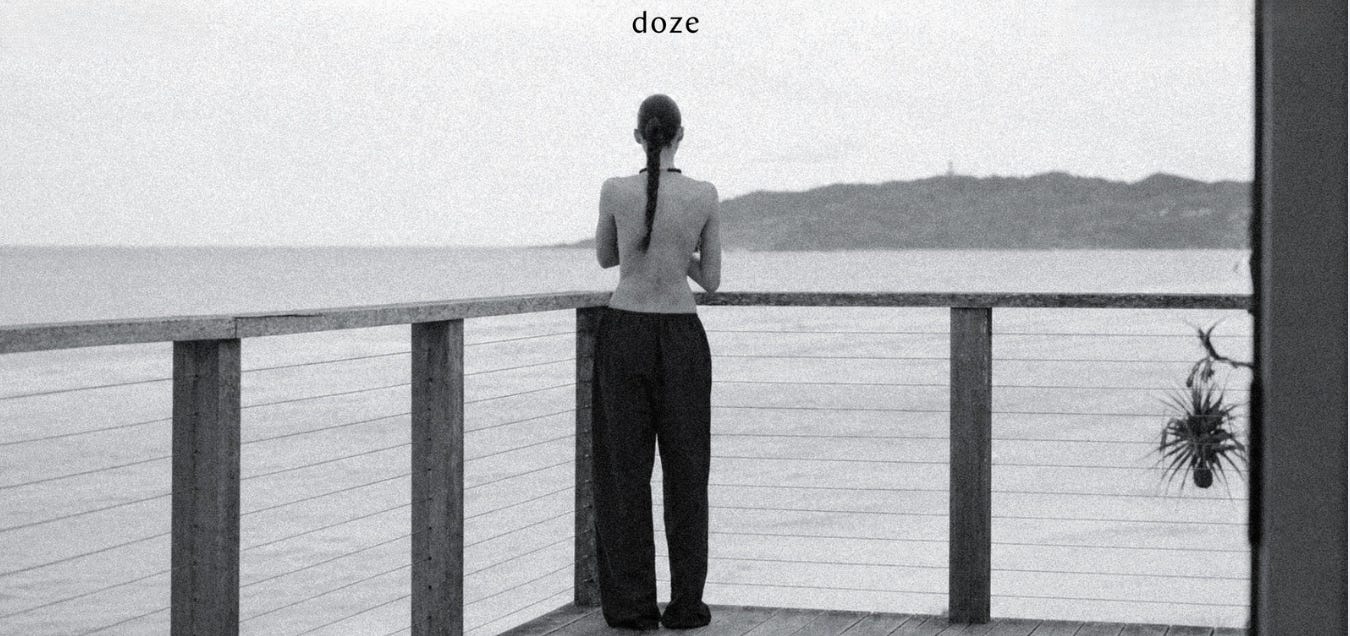
Their response has been to become more deliberate about what enters the collection. “We like knowing the people buying our pieces are keeping them forever,” they say, “so making sure everything we put out is considered and not just a loud voice is a priority for us.” That becomes even more personal when you consider Doze itself. The brand has not existed as one uninterrupted chapter. As their lives expanded beyond their cancer diagnoses, they reached a point where they “didn’t have the bandwidth to keep the brand going.” They stopped. And eventually, they came back. “That drive to keep telling our story was always there, and that’s ultimately why we relaunched this year,” they say. “Same product offering, same founders, just a new energy, and the brand is being received completely differently.”
And then there is the friendship that came first. Neridah and Katie had been friends for fifteen years before they became business partners. “A partnership is really hard. It’s like a marriage, and sometimes we just don’t agree on things.” They have learned to let each other be different, even when they are working toward the same thing. “Some days I come in hot and heavy with a dozen ideas I feel need to be handled immediately, and Katie’s the one saying, okay, slow down, or the other way around.”
What they protect most carefully is the friendship outside the business. “Keeping the foundation of our friendship strong outside of the business is a huge priority for us.” They have never had a proper fight in fifteen years, but they are not suggesting that endurance comes from never disagreeing. “It’s important to respect the partnership even when you don’t agree. Give it a minute to breathe rather than act out of frustration.” The business is something they built together. The friendship is something they had before it and intend to have after it.
When they imagine Doze decades from now, their vision is remarkably simple. “We love imagining looking back and seeing our customers mixing our newest offering with pieces from our first collections,” they say. “That to us would be proof that when we make new things, they don’t render the old things obsolete.” The old piece does not have to become embarrassing, irrelevant, or disposable simply because something new has been designed. “We want to make a timeless product that serves our community,” they say, “and we feel there’s no expiration date on that.”
“Whatever you’re building or going through in life there will always be an ebb and flow whether that is positive or negative,” they say. “Life is extremely messy, and so is entrepreneurship, so it’s important to never assume anything stays just one thing.”
In their office, they keep a quote from Virgil Abloh: “The world produces waves. Surf or drown. You decide.” And then they add, “Life is a blessing, and it’s not a given. Try not to take it for granted, and give everything a go and another go, whether you’re ready or not.”
Maybe the things we keep are not the things we were certain would last. They are the things that continued to make sense as we changed. A garment that still feels right years after you bought it. A friendship that survives becoming something more complicated. A business you can leave and still find your way back to. Perhaps permanence has less to do with refusing change than with recognizing what remains worth returning to.
The best conversations rarely happen on stage. They’re the ones worth writing down.
Bai
No posts
Comments
Nothing yet. Say the first thing.
Sign in to join the conversation.