
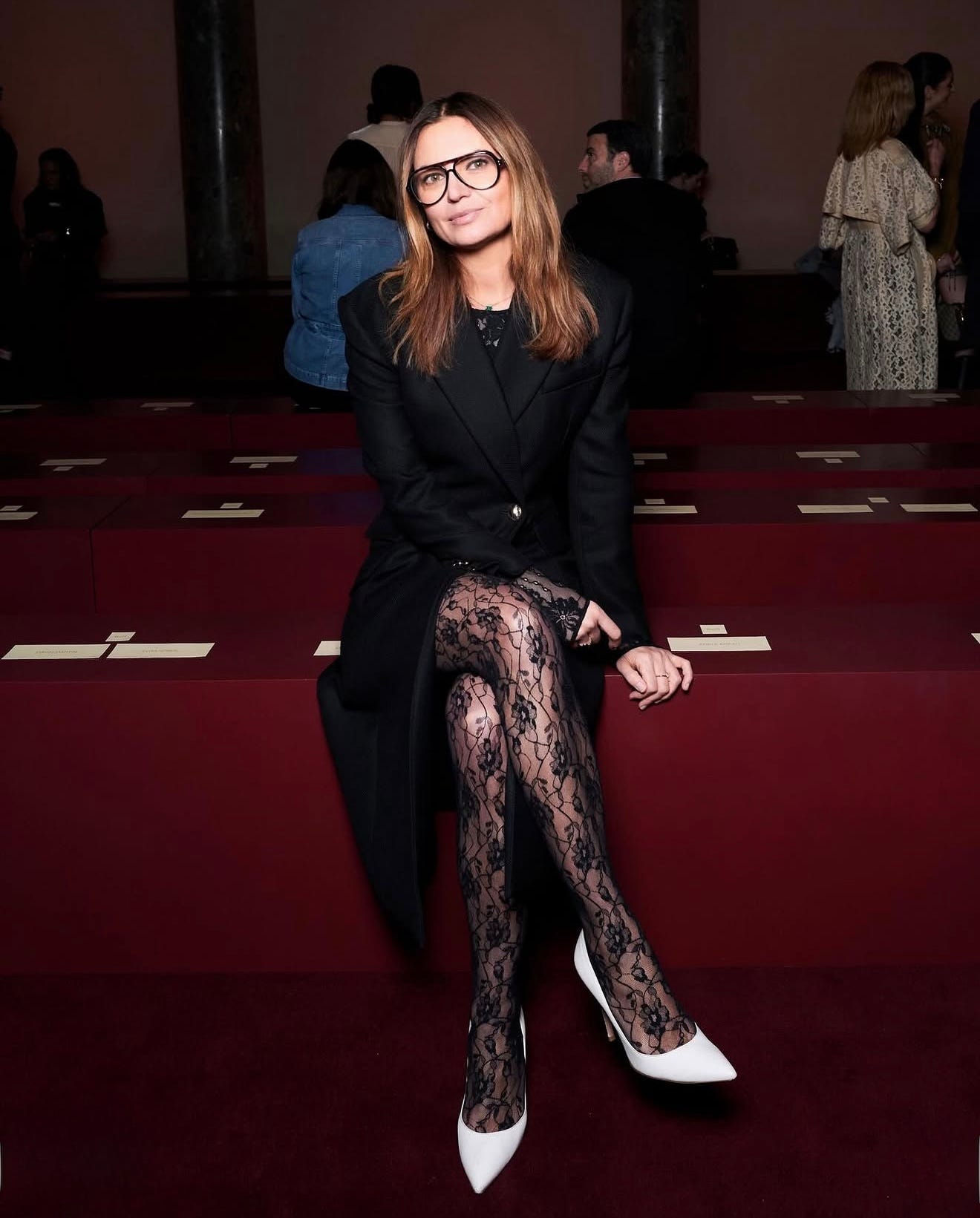
I’ve always been interested in the part of fashion that exists beyond the clothes. The psychology behind why we choose certain things, why certain pieces become meaningful, and why some objects stay with us long after the trend has disappeared.
That question is what brought me to Gabriele Hackworthy.
Looking at her career, it would be easy to focus on the titles: Fashion Director at Vogue Australia, Japan, and China; Fashion Director at Harper’s Bazaar; Global Fashion Director at Net-a-Porter; and Senior Vice President of Brand Communications and Marketing at Jimmy Choo. But titles aren’t where her education started. Long before any of that, she was on a shop floor, selling designer shoes on weekends while she was still in school. That was the real education: learning to recognize what people wanted before they could articulate it themselves.
We are living through a moment where everyone has an opinion, everyone has access, and everyone is being told what deserves our attention. Ironically, however, it has made the idea of discernment harder to find. I wanted to understand what three decades inside of some of fashion’s biggest companies and brands taught Gabriele about what we’re buying when we buy into luxury.
“Looking back, I don’t think I was really learning about fashion on the shop floor,” she told me. “I was learning about human desire. Working in luxury retail at such a young age gave me a front-row seat to human behavior. I watched people fall in love with beautiful objects, but what they were really buying was a feeling: confidence, aspiration, identity, the promise of becoming a slightly different version of themselves.” She brought up Maslow. Once your basic needs are met, she explained, desire shifts toward belonging, self-expression, esteem. Luxury has always lived up there, in that upper tier of wanting.
Once you see luxury that way, the object stops being the whole story. What you have been buying is identity, worn in the shape of a shoe, clutch, or brooch. And if luxury is selling identity, then the real skill is knowing which version of yourself is worth buying into. That is where taste ends, and discernment begins.
“Taste is often shaped by culture, trends, and the moment we live in, which is why there can be such a thing as popular taste,” Gabriele said. “Discernment, on the other hand, is about judgment. For me, it’s the ability to distinguish between what’s merely trending and what has lasting value.”
The distinction sounds simple, but in an industry built around telling us what to want, it becomes surprisingly difficult. Fashion has always had its own language of value: craftsmanship, proportion, restraint, authenticity. But those standards are not universal, and sometimes the things that look wrong to one person are precisely what make them compelling to another. Gabriele offered Carine Roitfeld as the perfect example. The former Editor-in-Chief of French Vogue has long been one of her style idols. “I would die to be as cool as her,” she said. She spent years trying to emulate Roitfeld’s bourgeois punk style. Her mother saw it differently. After spotting a photo of Roitfeld in a magazine, she told Gabriele: “I just saw a picture of this very unattractive-looking woman, and I can’t believe she is the Editor of French Vogue.” To Gabriele, Roitfeld was a goddess, the ultimate in style and sophistication. To her mother, she looked unpolished, and nothing like a glossy fashion editor was supposed to look.
That story gets at something larger than personal taste. To recognize why something works, you have to know what you are looking at. Discernment is not necessarily an instinct you are born with. It is something you develop through exposure, context, and the accumulation of references. You learn to look beyond whether you like something and ask a more interesting question: why does this matter?
That ability to interpret rather than simply consume has been central to Gabriele’s career. Each chapter of her professional life taught her a different way of seeing, and each one sharpened the judgment she had begun developing on that shop floor years earlier. “Working as a Fashion Director at Vogue, Harper’s Bazaar, and Net-a-Porter taught me the power of curation,” she explained. “It wasn’t just about selecting beautiful images or products. It was about developing a clear point of view and understanding exactly who your audience is.” For Gabriele, the role of an editor has never simply been to identify what is beautiful. It is to create meaning around it. A magazine, a campaign, an event, or a brand partnership only becomes powerful when it communicates a clear perspective. That perspective was shaped, in part, by the particular era in which she came of age professionally. “Vogue was much more than a magazine. It was a culture and, in many ways, a finishing school for anyone wanting to work in luxury.” During her time there, she learned the architecture behind fashion’s most influential storytelling: how imagery and words work together, how photographers, stylists, designers, and brands collaborate, and how relationships are built across an industry where creativity and commerce are constantly intertwined.
She was fortunate to work during the 2000s, a period when some of fashion’s most influential editors, photographers, stylists, and creative directors were shaping culture from within the pages of magazines. It was an environment where learning happened through proximity. You absorbed standards by watching people who were exceptionally good at what they did. Today, Gabriele observes, much of that creative energy has migrated elsewhere, including to high-street brands such as Zara. But she does not see that as evidence that creativity has disappeared.
Creativity has never disappeared; it simply moves. And that, perhaps, is one of the harder lessons for anyone entering fashion now. The problem is not a lack of inspiration. There is more of it than ever. The problem is learning how to recognize what is worth paying attention to. For the next generation entering the industry, Gabriele’s advice is to become a student of the past.
“Art history, cinema, architecture, literature, music, and design,” she said. “Almost everything that feels original, intelligent, or culturally resonant today has roots in what came before.” In an industry that loves novelty, historical knowledge becomes a competitive advantage. The more references you have, the better equipped you are to recognize genuine innovation rather than diluted versions of ideas that have already existed. That same philosophy extends to building a career. “I would focus less on collecting titles and more on developing expertise, judgment, relationships, and a reputation for excellence,” she said.
“Early in your career, I believe it can be far more valuable to take a lower-paid role at an exceptional company than a more senior position somewhere less inspiring.”
This lesson feels increasingly relevant in an industry where visibility can sometimes be mistaken for achievement. A title may signal status, but the environments we enter, the people we learn from, and the standards we absorb are what ultimately shape us.
I wanted to end our conversation where it began: with the idea that attention might be the one true luxury none of us can buy back once we have spent it. We can earn more money, acquire more things, and chase more opportunities, but we cannot create more time. And once our attention has been given away, it is gone forever. After a career spent understanding desire, aspiration, and the psychology behind luxury, I was curious how Gabriele’s definition of value had evolved. What does ambition look like after decades spent building a remarkable career? What does success mean to a woman who has experienced the highest levels of the fashion industry, while also understanding that a meaningful life extends far beyond professional achievement?
“Without question, my daughter has deserved more of my attention than anything else,” she said. “Careers evolve, industries change, successes come and go, but my relationships with friends, family, and loved ones matter most.” It is perhaps the ultimate lesson in discernment: knowing not only what deserves your attention, but what does not. In a world where attention has become one of our most valuable currencies, Gabriele’s definition of luxury is not a handbag, a watch, or a rare jewel. It is the ability to choose where your focus goes. “Time is the one thing you can never get back,” she said. “If attention is our greatest luxury, then I’ve learned it’s best spent on the people you love and admire, and work you genuinely believe in.” And perhaps that is the truest form of taste: not simply knowing what is beautiful but knowing what is worth keeping.
The best conversations rarely happen on stage. They’re the ones worth writing down.
Bai
No posts
Comments
Nothing yet. Say the first thing.
Sign in to join the conversation.