
Welcome back team.
It’s been a while since I’ve gotten the chance to sit still and write. Our SBIR began in October alongside a campaign to get within arms reach of as many fermenters as possible, so a few recent wins have sat on the back burner for some time now. I’ll cover the fine points below; expect ~quarterly updates going forward.
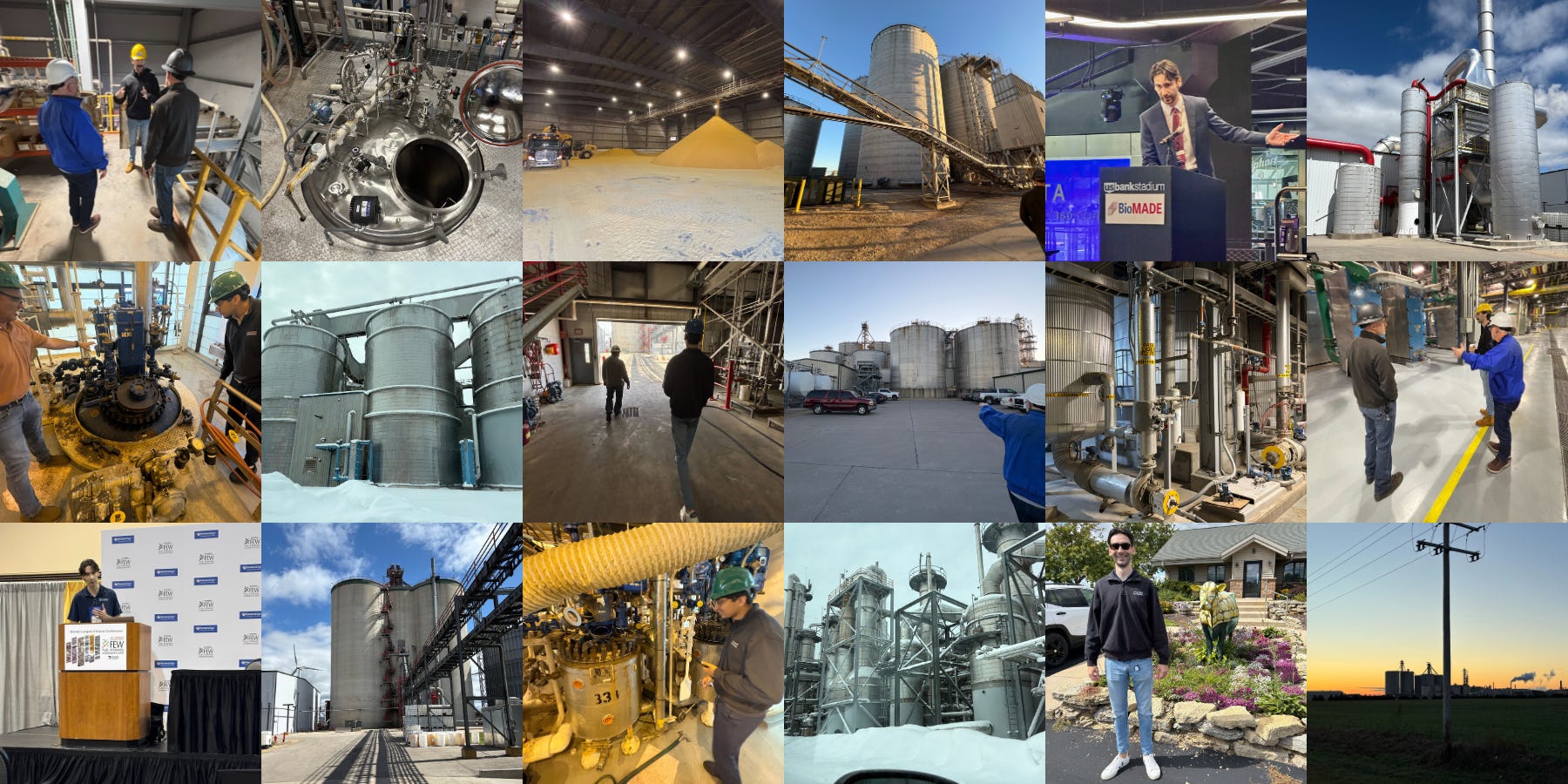
From the beginning we’ve sought to make our fermentation platform effectively scale invariant by categorically eliminating contamination risk and oxygen dependence. These are great wins against standard bioprocess on paper, but scaling is actually done in real facilities in the middle of nowhere and not on a spreadsheet. Even with extensive modeling, some unknown unknown amongst the valves, pumps, and piping will invariably break your process. The only way to survive is to be ahead of it.
Through the hospitality of our scaleup and ethanol plant partners we’ve been able to visit seven facilities and get hands-on time with hundreds of real fermenters from tens to millions of gallons in size. Major wins: preempting at least five unforeseen engineering challenges, spending a few days on the plant floor with operators learning the ropes, developing a tangible path from our 50L fermenter to the 100kL scale, and getting out of the lab.
Many thanks to Dr. Yanhong Zhang and the NCERC team, Dr. Beth Conerty and the IBRL team, Alaina Pardonnet and the MSUBI team, Lee Olson and the UWGP team, Mike Chisam and the Kansas Ethanol team, and Mike Tormey and the Fulton Ethanol team for letting us poke around.
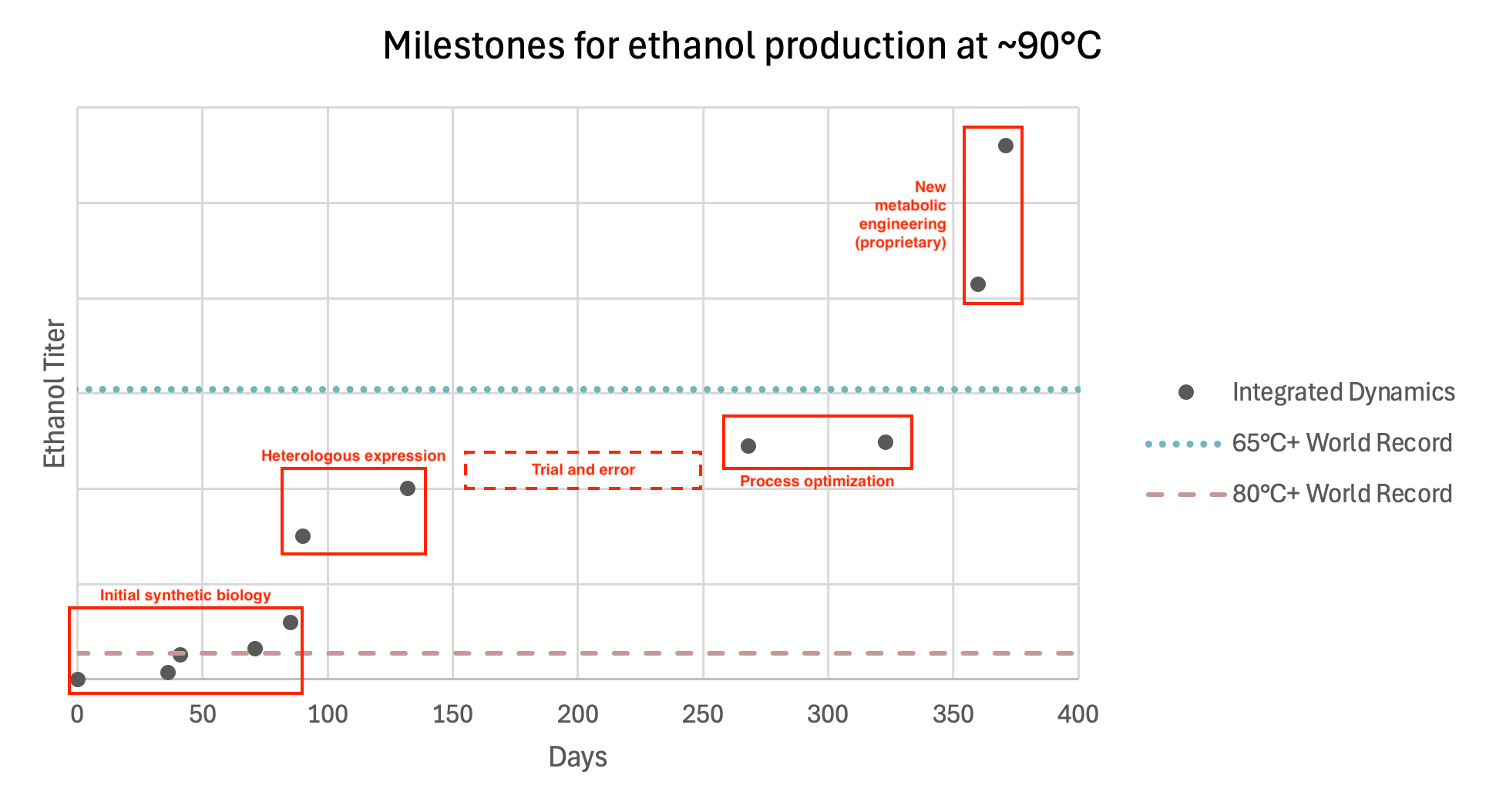
The graph above shows how long it has taken us, in days, to blow through decade-strong records in the production of ethanol* with thermophiles. ~1mo to match the hyperthermophile record, ~2mos more to break it, and only ~8mos more to nearly double our advantage over every other kind of microbe remotely comparable to ours.
The past ~month’s major improvements follow a campaign of exploratory research on optimizing the archaean central carbon pathway for bioprocess. Initial applications of this research have yielded a best-in-class biocatalyst by a margin of nearly 100%, and we expect the current trend to continue as we stack more of our findings into flagship strains.
The engineering we do here will generalize broadly to arbitrary pathways in a large group of archaea and bacteria that have not previously been considered bioprocess-viable. As we’ve said before, the work we do at Integrated Dynamics reaches far beyond just one chassis and and a few products. We’ll submit a provisional patent application disclosing this innovation by EOQ.
*We use ethanol titer as a proxy metric for growth rate, but the same uplift has been observed in total feedstock consumption, feedstock consumption rate, and ethanol productivity.
If you’ve made it this far, you might want to learn more about our work. Feel free to shoot me an email or reach out over LinkedIn whenever.
I’ll be in St. Louis for the DARPA Connect event in two weeks, in Champaign for the AgTech Summit in March, and stuck in the lab in between.
-Henry Markarian, CEO
Comments
Nothing yet. Say the first thing.
Sign in to join the conversation.