
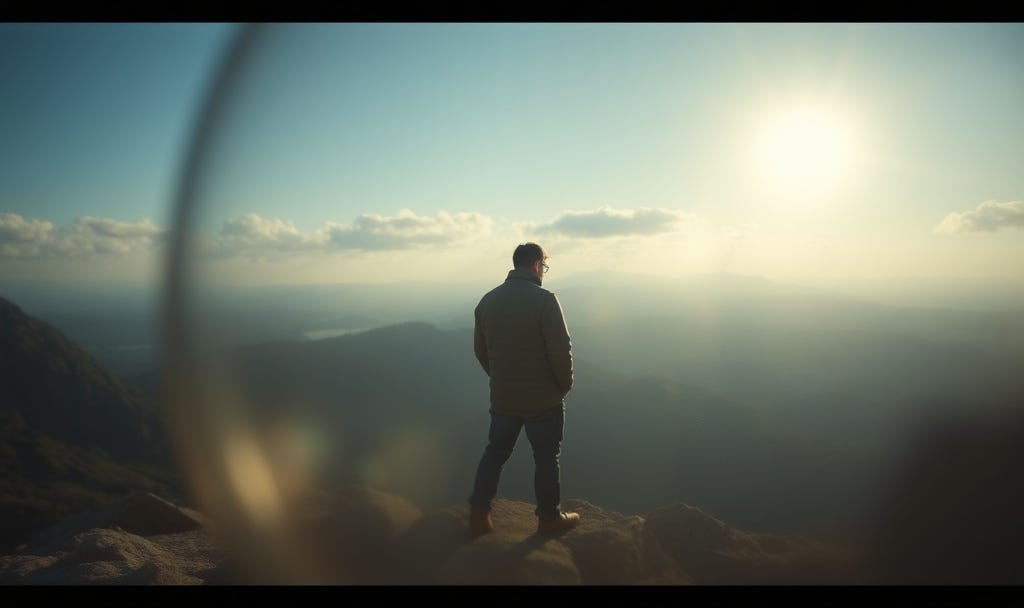
I once had a Human Design facilitator warn that genuine transformation never occurs by focusing on predicted results, starting points, or end points. The true worth lies in the process itself, as it uncovers the hidden qualities of the dialogue and the associations that influence the viability of an emergent outcome. Sometimes, the best place to arrive is far from the intended goal; often, that goal is merely a crossroads on the journey to where you genuinely want to go.
I have returned to that insight many times over the years. The more experience I gain, the more I realise that clarity often operates in similar ways. We tend to treat it as a destination—a place we arrive once we have enough information or understanding. Yet clarity is rarely an endpoint. More often, it is a stage in an ongoing process of discovery, one that changes both the questions we ask and our relationship to the answers we find.
Many people assume that being able to see clearly is the ultimate goal. We celebrate awareness, encourage learning, and speak of truth as though once it is discovered, the path forward naturally reveals itself.
Seeing clearly is not simply about gaining information. It is about encountering realities that may challenge how we understand ourselves, our communities, and the world around us. That can be uncomfortable, destabilising, and at times feel like a loss because clarity comes with a cost.
Sometimes what becomes visible is not a hidden truth “out there,” but something much closer to home. A pattern we participate in. An assumption we inherited. A belief that once felt certain but now appears incomplete. The more honestly we look, the harder it becomes to maintain simple stories.
Problems that once seemed to have obvious causes begin revealing deeper layers of complexity. The people we once viewed as opposition begin appearing more human. The systems we criticised from a distance reveal how deeply interconnected we are with them.
Clarity invites us to question the certainties we build to protect our sense of security.
When the world feels unstable, certainty can create the illusion of solid ground. It allows us to quickly identify who is right, who is wrong, and what should happen next. Seeing clearly often disrupts that comfort.
Complexity can feel distressing because it rarely provides immediate relief. It invites us to sit with tensions that do not resolve neatly while trying to hold multiple truths at once. It reminds us that most meaningful human challenges cannot be reduced to simple answers.
This is one reason why genuine awareness can feel exhausting, although not always difficult. Understanding often requires us to loosen our attachment to familiar explanations, remain present, and continue listening. It asks us to stay curious beyond facts and figures, leaning into process and understanding when certainty, withdrawal, and defensiveness would be easier.
And perhaps most challenging of all, it asks us to acknowledge that we are not separate from the systems we critique. We not only participate in them, but also influence them and are influenced by them.
That recognition can feel heavy at times. Yet within that burden of relatedness, possibilities can begin to take shape through the power of connection. If we are connected to the systems around us, then we are not powerless in our relationship to them. We can discover not only our participation in those systems, but also our capacity to engage and contribute differently.
This is not easy. It requires a willingness to remain in relationship with reality and all its layers of complexity rather than retreating into simpler narratives that offer temporary comfort.
What if we shifted our understanding of clarity from a loss of certainty to an exchange—trading simplicity for the capacity to hold greater complexity? What if we recognised that complexity, despite its challenges, offers us something far more valuable than the comfort of easy answers?
Emerging in place of certainty are humility, connection, and responsibility, along with the ability to operationalise them in response to the world as it is, rather than as we wish it to be.
This is the fifth article of a broader exploration into what happens after awareness—how we stay open to complexity, deepen connection, and move toward meaningful collective action.
No posts
Comments
Nothing yet. Say the first thing.
Sign in to join the conversation.