
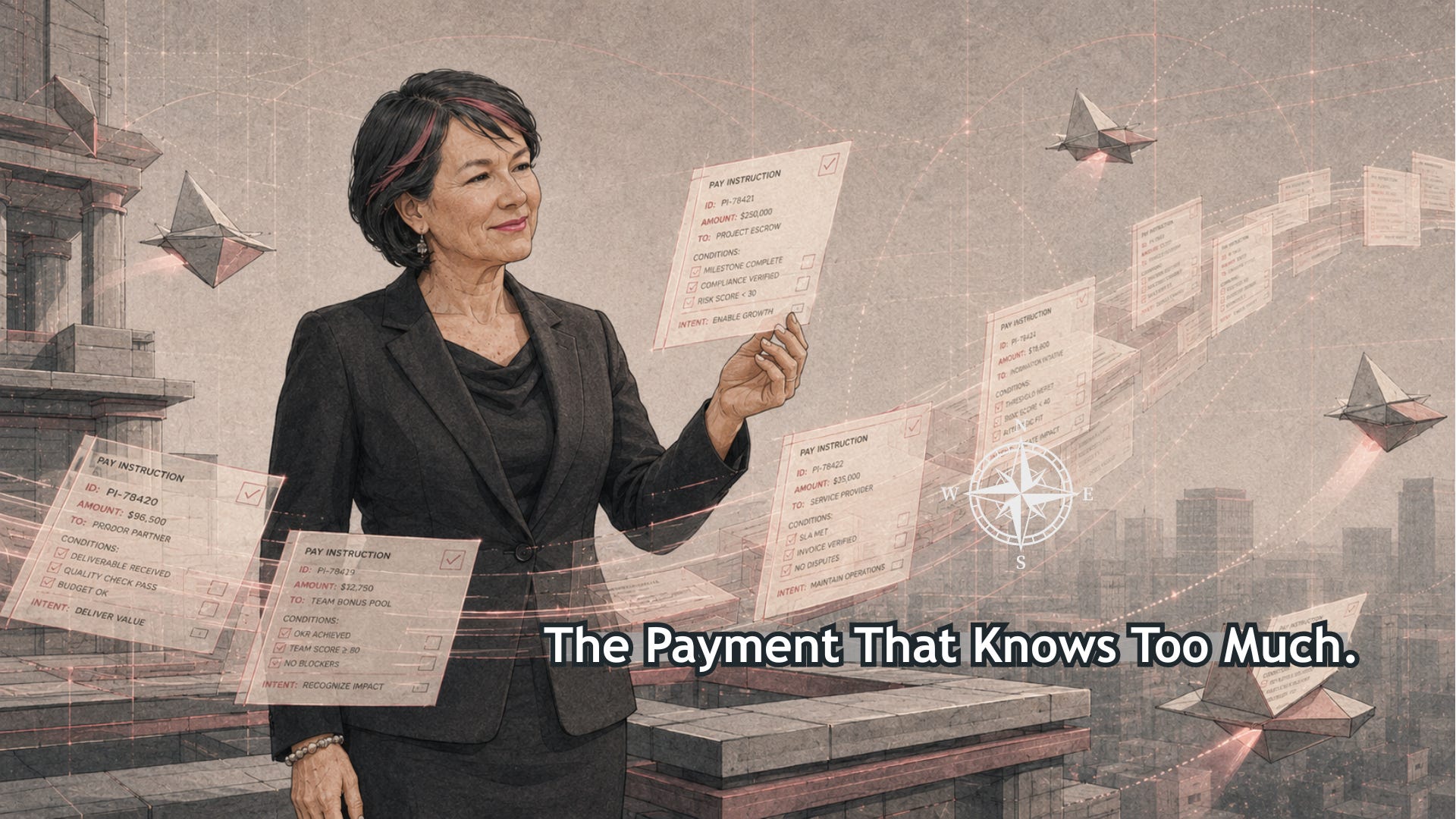
A CFO told me about the night an AI agent moved her company’s money without anyone signing off.
Normally her treasury analyst reviews anything above a set threshold before it releases. That night, a supplier invoice cleared the threshold at eleven o’clock, and the agent, running treasury operations on autopilot, released payment on an instant rail and swept the exact amount from a linked pool. No analyst reviewed it. No one was in the room.
The instruction was well formed. The authority was real. The money was gone, and final.
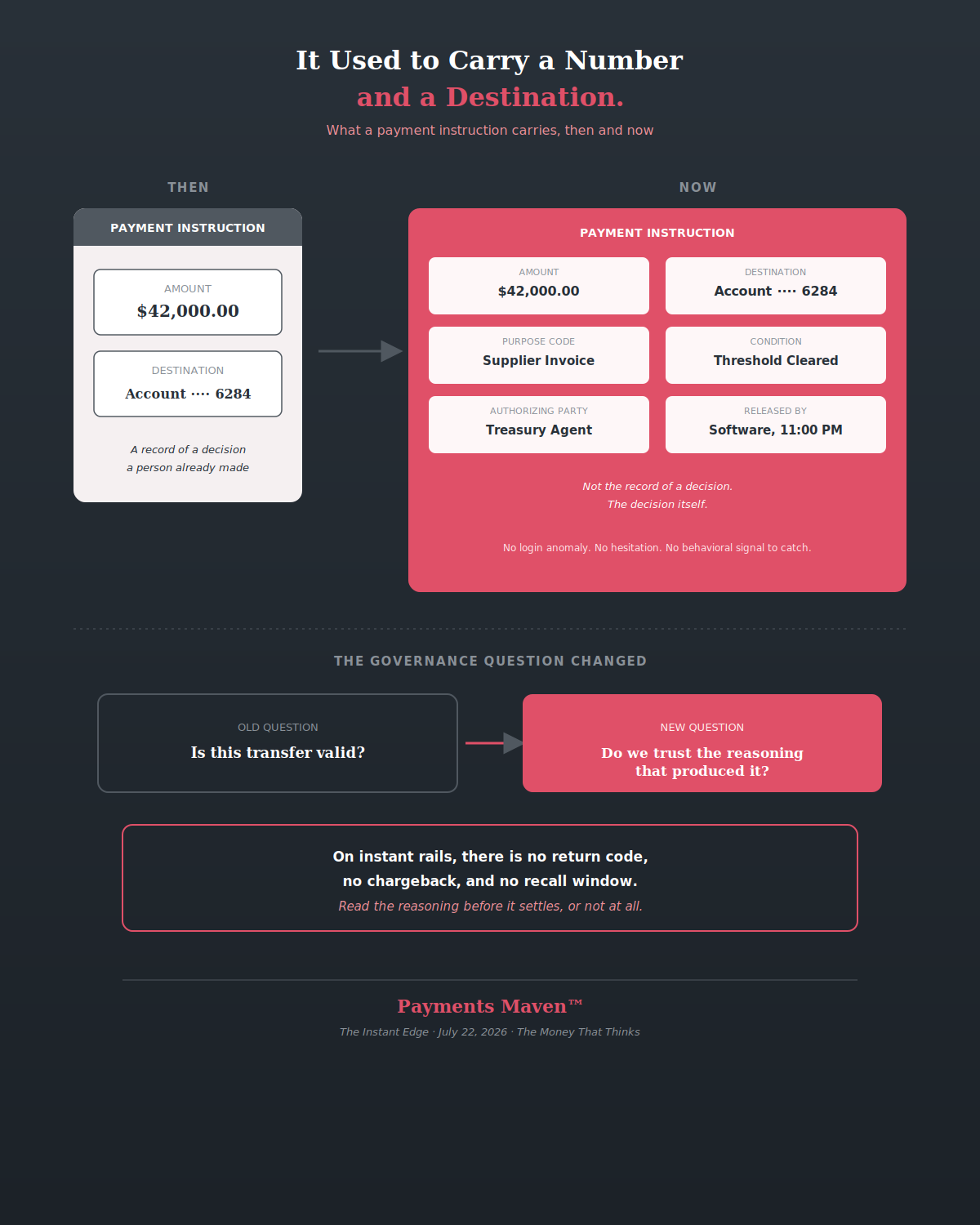
For most of banking history, a payment instruction carried two facts. How much, and where. Everything your systems did downstream, the posting, the reconciliation, the fraud review, worked off those two facts and a handful of static fields around them. The instruction was a record of a decision a person had already made.
That is not the instruction crossing your rails tonight. The payment moving across your rails now carries why it is being made, under what conditions it should execute, on whose authority it was released, and what should happen next if a condition changes. Increasingly, no person authorized it at all. It was reasoned into existence by software acting on a goal.
Your systems saw a valid payment. They did not see a decision being made.
The instruction knows too much to be treated as a simple transfer. Most institutions are still governing it as one.
What the instruction started carrying
Two forces changed the character of the payment at the same time. The first is enriched data. As ISO 20022 becomes the language of the rails, the message stops being a thin string of numbers and becomes a structured document: purpose codes, remittance detail, party identifiers, references that tie the movement to an invoice, a contract, an event. The value of that richness sits at the application layer, in the logic that reads it, not in the message itself. Structured context reaching an institution with no way to act on it is just heavier plumbing.
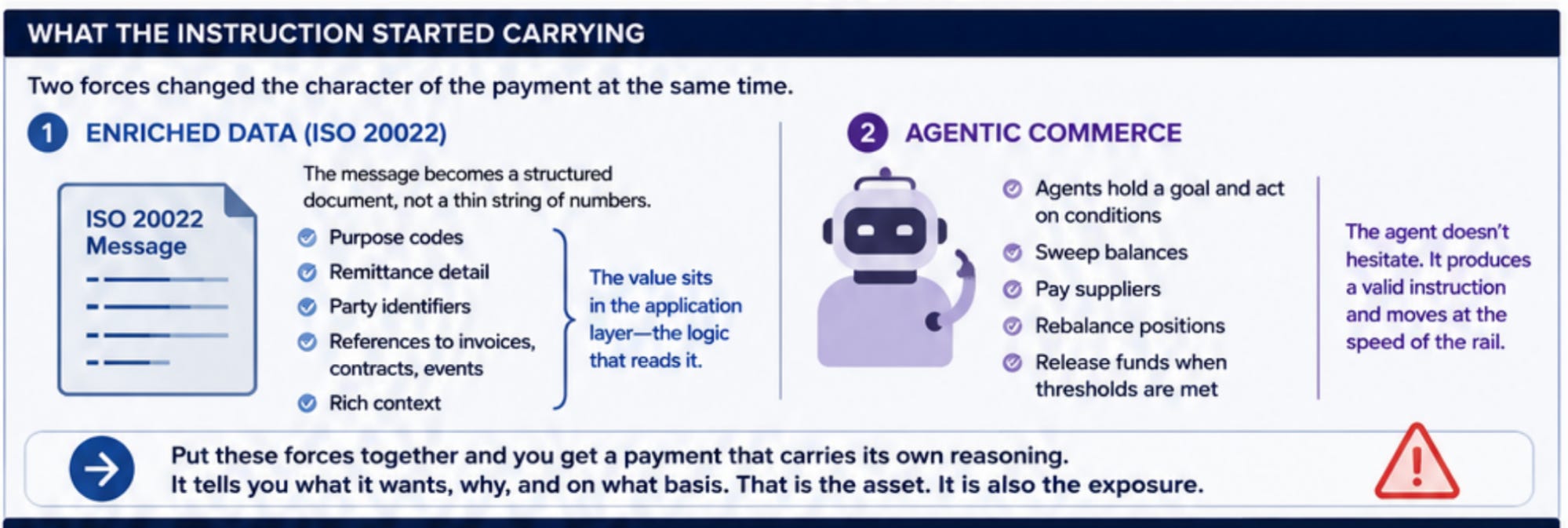
The second force is Agentic Commerce. Payments are beginning to originate from software agents that hold a goal and act on conditions, sweeping balances, paying suppliers, rebalancing positions, releasing funds the moment a threshold is met. The agent does not hesitate, does not log in from an unusual device, does not exhibit any of the behavioral signals your fraud models were trained to read. It simply produces a valid instruction, correctly formed, fully authorized, moving at the speed of the rail.
Put those two forces together and you get a payment that carries its own reasoning. It tells you what it wants, why, and on what basis. That is the asset. It is also the exposure.
Here is the shift most leadership teams have not named yet. You used to govern a transfer. The question was narrow: is this movement valid, is the account real, is the amount within limits. Now you are governing an instruction that carries a decision inside it. When a payment knows why it is being made, the governance question moves from is this transfer valid to do we trust the reasoning that produced it. Those are not the same question, and the controls built for the first do not answer the second.
On instant rails, that gap has teeth. There is no return code, no chargeback, no recall window. (I have made this point before, and it matters more here than anywhere.) An ACH or Wire transfer you can sometimes claw back. A decision that has already executed, irrevocably, on reasoning you never inspected, you cannot. The intelligence in the instruction is only useful to you if you can read it and rule on it in the moment, before it settles.
The payment is no longer the record of a decision someone already made. It is becoming the decision itself.
The payment is becoming the decision itself, not the record of one.
The institutions that recognize the instruction as an intelligent object stop treating its context as noise to be stripped and start treating it as a control surface. The purpose code, the originating authority, the conditional logic, the agent’s identity: these are signals you can govern against in real time, if you have built somewhere for that decision to happen. The same enrichment that raises the exposure is the material a real-time control layer reads to manage it. Programmable conditions stop being a product feature and become the place where your policy lives.
That is the posture this arc is going to build on. A payment that knows too much is a problem only for an institution that cannot read what it knows. For one that can, the intelligence in the instruction is the richest fraud signal, reconciliation input, and liquidity read you have ever had access to, in hand before the money moves rather than after. The question is not whether to let intelligent payments onto your rails. They are already there. The question is whether your institution is built to listen to what they are telling you.
So here is the question worth taking into your next leadership conversation: when a payment reaches you carrying its own reasoning, does your institution have a place to read that reasoning and rule on it, or does it simply post the result?
If your leadership team would benefit from this perspective in the room, connect with me on LinkedIn.
Comments
Nothing yet. Say the first thing.
Sign in to join the conversation.