
A payroll disbursement lands at 11:47 PM on a Wednesday. The treasury automation system read the account conditions, confirmed the balance, matched the payroll file, and sent the instruction. No human in the loop at that moment. The payment settled in seconds.
Your institution processed it normally.
Now imagine the fraud alert fires on that same transaction. Midnight initiation. High velocity. A pattern that breaks every historical baseline in the system. The operations team gets a flag. The client’s treasury platform does not have a contact number. There is no one to call.
The client finds out in the morning that payroll was delayed. They are not angry at the AI. They are angry at the bank.
That scenario is already playing out inside commercial portfolios at institutions that have not yet named what changed.
For most of banking’s history, every transaction had a human on at least one end. A business owner deciding to move money. A controller approving a vendor payment. A clerk running the disbursement file. The fraud controls, the authentication flows, the relationship model: all of it was calibrated for that person.
Agentic commerce replaces that person with a software system that decides and executes without human approval at the moment of transaction. Treasury automation platforms, ERP-integrated disbursement tools, AI-managed cash sweeps: these are live inside mid-market and commercial banking right now. The client whose working capital management runs on automated rules is running an AI agent. The business whose payables platform initiates hundreds of vendor payments without a human touchpoint per transaction is running an AI agent.
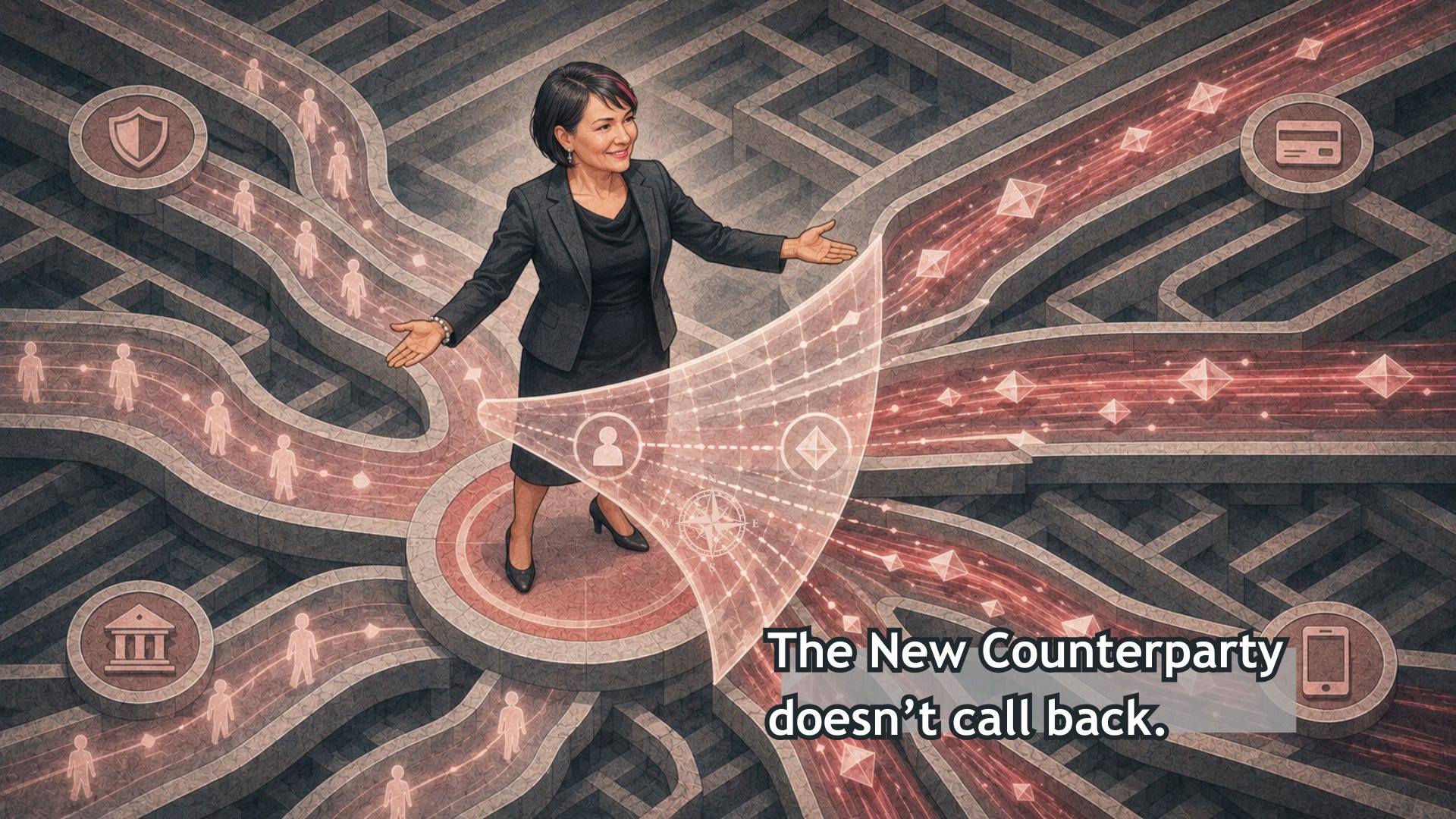
When instant rails are live, those agents transact at a speed and a volume no human-approval flow could match. And the new counterparty behaves nothing like the old one. It does not call the branch. It does not confirm by text. It initiates at 2 AM, at high velocity, in patterns no human account holder ever produced.
Here is the part that makes this hard. The fraud flag is often correct to fire. A high-velocity payment initiated at midnight genuinely could be an account takeover. The model is not wrong to notice it.
The institutions navigating this poorly are splitting into two failure modes, and neither is acceptable.
The first holds legitimate AI-initiated transactions because they break human baselines. Every hold creates friction on a commercial client running governed, legitimate automation. That client experiences the delay. They do not experience a thoughtful risk decision. They experience a bank that does not understand how they operate.
The second relaxes thresholds broadly to avoid false positives. The AI patterns stop triggering holds. Now the institution has no way to see which of those transactions were genuine and which were not. The blind spot is not the exception. It is the policy.
Fraud models do what they were built to do: flag transactions that don’t match historical patterns. A high-velocity payment at midnight should raise a flag. The real question isn’t whether to flag it. It’s whether the institution has the signal to tell a governed treasury agent apart from an attack.
Most institutions do not, because most fraud models read the wrong layer. They read behavior: time, velocity, amount, frequency. Behavior alone cannot distinguish a legitimate automated payroll run from a coordinated attack, because at the behavioral level they look identical. Both move fast. Both move at odd hours. Both break the historical pattern.
The signal that separates them is not behavioral. It is contextual. And on instant rails, that context is already in the message.
FedNow and RTP both run on ISO 20022, a structured data standard that carries far more than the amount and the account number. Most institutions are not yet reading the fields that would let them classify an AI-initiated payment instead of merely flagging it. The fields already exist in the message arriving today.
A few of them matter directly here:
Initiating Party. When a payment is made on behalf of someone, this field names the party that initiated it. A treasury platform acting for a business client is exactly that relationship. This is the single most useful field for agentic commerce, because it can show that a payment was initiated by a delegated system acting for an authorized principal, not by an unknown actor.
Purpose and category purpose codes. These declare why the payment is being made. A fraud model can check whether a transaction’s characteristics are consistent with its stated purpose, rather than guessing from amount and timing alone. A midnight payroll run that declares itself a payroll run is a different object than a midnight transfer with no stated purpose.
Ultimate debtor and ultimate creditor. These identify the real parties behind a transaction, even when an agent or intermediary sits in the middle. They let the institution see the principal the agent is acting for.
Structured remittance information and structured party identification. Invoice detail, organizational identifiers, and party data arrive in discrete fields rather than free text. That lets a model reliably tell whether a payee is a business or an individual, and match a payment to what it claims to be for.
Read together, those fields turn an anomalous-looking payment into a legible one. The transaction that looked like nothing more than “midnight, high velocity, pattern break” becomes “initiated by a known delegated party, on behalf of an authorized principal, for a stated and consistent purpose.” That is no longer a pattern to fear. It is a counterparty to classify.
The redesign is not a new fraud tool. It is reading the data the rail already delivers, and treating message context as a first-class fraud signal rather than discarding it.
This is where the question changes shape. When an AI agent initiates a payment, the institution needs to answer three things before it acts: who authorized this agent, what governance boundaries apply to its behavior, and does this transaction fall within them right now.
That is not a fraud question. It is a counterparty governance question, and the response is different. A fraud flag produces a hold and an alert. A counterparty governance signal produces a rule-based escalation to the human principal who authorized the agent. The right architecture makes both responses possible at once, without friction for legitimate commerce.
A governed data layer that reads context from every rail before downstream controls fire is what makes that distinction operational. The Real-Time Control Layer matters here in exactly this way: it does not just serve fraud detection, it serves counterparty classification. The institutions that build this will not advertise it. They will simply process commercial payments with fewer exceptions, fewer delays, and fewer misclassified events. Their commercial clients will notice.
If your chief risk officer and head of payments have not been in the same room discussing AI-initiated transactions, this is the moment to bring them together. Share this issue.
These each have a direct answer and a direct owner at your institution:
When your commercial clients’ treasury systems initiate automated payments, does your institution classify those transactions differently from human-initiated ones, or does every transaction pass through the same review logic?
Is your fraud and payments operation reading the structured context already in the message, the initiating party, the stated purpose, the ultimate parties, or is it making decisions on behavior alone?
If a commercial client’s AI agent initiates a high-value payment at 2 AM that violates no explicit rule but breaks every historical pattern, what happens next, and is that outcome governed by design or improvised by whoever is on call?
If the answers are unclear, that is meaningful signal. The agentic commerce layer is already operating inside your existing commercial relationships. The data to govern it is already arriving. The reading of it has not caught up.
The institution that governs AI-initiated commerce as a first-class counterparty category can serve the next generation of commercial client at a depth that human-only-designed institutions cannot match.
The commercial client whose treasury agent operates without friction, whose payment instructions clear cleanly, whose exceptions route to the right principal at the right moment, that client does not leave. It deepens the relationship. It expands its operating reliance on the institution that built a system capable of handling what it actually does today.
Agentic commerce is the client’s present tense. Governed agentic commerce infrastructure is the institution’s competitive future.
The next issue of The Instant Edge moves to the revenue side. When agentic commerce is governed at the institutional level, new commercial service categories emerge that batch-era institutions were never positioned to offer. The monetization question lives there. That is where June 24 leads.
If someone on your team should read this,
If your leadership team would benefit from this perspective in the room, that conversation is worth having.
© 2026 FinTech Consulting LLC | Proprietary Frameworks (SAFE™, SEND™, Payments Maven™)
Use by license or written agreement only.
Comments
Nothing yet. Say the first thing.
Sign in to join the conversation.