

I have heard people say “stablecoins will make banks irrelevant, instant payment rails will become obsolete, and a new generation of digital-native infrastructure will bypass everything financial institutions have spent the last decade building.”
I believe that story is wrong, although the events of the past week make it easy to understand why senior leaders are paying attention.
On June 30, a consortium of more than 140 partners, including Visa, Mastercard, BlackRock, Stripe, Coinbase, and BNY, launched Open Standard, a new initiative that is expected to issue Open USD for global business payments later this year. The next day, MiCA enforcement went live across the EU. And here in the United States, the GENIUS Act’s implementing regulations are due by July 18, a mere ten days after this article publishes.
In other words, the regulatory and market structure for stablecoins is not far off, it is materializing now, as I write.
But here’s the thing to note: nothing in that structure replaces the domestic payment rails that your financial institution already participates in.
In fact, the structure depends on them.
The GENIUS Act, signed into law July 18, 2025, creates a federal framework for payment stablecoins: digital assets designed for payment or settlement, issued by permitted entities, and backed one-to-one by high-quality liquid assets.
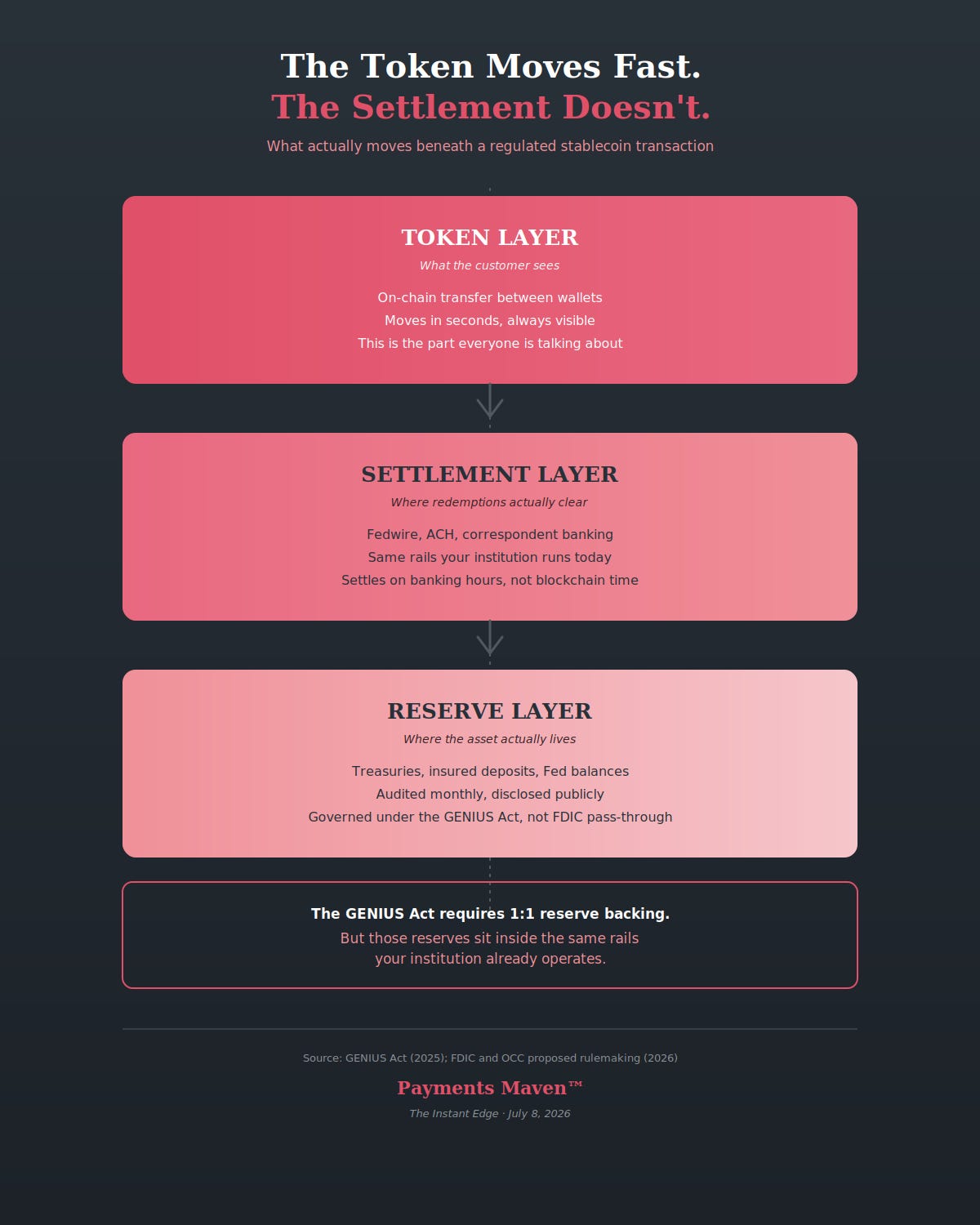
Those reserves must be segregated, regularly audited, and publicly disclosed. They can include assets such as short-term U.S. Treasuries, deposits at insured institutions, and other approved liquid instruments.
Issuers also cannot pay interest or yield to stablecoin holders. Third-party platforms may still offer incentives independently, and some already do. But the issuer itself operates under constraints that look less like a fintech disruptor and more like a narrow, reserve-backed financial institution.
The most important distinction for financial institution leaders is this: a stablecoin holder does not have a deposit claim against a bank. Their claim is against the stablecoin issuer.
That means FDIC insurance does not pass through to the stablecoin holder simply because the issuer holds reserve deposits at an insured bank. The FDIC’s proposed rule makes this explicit: deposits held as reserves backing a payment stablecoin would not be insured to stablecoin holders on a pass-through basis.
This is not a technical footnote. It is the “load-bearing wall” of the entire framework.
A stablecoin transaction looks instant… on-chain. A token can move from one wallet to another… in seconds. But the money behind that transaction still depends on traditional infrastructure.
Reserves are held in bank deposits and Treasury bills. Redemptions still have to move through the banking system. Fiat still moves across Fedwire, ACH, correspondent banking relationships, and increasingly, instant payment rails.
Reality: your instant payment rails are part of the settlement backbone regulated stablecoins need to function. When a stablecoin is redeemed, the underlying fiat still has to move. When reserves are replenished, deposits still have to clear. FedNow and RTP are not being replaced. They are being relied upon.
Opportunity: institutions that have already built governed instant payment capabilities are better positioned to participate in the stablecoin ecosystem than those that have not. The governance, liquidity management, and fraud decisioning infrastructure built for instant payments is the same infrastructure stablecoin activity will require.
I often hear stablecoins framed as a threat to existing rails. I see it differently. The important distinction is between what stablecoins do on-chain and how the value behind them actually settles.
Share this with colleagues who are trying to understand how stablecoins may affect payments strategy, liquidity, deposits, and governance.
This is where the stablecoin conversation moves from theoretical to operational.
Stablecoins do not eliminate deposits from the banking system, but they can change where those deposits sit. Every dollar backing a stablecoin in circulation has to be held in reserve. That means it may be sitting in a reserve account instead of supporting your institution’s lending portfolio, customer relationships, or balance sheet strategy.
The American Bankers Association has estimated that if institutions lose 10% of their core deposit base, funding costs could rise by 20 to 30 basis points. For community and regional institutions that rely on retail deposits to fund small business and agricultural lending, that pressure could be even more meaningful.
But the displacement story is more nuanced than the headline suggests. Today, stablecoin circulation represents roughly 1% of the U.S. money supply. Payment use cases, the ones the GENIUS Act specifically regulates, are still a small share of stablecoin activity. Most activity remains tied to crypto trading infrastructure.
So the strategic question is not whether major deposit displacement is happening today.
It is whether your institution can see where deposits are moving, in real time, across every rail you participate in — including this one as it emerges.
The regulatory convergence is happening now.
In Europe, MiCA’s transitional period ended July 1. After that, any crypto firm operating in the EU without a MiCA license is in direct breach of EU law. Of the more than 1,200 firms that previously held national VASP registrations, only about 210 have converted to full CASP licensing. The rest have exited, gone dark, or are in legal limbo.
MiCA also requires stablecoin reserves to include a minimum deposit share held at banking institutions: at least 30% for standard issuers and 60% for significant ones. That pushes reserve deposits back into the banking system, but these may not behave like traditional core deposits.
In the United States, the GENIUS Act’s implementing regulations are due by July 18. Final rules from the OCC, FDIC, and Federal Reserve must be issued within 180 days of enactment. That deadline is now. The effective date follows: the earlier of 120 days after final regulations or January 2027.
On June 30, as MiCA enforcement began, Open Standard launched Open USD, a consortium-governed stablecoin backed by more than 140 partners, including Visa, Mastercard, BlackRock, Stripe, Coinbase, BNY, Ripple, and Google. Circle’s stock fell 16% intraday as the market weighed the threat to USDC.
But watch the consortium, not the stock price. When BNY is a settlement partner, reserve management and redemption still depend on traditional banking infrastructure. When Visa and Mastercard are part of governance, this is not a network bypassing existing rails. It is organizing around them.
There is one important nuance: Open USD uses consortium governance, which does not fit neatly into the GENIUS Act single-issuer model. How regulators handle consortium structures in the final rules is still not locked down. What we do know: whichever stablecoin gains share over the next 18 months whether USDC, OUSD, or something else, the settlement backbone underneath still runs through traditional banking and payment infrastructure.
Separately, twelve major European banks have formed a consortium to launch a MiCA-compliant euro stablecoin by late 2026, focused on institutional settlement and tokenized assets. This is infrastructure being built across multiple continents at the same time.
This means that stablecoins are no longer something to “revisit in the next annual planning cycle”. The rules that will shape how they touch deposits, reserves, liquidity, settlement, and customer-facing payment flows are being written now.
The practical question is not whether stablecoins will matter someday. It is whether your institution understands where they may intersect with your operations, and whether your current payments governance is ready for that next layer.
Financial institutions building governed instant payment capabilities are not just solving for faster payments. They are building the control model for modern money movement.
That includes real-time decisions about whether a payment should move, liquidity visibility across prefunded accounts and settlement positions, and fraud controls that operate before or during the transaction — not after the money is gone.
That same control model is what stablecoin activity will require.
When stablecoins touch reserve accounts, redemption processes, treasury operations, or customer-facing payment flows, the questions are familiar:
Who authorizes the movement?
What limits apply?
How is liquidity monitored across pools?
What happens at midnight on a Friday when activity does not stop?
These are not fundamentally new questions. They are the same governance questions financial institutions are already working through for instant payments send.
That is why stablecoins should not be viewed as a separate architecture conversation. They are another place where your existing governance, liquidity, risk, and decisioning capabilities will need to operate.
If your board is still framing adoption as a technology evaluation: should we issue one, should we custody them, what platform do we choose?
They are missing the (structural) point.
This is the question they should be asking:
Does your financial institution have the real-time visibility, the liquidity governance, and the multi-rail decision architecture to participate in an ecosystem where deposits, reserves, and payment flows move across regulated stablecoins, instant payment rails, and traditional settlement systems simultaneously?
If the answer is yes, stablecoins are not a distraction. They become another place your institution can extend trust, control, and customer value.
If the answer is not yet, the work you are already doing around instant payments governance is the work that gets you there.
So the real question is not, “Should we do stablecoins?”
It is:
Is your institution building the control layer required to participate safely and strategically in whatever form modern money movement takes next?
What is your institution’s current answer to that question?
If your leadership team would benefit from this perspective in the room, I’d welcome the conversation. Reach out to me on LinkedIn.
Comments
Nothing yet. Say the first thing.
Sign in to join the conversation.