
For years, investors have known HEG as a graphite-electrode company.
But HEG is now preparing for a major restructuring. Its graphite-electrode business will move into a separate listed company, while the existing company will absorb Bhilwara Energy and become HEG Greentech.
This new company will bring together three very different businesses advanced battery materials through TACC, battery systems through REPlus, and the group’s green-power assets.
The logic is simple. The mature hydropower business can provide steady cash flow, while the newer businesses in anode materials, graphene and energy storage pursue growth
HEG Greentech is not a new company starting from an empty plot of land. It is a proposed listed platform being assembled through a demerger and a merger. It will combine old cash-generating power assets with newer, capital-hungry clean-tech businesses.
The easiest way to understand HEG Greentech is this: mature hydropower is being used as the financial base for much younger bets in battery materials, graphene and energy storage
HEG plans to move its graphite-electrode business into a separate listed company. The company left behind will absorb Bhilwara Energy and be renamed HEG Greentech. That entity will own advanced battery materials through TACC, 74% of battery-systems company REPlus, and the group’s green-power assets
The plan is ambitious: about ₹5,500 crore of capex, funded broadly with ₹1,500 crore of equity and ₹4,000 crore of debt. The presentation also makes clear that future expansion depends on approvals, funding and market conditions
HEG Limited’s core business is graphite electrodes. These electrodes are used in electric-arc furnaces that make steel.
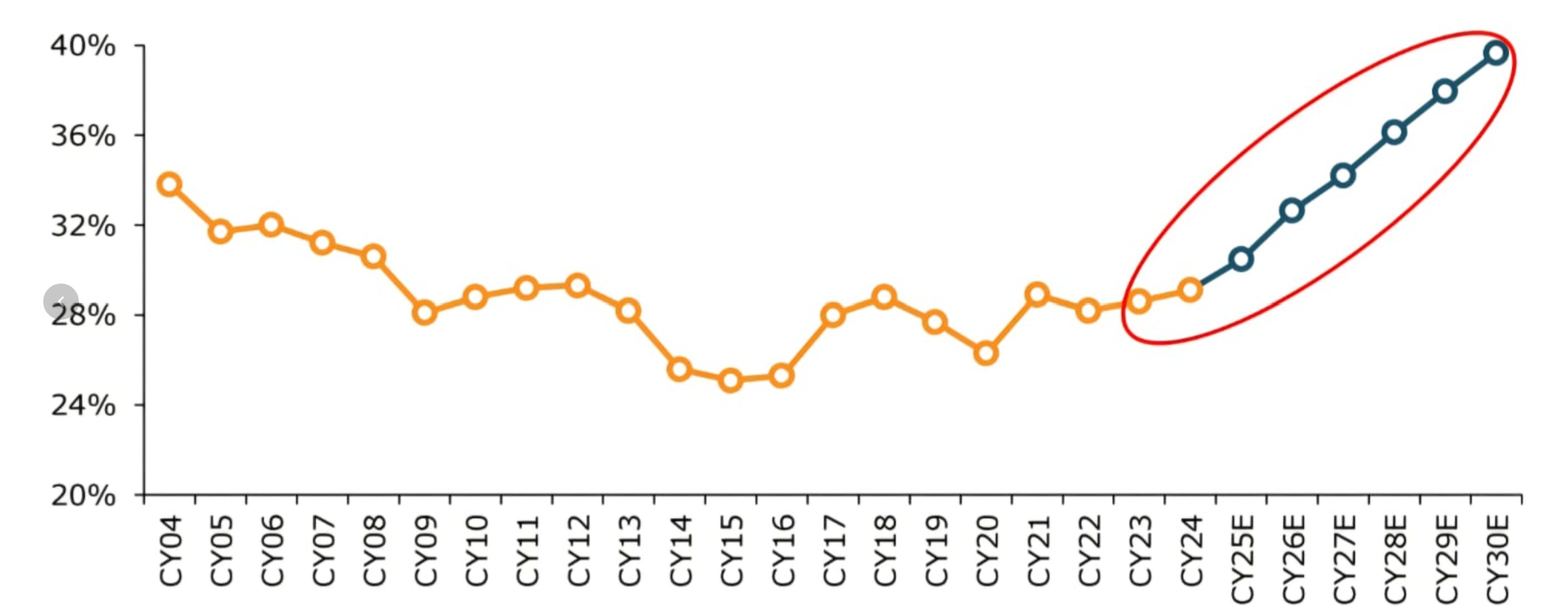
The World’s EAF share is expected to accelerate to 40% by the end of the decade as depicted in the below chart.
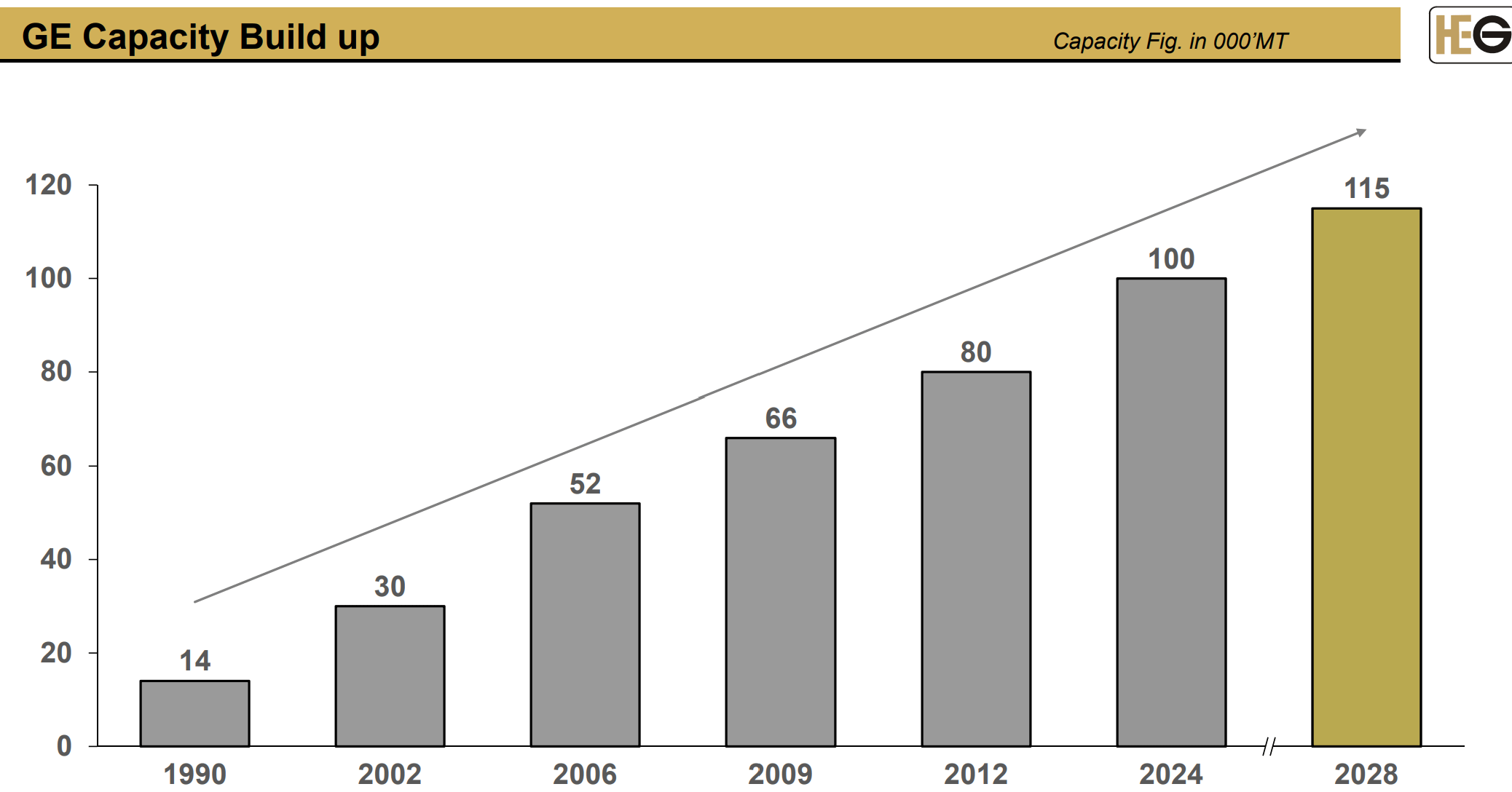
HEG owns World’s Largest Single Site Graphite Electrode Plant under one roof with a capacity of 80,000 tons p.a. for a long time. Now further expanding to 115,000 tons by early 2028.
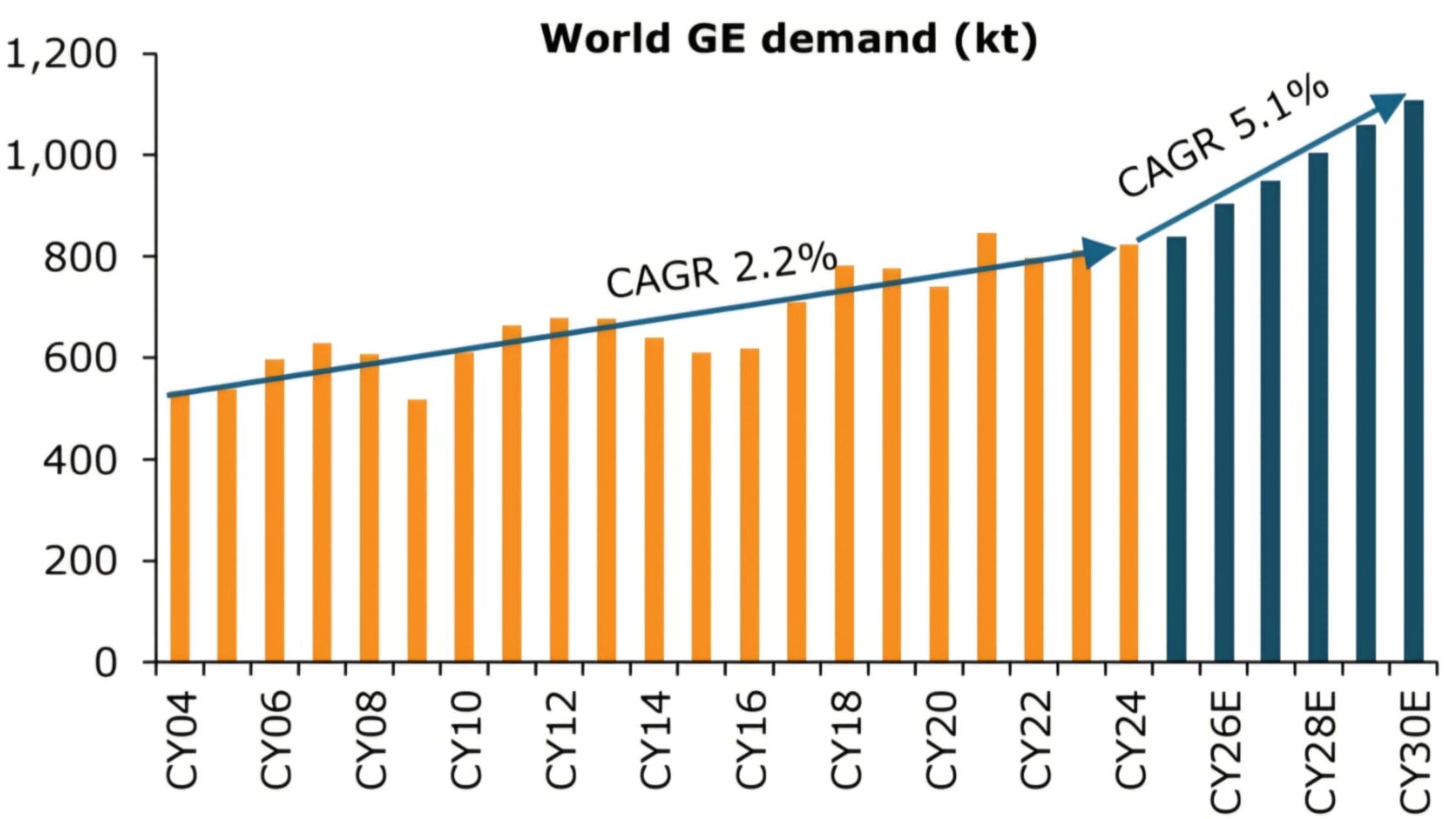
The traditional business is also having tailwind.
As due to ongoing geo-political conflicts the input costs and energy prices are rising. The Ocean freights have started putting pressure on margins which necessistates price increase of graphite electrodes.
Strong EAF capacity pipeline around ~110 mmt additions by 2030 (20 mmt already added), driving ~200,000 tons incremental graphite electrode demand (ex-China). Ex-China demand subdued, Production ~212 mmt, flat QoQ, indicating stable but weak underlying demand outside China
But HEG and the wider LNJ Bhilwara Group had also built or invested in businesses outside graphite electrodes. That includes:
There were hydropower projects under Bhilwara Energy.
A battery-storage company called REPlus.
An advanced-carbon company called TACC.
A graphene programme.
Wind power.
New solar and storage projects
These businesses did not fit neatly inside the public-market identity of a graphite-electrode manufacturer. They also needed a different amount of capital, a different risk appetite and a different kind of investor
The answer was Restructuring.
Step 1: Move Graphite Out
The graphite-electrode business, its related assets and liabilities, and 76.5 MW of captive power will move from the current HEG Limited into HEG Graphite Limited
Step 2: Give Shareholders Both Companies
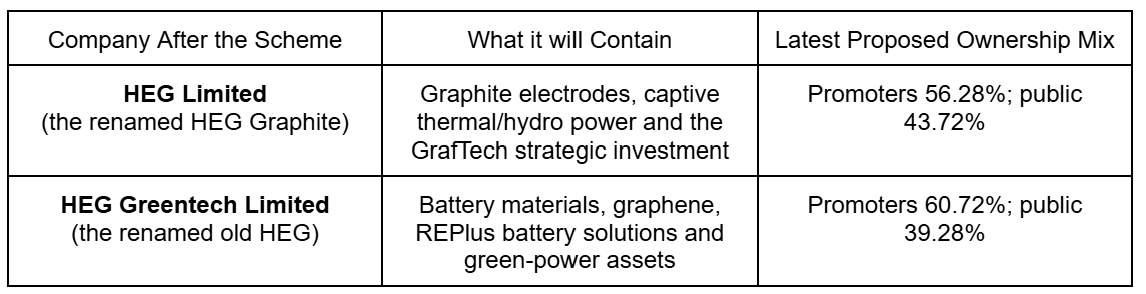
Existing HEG shareholders are to receive one share of HEG Graphite for every one share held in HEG. HEG Graphite will be listed and is proposed to take the familiar name “HEG Limited”
Step 3: Merge Bhilwara Energy
Bhilwara Energy Limited will merge into the old HEG Limited. Its shareholders, other than HEG itself, will receive eight HEG shares for every seven BEL shares under the scheme
Step 4: Rename the Old Company
The old HEG Limited, the company left after graphite is moved out will be renamed HEG Greentech Limited.
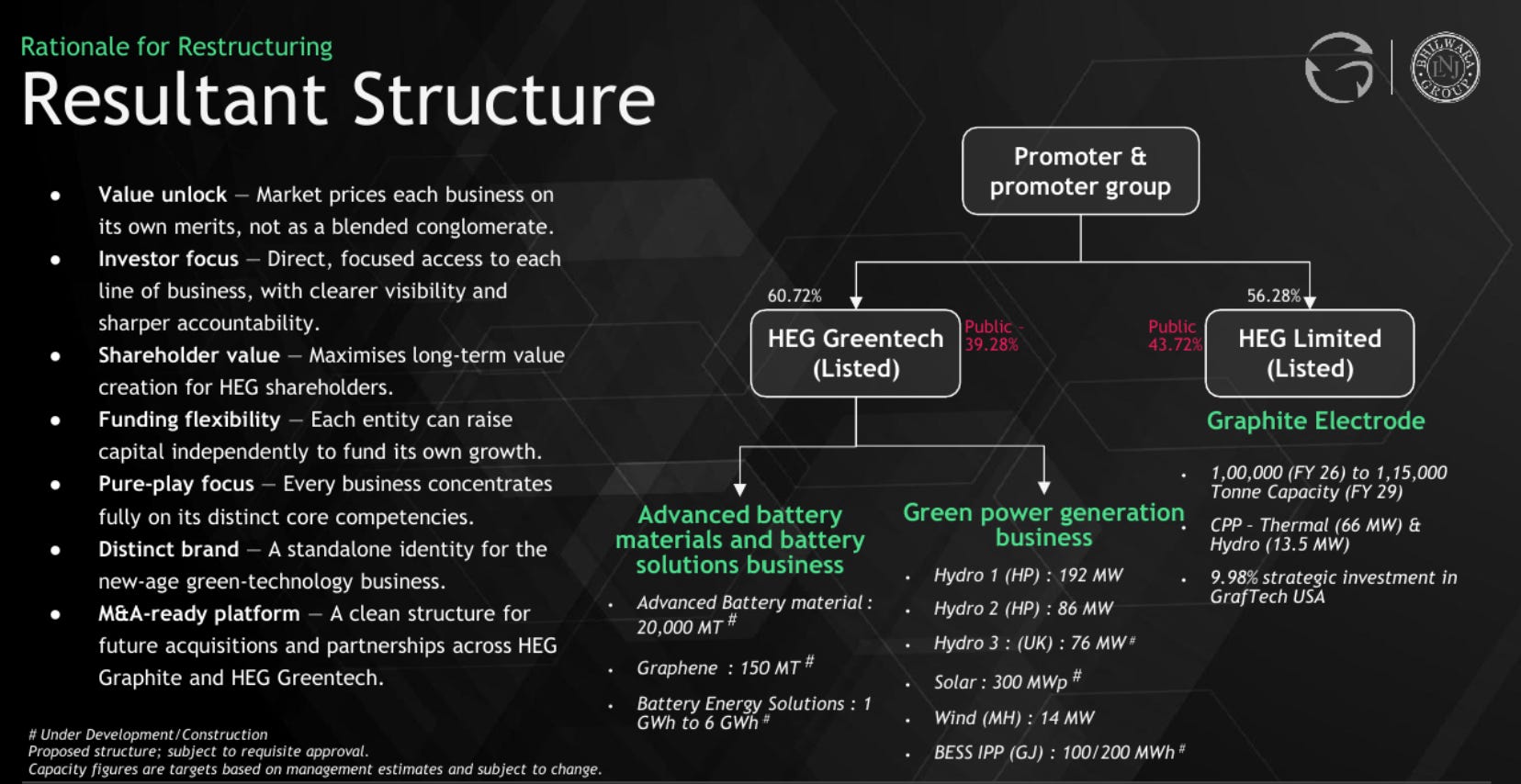
Shareholders and creditors approved the scheme in May 2026. The NCLT’s Indore Bench heard the petition on 2 July 2026 and reserved its order.
So an existing HEG shareholder should ultimately own shares in two listed companies:
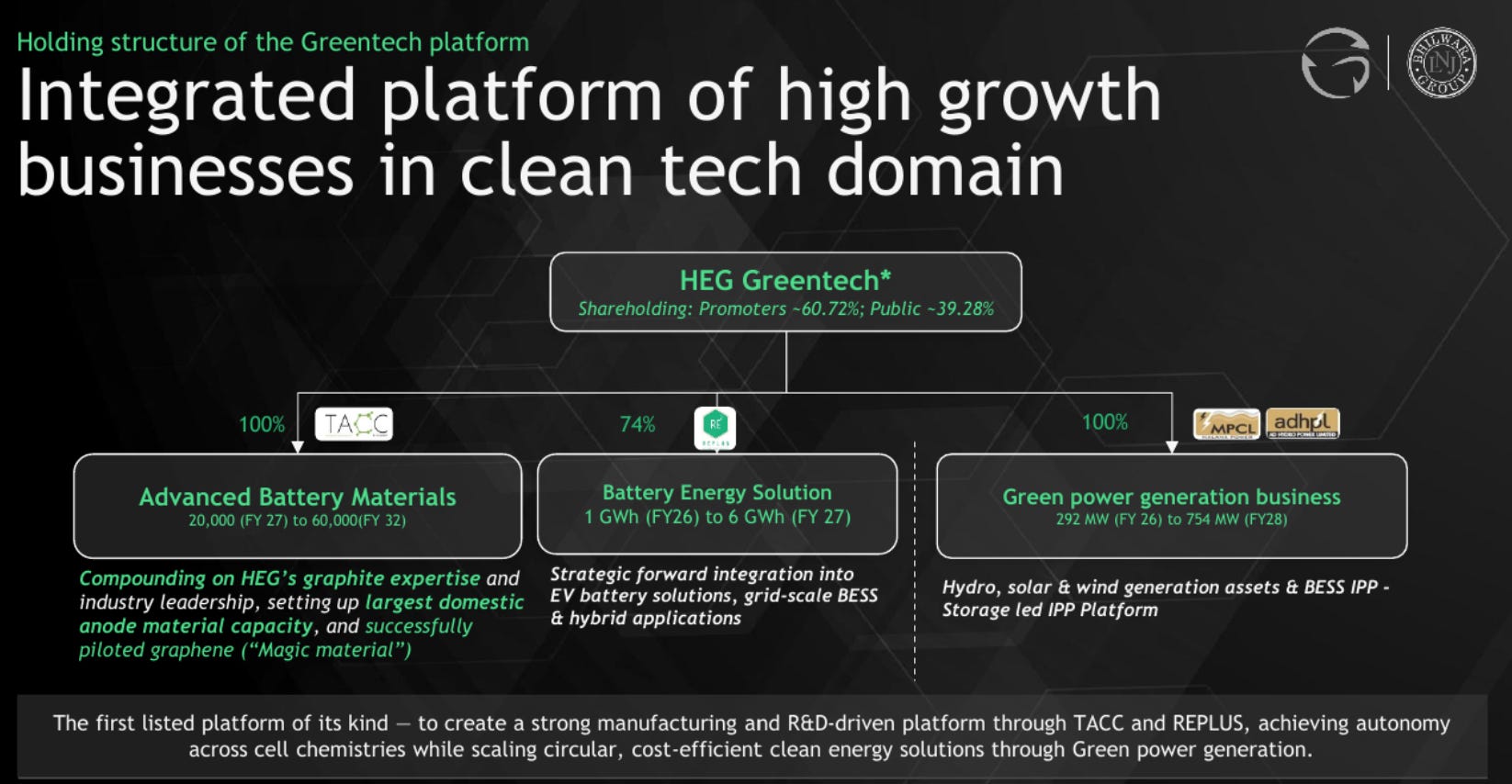
*The proposed platform combines 100%-owned advanced materials, a 74% stake in REPlus and 100%-owned green-power generation assets
The proposed company has three main pillars. They look connected, but they are at very different stages of maturity.
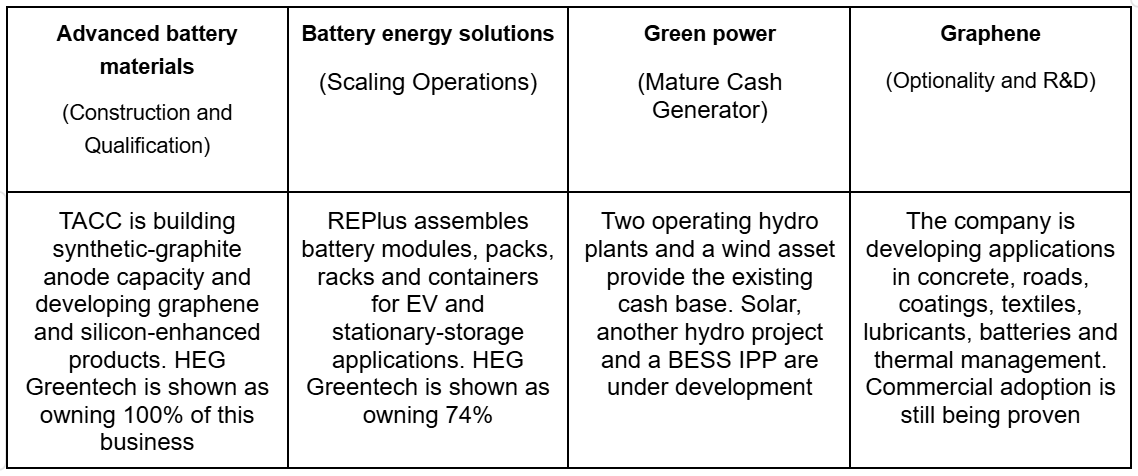
The company’s logic has three parts.
First, cash flow. Hydropower is the stable side of the platform. The two operating hydro projects are described as debt-free and together are said to generate more than ₹300 crore of annual free cash flow based on historical performance.
Second, technical adjacency. HEG has decades of experience in graphitisation and graphite procurement. That knowledge can help TACC manufacture synthetic-graphite anode material. REPlus then sits further down the battery chain, building battery systems for EV and grid-storage use.
Third, funding flexibility. A separately listed Greentech company can raise debt or equity without tying every decision to the cyclical graphite-electrode business
TACC will make anode material. REPlus makes battery modules, packs and storage systems, generally using cells sourced from cell manufacturers. One business does not automatically become a captive customer of the other. The link is strategic, not a guaranteed internal sale
The anode is the negative electrode inside a lithium-ion battery. Graphite is the dominant anode material, especially in mainstream lithium-ion chemistries.
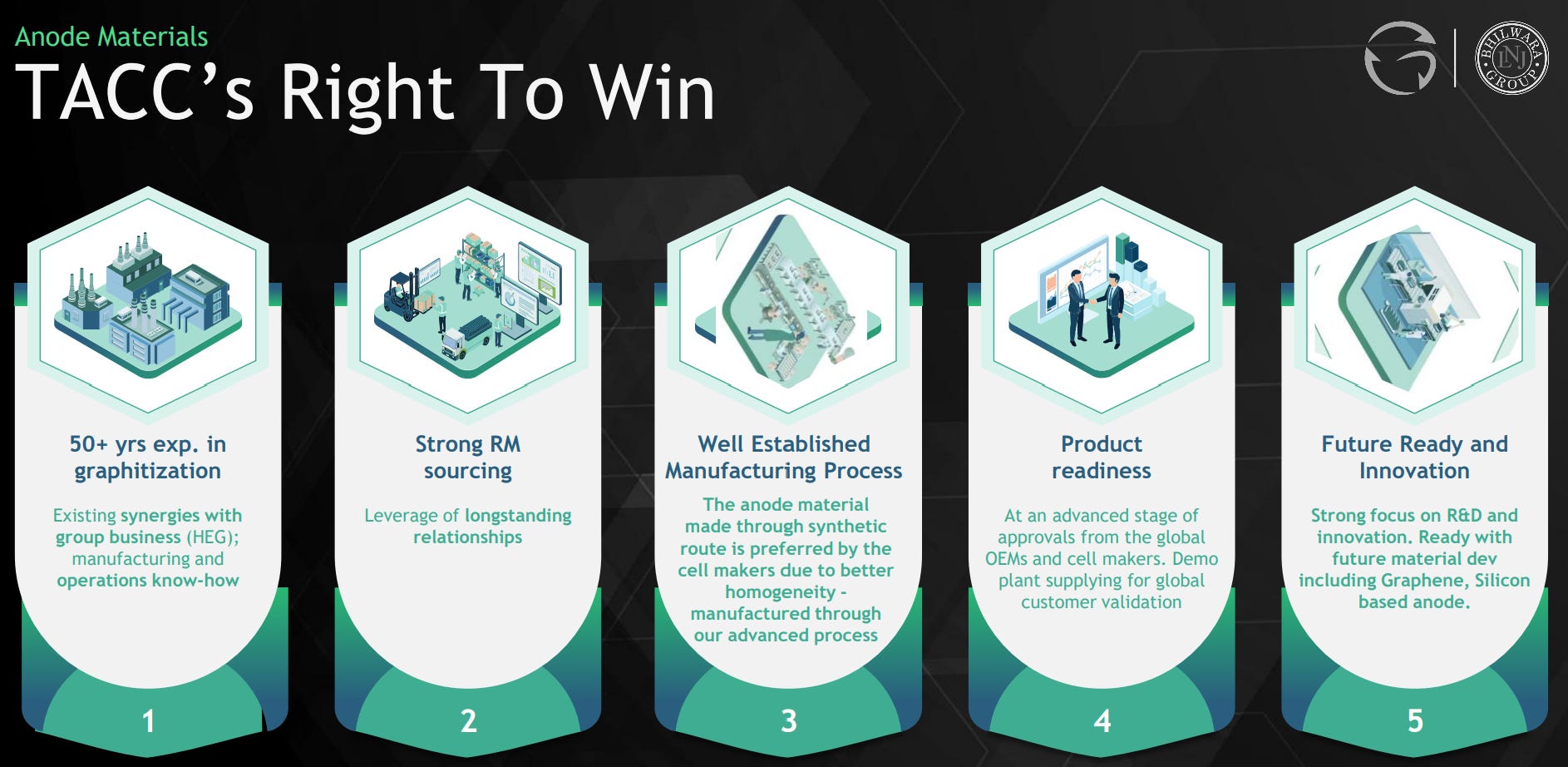
This is the closest Greentech business to HEG’s historic capability. HEG already understands high-temperature graphitisation, carbon materials and global raw-material sourcing.
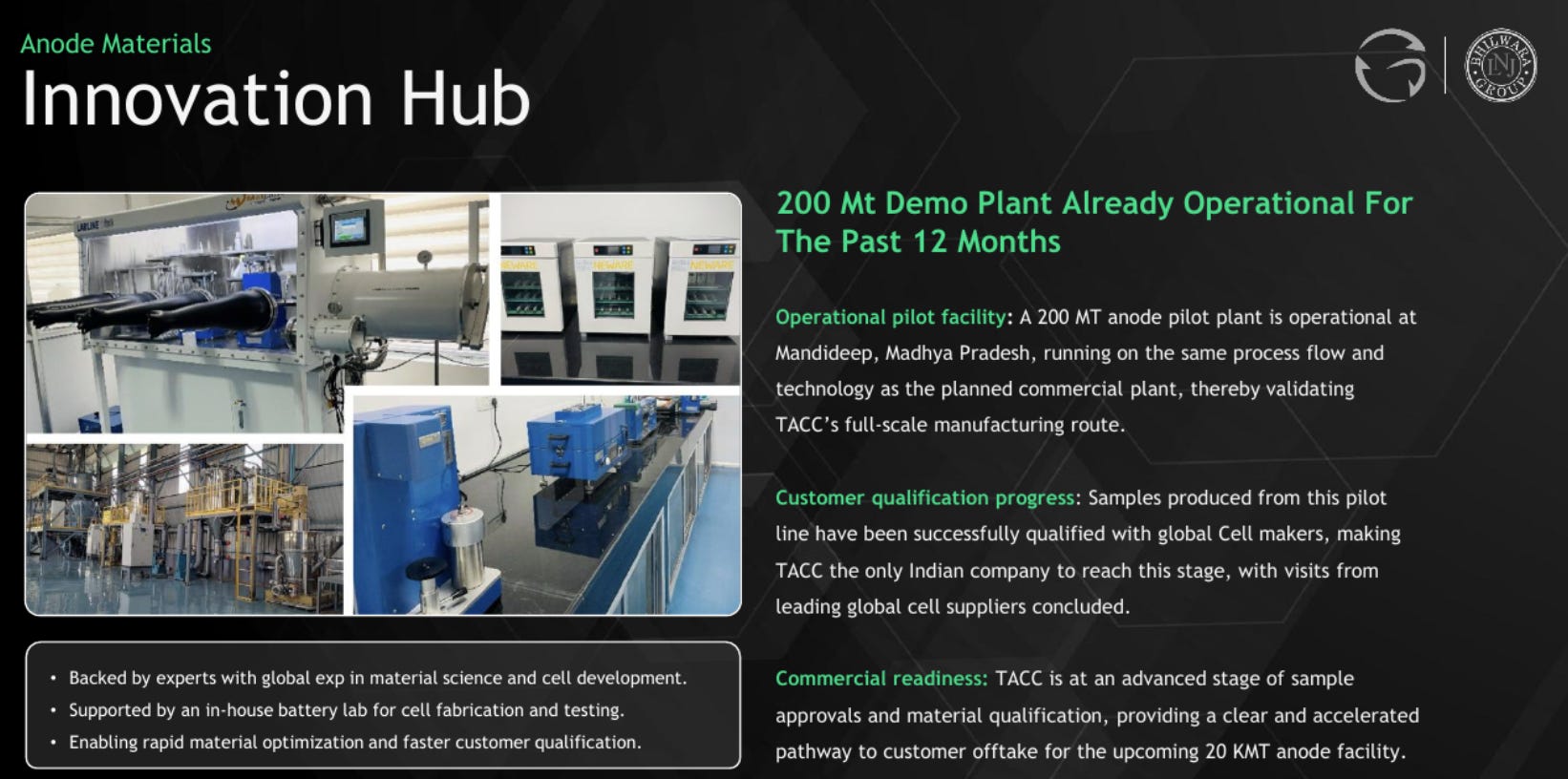
TACC has operated a 200-tonne demonstration plant at Mandideep. The company says this pilot follows the same process route planned for the commercial plant and has supplied material for customer validation.
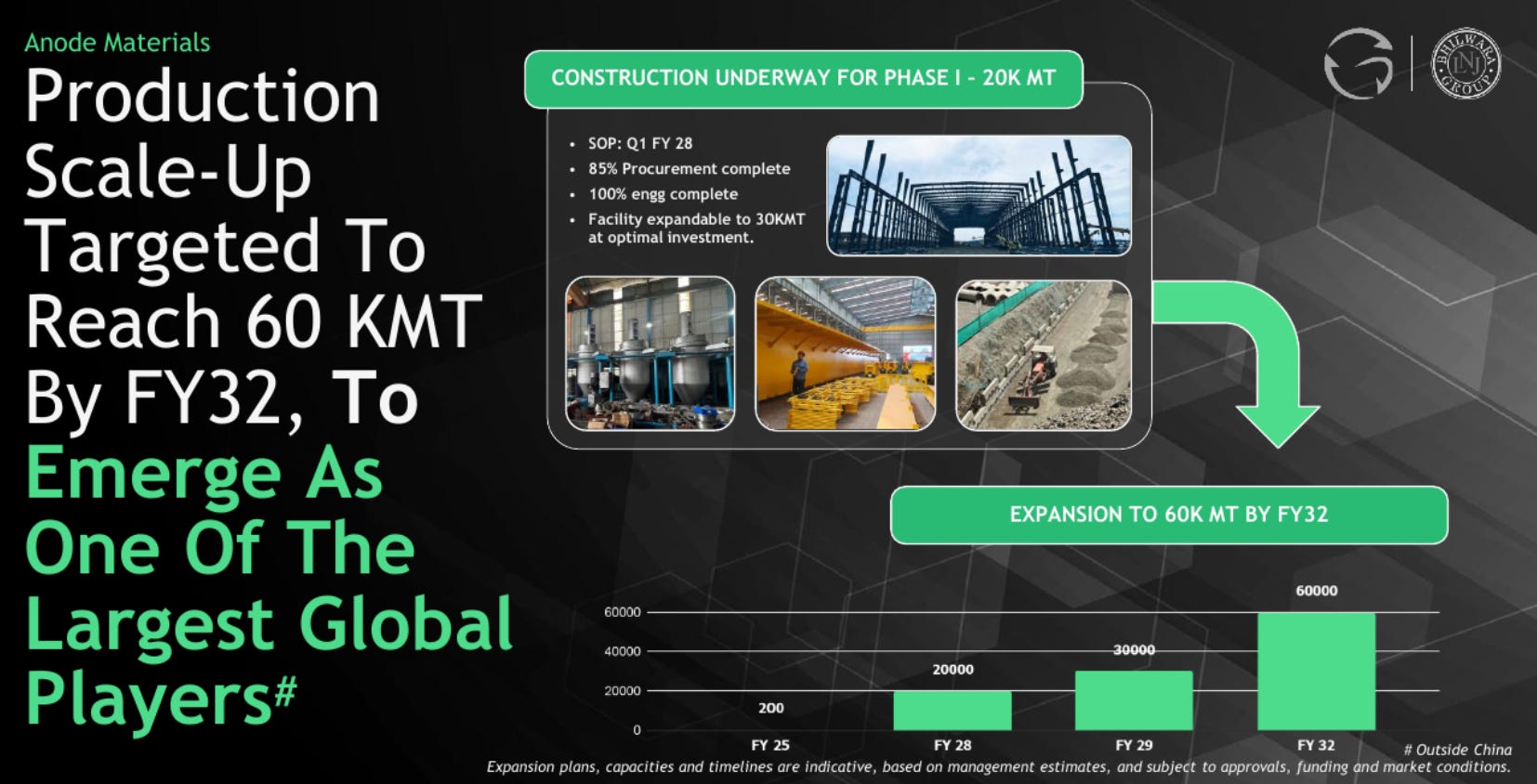
Phase I is a 20,000-tonne commercial facility. The engineering is complete, procurement is 85% complete and start of production is targeted for the first quarter of FY28.
The plant can reportedly be expanded to 30,000 tonnes with a lower incremental investment. Management’s longer target is 60,000 tonnes by FY32.
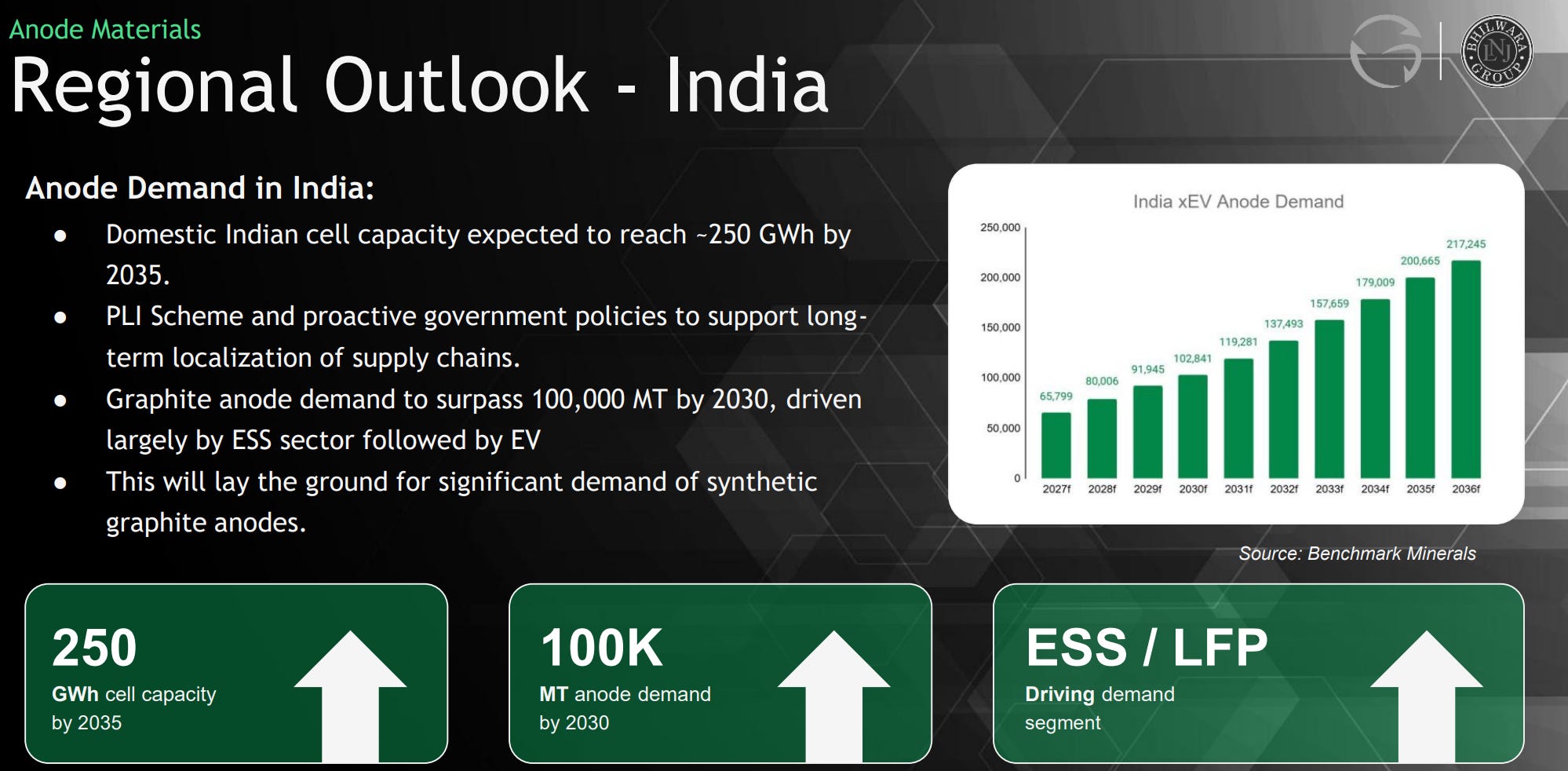
The localisation argument is strong. The IEA has estimated that China produces more than 90% of global anode active material. India is also supporting domestic battery-cell manufacturing through the ₹18,100 crore ACC battery PLI programme, which targets 50 GWh of domestic capacity.
TACC says it is seeing early commercial interest from global automotive companies, cell makers and energy-storage customers. Advanced discussions include potential multi-year offtake of more than 40,000 tonnes with a European automotive OEM, over 70,000 tonnes with a North American automotive company, and further discussions across APAC and India.
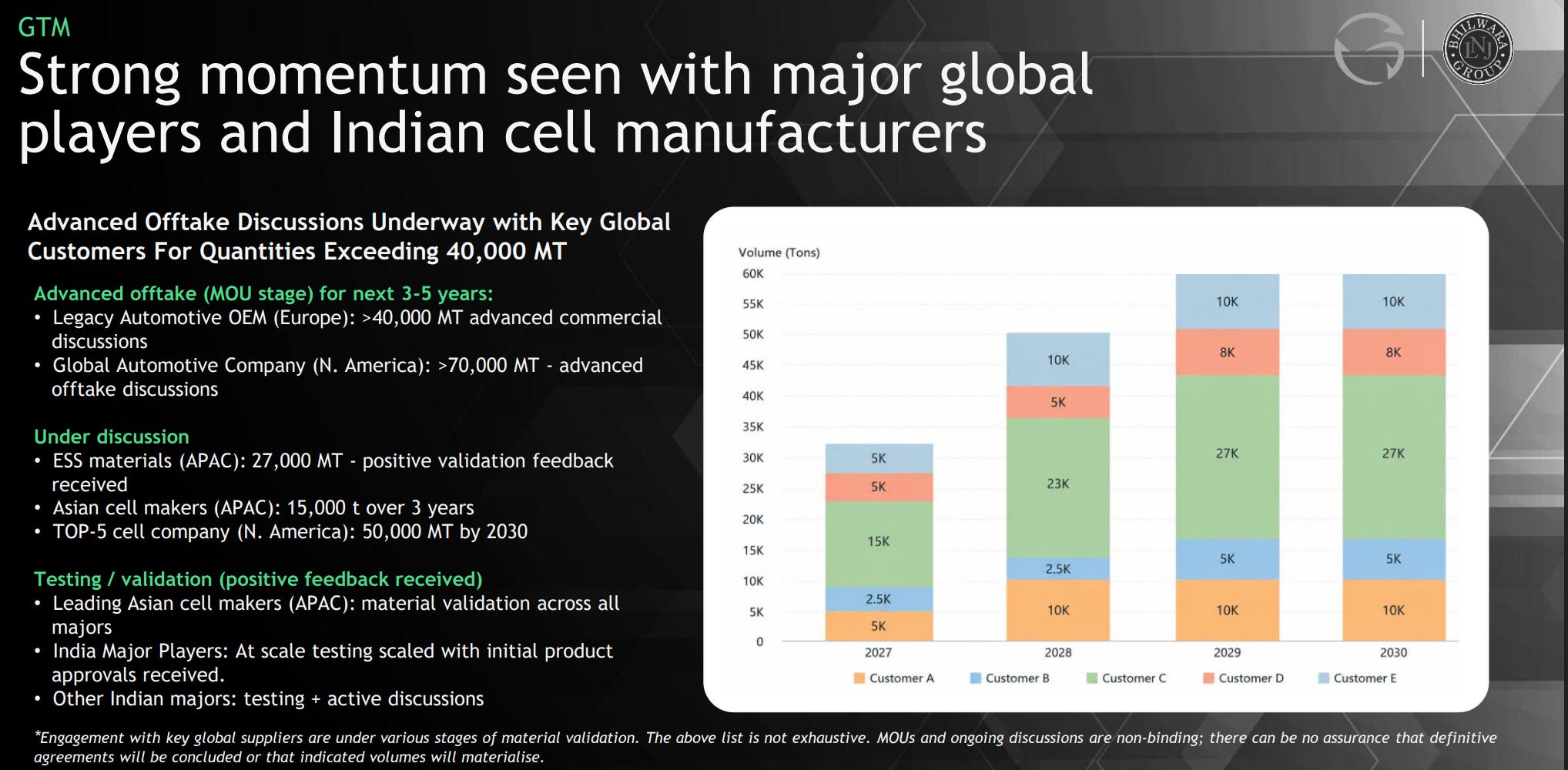
The opportunity is meaningful, but it is still at the validation and MoU stage. These discussions are non-binding, so the key milestone will be conversion into firm contracts before the 20,000-tonne anode plant begins commercial production
Graphene is one layer of carbon atoms arranged in a honeycomb structure. In small quantities, it can improve strength, conductivity, wear resistance or thermal performance.
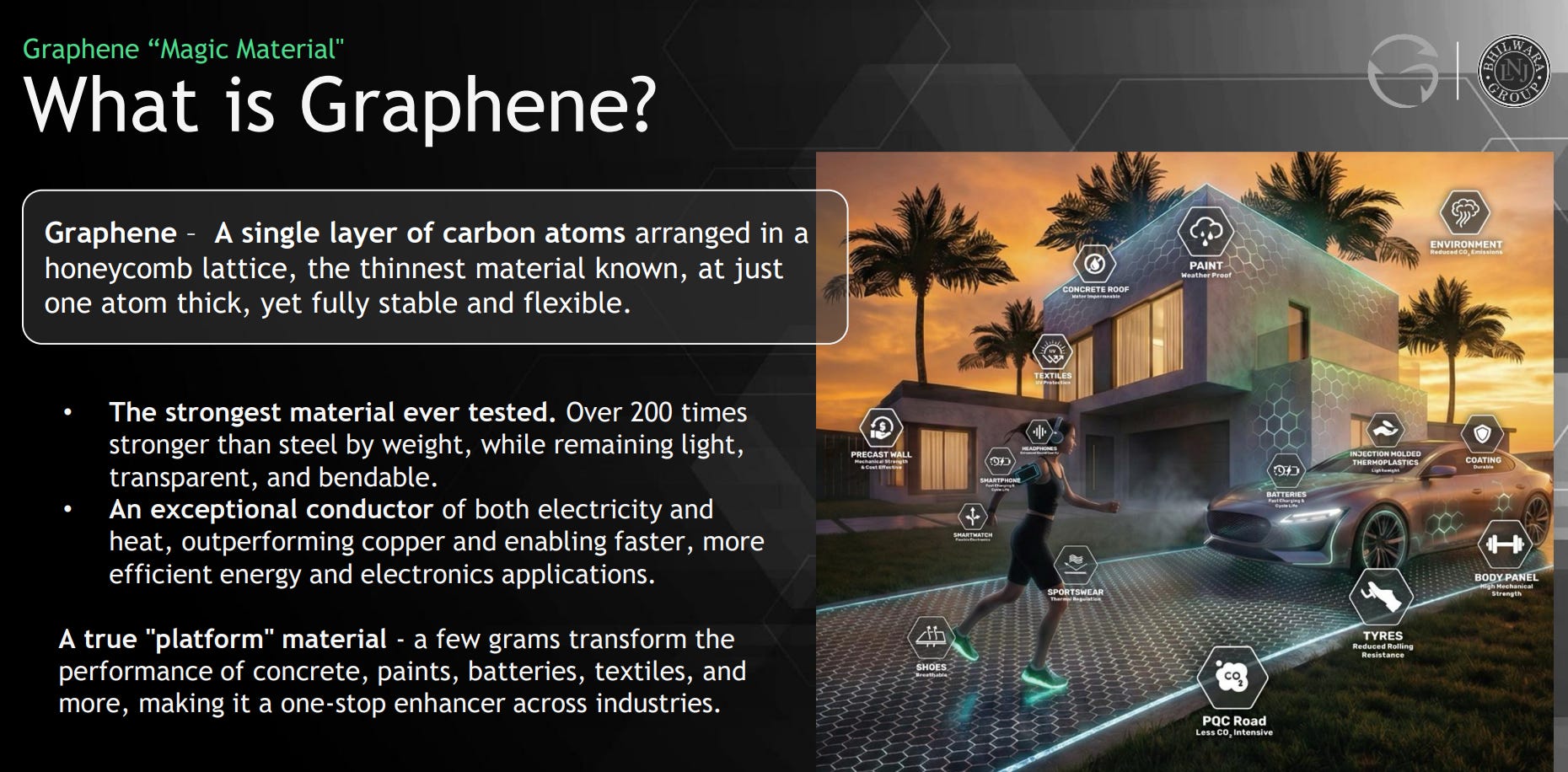
The company has their own process for manufacturing Graphene with continuous consistent results. Also graphene is manufactured indigenously with Graphite.
Already working on different stages of commercial scale validations with key customers for various applications
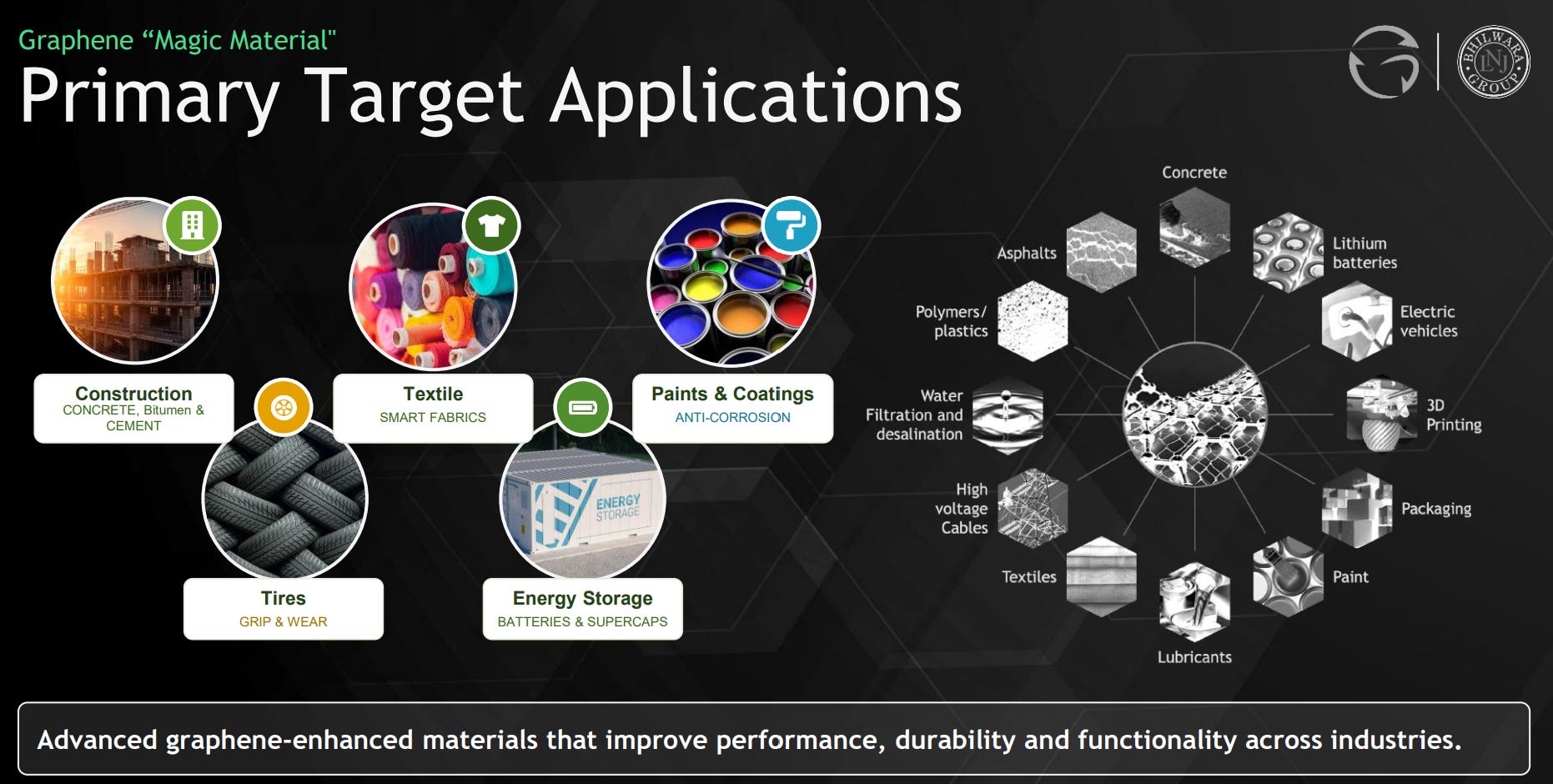
TACC is targeting applications in concrete, roads, coatings, textiles, lubricants, batteries and data-centre thermal materials. The company has filed patents, built an R&D team and entered validation partnerships with research institutes and commercial companies.
A 85 to 95 tonne capacity plan and opportunity pipeline.
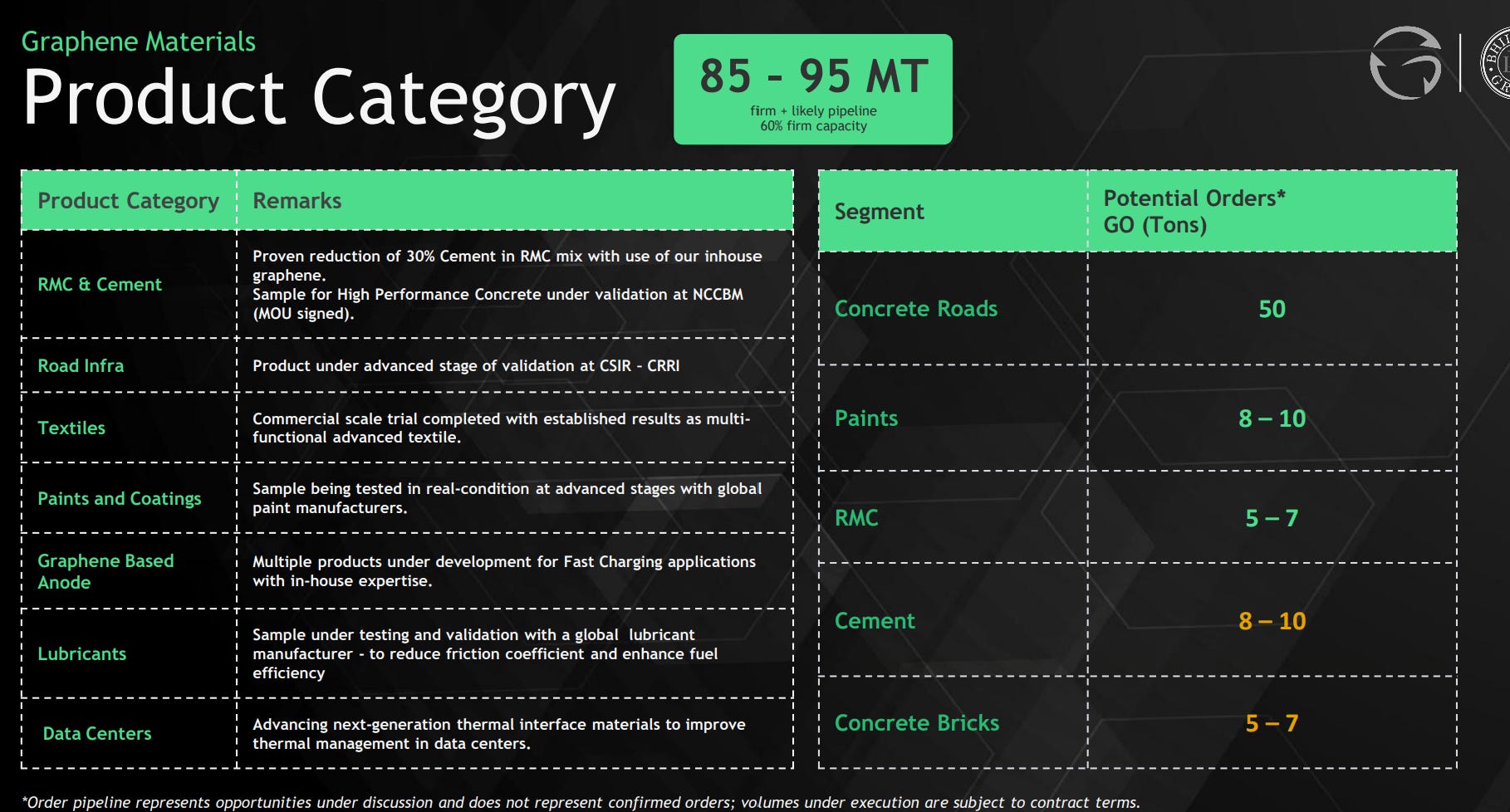
Graphene may become a valuable option. It should not yet be treated like a mature earnings stream. For now, the more conservative approach is to value it only after repeat commercial orders, stable product specifications and visible margins appear
REPlus is the most commercially active of the newer Greentech businesses.
It designs and manufactures battery modules, packs, racks and containerised systems. It also develops battery and energy management systems and provides project execution and service support.
The company has a 1 GWh operating facility with two 500 MWh lines. A 5 GWh expansion is under construction, taking the target to 6 GWh by the second half of FY27.
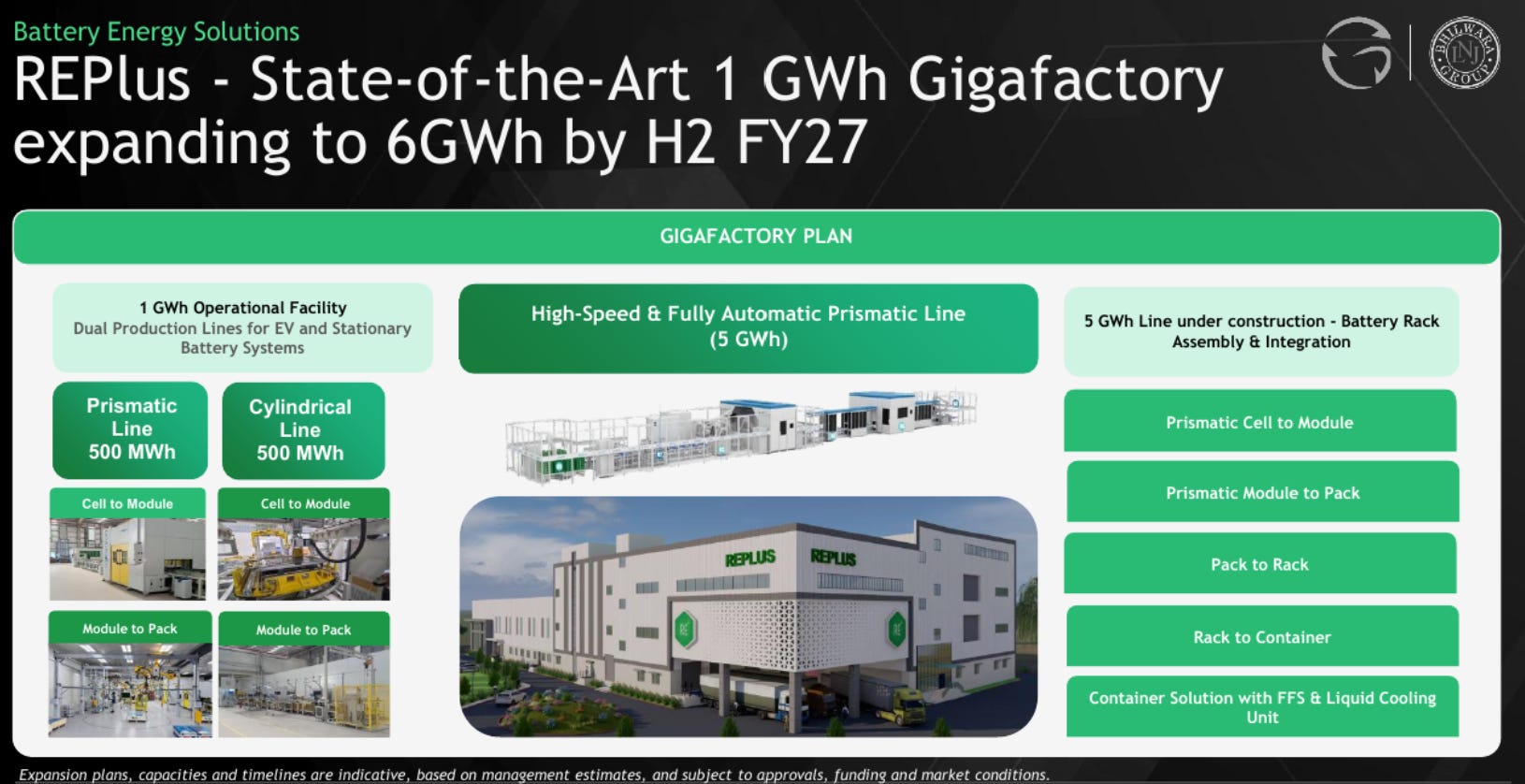
*REPlus plans to move from 1 GWh to 6 GWh of manufacturing capability. Expansion timelines are management estimates and depend on funding and market conditions
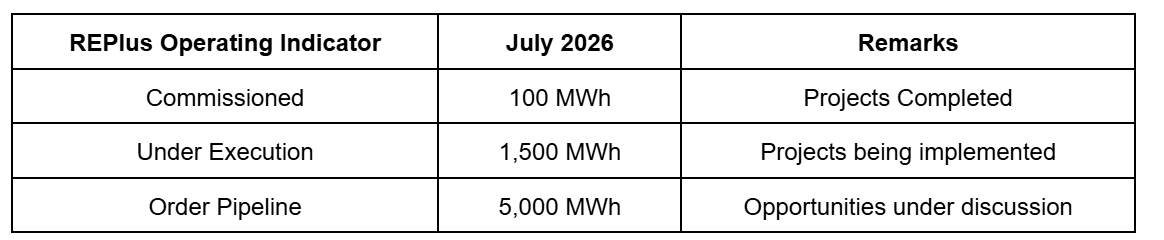
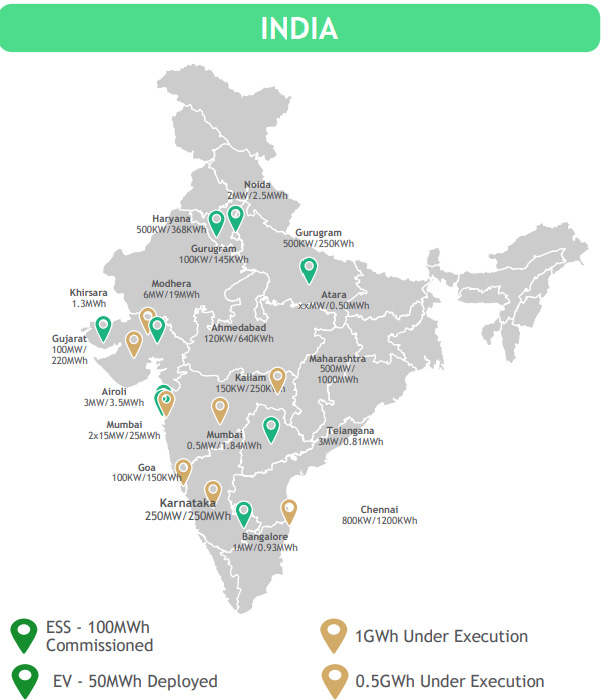
REPlus is building its advantage through a mix of manufacturing, in-house engineering and project execution. The company already operates a 1 GWh facility and has capabilities across battery design, embedded hardware, software, BMS and EMS development.
It also has a pan-India service network and experience in commissioning storage projects, which is important in a business where installation, monitoring and after-sales support matter as much as manufacturing
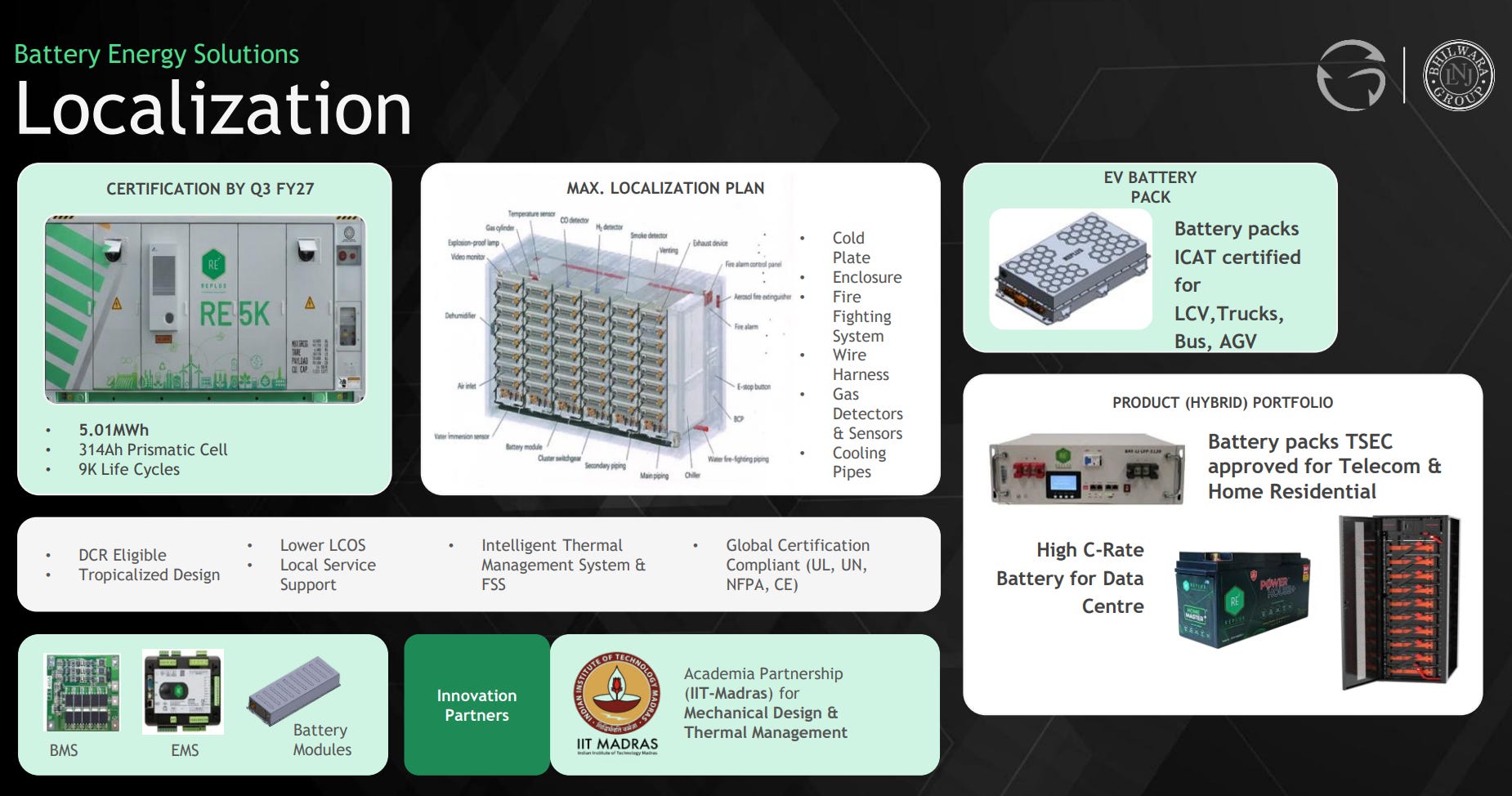
The next focus is localisation. REPlus plans to source or develop more components locally, including enclosures, cooling systems, wiring, sensors and fire-safety systems.
Its product portfolio covers EV battery packs, telecom and residential applications, data-centre batteries and containerised storage systems.
The company is also working with IIT Madras on mechanical design and thermal management, while global certifications for its 5.01 MWh storage system are targeted by Q3 FY27.
But storage-system assembly is competitive. Cell prices move quickly, customers demand performance guarantees and projects can consume working capital. REPlus also represents only 74% economic ownership for HEG Greentech, not 100%.
This is the part of HEG Greentech that makes the rest of the plan more credible. The HydroPower Journey of HEG which builds stable green cash flows is as follows:
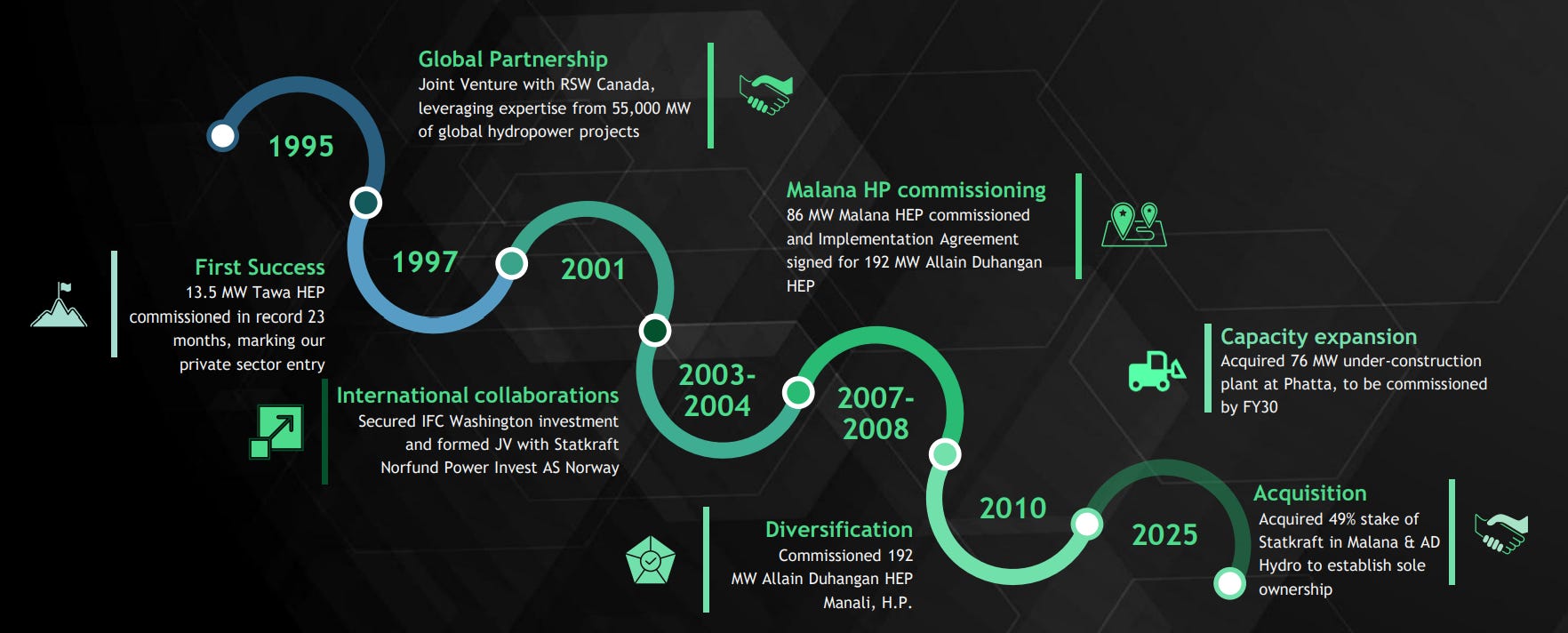
The operating portfolio consists of an 86 MW hydro plant, a 192 MW hydro plant and 14 MW of wind capacity. The two hydro plants have long operating histories and are described as debt-free.
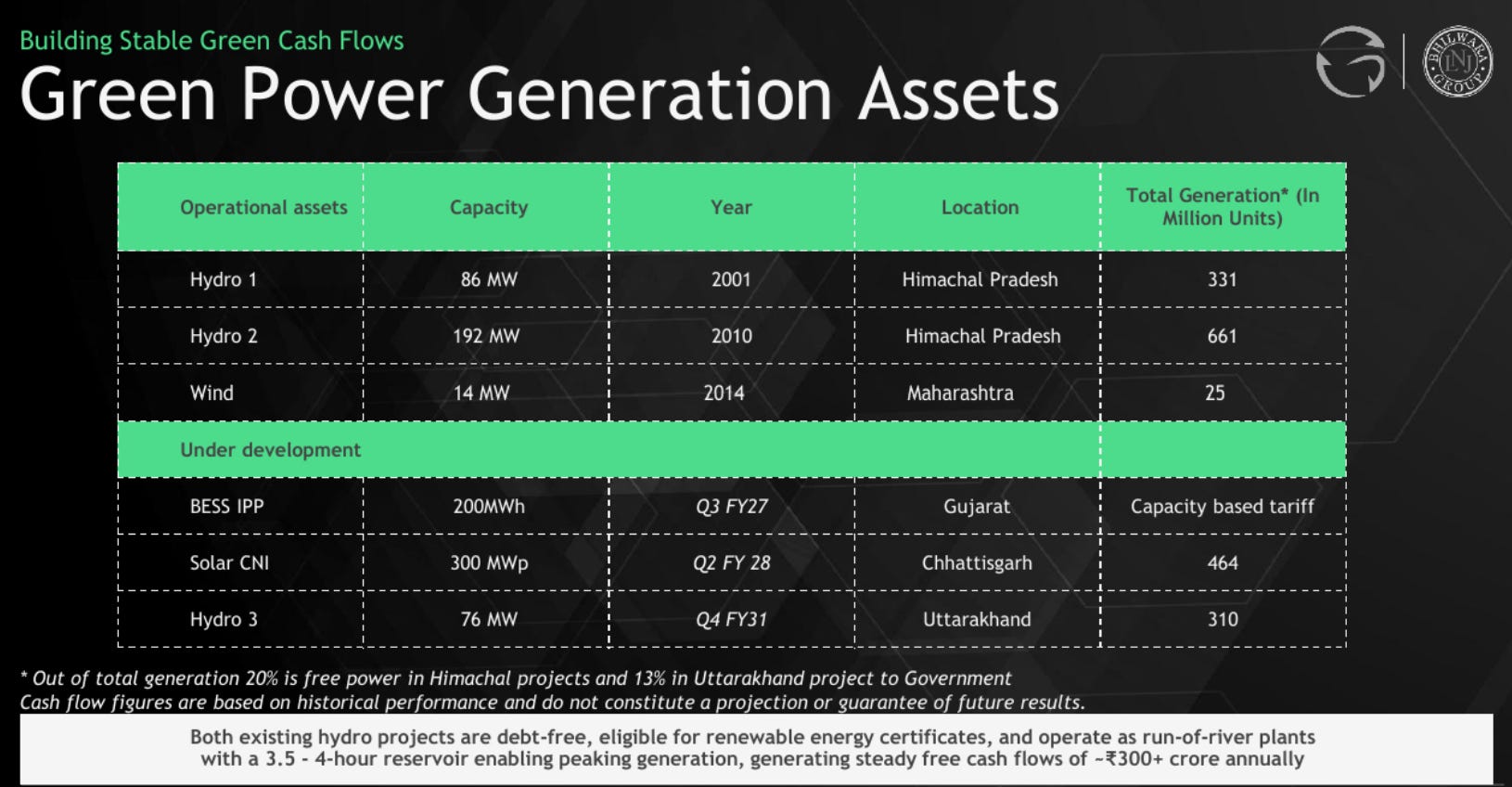
*The operating base is 278 MW of hydro plus 14 MW of wind. A BESS IPP, solar project and another hydro plant are under development
The stable hydro cash flow can support equity contributions to new projects and improve access to debt. It can also soften the early losses or low utilisation of the anode and battery businesses.
Still, hydropower is not risk-free. Generation depends on hydrology. The Himachal projects provide 20% free power to the state government, while the Uttarakhand project is expected to provide 13%. New projects also carry construction, tariff and commissioning risk.
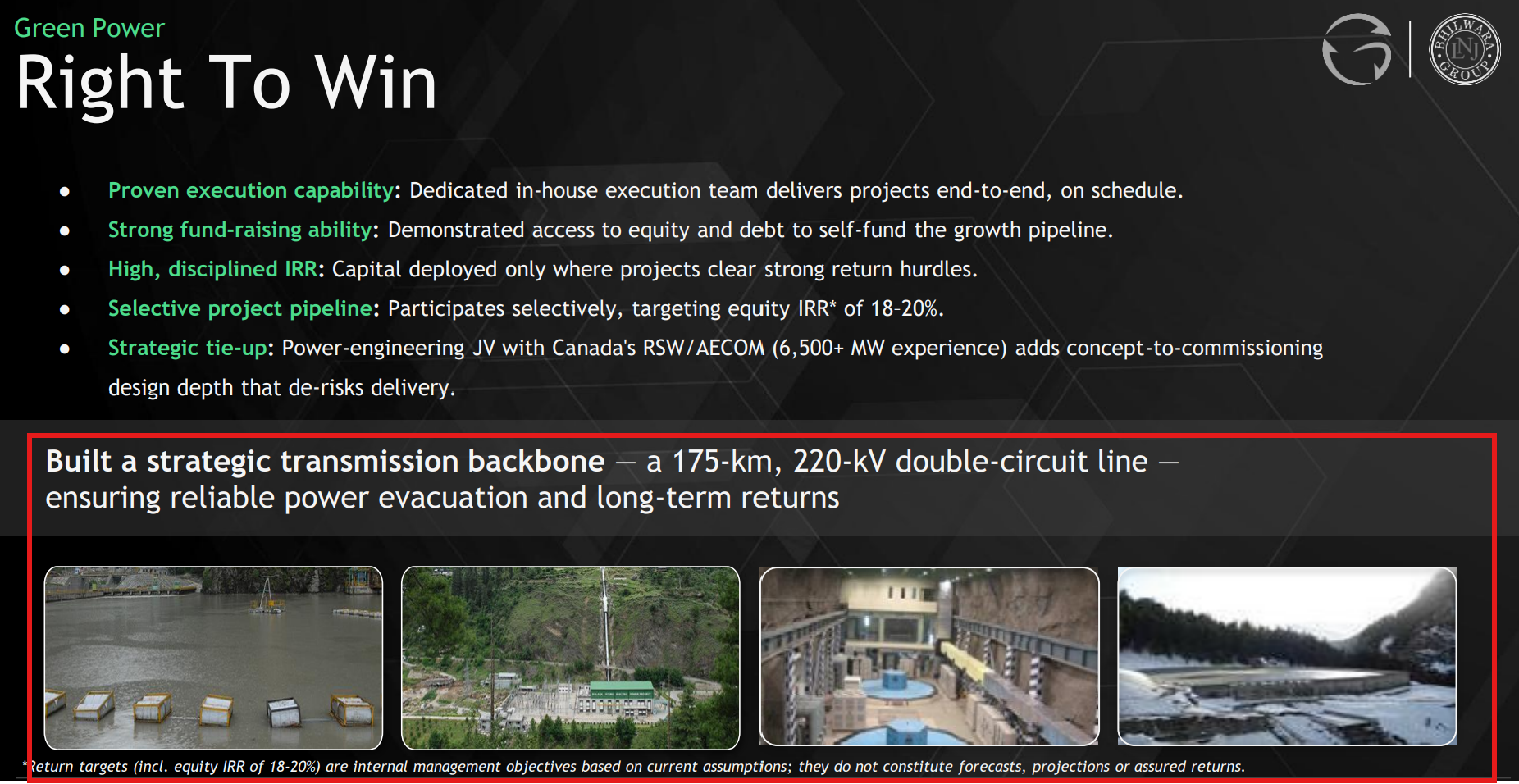
HEG has the right to win due to proven execution backed by fund-raising ability. Even the IRR from the projects are strong by selecting projects which generate equity IRR of 18% to 20%
HEG Greentech has outlined a capex plan of around ₹5,500 crore, with the anode-material business as the main growth driver. Around ₹3,150 crore is planned for 30,000 tonnes of anode capacity, followed by ₹2,000 crore for green power, ₹250 crore for REPlus and ₹200 crore for graphene
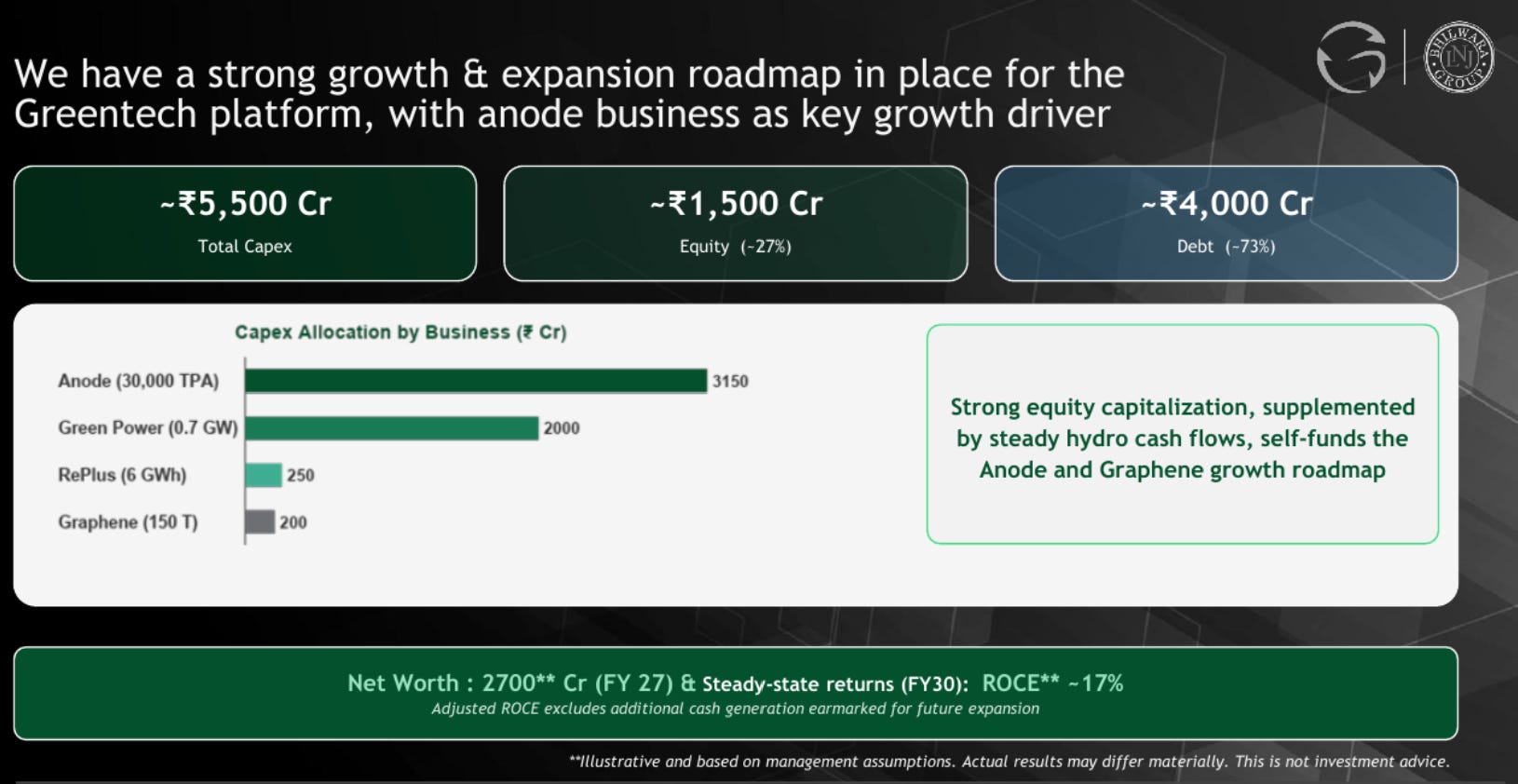
*The company presents the funding plan as illustrative. It also targets a FY27 net worth of about ₹2,700 crore and a steady-state FY30 ROCE of about 17%
The proposed funding mix is ₹1,500 crore of equity and ₹4,000 crore of debt. The equity portion may come from existing net worth, hydro cash flows, committed investor capital or a future fundraise not necessarily a single public issue
Management expects a net worth of about ₹2,700 crore in FY27 and targets a steady-state ROCE of around 17% by FY30. One small point: the individual allocations add up to ₹5,600 crore, so the ₹5,500 crore headline should be read as an approximate figure
In March 2025, Bhilwara Energy agreed to a ₹250 crore investment led by Singularity Growth Opportunities Fund II. That first investment closed in April 2025
The agreement also gave Singularity an option for another ₹250 crore. In September 2025, BEL allotted partly paid shares for this second amount and received ₹25 crore upfront. The remaining 90% was structured to be paid when called by BEL under the agreement
So it is more accurate to say that a ₹500 crore equity round was arranged, rather than assume every rupee of the second tranche was already sitting as cash on the balance sheet at that date
In project finance, equity can come from existing net worth, retained cash flow, already committed investor money or fresh capital.
Management expects HEG Greentech to have a net worth of around ₹2,700 crore in FY27 and says the hydro assets can generate ₹300 crore-plus of annual free cash flow. That can fund part of the equity requirement.
Even so, several facts point to further capital activity over time:
The capex is large.
The plan requires about ₹4,000 crore of debt. That means multiple project loans, construction facilities or asset-level financing arrangements are likely.
The disclosed anode capex covers 30,000 tonnes not the full 60,000 tonne FY32 Ambition
The later expansion may need a separate funding phase.
The scheme is designed for independent fund raising
Funding Flexibility is one of the stated reasons for creating a separate listed entity.
Growth may move faster than internal cash generation
If customer contracts arrive early, management may choose to raise capital rather than delay capacity
The following are possible routes:
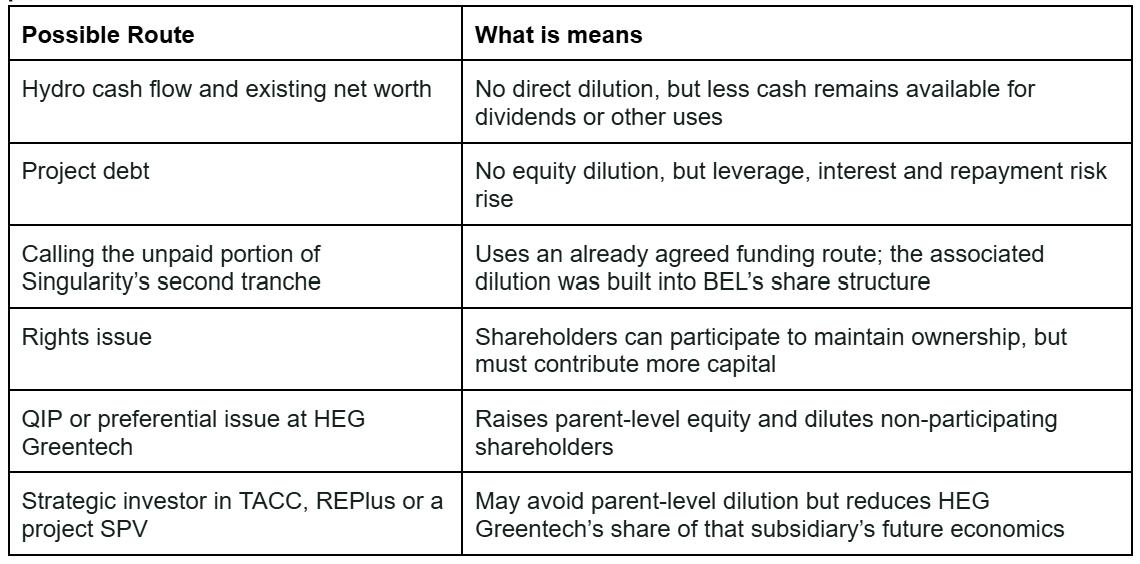
The platform has a real financial anchor. Many clean-tech stories begin with only a project plan. HEG Greentech begins with operating hydro assets and a claimed ₹300 crore-plus cash-flow base.
The anode project has a logical parentage. Synthetic graphite is not a random diversification for HEG. Graphitisation, raw-material sourcing and carbon know-how are genuine areas of experience.
Storage demand is moving from promise to procurement. Government VGF programmes, renewable-energy additions and grid-balancing needs are creating actual BESS tenders.
The platform has several ways to win. If anode qualification takes longer, hydro and REPlus may support the business. If graphene finds a commercial application, it adds upside without being the only thesis.
HEG Greentech should not be viewed as a new green-energy startup.
On one side are mature, debt-free hydro assets producing cash. On the other are high-growth but higher-risk projects in synthetic-graphite anodes, graphene, battery systems, solar and grid storage.
The restructuring can make the story easier to see. It cannot remove the execution risk.
The real opportunity is that hydropower may finance a credible Indian battery-material and storage platform without forcing the company to depend entirely on external equity.
The real risk is that several projects ramp up together, consume capital together and take longer than expected to turn pipelines into cash.
Disclosure: The content shared is for educational purposes only and should not be construed as a recommendation.
No posts
Comments
Nothing yet. Say the first thing.
Sign in to join the conversation.