
Five years ago exactly, the first issue of Inside Medicine was published. Inside Medicine was part of the second wave of publications rolled out on Bulletin, Facebook’s brief attempt to get into the newsletter business.
So, July 20, 2021, was a big day. It’s our community’s birthday.1
But that day had been a long time coming. A month earlier, in preparation for the launch, production of Brief19 finally wound down. Brief19, a two-pager written by physicians and scientists that I edited (and often wrote) had been published every single weekday—and most weekends too—from March 20, 2020, until June 17, 2021. Dozens of contributors, and a dedicated masthead, made that massive undertaking possible.
With Inside Medicine, my goal was to continue covering Covid-19, but begin returning to other medical topics. With the vaccines saving millions of lives, and many people returning to some semblance of normalcy (albeit we still had Delta and Omicron ahead of us), it felt like the right moment to re-diversify.
Inside Medicine was slated to come out a couple of times per week. (Little did I know that I would often write this newsletter 3, 4, 5, and even 6 times per week over the following years.) I wanted the then nearly 24,000 Brief19 readers who migrated to Substack with me to have an immediate sense that this newsletter would be different. Today, over 87,000 of you know that we cover a wide array of topics, from deep dives on data to breaking news.
For the inaugural installment of Inside Medicine, I wrote a massive deep dive on whether or not healthy adults really need annual checkups. Fascinating stuff.
The upshot? Most people do not need an annual checkup. That said, having a primary care physician is worthwhile—though not necessarily for the reasons you might assume.
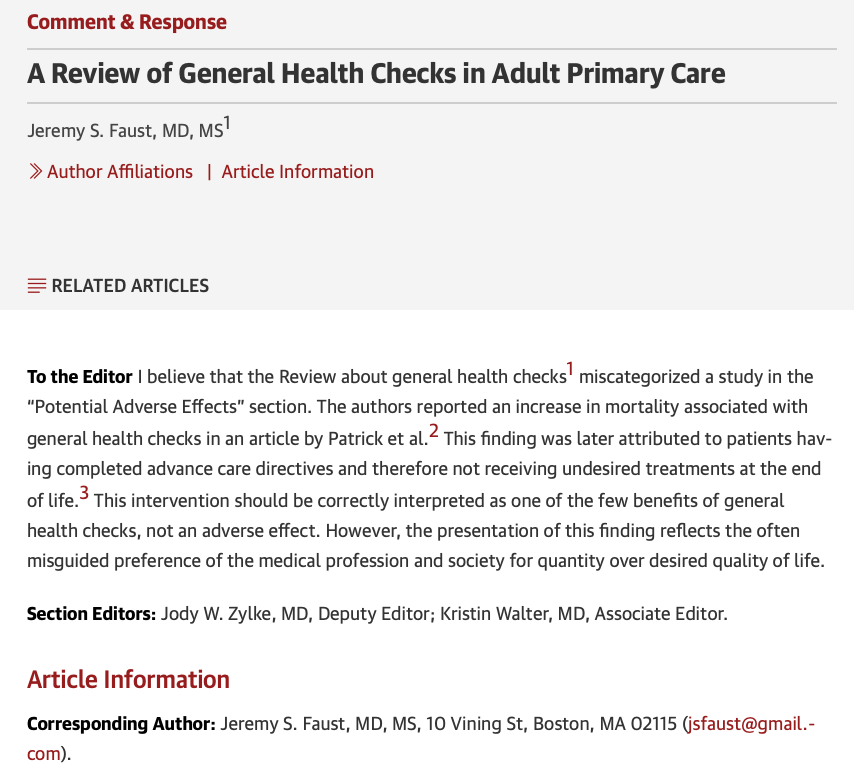
In fact, one finding of a major 2021 JAMA study found that people who had annual checkups died sooner than those who did not, which the authors categorized as a “potential adverse effect.”
But I didn’t necessarily see this as an “adverse effect.” Many, even most, people would rather die sooner than live longer by burdensome artificial means (i.e., life support in intensive care units or long-term nursing facilities).
So, I wrote a letter, which JAMA published that fall. Check it out…
What I never noticed, somehow, is that the authors replied in the same issue of JAMA! Reading it now, I genuinely adore their reply. The authors clearly wrestled with this all, and I appreciate it. It’s academic hair splitting I can get behind….
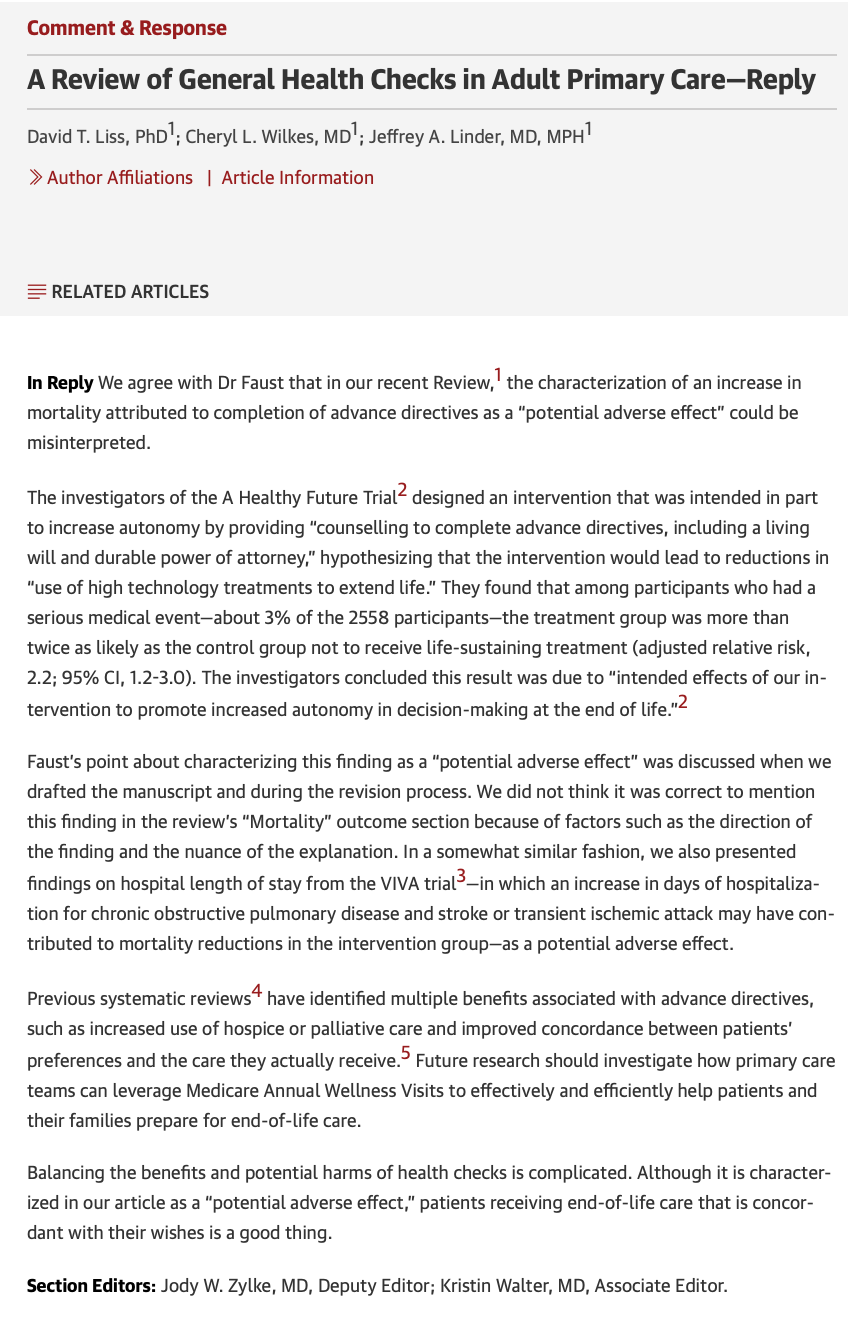
So, the first Inside Medicine, from July 2021, led to, what I believe, is a thought-provoking little exchange in JAMA. What a perfect way to start.
In a 2022 JAMA article for patients, the journal nodded to this all—that there were benefits to annual checkups, but decreased mortality was not one of them.
Looking back to the first Inside Medicine ever published, I stand by it. (I particularly love that it was our inaugural post, because it’s your classic counter-intuitive circumstance—which is precisely where this publication excels.)
Without further ado, here’s “Do you really need a routine medical checkup?,” from July 20, 2021, which includes a beautiful data visualization by Dr. Kristen Panthagani—our very first collaboration among the many that would follow.
Note: At the end of the article, there’s a short archival video from the day Inside Medicine went live on Bulletin.com. It’s likely the first and last time you’ll see me paired with…Malala.
Jeremy Faust, MD. July 20, 2021.
I don’t have a primary care physician. Neither do around a quarter of people in their 40s living in the United States, though the number drops with age. Around 10% of Americans in their 60s, and just 5% of those over 80 years of age, lack a primary care physician.
Even though I am a practicing physician, I need a primary care doctor. What I don’t need, it turns out, is an annual physical, or routine “checkup.”
•••
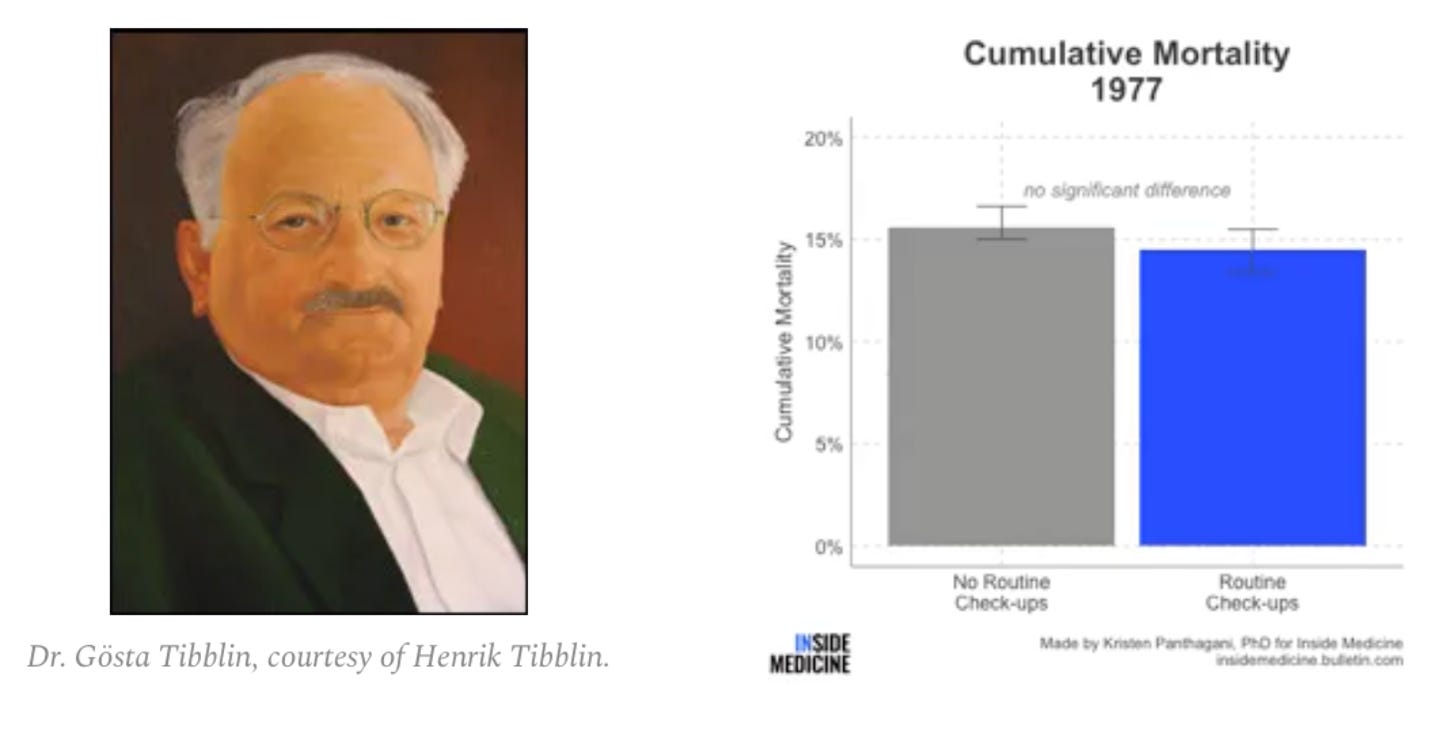
In 1965, a physician-researcher wrote in a Swedish medical journal that “the scientific arguments for the value of large-scale health examinations are founded merely on assumptions.” Accordingly, he had set out to study whether an annual checkup carried any measurable benefit. The man’s name was Dr. Gösta Tibblin.
A few years earlier, Tibblin, then just a couple of years out of medical school, had something of a revolutionary thought, and one which would eventually upend conventional wisdom. He wondered whether modern medicine’s grasp had exceeded its reach. He wondered whether physicians were intervening too often when the body would be fine on its own. He wondered whether all the fixings of modern medicine really could not only treat active disease, but also catch silent disease early as many assumed it could, and in time to make a difference. To find out, he decided to do something both simple and bold. He decided to test the tests.
•••
In 1963, Gösta Tibblin and his colleagues assembled a list of every living man born in 1913 then residing in Gothenberg, a city on the west coast of Sweden. All of the men would turn 50 that year. A third of them were invited to participate in what would then have been considered to be a fairly intense barrage of medical tests. Even by today’s standards they did a lot. The evaluations would be repeated 5, 10, and 15 years later. This was to be the “experimental group.” The other two-thirds of the men born in 1913 living in town would be the “control group.” Thanks to the Swedish Revenue Office, and apparently loose privacy laws, Tibblin and his team could follow all of the nearly 3,000 men they identified over time. The question was whether the experimental group had a lower rate of long-term mortality. In other words, did a series of comprehensive tests administered every five years designed to unveil any number of silent diseases give the experimental group a statistical survival edge?
•••
The “men of 1913,” as Tibblin called them, were game. At least most of them, anyway. Of the 973 men contacted twice by mail and then the night before by phone, 855 of them showed up to Sahlgren’s Hospital on an appointed day. The fact that the town’s various employers apparently thought this all to be a fine enough endeavor to give the men paid time off so that they could participate is among the delightful details to be found within Tibblin’s eventual reports.
Each day, 4 to 6 men arrived, “fasting and thirsting” at 7:15am. No wonder they needed paid time off. The participants lined up and proceeded through various stations, like some kind of health fair. There were blood tests, urine samplings, and an electrocardiogram. The men were asked about their medical history, especially regarding any heart or lung disease risks. After some anatomical measurements were recorded, an x-ray of the chest was taken. They then briefly adjourned for breakfast, joined by some of the investigators. (A rectal examination, as well as blood pressure and lung function measurements, took place after breakfast.) Some of the men then underwent psychiatric testing while others had further lung testing. A visit to an ophthalmologist rounded out the morning. All told, the checkups lasted around 4 hours. Any concerning findings were acted on, either by treatment or further testing.
Tibblin and his team watched and waited. For years. Starting in 1963, the year the study began, all deaths in the experimental group and the control group were dutifully recorded. The experimental group was invited to return to Sahlgren’s to repeat the examinations in 1967 and again in 1973-74. Around 97% of the men still living participated in 1967, and nearly 90% of the surviving men did so at the ten-year mark. Over time, Tibblin and his colleagues could see the effect of routine screenings: nothing. The men selected to attend the 4-hour checkups lived and died at the same rates as the other men in town who had not had the “benefit” of the tests. By 1978, around 85.5% of the men in the experimental groups were still alive, compared to 84.4% in the control group. While in Tibblin’s time, such calculations were not done, today we can say that given the number of subjects and the frequency of deaths in the cohort, the “men of 1913” study had a strong ability to detect whether the checkups decreased mortality by the time 15 years had passed. Technically speaking, Tibblin’s study was adequately “powered” to detect a statistically meaningful difference of just 3.8%, meaning that if just 1 in 25 men were saved by checkups, the experiment could show that confidently. So the 1.1% difference between the experimental and control groups was just noise.
Animation by Dr. Kristen Panthagani.
Over time, Tibblin and his colleagues could see the effect of routine screenings: nothing.
•••
Much has changed since 1963. Have decades of medical progress since changed the prognosis for routine checkups? To find out, a group of researchers in the United States recently analyzed the results of all the trials performed by other researchers since. The findings were recently published in the Journal of the American Medical Association. Though limited to medical literature in English, the investigators found 12 cohorts that researchers had followed for years, as the men in Gothenberg had been. Some had intense screenings every few years, while others were less comprehensive yearly examinations. The studies, from the US, the UK, Denmark, and Sweden, including ones whose findings have been published in just the last couple of years continue to find the same thing. For all of our innovation and technology, routine checkups don’t appear to extend life—or stave off early death or early cardiovascular events like heart attacks and strokes. In fact, in one study, routine checkups were surprisingly associated with higher mortality rates in older adults. The researchers later determined a perfectly good reason for this. Those attending regular checkups were more likely to have filled out advanced directives stating that they did not want their lives to be artificially extended by having to live on machines.
The authors of the JAMA study did find that people who went to regularly scheduled checkups were more likely to have completed some recommended screenings for certain cancers and other chronic conditions. These led to patients feeling more reassured, which is not the same as healthier. For example, patients who attended checkups were more likely to be prescribed cholesterol-lowering medications. But if heart attacks, strokes, and deaths were not decreased, what’s the point? One study found that men, though not women, who went to checkups had a 2.6 pound weight reduction a year out. But would a trip to a nutritionist or a fitness professional have accomplished the same or better?
•••
The evidence suggests that I don’t need an annual physical. That’s good because I haven’t had one in years. What I do need, what we all need, is a primary care doctor to check in with from time to time. I need someone to keep track of what vaccines I’ve had, and which ones I need, which screening tests I’ve had, and which I need. I need someone to go to when a nagging problem, but not an emergency, comes up. At the core, the studies mentioned here do not refute the idea that modern medicine can treat many symptomatic diseases, many of which do require checking in with your doctor from time-to-time. What they do show is that other than vaccinations, most of which we receive in childhood, very little else in preventive care has an explicit mortality benefit.
The most important lesson I took from these studies is that I need a physician who gets to know me over time. I need someone to discuss my goals and values with and who will document my preferences in my medical chart, thereby helping make sure I do not live so long that my final weeks, months, and even years are defined by suffering and discomfort. This is not to say I do not value longevity. I’d like to live a long and healthy life. But the data suggest that primary care doctors have surprisingly little influence on that. When I go to find my new primary care doctor, I’ll be less focused on finding a physician who will help me avoid dying too soon than in one who will make sure I do not live too long.
Do you see your doctor annually? Do you do it because it makes you feel good about your health or is it something you do just because you feel obligated to do it?
Contribute your thoughts in the Comments section…
Archival screen capture from the day Inside Medicine went live. Yes, that’s me and Malala, and whomever Maria Celeste is….
Special thanks to Fred Taylor, my father-in-law, for coming up with the name Inside Medicine approximately 3 seconds after I asked what I should call my new publication.
No posts
Comments
Nothing yet. Say the first thing.
Sign in to join the conversation.