
Editor’s note: Our Locarno Film Festival coverage continues throughout the week of August 9th with paid subscriber-exclusive reviews of key festival titles. Click the links to read reviews from our first and second days of coverage.
Like his previous feature, which opens with a 1988 Coca-Cola ad, Nicolaas Schmidt’s September Afternoon begins with another vintage commercial — or, at least, a knowing pastiche of one. Smiling families frolic on a beach at the height of summer. Young men and women in bathing suits run by each other flirtatiously. A man in snorkeling gear clowns by the shallows as surfers ride the waves in the background. Somewhere, someone is enjoying an icy popsicle. If the sequence is amusing, however, this is not because of the ad’s intended humor, but rather because it keys us into the strident, rather ridiculous way that the ad wants us to see the world. Scholars of government policy routinely speak of “seeing like a state.” With a sequence such as this, we might well speak of seeing like a multi-national corporation.
Within the larger context of September Afternoon, the opening is significant for how it detaches the concept of cinematic point of view, centered on the question “Who sees?”, from its usual and narrow restriction to dramatic fictional contexts. The nominal plot of this 70-minute, dialogue-free film is easily summarized: a family of three takes a rather ill-advised trip to the beach on an especially windy day. But what is startling about Schmidt’s film is how its découpage — its compositions, shot selection, and cutting — continually estrange us from any sort of human-centered perspective on this ordinary activity. The packing of a beach bag, filmed from overhead, offers a view all but divorced from the psychological coordinates of this otherwise unremarkable action. Similarly, the family’s walk to the beach is articulated in images whose rhythms and durations are conspicuously, deliberately detached from the rhythms and durations of an afternoon stroll. Later, in an apparent homage to Michael Snow’s Wavelength (1967), we slowly zoom back from an image of the mother walking pensively across the shore, backed by the rolling surf — a five-minute shot whose formal presentation relates not a whit to the mother’s apparent goal, revealed only at the end, of bringing a shovel to her toddler. At various points across the runtime, Schmidt presents us with what are unmistakably point-of-view shots. A child goes up to a window; we see the view through the window. A man lays down and covers his face with a blanket; we see darkness dotted by specks of light. But in the larger context of this film, what these shots make clear is just how little mere camera position ultimately matters to the issue of perspective.
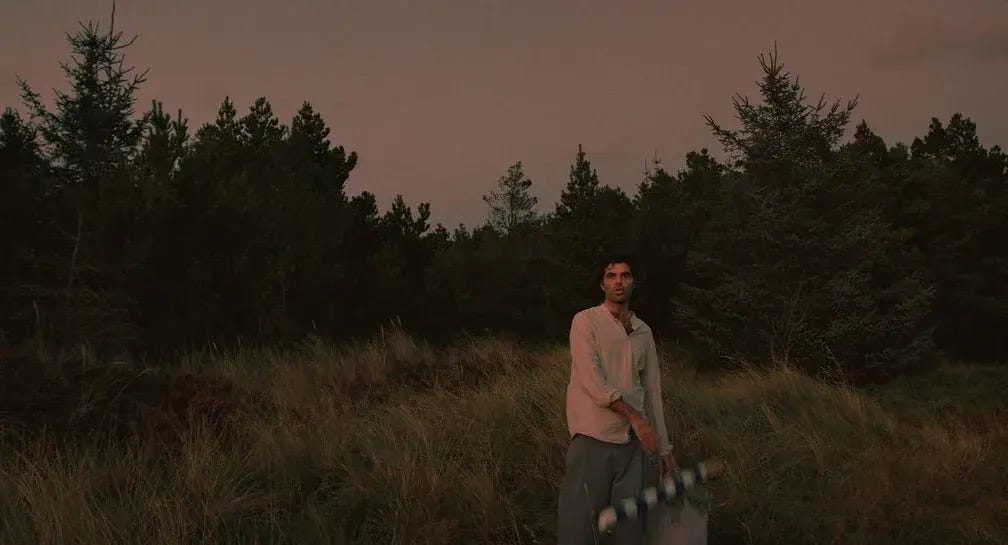
It is conventional to think of a film’s diegesis, its fictional world, as more or less insulated from a filmmaker’s formal or stylistic decisions. But like Godard, Schmidt seems interested in the way that “mere” formal or stylistic decisions are in fact capable of unsettling what we take the diegesis to be. Early on in September Afternoon, we are presented with a shot of a landscape seen through a train window, in which the sky has taken on an intense pink hue. As with similar shots in Schmidt’s earlier FIRST TIME [The Time for All but Sunset – VIOLET] (2021), we may initially be inclined to take this coloring as more or less external to the film-world, as a pleasing but dispensable artistic flourish. By the film’s end, however, after the downright apocalyptic turn the plot takes, the sky ablaze in reds and oranges, we might perhaps recall that initial assessment, wondering whether this or any detail may ever really be seen as outside the text. — Lawrence Garcia
Comments
Nothing yet. Say the first thing.
Sign in to join the conversation.