
A few years ago while re-watching Jean-Luc Godard’s Histoire(s) du Cinéma, I was taken aback when 2a: Only Cinema ended with a durational shot of Baltimore’s Inner Harbor. I thought I had a great familiarity with both the commercial and independent film sectors of Baltimore — having lived there for a number of years — but I had never seen anything like this image before. After some asking around, I learned the clip was pulled from Rob Tregenza’s debut, Talking to Strangers (1988), an extraordinary picaresque of long-takes set on the South Side, from downtown homeless shelters, under overpasses, and through the harbor.
Talking to Strangers would be the first in a trio of films Tregenza made in Baltimore, including The Arc (1991) and Inside/Out (1997), the latter of which was produced by Godard; the two met after Tregenza, via his company Cinema Parallel, distributed Hélas pour moi (1993) and a number of other of Godard’s films throughout the decade. It’s through this distribution arm that Tregenza would eventually work with Béla Tarr on Werckmeister Harmonies (2000), DPing two of the film’s most famous shots: the opening, and the hospital riot. Tregenza’s directing career, meanwhile, went on pause for nearly 20 more years — as he raised his kids and taught at Virginia Commonwealth University — until he returned with Gavagai in 2016. Since then, he has accelerated production; he started work on Fast (2026) almost immediately after releasing 2024’s The Fishing Place.
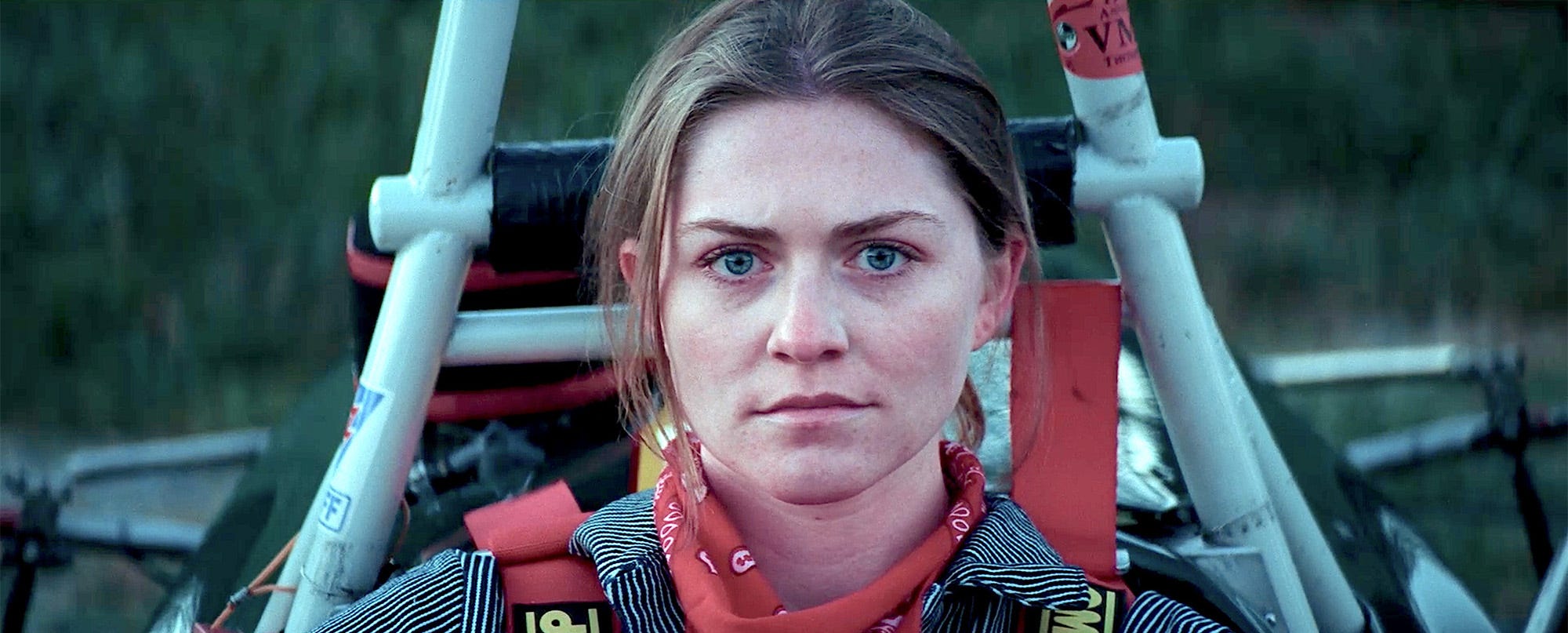
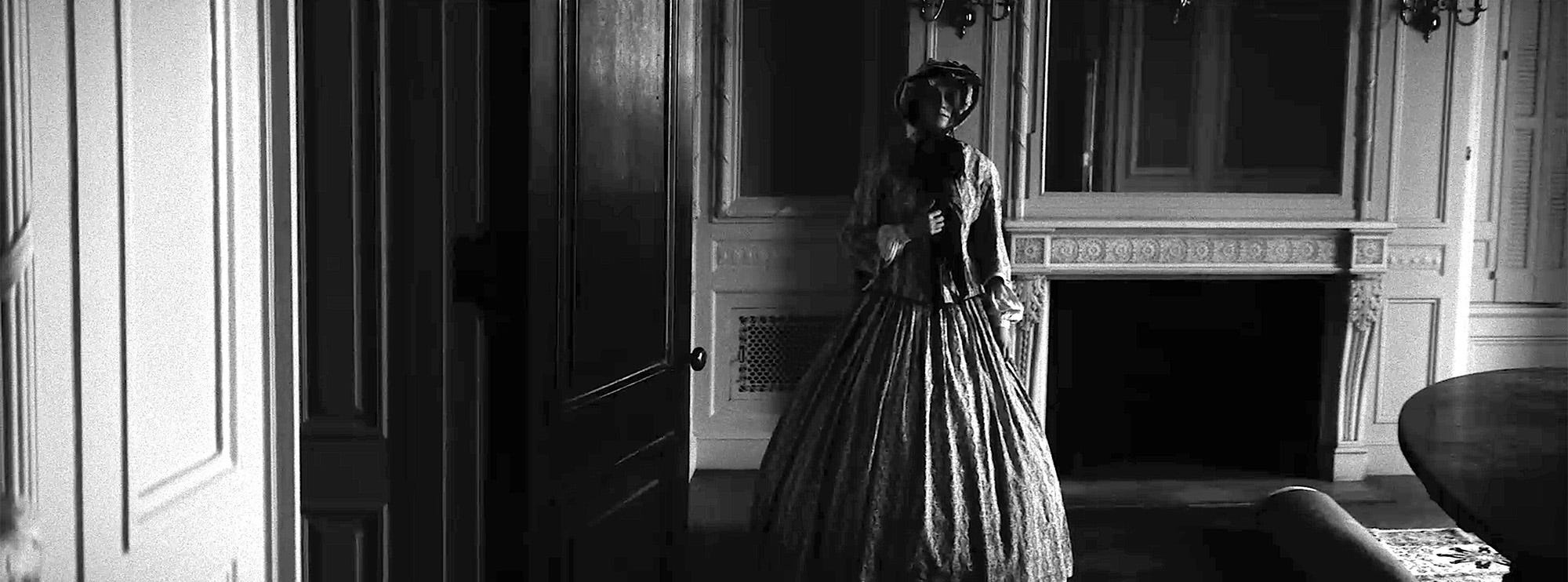
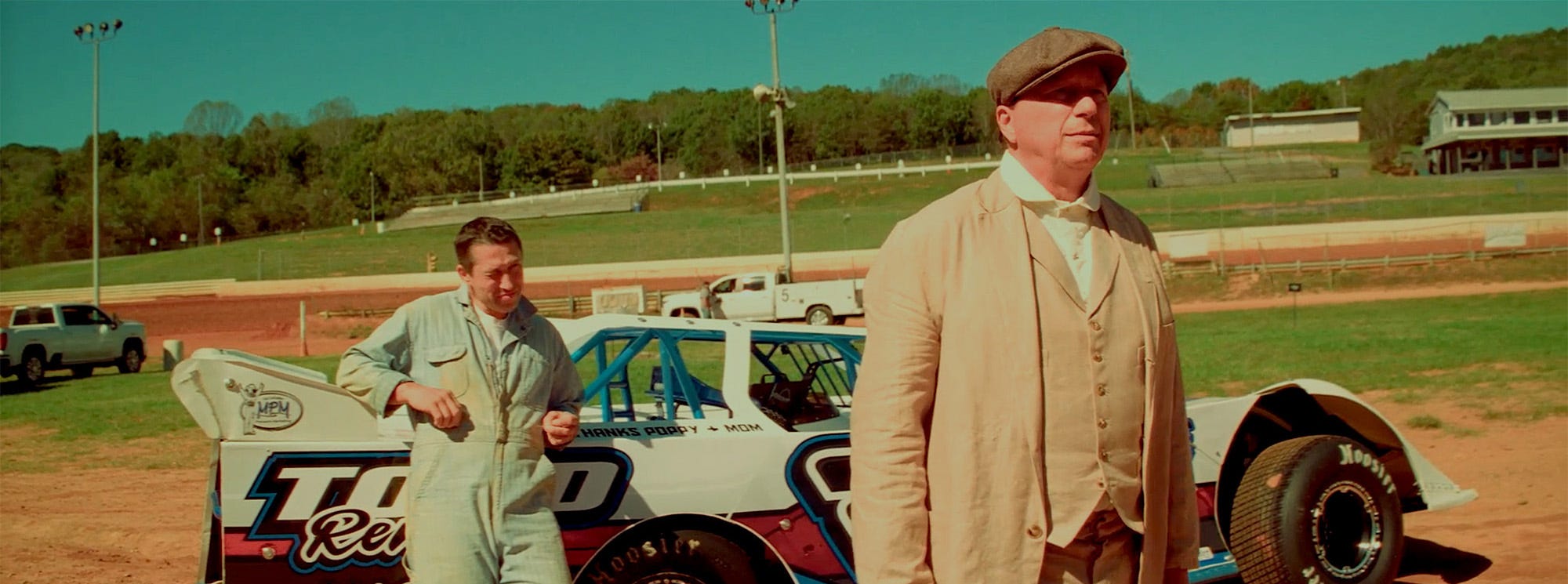
All of Tregenza’s films inhabit a ghostly diegesis that blurs the physical past and present. Fast leans into this the most of any of his works. Sterling (Madison Pankey) spends most of the film trying to get her old Lotus souped up and race-ready, though we’re first introduced to her asleep in a train car, as if the world of 1950s mechanics in modern junkyards, men in cream suits driving late model dirt racers, Confederate policemen, and antebellum memories has emerged from an hypnotic dream. After talking with Tregenza, I think he would insist this is a metaphor for cinema itself.
Ahead of Fast’s run at MoMA from August 12-18th, I got together with Tregenza over Zoom to discuss his new film, his work, and ethos.
This interview has been edited for length and clarity.
Alex Lei: Let’s talk about the bookends to Fast, which you shoot on the front of a train. It’s interesting that this movie is ostensibly about cars, but you’re bookending it on what’s kind of the original dolly track.
Rob Tregenza: Exactly. The “phantom road” is a play on the phantom ride [an early film genre from the 19th century, wherein a camera tracks while strapped to the front of a moving vehicle]. There’s in-jokes in a lot of my stuff. They’re not profound by any means, they’re just little allegorical references. Visual, and also words. So, it is a phantom ride on a phantom road. This whole film was started and done in one year, which is another reason why I call it Fast.
The original moving camera was basically rooted in phantom rides, the train stuff. That was one of the images that I had way back in the beginning — doing something about moving the camera, looking at the anthropology: how did the moving image come, where did it come, why did it come? The bookend image, starting and closing with that, starts the meditation on the whole idea of point of view, of moving camera, and then the subjective position of the viewer on the ride. It’s another metaphor for cinema. All of those reasons and about a hundred others, but it all coalesces around the origins of the moving camera.
AL: The film has this ghostly narrative. You could even see it as sort of a dream someone is having in a train car. The train is also something that haunts the 20th century. I know that Night and Fog was a very influential film for you, and Resnais seems to think something similar.
RT: Well, you never see the train. You hear it. You see it in the sense of the phantom ride, but it’s never physically introduced. It’s always off-camera. When it appears, it appears in its absence. I love off-screen sound in space. That, to me, is one of the keystones of mise-en-scène: to remember that there is always sound or the absence of sound. Resnais was, to me, important in starting to look at images and sounds, and how he used them to be evocative in terms of memory, and displaced memory, like [Last Year at] Marienbad, obviously, and Night and Fog, obviously.
AL: You use a similar off-screen train sound in Inside/Out, as well.
RT: That scene with the two of them fighting on the railroad tracks is one of my favorite scenes. You never see the train.
AL: I want to come back to you saying this film came around very fast. Your other works, there’s very large gaps between production, besides Talking to Strangers going into The Arc. How did this come around so quickly?
RT: I’m not getting any younger, okay? I think when you’re younger there’s a sense of — I’m not sure that it’s patience — but you sort of think, “Maybe I’ll be around longer.” As you get older, I think there’s an obvious reality of the existential state of your body, of your time. I think that does induce, at least in me, more of a sense of urgency about making films than I had in the past. Plus, the situation was just making a living — having kids, raising kids, the whole process of helping. When you’re a young independent filmmaker, that’s a different situation. Middle-aged, you have these other sets of responsibilities. Part of it is approaching the reality of the finitude of your own existence, coupled up with the fact that I’m now able to do more than I was able to do in terms of financial situations. And also technology. I’m not as good a camera operator now as I was 40 years ago, but I’m certainly more visually astute than I was 40 years ago.
I did The Fishing Place and we showed it at MoMA about a year ago. I was sitting on a train coming back to Baltimore, and I said, “You know what, why don’t you just make another film? Why aren’t you doing it? Why do you wait 20 years, 10 years?” A lot of the financial realities of that period and those times no longer exist, so I just said, “Let’s see if I can do it fast.” I had this realization that there was something to be gained by doing things fast, and the fast film about fast that was slow—that was a kind of contradiction, a paradox. I like paradoxes. I won’t say I seek them out, but I enjoy them when I find them.
So, I’m on the train and by the time I got from New York to Baltimore…I won’t say I had the whole film in my head, but I had the structure. I knew it was going to be a phantom ride, so it made me think about the relationship of technology to culture, then technology to time. Then it had to be sports cars, then it became a Lotus. The imagination just sort of blooms. It was a combination of approaching the historicity, the existential realities of your own life, coupled with time and place. It just seemed right, go do it. Don’t talk about it, do it. Now I’m talking about it.
AL: I wanted to ask about the car, because it’s so specific to the story. Did you have a conceptual idea of the vehicle, or was it, “I have this friend who has this old Formula Ford, we’ll put that in the movie”?
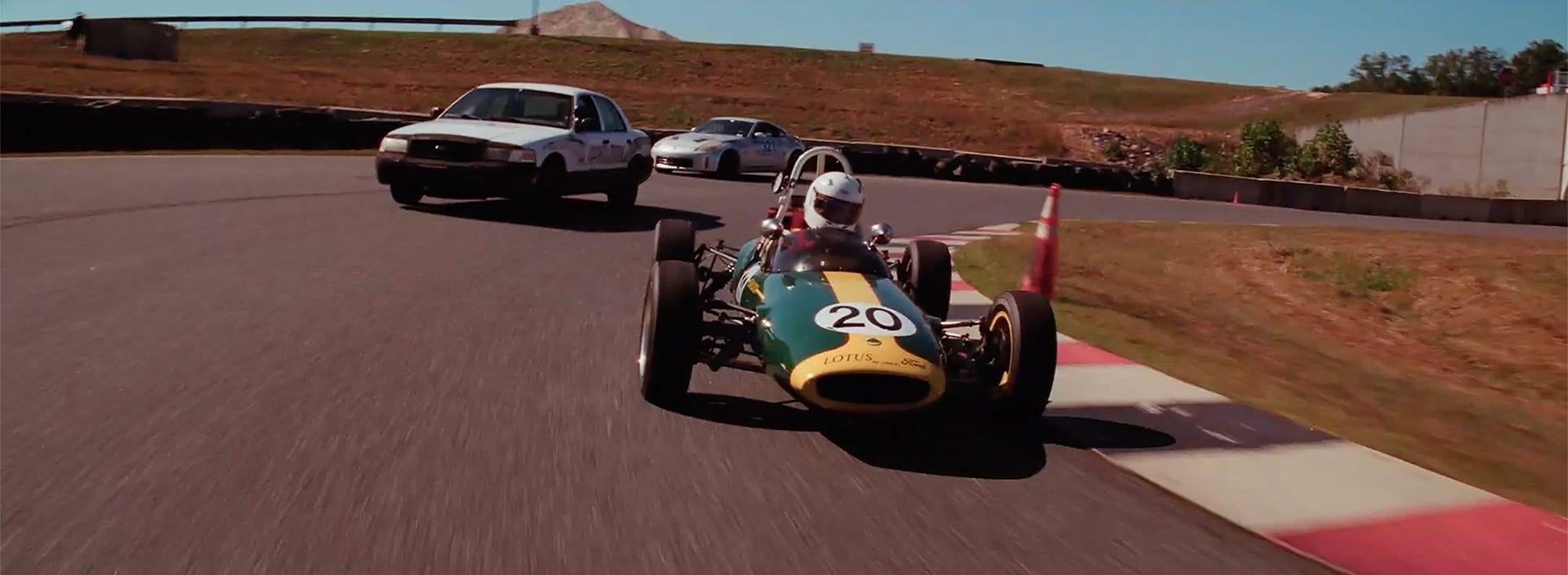
RT: No, that’s part of the gestalt. It’s part of the technology. I knew I wanted to a sports car because A) it was in Virginia, and B) The woman is Scots-Irish, an old import into the United States. I thought about the English car right from the beginning. Then, of course, came the play on words of “Sterling,” her name. Then I said, “Okay, it probably needs to be a Lotus.” Then I was fortunate by grace to actually meet someone who had [a Lotus 51C painted like Stirling Moss’s Lotus 18]. Independent filmmaking is brought with much danger and also some blessings that just sort of happen. I was looking around all over for just an English sports car, and then I met Stewart [Bartley], who owns that car, and just hit it off. And thank God for these blessings. The other cars are stand-ins for how auto technology evolved and developed, so you have the American stock car and the Japanese car.
AL: It’s a great image for your kind of filmmaking, this contrast between this old open-wheel car and a Crown Vic racing each other. You are an independent filmmaker who shoots on 35mm with a lot of jibs — it doesn’t look like most American films.
RT: I’m always moving the camera, and I’m always looking for the cut. I knew I had to do racing scenes, but I didn’t want to do Le Mans (1971). I wanted to do racing scenes with long takes. I still wanted montage, you want them both. I’ve always used cranes, I’ve always used jibs, I’ve always used dollies. I never use Steadicam. Those are kind of my habitual ways of doing it. Now I tend to shoot off cars a lot. Most of The Fishing Place was shot off of cranes, trucks, or four-wheel drive vehicles. We couldn’t afford that for this film, so we’re shooting jibs off Suzuki MULEs. You may come down in budget, but you try to get the same image. All those shots are basically trying to move the planned sequence as far as you can, and know the cut’s inevitable. And then when the cut comes, hit it as hard as you can. That’s where my style developed from Talking to Strangers to this.
AL: That’s funny you bring up Le Mans, because when they were shooting that film, they shot all the racing sequences in duration with real drivers who were going at close to racing speeds. They showed [the drivers] the rushes, and they were these great eight or nine-minute long sequences of them just driving, and they were upset when they saw the final film and saw how chopped up it became.
RT: When I say “montage,” I don’t mean Eisenstein. I mean linkage cuts. I mean using cuts like Abel Gance or Jean Epstein did, which are not Hollywood ideas of editing. Eisenstein, in many ways, and [Slavko] Vorkapich had more to do with Hollywood montage than the French did at that point. Although, the French also took it all from Griffith. I mean, they all stole it from Griffith. Whether we like Griffith’s politics or not, he is the source for that kind of editing. I respect it, I know it, I like it. But I don’t do it because I find it, at this point, distracting. As I said, I’d rather let the camera do the planned sequence up to the point you can’t do it, and then find a way to put the montage in as accent points, or take the plot, the metaphor, or the allegory up a level. I look at the over-edited scenes and it’s pleasurable. I mean, my mind goes crazy. But for me, anyways, it just existentially doesn’t work. That’s just my bias. I’m not suggesting that everyone should have the “Rob Tregenza School of Eisenstein.”
AL: I think it’s in La Roue, where there’s the dolly shot that’s literally on a train track, and the camera pans over to the man standing, looking at the valley, and it’s like the physical train track itself is transforming in that moment into the cinematic dolly.
RT: Right. And the whole thing with the editing that he did there with the locomotive smashing into another locomotive, that section is amazing. But he’s doing all of that independently of the Soviets. First of all, he wasn’t a communist or a Marxist. He’s not running around trying to use Soviet dialectics to talk about editing. That’s what happens when you finally get to the politics of Eisenstein, it’s elevated to a historical, scientific model for editing. That’s not what Gance was doing. In my mind, that’s certainly not what Jean Epstein was thinking about. They’re cutting on motion and they’re cutting for impact, but it doesn’t have the same mechanical nature. Without being too metaphysical: they don’t lose the soul. They’re still interested in somehow maintaining the direct connection to the body. I think that’s where, to me, cinema really hits you in the solar plexus or in the mind or the stomach or the ears; it reaches through the screen to you. I think it was Faithful Heart, one of [Epstein’s] early films — there’s a scene where she’s on a ferris wheel. Have you seen it?
AL: I’m not as familiar with Epstein.
RT: Look at that scene. I mean, it’s incredible. You look at it and you go, “Whoa.” There’s a whole style of editing that was developed in France that had, at that point, nothing to do with the Soviets. In fact, Epstein got into a lot of trouble because he wasn’t a Marxist. Off the subject, back to Fast.
AL: Back to Fast. The sequence that you do the most aggressive editing in is that racing scene, where you’re cutting between the racing itself and the control room, which also has some rare digital images from you.
RT: The images in the TV monitors are drones. Because it was a TV set and it was in a control room, I felt it was appropriate. Everything else is 35mm CinemaScope. 4-perf, 35 anamorphic. Which, as you alluded to the weight, and just simply the mechanical necessity of fighting gravity and maintaining the stable image, that’s always been—after 1926, even more-so — the problem for independent cinema: do you try to maintain the stable camera, or do you just throw it out the window and say, “By any means necessary”? I try to maintain a stability where the horizon lines maintain consistency. In 35mm with the BL [sound dampening blimp around the camera] — in this case it was a Moviecam 1000ft magazine, 22lb lens on the front of it — you’re looking at moving 40+ pounds around, with video assist on top of that.
AL: In your films, you have a really good sense for old cars. Are you much of a gearhead?
RT: Somewhat. My second car was a ‘66 Ford Mustang. It makes an appearance in Talking to Strangers. I’ve always liked sports cars or road cars, in some sense. I’ve had Jaguars, I’ve had Triumphs. But now I can’t afford them, so I’m driving a Ford.
AL: Well, you’re back to a Ford.
RT: Yeah, back to a Ford.
AL: You alluded to this in your first The Film Stage interview with Nick Newman that, “the cinematic event requires widescreen projection.” Can you elaborate on this?
RT: Required but no longer requires. For me, being an old person, I still labor under the illusion that cinema should be in the theater with an anonymous audience; somebody eating popcorn to your right, and somebody down there — heaven knows what they’re doing down there — but you’re in a space with other people, but you’re protected by the anonymity of it. Yet you’re also exposed to the fact that it still remains a public place. Then, the proximity between you and the screen, or you and the speakers, is an essential part of the event as well, because then it situates you in time and place while you’re also being situated in the cinematic world. You’re never separated from the physical place of the theater, or the space of the imagination of the screen. You’re carrying the sense of time and place of the theater into the moment, into the now.
I feel that that gets disrupted, obviously, when you start looking at something like that [Tregenza holds up his phone]. You no longer have the anonymity of being private in a public place — the paradox and contradiction of that. You no longer have the proximity of yourself and a 40ft screen, which then affects perception, cognition. In my preferred world, we’d all be going to theaters to see Fast, you’d be sitting there looking at that thing up on a huge screen with the 5.1 surround sound. Having said that, ironically, the other day I looked at Fast on my iPhone. Conveniently, at 2.66 it fills that screen. The sound wasn’t as good. I didn’t have the event elements that I prefer. But still, the transmission of the art — although without the aura of the art — comes through. So I’m becoming maybe a little less dogmatic about that now.
I think that if I had a choice: could people only see Fast in a movie theater at MoMA and nowhere else? I would have to say that is elitist, problematic. It’s art. It has to be accessible to whoever wants to access it. I think I said that three years ago, and hopefully I’m still growing. If I put up artificial barriers, I’m doing the art a disservice, I’m doing the film a disservice. So I would say, Alex, I’m modifying my position on that.
AL: I want to revisit the question of aspect ratio, too, because in the last few years especially, IMAX has been the format that’s become the cinematic event.
RT: This is 2.66 scope, which was the original CinemaScope aspect ratio, and then it gets cut down because they put optical tracks on the side of 35mm prints. So 2.66 is the widest possible anamorphic standard when blown out. Then you put optical tracks on one side, it cuts it down. Now, in digital I can literally shoot a composed 2.66 for a video image. In Fast, I’m going between 2.66 and 2.39, and you’re not aware of it, but I change aspect ratios while the film goes on. I couldn’t do that in a theater without printing a print-up optically, but the expense would be impossibly cost prohibitive. But in digital post, I can have the whole film be 2.66, and if I want to change the aspect ratio in the middle I can do that.
AL: Something I wonder with IMAX coming back is if that has to do with people looking at movies through social media or vertical screens, where these tall images can be more appealing than a widescreen one.
RT: I think that’s a limited play. I like the vertical image as far as composition, but gravity is what it is, and gravity is something that we can fight but we can’t defeat. There’s that joke in Contempt [1963], where Godard has Lang say something about Scope, “That’s only good for shooting snakes” or something. But the horizontal frame is a more existential extension of the human body than the vertical. There’s a lot to be said for gravity holding you down, and also perception being rectangular. Given time, all things will fall to gravity. The novelty of the vertical, I would think, will eventually go back to the horizontal.
No posts
Comments
Nothing yet. Say the first thing.
Sign in to join the conversation.