
Every time I discover a cool new apparel, skincare or other brand through Instagram or anywhere else, I check to see if it’s also sold on Amazon. If it is, it’s very likely that I buy it on Amazon rather than on the brand’s own website.
Fair or unfair, the reason is simple. I know I won’t have to pay for shipping for most products because I am an Amazon Prime member. And I’m going to get super fast delivery.
Amazon has spoiled me and other customers who now expect the same free, super fast delivery from every online shopping experience. But, most independent brands find it difficult to achieve Amazon-like speed at an affordable cost as they grow and scale because they don’t have its logistics infrastructure.
That gap is exactly what an Atlanta-based logistics tech startup founded in 2015 is trying to close. The startup is Stord.
It offers brands access to a physical network of warehouses paired with a software system to manage inventory. It’s positioning itself kinda like an anti-Amazon, calling itself ‘The Consumer Experience Company’. Different from the Everything Store because it allows brands to actually own their customer relationships but with similar efficiency as the behemoth in package fulfillment and delivery.
Stord has raised a total of $775 million through venture capital. Its valuation has doubled in a year to $3 billion and its revenue has 10x over the past four years to almost $1 billion.
What’s interesting is how it is being framed in the tech media as a company that will threaten Amazon’s dominance in e-commerce logistics, i.e. a David vs Goliath story. I get why. It’s a juicier take. And who doesn’t love a tech disruptor? Take a bow, Netflix!
After researching Stord, I think it’s the wrong frame entirely. Stord can’t unseat Amazon without becoming Amazon. More importantly that’s not its path to begin with.
Instead, it is developing a coopetition (= cooperation + competition) model that simultaneously supports Amazon’s retail storefront while offering an alternative fulfillment service for omnichannel medium to large, high-growth brands.
Disruptors don't just take market share. They make the incumbent's business model economically unviable. Like Netflix and Blockbuster. Stord isn't doing that. It can't. What it's doing is challenging Amazon in the logistics layers where it's extractive while cooperating with it where it's unbeatable. That makes it a challenger. That’s what this article is about.
I cover -
The physical infrastructure of online delivery and its four layers.
Amazon’s dominance in all four layers and whether it is too big to fail
When industries become ripe for challenge
The challenger playbook
Stord and the coopetition model
How to spot the pattern
To understand Stord’s position, you first need to visualize how online delivery actually works. It has four layers. Where a company sits in those layers offers insights into the power and limits of its position.
Shoppers find and purchase products online through an online storefront of some form. It could be the brand’s own website, an aggregator site like Amazon, TikTok, or even Instagram shopping. These days, most brands list and sell their products on multiple online stores or channels. Which channel comprises the highest percentage of total sales varies by product and/or brand.
For many brands, putting their products on Amazon makes sense, regardless of how many other channels they use, because customers can discover the product much more easily. This is one of Amazon’s core competencies in online retail alongside giving brands the ability to advertise those products on a platform that gets an estimated 90 million daily visits.
Stord has no online marketplace and no presence in this layer.
While the storefront displays the products that are available for sale, the actual products sit in a warehouse before they are ordered.
Brands that use Amazon’s Fulfillment by Amazon (FBA) service have to send their products or inventory into Amazon’s warehouses. The catch here is that this gives Amazon visibility into what’s selling, in what volumes, and in which geographies. This data is enormously valuable to Amazon and a source of significant controversy.
Stord provides this warehousing service and exists in this layer.
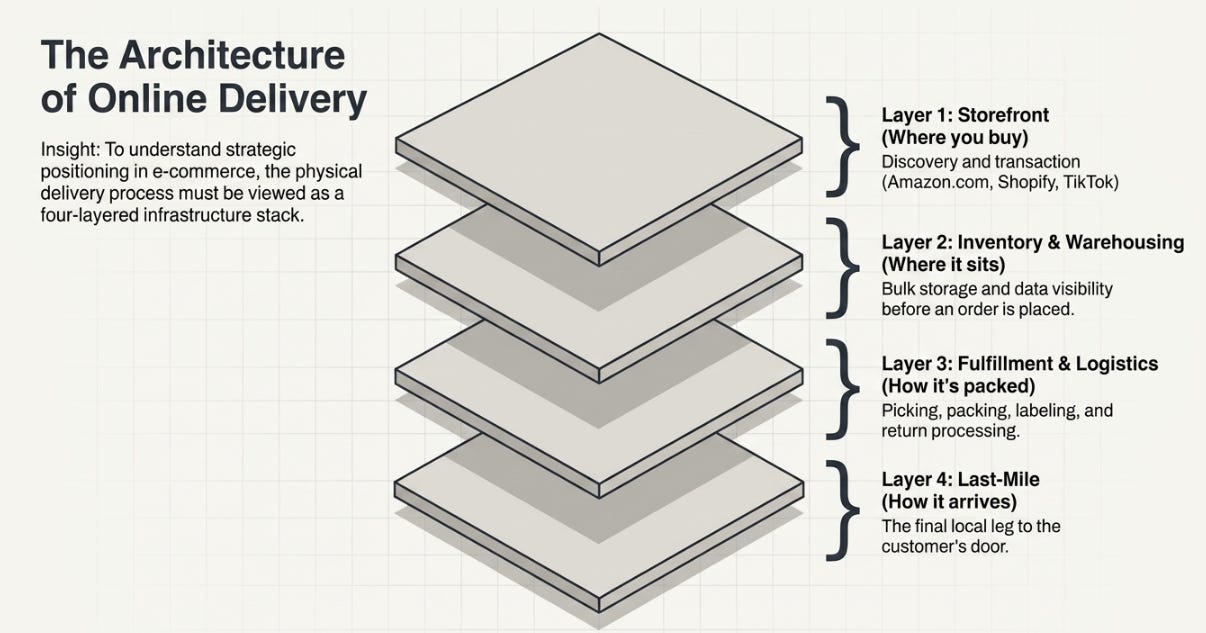
There is a distinction between a warehouse and a fulfillment center. Warehouses are spaces that store bulk inventory, often for longer periods of time. Fulfillment centers are hubs which pick, pack, label and ship individual orders to end customers. Many locations now combine warehouses and fulfillment centers for greater efficiency. Fulfillment centers also process returns and exchanges while warehouses generally do not.
Fulfillment centers are where Amazon optimizes by placing them physically close to most customers. And that is how they can give us Prime next day delivery. That proximity makes it possible. Once a customer places an order, a human worker or possibly even a robot in the center, picks the product off the shelf, packs, labels and gives it to the carrier to ship to the end customer.
While FBA includes a seller’s participation in the four layers mentioned here, brands can opt to only use Amazon’s Multi-Channel Fulfillment (MCF) service. This lets brands store inventory in Amazon's fulfillment centers and use its logistics network to ship orders that come from anywhere, whether their own website, TikTok Shop, wherever without those products being listed on Amazon.com at all.
In reality, MCF is just another 3PL service or a third-party logistics service. There are other providers which also enable this for sellers. MCF can be cheaper or more expensive than those other providers depending on the quantity, size, and other variables of the package.
Another option for brands is to list their products and sell through Amazon but get the order fulfilled through a third party like Stord. So, choosing to be in the first layer but not the others. It’s called the Merchant Fulfilled Network (MFN) service by Amazon.
Seller Fulfilled Prime (SFP) is an Amazon program that allows brands to get the coveted ‘Prime Badge’ on Amazon while shipping the products from their own non-Amazon warehouse, provided they meet strict 1-2 day delivery deadlines.
Stord provides fulfillment services that support Amazon MFN and SFP and hence operates in this layer.
As the term tells you, this is the final leg from a local facility to the customer’s door. Over the years Amazon has built its logistics operation to be able to control this layer and has reduced its dependence on external providers like UPS, FedEx, and USPS.
Stord exists in this layer but as a logistics coordinator that uses multiple partner carriers for these deliveries.
….which is the entire stack of online delivery.
For brands using Amazon’s FBA, the pros are that it is an efficient, integrated system that has nailed e-commerce from start to finish. It offers a substantial advantage that is hard to match. The closest equivalent is Walmart’s physical infrastructure which has a similar end-to-end e-commerce stack as Amazon but isn’t used as widely by third-party sellers.
While the pro is a big pro, here is a con.
The integrated control comes with real costs for brands. A brand that uses Amazon’s FBA Service is also invariably giving Amazon access to its data. Amazon sees all its sales data as in which products are selling, in what quantities, margins and location. It has been repeatedly accused of using independent sellers’ data to launch its own competing, private-label products at lower prices. A glaring conflict of interest.
Take a look at the shopping alternatives for cotton swabs including the one by Amazon Basic, the company’s private label brand, to the extreme right.
The company has been under investigation for these practices. Of course, it disputes the accusation and points to its own policies against the practice, but regulators haven't been satisfied.
The European Union forced operational changes after a December 2022 settlement. The US Federal Trade Commission (FTC) has filed a major antitrust lawsuit over Amazon's marketplace power. The legal battles are ongoing, and the accusations haven't stopped.
There are some more cons of using Amazon FBA.
Amazon controls the customer relationship when someone buys a product through Amazon. The brand doesn’t get customer emails, which allow it to build the relationship with the purchaser. It cannot market to that customer directly afterward. Then there are the high fees, up to 40% based on some estimates, that Amazon charges to brands to access its platform and services.
Amazon’s MCF service can seem like a better alternative because it allows brands to own the customer relationship. Amazon only receives the customer data to physically deliver the box but not browsing and consumer behavior data. However Amazon still has the ability to track product names, quantities ordered, and destination zip codes. This meta data gives it insight into market trends and localized sales volumes for certain products which can potentially surface popular market opportunities for its own business even if the brand never listed the product on Amazon.com.
Amazon’s fulfillment infrastructure is almost certainly too entrenched to displace. Building anything resembling its physical infrastructure takes decades and capital that no startup can easily match, in the short term at least.
The sum and essence of using Amazon’s FBA service is that the brands have very little to no negotiating power. They can either accept Amazon’s terms and conditions at this point or lose access to the speed that keeps them competitive.
So, Amazon feels too big to fail in the fulfillment layer and structurally, it probably is. But ‘too big to fail’ and ‘immune to challenge’ are not the same thing. History shows that dominant platforms unintentionally create the conditions for challengers to emerge from beside them when they become too powerful, too expensive, or too indifferent to customer interests.
It motivates brands, in this case, to use the incumbent where they must and find alternatives where they can. Apple's App Store fees pushed developers toward direct web subscriptions (case in point - readers can get the same Substack subscriptions for less via the web than if you use the Substack app). Salesforce's pricing power gave HubSpot its opening.
That's the tipping point when challengers emerge. In most cases the incumbent doesn't fall, but the challenger becomes a valid alternative in the market.
Enter Stord which is capitalizing on the opportunities to create competition at one or more of the online delivery layers, particularly for mid to large high-volume, high-growth brands which are able to fragment the stack.
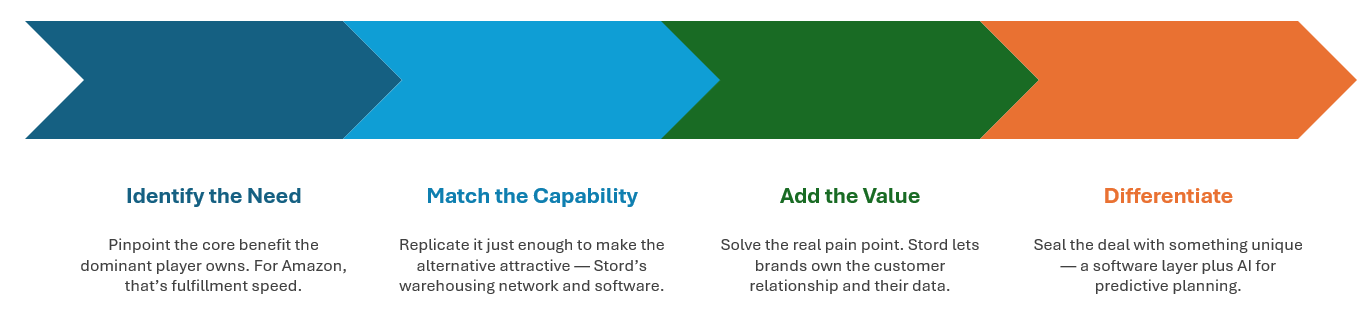
The playbook looks like this.
First, identify the specific benefit the dominant player delivers that brands can’t replicate on their own; i.e. the need. With Amazon, it’s fulfillment speed.
Second, match that capability just enough to make the alternative attractive. Stord's warehousing network and software do this. As Stord founder, Sean Henry, says, it is looking to “level the playing field” against companies such as Amazon’s Prime.
Third, solve the pain point. In Stord's case, it enables the brands to own the customer relationship and data.
Fourth, offer something else that is unique to enhance ‘value-add’. Stord built the software layer on top of the physical infrastructure hoping that gives brands one more reason to switch over to it. And then added AI capabilities for more planning and predictive power.
Shopify used this playbook at the storefront layer. Before Shopify, brands that were looking to build a direct-to-consumer website required significant technical resources, custom development, and payment infrastructure that most independent brands couldn't afford or manage. So, some brands were just using Amazon as the storefront.
Shopify made that infrastructure accessible, cheap, and fast. It didn't replace Amazon. In fact, Shopify cooperates with Amazon through its Buy with Prime feature. But, it gave brands a cheaper and more independent alternative to depending entirely on Amazon’s storefront. It reduced how much of a brand’s business had to flow through Amazon to be operationally competitive. Especially if the brand was successful at acquiring customers through other means like social media.
HubSpot built its CRM specifically targeting mid-market companies priced out of Salesforce. It competes directly for those customers. But it also integrates deeply with Salesforce for companies that use both, because many larger organizations run HubSpot for marketing and Salesforce for sales.
Stord is using the playbook at the warehousing and fulfillment layers.
Launched in 2015, Stord went through a few pivots before it landed on its current business model. I am not going to go much into the history of the startup to stay focused on the problem that it is solving.
To better understand the unique service that Stord is offering to brands, let’s go back to the four layers described above. Most players in this logistics space operate in one or two layers. Traditional 3PL companies operate like old school warehouses, i.e. they own warehouses or the physical infrastructure, but they have weak software. On the other hand logistics software companies have the technology but don’t own the physical facilities. Amazon, of course, owns all the layers.
Stord is filling the gap in the market that the 3PL and logistics software companies have left with its ‘cloud supply chain’ system and challenging Amazon. It does this by combining a massive network of independent partner fulfillment centers (physical) with the central software layer and AI capabilities (intelligence), i.e. a physical intelligence flywheel. The goal is to give independent brands and smaller companies Amazon-level delivery capability but without its ecosystem dependency. And let them own their customer relationships.
A unique value proposition has now been enabled by AI. Every order that flows through Stord's platform generates data that improves its predictions. Where to pre-position inventory, how to route shipments, how to optimize warehouse operations. The more brands use the platform, the smarter it gets. That compounding logic, if it holds, is where Stord's moat will be built around its physical infrastructure through a vertically integrated physical + software + AI stack.
Stord has scaled quickly in the last few years by partnering with independent logistics companies and executing an aggressive acquisition strategy. It bought existing networks and overlaid them with its AI software stack.
Key acquisitions include Fulfillment Works in 2021, a freight and logistics platform in 2024, SaaS platform Penny Black that specializes in data-driven print-on-demand inserts added to packages in 2025, a third-party delivery and fulfillment company owned by UPS called Ware2Go in May 2025 and more recently e-commerce fulfillment platform Shipwire in 2026. This has also given it an international presence in Europe.
Stord’s thesis seems solid. I can understand why it has been in the news and received multiple rounds of funding. For five consecutive years, it has appeared on the list of the fastest-growing companies, a feat that less than 1% of companies have achieved. It handles 50 million packages annually. Not a small number but definitely not comparable to the 6+ billion packages a year that Amazon ships in the US alone.
The logistics business, especially setting up or buying physical facilities, is extremely capital intensive. It takes a long time to capture returns. Stord is actually ahead of the curve there because it reached sustained profitability in mid-2024 while expanding aggressively. It claims that its “network powers over $15B of GMV for over 1,000 brands”. GMV refers to Gross Merchandise Value.
All of that is remarkable progress and likely to continue. The brands that benefit most from Stord are ones with established customer acquisition channels, a strong social media presence, owned email lists and subscription programs. Brands like AG1 and Native, which Stord cites as customers, don't need Amazon for discovery the same way a new brand does. What they need is fulfillment infrastructure for their direct-to-consumer channel, where they actually own the customer relationship. Stord fulfills those needs and then some!
Even then, those same brands don’t leave Amazon. They can’t afford to. They maintain a presence on Amazon because a significant portion of their customers still shop on there and not on their own websites → as in the example I gave about my own behavior at the beginning of this article.
So they maintain their Amazon presence for reach and discovery while using Stord for fulfillment and relationships.
For new brands, however, Amazon is almost an imperative because that is how a lot of customers discover new brands which lowers their customer acquisition costs. Or then they can spend on advertising on Amazon to surface their products where millions shop per day. Amazon is a discovery engine in addition to being a marketplace.
This is not a story about Stord replacing Amazon's fulfillment business. For Stord to genuinely challenge Amazon in a head-to-head sense, it would need to add at least one more layer to its business model viz. the discovery layer. The marketplace. Stord has expressed no intention of going there, and for good reason.
What Stord is doing is more nuanced than the headlines suggest and IMO, more durable.
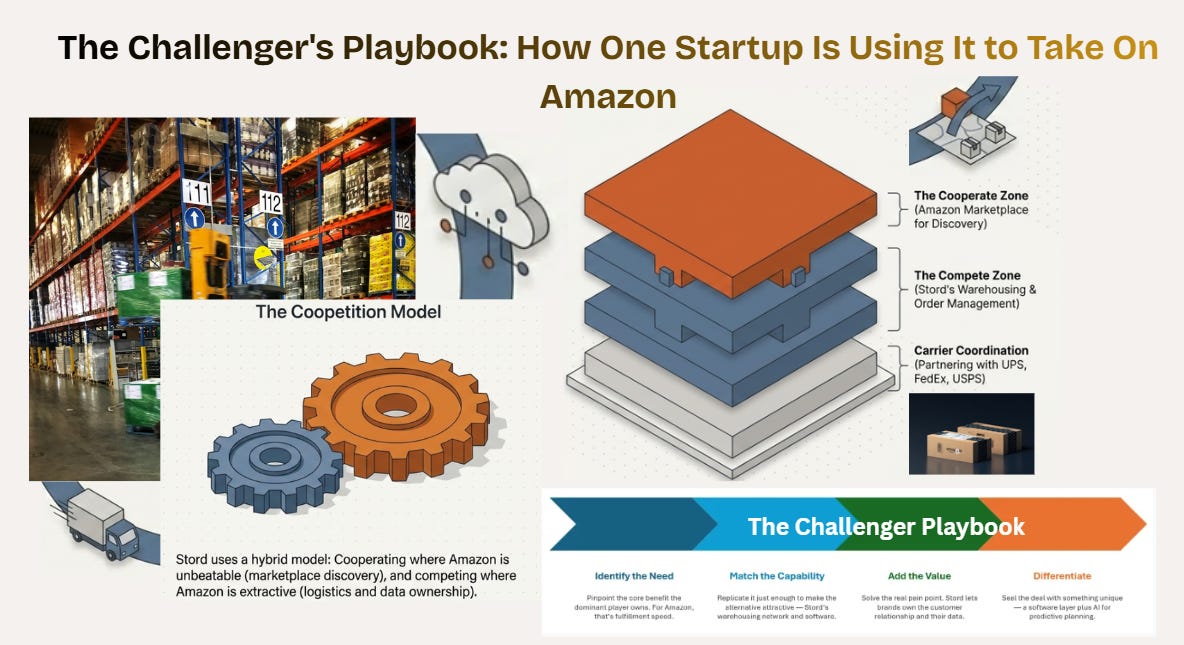
Stord has figured out that in markets where an incumbents is too entrenched to displace, the winning move isn't to compete in every layer and for every type of customer. It's to cooperate where the giant is unbeatable and compete where it's extractive. That's coopetition. And it may be the only viable model for challengers especially in (physical) infrastructure-heavy industries.
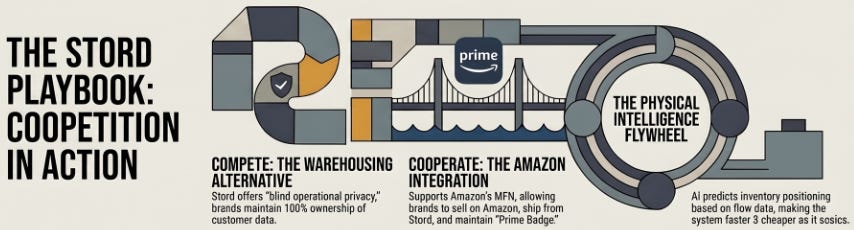
Stord provides fulfillment services that support Amazon’s MFN and SFP. A brand can store inventory in a Stord warehouse, list those products on Amazon, and when a customer buys, Stord packs and ships the order while maintaining the fast delivery standards required for Prime eligibility. Stord's order management and warehouse management systems link directly to Amazon so sellers can sync orders and inventory through a single platform.
…much of this has already been covered in previous sections. As a recap, Stord competes with Amazon primarily in the warehousing and fulfillment layers of the online delivery stack for a certain clientele of brands. Brands can avoid the fees of using Amazon’s fulfillment services by switching to Stord but get the same shipping speed and delivery speed. They also get to keep their customer lists and build relationships with their customers.
This balance matters strategically. A pure Amazon challenger is an existential threat that, and let’s not mince words here, it would spend billions to neutralize. A coopetitor is a partner the incumbent tolerates and arguably benefits from, because it helps sellers fulfill Amazon orders more efficiently. And Amazon still earns referral fees.
Can Stord unseat Amazon’s logistics business? No. Not without becoming Amazon. That’s very hard for a new entrant in a high capex industry that requires physical space (see how long data centers are taking to be constructed in the AI race or new fabs for chip-making, as other examples).
But that’s the wrong question anyway. The coopetition model that Stord is building is actually more durable than a pure disruptor business precisely because it doesn't require Amazon to lose. It requires only that enough brands find value in owning their customer relationships. And that the fees and data exposure of Amazon's FBA keep rising faster than brands are willing to accept.
The specific thing to watch with Stord is whether its physical intelligence flywheel compounds while its physical infrastructure spend also grows. The company claim is that every order that flows through the platform makes the AI smarter, which makes the next order faster and cheaper, which attracts more brands, which generates more data. If so, its moat deepens with every customer it adds. If not, Stord is basically a well funded third-party logistics provider competing on price against Amazon MCF, Flexport, and ShipBob. Right now, it’s too early to tell.
So, the next time you see a headline about a startup challenging a dominant platform, ask these three questions.
What is the incumbent’s business model and which specific layers is the challenger….well, challenging? A startup competing at every layer simultaneously is probably selling a story, not executing a strategy. A challenger attacking one or two layers where the incumbent is genuinely extractive is probably more realistic, especially in the early stages.
Is the challenger partnering (i.e. cooperating) with the incumbent in the layers it can’t win? It signals that the company has found a workable relationship and an avenue for growth by piggy backing the incumbent, so to speak.
Has the incumbent become extractive enough that its own customers are motivated to fragment their stack? The tipping point isn’t when the challenger gets strong enough. It’s when the incumbent gets expensive enough that the incentives start to align for the customers.
At the end of the day, tech disruptors like Netflix come by less often than challengers which can build durable, sustainable and profitable businesses using coopetition models.
Comments
Nothing yet. Say the first thing.
Sign in to join the conversation.