
I’m forever fascinated by people and companies that take bold, contrarian bets.
I want to differentiate between bold new ideas and contrarian ones. New ideas create markets and establish a way of doing things. Contrarian ideas directly challenge an established, dominant way of doing things. Like semiconductor chip maker Cerebras’ bet.
Cerebras was all over the news in May 2026 because it had the biggest IPO so far this year, raising $5.6 billion and then surging 68% above its IPO price. The stock has since normalized.

For startups and their investors, making it to IPO has traditionally been a key milestone of success. It indicates that it survived long enough to be taken seriously by public markets after scrutiny by investment banks, institutional investors, and regulators.
You generally can’t IPO without recurring revenue and customers; so it proves the idea scaled beyond a lab. Since most startups never make it that far, getting through to IPO can be a meaningful win.
Up to this point, Cerebras shared patterns in attaining milestones with other companies that took contrarian bets like Apple back in the day. Or in its own sub-industry, like NVIDIA.
But there’s an important difference. Apple went public just four years after it was founded. Nvidia took six years. Cerebras took eleven. Today, startups are staying private much longer. By the time public investors could participate in the Cerebras story, most of the contrarian journey, the near-death moments, the pivots, the validation had already happened behind its private company doors.
So, the first milestone of success is no longer an IPO. It’s whatever inflection point, whether a breakthrough product, a major customer, a revenue threshold, convinces investors to keep funding the journey.
For Apple and Nvidia, that ‘success’ milestone was a takeoff in sales that started to happen in full public view, with major growth following shortly after. For Cerebras, it was an IPO that arrived after the contrarian work was largely done.
This article covers what it takes for a startup developing a product the world calls ‘impossible’ to reach that first milestone and the pattern it reveals.
I'll end with a hypothesis about what (I think) comes next. Because getting to that first milestone and sustaining what follows are two very different beasts.
This is not investment advice. Please speak with your investment or financial advisor before making any investment decision.
Cerebras has its beginnings in the technology cluster of Silicon Valley. Its CEO, Andrew Feldman, co-founded it in 2015 with four former colleagues from SeaMicro. SeaMicro was a server company that they had sold to AMD for $334 million before embarking on the Cerebras journey.
Collectively, these individuals had considerable background knowledge in semiconductors and data infrastructures through SeaMicro and other projects. So, they knew to ask the question that no one else in the chip sub-industry was exploring.
Why were GPUs or Graphics Processing Units, originally engineered for graphics the default for AI workloads, i.e. a completely different use case?
Well, because GPUs were better than CPUs at the task. But that was almost accidental. What if they designed a fast chip specifically for AI from scratch?
Could that be done and could they be the team that did it?
Possibly!
If they could use the whole silicon wafer as one single giant processor instead of making chips smaller by cutting up the single wafer into pieces and then connecting them through complex communication infrastructure, the way the entire industry had been doing, it was doable.
That meant they would need to build a wafer-scale chip that was 46,000 square millimeters or 58x larger than the largest chip ever produced in the market. The new chip would be about the size of a dinner plate.
And by keeping the entire AI model on one chip, data would travel shorter distances eliminating the communication lag that slows down clusters of smaller chips.
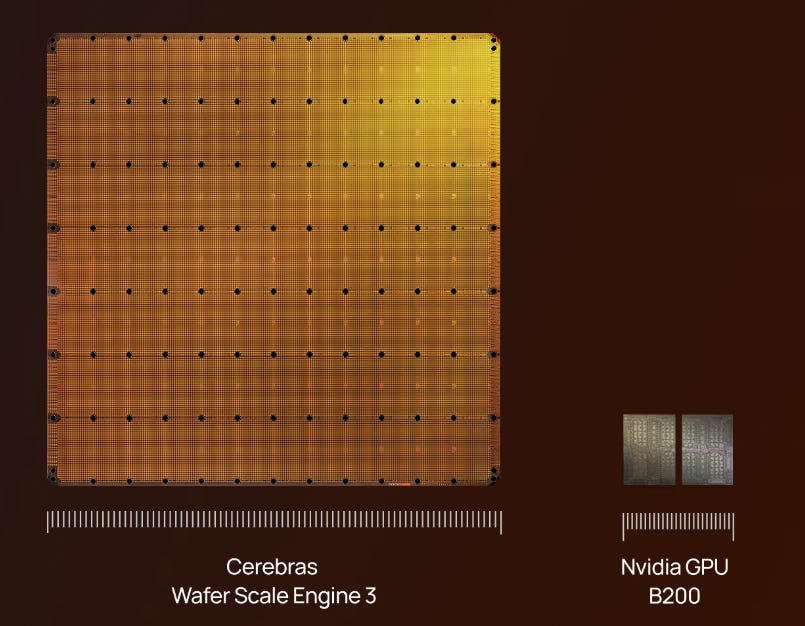
In theory, it felt reasonable. In execution, as they soon found out, it seemed closer to impossible. Even their own early investors were skeptical although they did manage to raise money from multiple backers. Their history of success with previous startups had convinced investors that they could pull off this idea of an impossible chip, in spite of the odds.
And in launching this chip, they also took on the market leader NVIDIA.
But, NVIDIA did not achieve success overnight. It got to its current status after decades of manufacturing experience, multiple pivots, billions in R&D, an army of engineers, and a moat in the AI chip market through its CUDA ecosystem. Every AI researcher in the world had built their work on top of NVIDIA’s product.
Challenging that position with a chip that had never existed before was either a very well-informed bet or a very expensive mistake. At that point, nobody knew which.
When they started out, the founding team had written on a whiteboard that they wanted to build something important enough to land in the Computer History Museum.
Now they had to actually build it.
Imagination is one thing. Bringing it to fruition is another.
For a chip that size that had never been attempted before, there was no playbook. Or rather the playbook that existed for smaller chips would have to be modified or rewritten.
Cerebras had to figure out how to power the chip, how to cool it and how to maintain electrical continuity across its larger surface. To add to the list of issues to conquer, there were no established parts, vendors, or partners to lean on either.
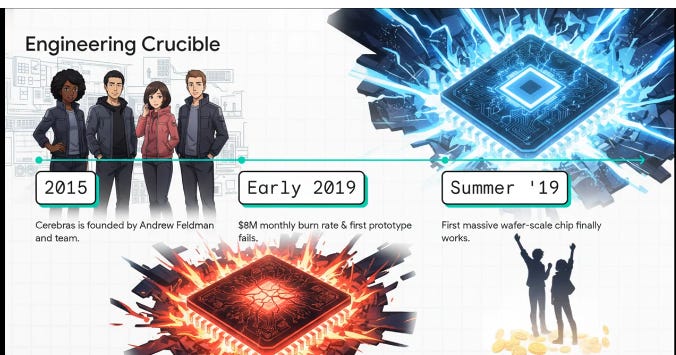
In such situations, where you are trying to solve multiple problems simultaneously, the problems can compound. Solving one thing exposes the next. The costs mount quickly. By 2019, three years into the project, the company was spending close to $8 million every month. After all that, their first prototype caught fire aka failed.
After every failure, the same question comes up. Is this still the right idea, or is it time to do something different? The pressure to pivot must have been constant.
Cerebras chose to persist on the contrarian idea of the bigger chip designed specifically for AI. Where they adapted was on the execution by working around the hard limits of engineering and physics until each problem yielded a solution. If you’re interested in a deep dive on how they solved the technical issues, here is a link to the details on their website.
In 2019 the chip finally worked for the first time. Their newest chip today, has almost 4 trillion transistors on a single piece of silicon, which is a major achievement.
That statement is widely recognized as a fatal lie in startup land. Simply launching a product, however great the founders and their well-wishers believe it might be, does not guarantee that it will actually gain customers. Founders need to actively validate, distribute, and find their market before and after launch.
Cerebras had built the wafer-scale chip for AI training. AI training is the process of teaching a model by running vast amounts of data through it repeatedly. Cerebras’ different architecture of a massive wafer-scale chip, which kept the entire AI model local and avoided the network delays that GPU clusters faced, should have been well suited for it.
But it wasn’t for at least these reasons.
AI training requires vast amounts of memory that the Cerebras chip did not have. GPU clusters are equipped with high-bandwidth memory, making them capable of training the massive foundational models prevalent today. Cerebras’ chips were unable to meet that memory requirement for AI training tasks. Adding external memory would mean losing the core architectural advantage the chip was built around of keeping everything on a single chip.
NVIDIA’s moat, i.e. the CUDA programming ecosystem is deeply entrenched across the AI industry. Switching costs are so high that developers hesitate to even consider it. The majority of machine learning research programs, frameworks, and libraries are optimized for NVIDIA GPUs. What’s the incentive for users to rewrite code or try out a new unproven architecture? There wasn’t a reason attractive enough.
This is where most startups with a hardware mismatch would have pivoted the core idea. Perhaps built something smaller, something more compatible. Cerebras didn't. Instead they figured out where their architecture could be a better fit, without changing it. They found it in inference.
The world is now moving in the direction of AI inference. The foundational models have largely been built through AI training (even though they are still improving). The bigger shift is now in applying them. Inference is the process of running a trained model to generate actual responses. It is where the industry is spending more time and money as AI systems respond to our queries continuously and at enormous scale.
The architectural strengths that hadn't given Cerebras an edge in training turned out to matter considerably in inference, where moving data quickly across a single large chip proved more efficient than coordinating it across many smaller ones. Memory constraints were less of an inhibiting factor. That’s where they found product-market fit.
Cerebras claims that its chip for inference is 15 times faster than its closest competitor. By the time Cerebras went public, roughly 70% of its workloads were inference-focused. The market was more welcoming of their chip as AI deployment scaled globally.
So now, Cerebras makes money in two ways.
The hardware business. Majority of total revenue comes from selling their CS-3 systems powered by their chips to multiple enterprise customers.
And the second is its cloud business where it’s providing AI model studios and dedicated infrastructure clusters. Here Cerebras lets customers pay to use its computing power and chips through the cloud. This is a growing segment for them and has high potential because of higher margins. If this segment grows, Cerebras would transform towards becoming more of a cloud infrastructure company.
Contrarian ideas don’t work just because they’re different or bold. Companies such as Apple, NVIDIA, and Cerebras, which took contrarian bets to the first success milestone, shared some core patterns listed below.
Apple and NVIDIA’s stories are by now well-known enough that I won’t repeat them here. In case you need a refresher, I’ve included a list of resources for both these companies at the end of this article.
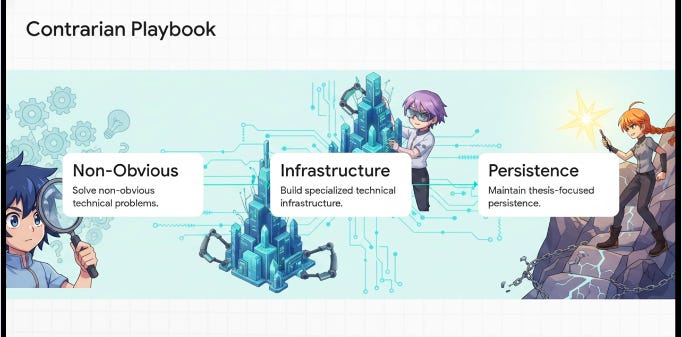
Contrarian winning bets fundamentally redefine the technical problem. Apple figured out that instead of building open, fragmented systems like its competitors that were trying to put software on every device, they enforced a strictly closed platform that made it seamless and safe for users.
NVIDIA built GPUs for computing, a very different use case from video games graphics. And while NVIDIA stitches thousands of individual GPUs together, Cerebras realized that they could reduce the speed at which data travels between chips by building the largest computer chip ever.
In each of these cases, the companies went against the tide or the established way of doing things. The established way was already solving the obvious problem for customers.
In startup land, advisors always recommend that the way to solve a problem is to talk to customers and figure out their pain points. Had any of these companies talked to customers, they might not have been able to identify these as pain points because customer’s explicit problems were indeed being solved in some shape or form. But the founders still believed that there was a better way.
And that belief came from domain expertise.
Feldman, the founder of Cerebras, had already built and sold companies in a similar infrastructure space. He knew semiconductor architecture as did his co-founders.
NVIDIA founder Jensen Huang had been a chip designer at AMD and LSI logic before founding NVIDIA. He understood GPU architecture and how it could apply to parallel computing.
And Steve Jobs had already built Apple once, been ousted, and then came back with a completely different understanding of what consumers actually wanted from technology.
The pattern across all three is the same. The contrarian insight didn't come from a brainstorming exercise. It came from years of working inside the industry and being close enough to see what everyone else had stopped questioning.
To develop a solution to a non-obvious problem often requires starting from scratch. Companies need to invest in building unique technical infrastructure. The more specific the solution, the higher the need to find specialized parts and suppliers. And this is no quick sprint. It takes a marathon to build an entire system.
Cerebras was playing the long game and optimizing for a future state they had envisioned. If the plan worked, they would also end up creating a moat that competitors cannot easily cross. But at that time you’re building it, you don’t quite know if that vision is going to manifest.
It has, for Cerebras. Its system includes highly specialized liquid cooling, custom power delivery, and data feeding pipelines engineered for its large-sized processor. It also has a proprietary software platform, CSoft, that allows developers to train their AI models on one chip without parallel programming.
Apple controls its entire hardware and software stack. It designs the chips, builds the hardware, writes the operating systems, and even runs the digital marketplace, the app store, where users download software.
NVIDIA built CUDA, which is a software platform that allows developers to use its GPUs for parallel computing and now AI.
For Apple and NVIDIA, the infrastructure took years to build and is now extremely difficult for competitors to replicate. That's the point. The long game is what creates the moat. Cerebras is playing the long game and does have specialized technical infrastructure. While it is not yet as advanced as the other two companies, the pattern is the same.

While this might be true of many startups across the board, it is especially true for contrarian ideas. Many of them fail in the early stages but they persist enough to make it to the end.
And contrarian persistence is different because it involves going against the dominant method of doing something and convincing users to abandon tried-and-tested ways and try it.
Apple, NVIDIA, and Cerebras almost went bankrupt at some early points in their evolution attempting this. Cerebras almost made it to IPO twice but had to delay it for a variety of reasons including a regulatory investigation.
What kept them going through those near-bankruptcy moments was something specific. Persistence, as a quality, is driven by a combination of a compelling ‘why’, resilience, and the expectation of some reward at the end of that journey.

The compelling why in the case of Cerebras was the question about why companies were cutting wafers into pieces and then spending enormous effort making them talk to each other.
For Apple the question was, why does technology have to be fragmented, complicated, and unattractive? And for NVIDIA it was the question about parallel workloads on sequential processors.
And the specificity of that grievance is important. Because it separates a contrarian idea from a vague hunch. It also makes persistence more thesis focused and gives the founder something precise to return to every time the pressure to abandon the idea becomes overwhelming.
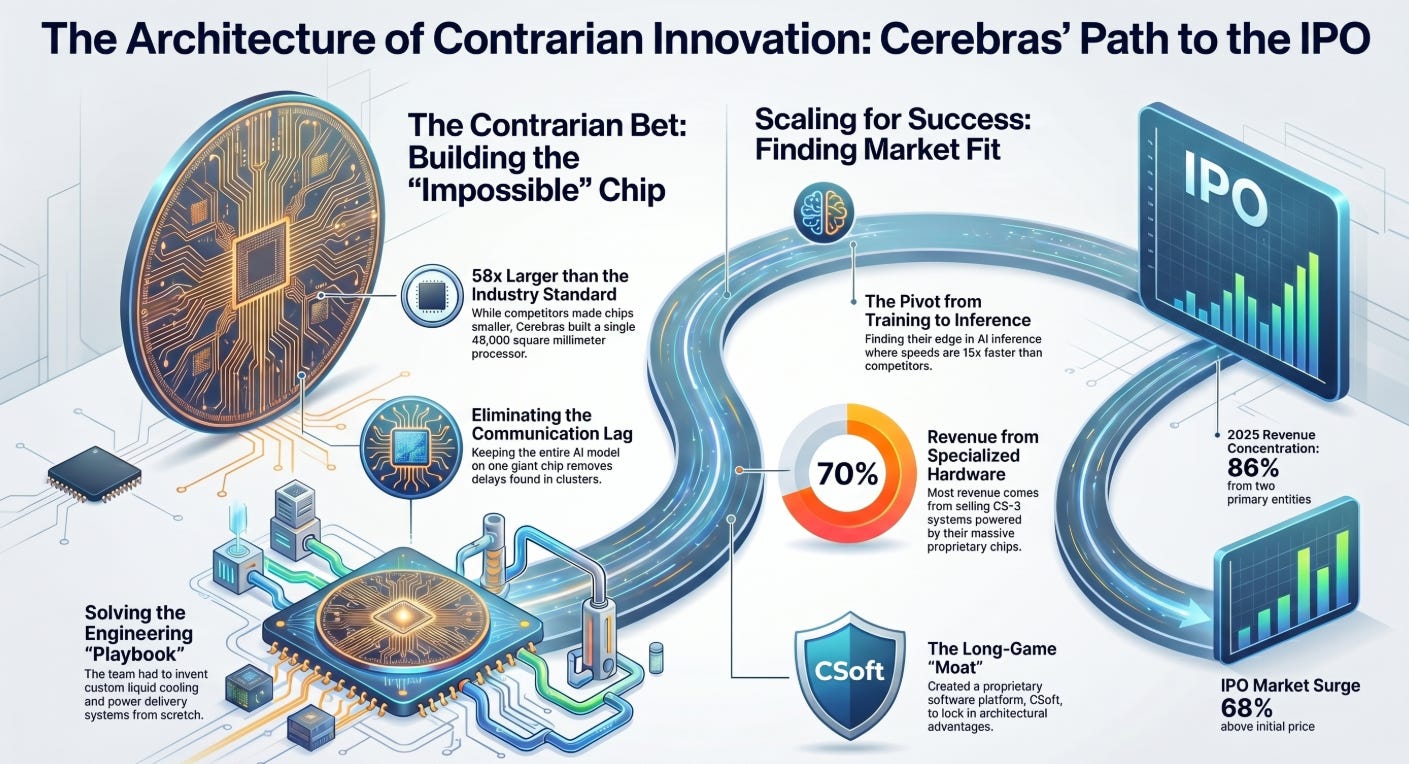
Getting to IPO required three core capabilities above all others; identifying a non-obvious problem through deep domain expertise, building specialized technical infrastructure for the long game, and holding the contrarian idea intact through prolonged adversity while adapting everything else around it to survive. Cerebras demonstrated all three.
But unlike Apple and Nvidia, whose post-milestone journey played out in public view from early on, Cerebras arrives at its public chapter with its first milestone already behind it and a different set of challenges ahead.
An IPO can feel like a bit of a fairy tale ending, especially after surviving all the hardships. Once the joy settles, it is also the beginning of another journey that is under constant scrutiny by investors, analysts and the media. It requires transparency that pre-IPO startups can avoid when they are behind that private company velvet rope.
Apple and NVIDIA have so far navigated public life successfully. But this is where I think Cerebras’ path might diverge from theirs.
My hypothesis rests on some challenges that Cerebras faces today.
The vast majority of Cerebras’ revenue comes from a handful of relationships. In 2025, 86% of Cerebras' total revenue came from just two United Arab Emirates (UAE) entities. One was the Mohamed bin Zayed University of Artificial Intelligence (62%) and the second was G42 (24%). G42 was also an investor in Cerebras.
This invariably invited an investigation from the Committee on Foreign Investments in the United States (CFIUS) which launched a national security review. Cerebras assuaged CFIUS concerns and eventually cleared its own path for an IPO by reorganizing the company such that G42's stake was turned into non-voting shares. But, if for any reason in the future, US export controls tighten further, its main revenue source could be instantly in jeopardy.
In the US, Cerebras signed a mega deal with OpenAI amounting to $20 billion and another with Amazon’s AWS to deploy Cerebras' chips in their data centers. Solid silver linings here but the OpenAI one also happens to be one of those circular financial relationships that the AI industry has become notorious for. OpenAI is also giving Cerebras a separate $1 billion loan with the option to take roughly a 10% stake in the future. The problem with some of these deals is the co-dependence that introduces fragility into the revenue stream. However, it could work out well and invite others in to add more revenue sources.
Rather than a broad tech platform like NVIDIA, Cerebras is, for now, more of a highly specialized niche provider with a few dominant commercial partners. That matters because it incurred operating losses to the tune of $146 million in 2025, although there is some profitability shown on paper due to a one-time accounting allowance for restructuring. The financial runway depends heavily on those relationships holding and new ones being formed quickly.
It could happen. If they’re able to engage more customers, this situation could change but the next point brings me to one of the hurdles in achieving that.
As the AI market shifts from a focus on training to inference, there are many other companies that are developing inference-optimized architectures, such as AMD, Intel and ARM. Hyper scalers like Google, Meta, Microsoft, and Amazon are designing their own custom chips for inference workloads. Companies like Groq, recently acquihired by NVIDIA, are competing directly for the same inference-seeking customers as Cerebras. Competition is fierce.
While the Cerebras chip shows inference speeds well ahead of GPU-based alternatives, speed alone is not a moat. Although Cerebras is building a proprietary ecosystem, currently it does not have anything equivalent to NVIDIA’s CUDA, which has high switching costs away from it. If anything, Cerebras needs to focus on getting users to switch toward its products and services. The question becomes whether it will be able to accomplish that amid intense and well-funded competition.
A set of core capabilities is required to get to IPO with a contrarian bet, as identified previously. Cerebras achieved that. The idea of a dinner plate-sized chip stayed intact through its journey so far even as the market, the customers and the timing was adapted as needed. That’s what it takes to successfully bring a product to market.
Public market success, however, requires a different set of capabilities, such as building a diversified customer base, solidifying and deepening a moat and eventually generating increasing profits, quarter over quarter.
Cerebras does have an architectural advantage. Whether that translates into the kind of compounding moat that Apple and NVIDIA have, that sustains a public company is TBD.
That’s my hypothesis. Not that Cerebras will fail. Its technology has merit and the market is large and growing. But that it has a long way to go and a lot more to prove before it can acquire a significant share of that market, in my opinion.
Let me end this hypothesis by saying that never underestimate someone who brought a contrarian bet to market! Its next chapter is still unfolding.
This pattern is easi-er (but not easy) to spot in real time for public companies. Earnings calls, filings, and analyst coverage give you trackable data over time. With Nvidia, you could watch Jensen Huang say the same thing about parallel processing year after year, see CUDA adoption growing, and watch the revenue mix shifting, all visible in real time.
Ironically, very few were paying attention to NVIDIA or tracking what Huang was saying at the time. Those who did invested, and reaped strong returns, as we now know.
With companies like Cerebras which stayed private longer, the big returns from spotting a contrarian idea early now largely accrue to private market investors. But, even public companies have to keep taking bets and evolving to stay relevant. Like NVIDIA, which is now pushing into the CPU market. Or Apple, which is still figuring out how to build AI capabilities while facing criticism for its delay in doing so.
And there are opportunities that exist today and new ones being created every year in the US for more people to invest in startups through secondary markets, crowd funding platforms and other paths, whether accredited or non-accredited investors. So, recognizing patterns of what drives success in different contexts remains pertinent and applicable.
Consider subscribing to our partner publication with international coverage https://mailr.tech

Library of Congress Research Guide including a list of all relevant print and internet resources that share details about Apple from its incorporation to recent events
Comments
Nothing yet. Say the first thing.
Sign in to join the conversation.