
Building an AI data center has predictable steps.
Pick a site. Lay down the bricks. Request a power hookup from the regional utility. Then, you wait in queue until you get access to power.
Once you do, the data center can then start operating the rest of the AI stack with its chips, models and everything built on top.
The power of power!
But now there are too many data centers being built. The queue for access to energy is long. The grid is overburdened. And it’s taking multiple months and in some cases, years to experience that first watt.
The choice is for the AI data center builders to just wait it out. Yeah, right!
Or find alternative ways to conquer the energy bottleneck.
Companies (or their investors) are not patient actors. AI companies in particular are highly impatient right now given the dynamics of the AI race.
So many are doing what their corporate ancestors did before them. Instead of waiting for the infrastructure to reach them, they are going to where the resource already exists.
This article is about the one startup that did this before the rest of the AI infrastructure industry. Most others in the industry started with compute and then backed into energy as the bottleneck. Crusoe started with energy and then went into AI compute.
That early idea is now paying off. Crusoe is in talks to raise funding that could value the company at ~$30 billion. That almost triples its valuation from less than a year ago.
It is also the startup that is building the flagship site for The Stargate Project, the ginormous $500 billion AI initiative that is expected to secure American leadership in AI.
I wanted to write about this startup because it came at AI infra from a unique angle at the time. That early innovation made all the difference. There’s a lesson in there for startups on how to enter an industry by seeking or building an angle that leverages their specific strengths.
And yes, the startup is named after Robinson Crusoe, the fictional character you might have encountered before, created by Daniel Defoe.
The book tells a tale about survival through self-reliance. And that tells you something about the idea behind the startup.
Crusoe’s founders and their story have been covered on various podcasts and articles. I’ll link references towards the end of this article in case you’d like to dig deeper on all things Crusoe.
To keep this article high signal, I won’t repeat all of it here. I will, however, mention a few details to provide enough context for why they were the right people to take this on. And that matters for startups to increase their likelihood of success because of founder-market fit….even if said fit is not a sufficient condition and provides no guarantees.
Chase Lochmiller, Crusoe’s CEO and cofounder, has a background in computer science and AI research. At one point, he was a quantitative researcher building algorithmic trading systems that forecasted stock prices.
Based on his interviews, there seem to be two takeaways that emerged for him from his pre-Crusoe experience;
“AI is the new electricity”, a belief he absorbed from Professor Andrew Ng at Stanford grad school; and
energy costs associated with advanced computing were going to keep increasing. He had run up steep power bills himself to work the forecasting algorithms behind his trading strategies.
The other cofounder Cully Cavness has a more direct relationship with the energy industry having worked extensively in the oil and gas industry. A few takeaways from his pre-Crusoe years include
multiple insights gathered from his study travel of global energy resources in 25ish countries
directly experiencing the problem of natural gas flaring, noticing that oil producers often had no choice but to set gas on fire when pipeline access to take it elsewhere was unavailable. He noted this as an inefficiency in the system, the waste of a valuable energy resource and an environmental threat.
As the founding story goes, on a hiking trip in 2017/2018, the two friends decided to combine Cavness’s energy experience with Lochmiller’s understanding of the energy demands of computing to set up an energy-first computing startup.
Given the evolution of their idea, it meant that Crusoe had to build at the energy source itself rather than building data centers in popular hubs like Northern Virginia which has too many friendly neighborhood data centers demanding constrained power.
Although Crusoe might have set a bit of a trend in the AI industry by moving to the source, there are precedents for that kind of location behavior by companies.
Weber’s model was designed for physical manufacturing plants back in the day. He theorized that bulk (or weight) reducing industries place their factories next to the sources of raw materials. Because that is the least-cost minimization approach.
Decades ago, Iceland had a huge surplus of cheap geothermal energy. There was no local demand for it at the time. Instead of building transmission lines to various destinations, it shipped in raw aluminum ore from across the globe, refined it on site using geothermal energy and then shipped the finished aluminum back out.
Even intuitively this makes sense. Because lugging expensive and heavy materials around incurs high costs.
While not a perfect fit, the theory aligns with how Crusoe set up its business close to energy sources.
If you consider electricity traveling over long-distance grid wires to be expensive and inefficient, it makes sense to build data centers next to the energy sources. They can turn that raw power into weightless data packets. Add to that the opportunity cost of waiting for energy in the AI race and the case for geographic proximity becomes very clear.
Crusoe’s CEO Chase Lochmiller made this case himself on a podcast on which he said
“You can run your back propagation and large-scale pre-training on significant amounts of data to train your LLM, and then you can sort of ship the finished product to wherever you need it to go, or you can run inference by sort of feeding tokens again across those subsea cables and then getting the output back to wherever you need it. So I think there’s this philosophy that moving data is quite a bit easier than moving real world physical materials, and it’s a way of sort of relocating the energy-intensive compute workload in an area that has that low-cost clean and abundant energy.”
Making the decision to locate close to energy is the first part of the equation. Crusoe also needed to harness that energy and then use it to power compute. They did this in an interesting way through DFM.
Digital flare mitigation (DFM) is an innovative technology, trademarked by Crusoe. It involves capturing gas from oil wells that producers might otherwise have burned off.
Oil producers do this to “get rid of and combust flammable gas that can otherwise over-pressurize their equipment”. On the environmental side, this practice is bad for the planet. The International Energy Agency (IEA) reported in 2020 that 142 billion cubic meters of gas was flared. That wasted energy could have powered 49 million homes!!!
However, this particular environment-protecting argument has been a bit of a tougher sell to climate experts who think that it is a deceptive solution. In their view the only way to avert a climate crisis is to reduce oil and gas (i.e. fossil fuel) production and consumption in the first place.
That climate debate is certainly important and one that I care deeply about. I plan to cover it in one of the upcoming articles. But, in this one I want to stay more narrowly focused on Crusoe’s place in the AI infrastructure world.
By using DFM, Crusoe was able to generate power on site with ‘on site’ being a key term.
Although many articles in the media report that Crusoe was the DFM pioneer, the truth might be a little more nuanced.
A company called Upstream Data, which was founded by Steve Barbour in 2017 (Crusoe was started in 2018) was running modular bitcoin mining units powered by flared gas. They had filed a patent on the idea. In fact Upstream sued Crusoe over it in 2023 which challenges the pioneer claim.
Eventually the case went away before any kind of ruling was made. Not sure what happened there. But pioneering accolades aside, based on multiple reports Crusoe was indeed the first to scale that specific combination of self-generated, stranded-energy power with compute.
Unlike Upstream Data, which remained a small, private equipment vendor in bitcoin mining, Crusoe took on the capital, the operational risk, and the regulatory complexity of building this platform at scale. That is no small feat. So ultimately what ended up mattering more than inventor status was the willingness of a startup to take on the hard part.
You could think of different use cases for DFM. Basically anything that requires energy and, as in Weber’s theory, is light enough to ship from site can be a potential use case for this technology.
In Crusoe’s case, the CEO’s experience led to its use case being computing. Solving for the energy constraint laid the foundation to solve for compute.
Interestingly they initially did this for cryptocurrency. Bitcoin to be more precise. Bitcoin mining relies on computational power to execute calculations, secure the network and generate coins.
This initial foray into bitcoin-ing ended up being the proof of concept for the eventual pivot to AI as the crypto boom abated and the AI one started.
Whether Lochmiller’s background gave him a vantage point that let him predict the upcoming demand for GPUs for AI or whether the experience with bitcoin positioned Crusoe to serendipitously capitalize on the next compute wave (i.e. AI) would make for an interesting debate.
But when the LLMs AI wave started to rise around 2022, Crusoe got on it. They had already solved for the energy problem, which the rest of the industry tackled a tad bit later. What Crusoe did next was direct its compute capabilities toward AI.
On the Acquired podcast, Lochmiller acknowledged that they might not have got the company off the ground if they’d started by building cloud infrastructure. Because oil companies needed their flaring problem solved immediately while AI customers needed a stable, working cloud platform on day one. He contended that bitcoin mining enabled them to bridge that timing gap.
In terms of identity, that put Crusoe closer to an energy company that decided compute was the highest value thing to do with its power rather than a cloud company that happens to source power differently and achieves a structural cost advantage in the bargain.
As NVIDIA CEO Jensen Huang said, “In the AI economy, compute is revenue”
In the last couple of years Crusoe has vertically integrated for AI. It operates what it calls a full-stack AI factory model rather than just a data center.
To see how, it helps to visualize the AI industry as a stack, as in this image. Full disclosure: I did not create this image. The source is linked in the caption.
Applications and interfaces sit at the top, closest to the customer. Models and clouds in the middle; land, power and shell at the bottom or beginning of the stack.
There is a lot more convergence towards the top. As you know having used them, that the models are converging as are the interfaces. Crusoe’s cloud product, given its nature including the GPUs API, etc., it’s unlikely to be too different from those of its neocloud cohort like Coreweave or Lambda.
So a lot of that differentiation basically lives at the bottom in the land, power and shell layers that Crusoe controls directly. More specifically,
Power and energy generation. Crusoe has now expanded its energy playbook from securing stranded or wasted energy, like the flared gas or even wind and solar to battery storage and also fossil fuels. This is in response to the sheer volume of power needed for the modern gigawatt scale AI factories that it is now building.
Rather than outsourcing, Crusoe manufactures its own critical electrical switch gear and mechanical data center components domestically. This allows it to reduce construction timelines from over a year through the external supplier model to just a few months by doing this internally.
Crusoe also provides its own cloud platform. It partners with chip makers like Nvidia, AMD, and others to access and deploy high performance GPU clusters. It also has its own networking stacks and software management systems.
It does not make GPU or networking chips. These are bought from suppliers like NVIDIA and AMD. It also does not build foundation models like OpenAI or Anthropic although it does provide the compute that AI labs use to train and deploy these models. It also does not build user facing AI applications like Claude or other tools.
This vertical integration in those lower layers has helped them increase speed to market, which is the ultimate priority in the AI industry right now. And that speed has given them a competitive advantage in this fierce data center battle.
Enter the Stargate Project.
At a high level, the Stargate Project is an initiative led by OpenAI, Oracle, SoftBank and others to build next generation AI data centers and infrastructure in the United States. It has the support of the US government and was announced at the White House. It is expected to be the largest network of advanced AI data centers in the U.S. when completed and one of the largest in the world.
Where Crusoe fits in is as the lead developer and infrastructure provider that is designing and building the flagship campus in Abilene, Texas. It is using its energy-first approach here too. It will use surplus local wind resources on site with natural gas turbines and battery storage on top of a grid connection. More of a hybrid approach than a pure play stranded energy one that it started its business with.
The Stargate Project is a testament to the belief in the AI industry that Crusoe can build well-powered, large data centers faster than anyone else.
And speed is the need of the hour. Lochmiller has said that of the 32 companies that bid on the RFP to build the Abilene campus, the fastest competing timeline was about 2.5 years. Crusoe committed to a year and delivered it in 11 months. Even better!
Given Stargate and some of the other contracts that Crusoe has signed, it is no surprise that it is raising capital again and at a much higher valuation.
Below, a video of Stargate Site 1 in Texas shared by OpenAI’s Sam Altman on X.

Sam Altman@sama
big. beautiful. buildings.
7:08 PM · Jan 23, 2025 · 2.96M Views
1.53K Replies · 883 Reposts · 14.6K Likes
Crusoe tackled it a few years before the rest of the AI infra industry. Now the problem that it identified, that computing’s energy needs are going to require that someone solve for power directly, is showing up across the industry. And it’s spreading in at least two different ways.
First, energy producers are reorganizing themselves around AI because they have identified AI companies as their most valuable customer. So they are going around the grid to cater to their needs.
Energy company Talen is selling nuclear capacity directly to Amazon; Constellation Energy is restarting the controversial Three Mile Island nuclear power plant for Microsoft. And a bunch of small modular nuclear reactor startups have reached criticality this year. Most of them are pretty much purpose built to serve data center demand.
The second is closer to Crusoe’s playbook of a compute or infrastructure company vertically integrating into power generation itself. Fermi is an example of a company that is building a complete behind-the-meter hybrid campus that combines gas, nuclear and renewables into one energy system. More Crusoe than even Crusoe.
Speaking of Crusoe, its own energy-first model has evolved over time. As described earlier in the Stargate section, it is now using additional formats for energy incl. natural gas.
The whole logic of ‘highest value thing to do with stranded or wasted power’ works great when power is low cost. Now that the company is involved in building massive power plants like The Stargate Project with its exorbitant capital and other costs, it has evolved into more of a compute company that is also a power plant developer to avert the constraint and build fast enough.
This evolution is fairly normal for start-ups as they pivot, scale and grow.
Potentially. If you can vertically integrate on site the way Crusoe does. That’s the TL;DR answer. The more nuanced one is that there are different paths to vertically integrate and a related set of decisions to be made.
Leasing energy from the grid is the default. It can be the right choice for some. It’s comparatively the low risk one because it is regulated, it is reliable and it is backed by the utility company. Someone else takes on the responsibility. Once it is set up by the utility company, you plug in and go. This skips the development phase but locks you into the existing infrastructure, timeline and pricing set by someone else.
CoreWeave, one of Crusoe’s competitors, has spoken about the virtue of this grid connectivity being less redundancy to hit uptime targets; i.e. simplicity and lower costs. It trades off speed for reliability.
On the other hand, building or buying your own power source could get you up and running faster because you’re no longer waiting in queue for access to energy. But whether that reduces time to market on a regular basis depends on other factors.
Crusoe built its energy-first identity on capturing stranded or wasted flared gas which is cheap. But it is also limited and it is location-specific. That means relocating to where the gas source is.
That’s possible in some cases where it is sufficient to have modular shipping container-sized data centers. But those are unlikely to fully meet the needs of larger scale projects like Stargate. Crusoe addressed that for Stargate through the hybrid approach mentioned earlier. While they still managed to deliver faster than the other bidders on the project promised, it meant adapting its own model.
If you’re not using cheap wasted energy and building your own power generator, the cost advantage that made Crusoe’s model work in the first place starts to dissipate.
In spite of that, many AI infrastructure companies are figuring out their own energy sources outside of the grid. Because cost is not as much of an issue right now for them as speed to market. That’s the trade-off they’re willing to make. And those high capital expenditures are showing on the balance sheets of the publicly listed AI companies.
So the sum and essence of the above decisions is that energy speed mostly holds if the power source is on location or at least close by. Stranded energy, for example, cannot be shipped easily, almost by definition. It has to exist at a specific well head or, in the case of wind energy, a specific area of curtailed wind capacity.
If you are trucking in equipment and building new generators from scratch at a site chosen for reasons other than the cheap power that is already here, you could lose the speed advantage.
And just to keep in mind that above decisions are primarily related to vertical integration of the energy source. As described in one of the previous sections in this article, Crusoe also made other parts and components required for its data centers internally. A vertical integration isn’t only about the fuel source. It also requires control over the physical data center supply chain, including switch gears, transformers, et cetera. That also shaves off time to market and is a key piece of the speed puzzle.
So, it is not impossible for someone to use Crusoe’s model and speed up the time to market. But doing so requires a specific kind of vertical integration model.
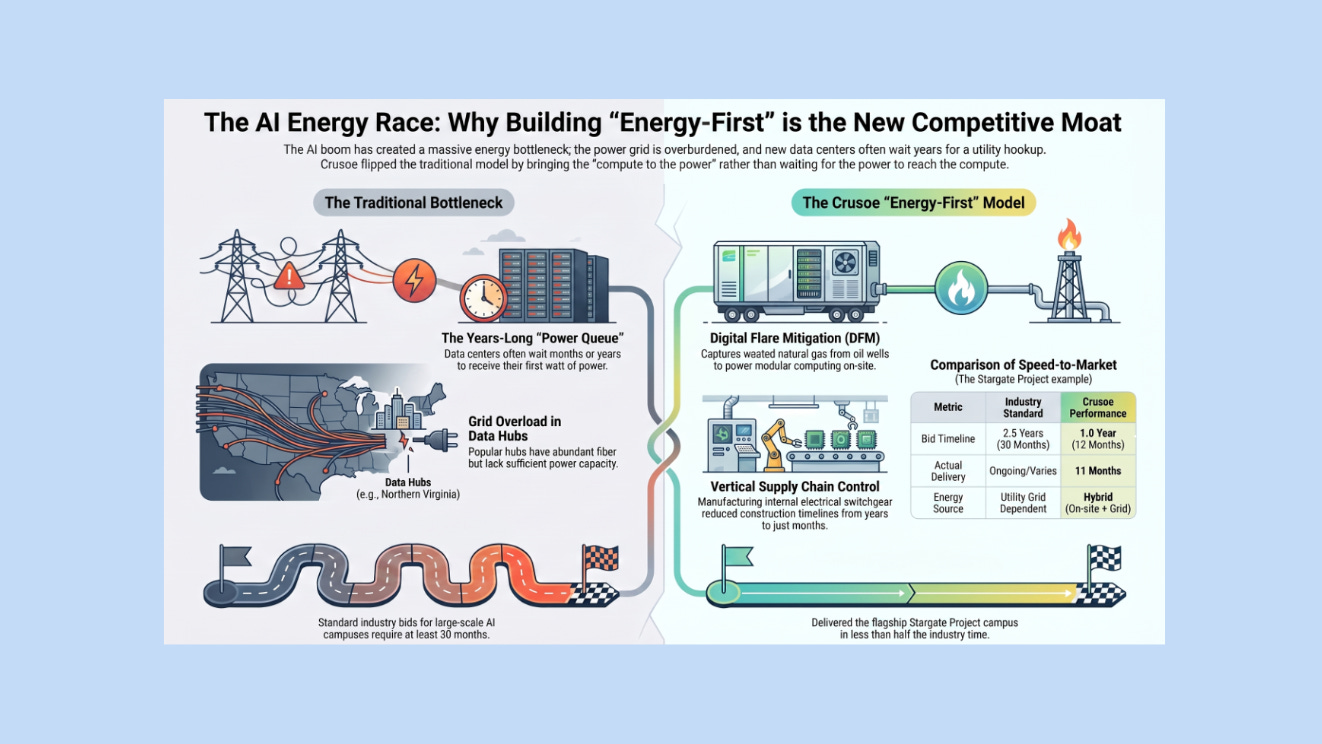
Where Crusoe set a pattern was in its idea to develop an energy solution that also lent itself to speed to market (along with efficiency in other parts of its vertical supply chain). In doing so, it solved more than just the energy problem.
There are many takeaways from its story so far that have been mentioned at various points in this article. The final one is more general.
Crusoe figured out the land, power, shell piece of AI infrastructure before others aggressively sought it out. So for new start-ups entering the frame and looking for problems to solve, a good question to ask themselves is….What’s the ignored part of the stack in your own industry?
Saving the Planet with Better AI Data Centers (with Crusoe CEO Chase Lochmiller) - Acquired Podcast
The Infrastructure of Intelligence: Inside Crusoe’s AI Factory in Texas - Madrona
The AI infrastructure of the future - McKinsey & Company
Meet The Tiny Startup Building Stargate, OpenAI’s $500 Billion Data Center Moonshot - Forbes
Frontier Forum: Inside Crusoe’s energy-first approach to data centers - Latitude Media
Crusoe - Contrary Research
Comments
Nothing yet. Say the first thing.
Sign in to join the conversation.