
Every few weeks, alongside my usual focus on business models and frameworks, I zoom out to highlight emerging patterns in tech and markets…..the shifts that can shape how we invest, operate and make decisions.
In this issue-
Drone delivery of packages is here but regulation is still catching up
Nuclear reactor miniaturization nears commercialization; 4 startups reached criticality in the last few weeks; could be positive news for AI data centers
Satellite direct-to-device (phone) connectivity is approaching mainstream. It’s an emerging white space for startups
In each case, as you will soon read, the underlying innovation has been around for some time. But recently, a formerly slow moving external gate, whether a regulator, a standards body or a spectrum allocation, is opening up and years of technological progress seemingly rushing out.
So, each of these trends has reached an inflection point and is now going live and getting competitive.

DoorDash was all over the news a couple of weeks ago for announcing that it was launching its drone delivery service, DoorDash Air developed by its in-house robotics unit, DoorDash Labs.
Of course this does not replace the cars, bicycles or rolling on-the-ground robots but it is one more option for customers in eligible neighborhoods in the coming months.
The FAA also regulates drone package delivery and DoorDash is the eighth drone operator to get certified for it by the FAA’s Part 135 Certification. Amazon Prime Air also holds this certification and has been in operation for some time and expanding fast.
So the obvious ‘what’s next’ here is that more companies will consider drones as a last mile delivery method. Some will do it vertically, like Amazon, basically an extension of its own logistics network. Others like DoorDash will probably open it up in the future to other drone companies which can plug into its ecosystem.
That strategic choice, however, on how to bring drones into your business model, exists because of how hard that certification is to get. And that certification becomes the bottleneck as this method propagates for at least these reasons.
The process is time-consuming and cumbersome. There are five phases to the FAA certification process. Some reports state that it takes 12-18 months and incurs considerable legal fees and paperwork to get through it. It covers maintenance programs, safety procedures, training and other aspects. That explains, at least partly, why there are very few companies that have gotten through so far.
Part 135 certification wasn’t designed for drones. It was written for smaller aircraft, charter planes and cargo carriers. It’s now being retrofitted for drone delivery certification through exemptions and waivers. Unless the FAA creates something specifically for drone delivery, there is always going to be a bit of a misfit, which makes it even more complicated.
So whichever company can push through and get certified creates a moat of sorts. That means that there will be a few certified operators with drone makers supplying them with hardware rather than launching their own delivery systems.
Sure, that moat or lead could be temporary. The barriers to certification could eventually lower if the FAA adapts its existing framework. It has done it before when it accommodated a new aircraft category for powered lift for electric vertical takeoff and landing (eVTOL) air taxis like Joby not too long ago.
If that happens it will open it up to more delivery companies to get certified and run their own operations. In fact, like the eVTOL companies have done, early companies like DoorDash can contribute and help standardize what the FAA expects from a drone operator as they scale up.
But for now, the certification-driven moat stands.
Nuclear reactors generate electricity by splitting atoms (fission) to release heat. The heat turns water into steam that spins the turbines to produce power.
The way that nuclear power used to work is that you built one nuclear power plant at one site. This required several years of construction and of course millions of dollars. And since you poured cement in the ground for this one, it wasn’t portable.
In the last decade, a bunch of startups have been working to change that model. Or more accurately, miniaturize that model. They have been trying to mass produce small, affordable, and portable nuclear reactors. Companies like NuScale (2007) and Oklo (2013) have been working on this mostly on the R&D front for Small Modular Reactors (SMRs) for some years now.
Recently, there’s been a twist in this tale which has drastically sped things up.
In May 2025 the government created the Department of Energy’s reactor pilot program. This is a fast-tracked testing pathway that lets companies build and run test reactors by skipping the traditional, highly time consuming Nuclear Regulatory Commission licensing process. But, it came with a goal that at least three advanced reactor designs reach criticality by American Independence Day 2026.
Criticality means that it reaches a stage where a nuclear chain reaction is releasing enough neutrons to keep splitting atoms on its own, i.e. self sustaining. That’s the first physics milestone that every reactor needs to clear so that it can generate power.
New 1-3 year old startups like Antares Nuclear, Valar Atomics, Deployable Energy and Aalo Atomics used the fast-track lane and reached criticality in the past few weeks. By this point, all these startups are pretty well funded to continue to move forward.
Reaching criticality is certainly an important goal but it mostly a minimum viability check. A proof of concept that proves that the physics works. But to take it to market is a different process.
To start producing electricity for customers, it needs to get licensed by the Nuclear Regulatory Commission (NRC). That is a still slower, multi-year process even if the NRC recently created its new ‘Part 53’ rule to streamline advanced reactor approvals. Meanwhile because of demand for energy, there is no dearth of customers right now.
There are two target markets for these products. The first is in the defense sector, where Antares and Deployable Energy are looking to make reactors that can be shipped on trucks or in containers to remote military bases and off-grid posts which need power on location.
The second market is created by energy demand at data centers. Valar Atomics is targeting this one. Its reactors are smaller but not portable. It clusters hundreds of them at fixed sites for data centers and other industrial customers, kind of the same way you’d stack servers rather than ship each one out. Valar has actually demonstrated this with its reactor powering an NVIDIA system and has a 30 MW AI data center deal locked down.
Although these are separate markets, my prediction is that the AI-powered one commercializes and scales faster than the defense one. Mostly because the demand is growing very fast. There is an energy shortage and the hyperscalers and other AI companies are going to any lengths to get the data centers up and operating quickly.
So interestingly enough, as nuclear reactors make the journey from cement-in-the-ground-plants to the portable devices model, the intermediate step of stackable-on-site model might be the initial winner.
The satellite-connected phone as a concept has been around for some time. These dedicated satellite phones were bulky and expensive. But they served their purpose and worked outside the range of a cell tower. So if you went hiking on some mountain with poor cellphone reception, the separate satellite phone device with its external antennas and customized internal components had you covered.
Now, a new and improved version of that, direct-to-device (D2D) satellite connectivity for our phones, eliminates the in-betweens. It doesn’t need cell phone towers or special hardware or a separate device because low earth orbit satellites are turning into space-based cell towers.
This has been made possible because two changes took place. First, 3GPP the body that develops the technical rules for mobile networks added satellite support called Non-Terrestrial Networks or NTN into the 5G standard. So most phone makers can use standardized chips instead of building custom chips for every different satellite provider (with some exceptions such as newer iPhones).
Second, satellite operators bought the specific radio frequencies that are required to communicate with our regular phones which made this service available more easily.
So now satellite direct-to-device connectivity is live.
As one example T-Mobile’s satellite service, which is powered by SpaceX’s Starlink, is available nationwide in the U.S. It offers texting, some limited app data and low-bandwidth voice and video on smartphones. However, these are not yet fully active for standard customers. Other providers like Verizon, AT&T plus carriers in Europe are getting ready to have their own commercial launches of these services.
Fresh off the press yesterday is the news below.
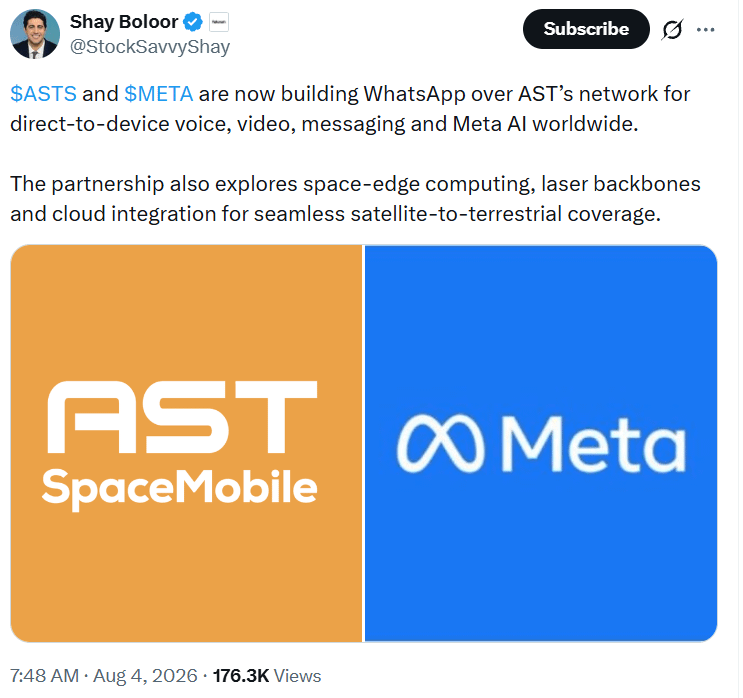
For carriers, this is quickly becoming table stakes. As consumers, we can expect that sometime in the next year or two, when we go to change or upgrade our mobile phone service, there will likely be no premium add-on pricing for satellite connectivity.
It will ideally come bundled in (assuming this has been fully rolled out by then). The dead zones that were common with tower based cell service will start to disappear. That’s good from a safety standpoint but it’s also good for enterprise customers which rely on communications for remote logistics and other systems.
But the bigger shift, IMO, is that this is an inflection point because companies will start thinking about how to build on top of this infrastructure.
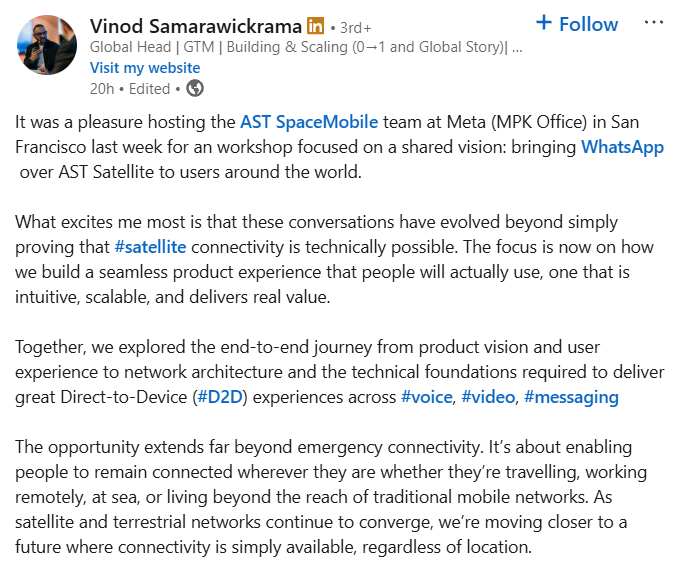
That’s what the Meta and AST SpaceMobile project focused on as shared in the posts above and below this section. It explored whether something like WhatsApp can be routed over satellite.
This also creates opportunities for startups to innovate and develop consumer apps or services where this becomes part of their ‘invisible’ technology stack.
That’s all for this issue.
If you enjoyed reading it, please share with others in your network.
Comments
Nothing yet. Say the first thing.
Sign in to join the conversation.