
When I was a deputy director at the Solar Energy Technologies Office (SETO), one question followed me around more than any other. A company would come in, often after months of lobbying, and ask some version of: Congress set aside $25 million for perovskite solar cell, module, and manufacturing research and development. Why is your funding opportunity so much smaller? Where did the rest go?
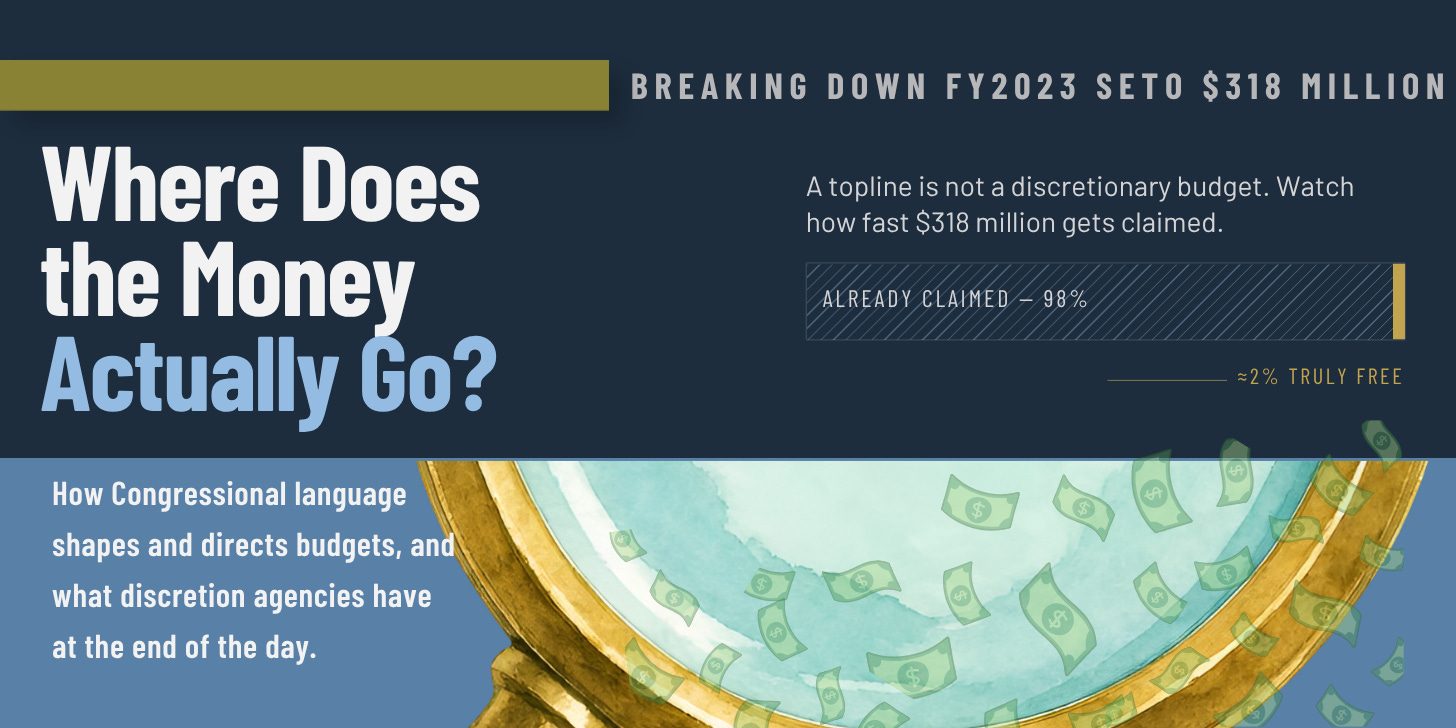
The honest answer is that the rest never disappeared. It was already working, spread across lab research and prior commitments that also counted toward that same $25 million. But that answer only makes sense once you understand how a program office turns a topline number into spending decisions. So let me walk you through it, using a real year: FY2023, when SETO’s budget was $318 million.
Almost none of that $318 million was a blank check. By the time it reached the director and me for final calls, most of it was already spoken for, and understanding how it got spoken for tells you more about federal funding than any press release ever will.
Take Away: An office’s topline budget is not its discretionary budget. The gap between the two is where most of the confusion, and most of the disappointment, lives.
This overview is more about how an office thinks about the allocation of a budget based on congressional direction and resource needs. There are numerous other decisions that get made about what to fund – which solicitations, what mechanism, staffing through fellowships – that are not necessarily covered in this post but are additional critical activities undertaken as part of budget scenario planning.
Budget season inside the office started the same way every year, with the director, the deputy director (me), and our topline appropriation on the table. For FY2023 that number was $318 million.
That figure arrived carrying scars. The Administration had requested $534.6 million, an 84% increase built largely around a new push into domestic solar manufacturing. Congress enacted $318 million, about 10% over the prior year. Every plan built for the bigger number, and the staff spun up to imagine it, now had to fold back into a budget that looked a lot like the year before. (How an office gets to that number in the first place, and why it spends a year and a half planning against five different versions of it, is the subject of the previous post.)
For clarity, I’m setting aside prior-year carryover and the mechanics of operating under a continuing resolution. Assume a clean $318 million landing on the table on day one. Even under those friendly conditions, watch how quickly it gets claimed.
The first and largest claim on the budget belongs to Congress, and it arrives in the appropriations report language: the joint explanatory statement (also known as conference language) that accompanies the bill.
Here’s how Congress told SETO to allocate funds among subprograms in FY2023:
● Not less than $60,000,000 for Concentrating Solar Power R&D
● Not less than $77,000,000 for Photovoltaics R&D
● Not less than $45,000,000 for Balance of System Soft Costs
● Not less than $55,000,000 for Systems Integration
● Not less than $70,000,000 for Manufacturing and Competitiveness
Add those five floors together and you get $307 million, or 97% of the $318 million topline, carrying a “not less than” directive tied to a specific subprogram.
That number sounds suffocating, and it’s the single most misunderstood thing about appropriations, so let me be precise: a floor governs distribution, not use. Congress told us how much had to land in each of our five subprograms. It did not tell us specifically what to fund inside them that would roll up to the top lines of each subprogram. Within Concentrating Solar Power R&D’s $60 million, we still decided which programs to run on which topics. The floors shape the funding structure of the office; they don’t hand you a shopping list.
SIDEBAR: WHAT SETO’S SUBPROGRAMS ACTUALLY DO
Congress set a funding floor for each of the office’s five subprograms. Here is what sits behind each name.
Photovoltaics R&D. The solar cells and modules themselves. Work spans efficiency, long-term reliability and durability, and new materials, including silicon, cadmium telluride, and perovskites.
Concentrating Solar Power R&D. Technologies that use mirrors to concentrate sunlight as heat, including collectors, receivers, and the thermal energy storage that lets solar power be dispatched after sunset. DOE also calls this area concentrating solar-thermal power.
Balance of System Soft Costs. The non-hardware costs of a solar project: permitting, inspection, interconnection, siting, financing, customer acquisition, and installation labor. Together these account for a large share of what a customer actually pays.
Systems Integration. Getting solar onto the grid reliably, securely, and affordably. Power electronics, grid services, cybersecurity, and operating a system with high shares of solar generation.
Manufacturing and Competitiveness. Domestic manufacturing and the path from lab to market. Manufacturing processes, supply chain security, support for entrepreneurs and small businesses, and cost and data analysis across the solar value chain.
But then a second layer arrives, and this one does start naming names. Nested inside those subprogram floors, the same statement directs:
● Not less than $5,000,000 for the National Community Solar Partnership (NCSP)
● Not less than $25,000,000 for cadmium telluride (CdTe) R&D and commercialization
● Not less than $25,000,000 for perovskites, including pilot-scale manufacturing
● Up to $40,000,000 to lower barriers to solar adoption for low-income households
● Up to $10,000,000 for research on solar’s impacts on wildlife and ecosystems
One more wrinkle. This isn’t even the only binding document. Report language from the House report, the Senate report, and the conference language all stand unless the final conference language explicitly contravenes them. Senate language that never gets mirrored in the House or the conference still counts as congressional direction. Stack all three reports on top of each other and the total volume of prescription an office wades through can be larger than any single document suggests.
SIDEBAR: THE TWO TECHNOLOGIES CONGRESS NAMED
Both directives point at photovoltaic absorber materials, the layer in a solar cell that captures sunlight.
Cadmium telluride (CdTe). The second most common absorber material (part of a cell that turns light to electrons) in photovoltaics, behind silicon.
Perovskites. A set of next-generation absorber materials that could be cheaper than today’s photovoltaics.
As a part of the markup of reports and final languages, appropriations staff and congressional members choose a set of terms to indicate the weight and importance of their direction. Understanding how to read these reports requires a translation exercise as these words are carefully and they are not interchangeable:
● “Not less than” (and its twin, “at least”) is a floor. You must spend this much or more. It is a mandate.
● “Up to” is the opposite: a ceiling. It’s permission, not obligation. You may spend this much; you may also spend nothing. Advocates routinely misread “up to $40 million” as $40 million guaranteed. It isn’t. Technically, it could mean nothing (though that would not likely make Congress happy).
● “Directed” means do it. When the statement directs SETO to support pilot manufacturing plants for perovskites, that’s not a suggestion.
● “Encouraged” is a strong hint with room to maneuver. Usefully, it’s often where next year’s funding topics are quietly born.
● “Notes support for” is the softest touch: Congress is signaling it’s watching a particular effort, without requiring anything.
There’s also language that binds without appearing anywhere on the page. Some direction arrives as a shared understanding; everyone involved simply knows what a phrase means. A directive for “competitively selected projects” can carry an unwritten subtext understood by all parties: this money is not for the national labs.
Report language doesn’t materialize from nowhere. Before appropriators finalize it, there’s a feedback loop in which DOE is asked to comment on draft language (known as technical assistance), and offices get one or two windows a year to flag what’s workable and what isn’t. Informal relationships matter too: a well-timed conversation could clarify which directives the committee actually cared about, and which were there to satisfy a persistent stakeholder. Knowing the difference changed how much sleep you lost over any given sentence. More on this process can be found in the first post of this series, The DOE Budget - 20 Months Before the Money.
Now for the part almost nobody outside the building understands. You cannot tally these directives by stacking them: $307 million in floors, plus $25 million CdTe, plus $25 million perovskite, plus $5 million NCSP, and conclude Congress over-programmed the budget. The directives nest and overlap.
A dollar of Photovoltaics R&D money spent on CdTe device performance satisfies both the $77 million floor and the $25 million CdTe directive, simultaneously. One dollar, two requirements met. Similarly, a single project on module durability could count toward CdTe and perovskites at once, and towards either the Photovoltaics R&D or the Manufacturing and Competitiveness budgets, but not both. Even SBIR dollars, the small-business set-aside we’ll get to below, could count toward these prescribed spending levels.
This is why I’ve come to think the right way to understand congressional direction isn’t as subtraction. It doesn’t simply remove dollars from your discretionary pile. It’s a reduction in degrees of freedom. Each directive removes some of your choices about what a dollar can do. Within Photovoltaics R&D’s $77 million, some portion now has to be CdTe-shaped. Within soft costs’ $45 million, some has to be permitting-shaped and some NCSP-shaped. The office’s real job becomes a constrained optimization problem: find the allocation where your dollars satisfy as many overlapping constraints as possible at once. An office that’s good at mapping those overlaps preserves more genuine flexibility than one that treats every directive as a separate, additive pile of money.
SIDEBAR: VIEW FROM ANOTHER OFFICE — When the directives exceed the budget
Solar’s FY2023 language was heavy but arithmetically workable. It can get worse. Take the Water Power Technologies Office, whose budget was $179 million in 2023. For the marine energy portion of the language alone, which had a ceiling of $120 million, the prescribed language stacked to $176 million if you read every directive as a separate pile: testing infrastructure, university marine energy centers (“up to $30 million”), standalone competitive solicitations (“up to $50 million”), a grid-connected test facility with its cost overruns, and a $24 million “Powering the Blue Economy” crosscut. This didn’t include other crosscutting language that would also draw on the marine energy portfolio, including a $5 million directive for aquaculture with wind and wave, and a $40 million “aquatic decarbonization” crosscut.
The only way to reconcile it was overlap-mapping the language and double counting investments. The marine energy program manager kept a running line-by-line ledger, color-coding every project against every directive it could satisfy; one SBIR topic might count toward the competitive-solicitation language, the marine energy centers language, and the Blue Economy crosscut simultaneously. Real mental gymnastics, and at the end of it, not a lot of genuine discretion left over.
Take Away: Congressional direction removes degrees of freedom, not just dollars. Read the report language (all three documents of it) and learn its verbs before you size any opportunity.
Some money comes off the top before we deliberate about anything, because the law requires it. Two set-asides matter most:
● SBIR and STTR, the Small Business Innovation Research and Small Business Technology Transfer programs, together claim 3.65% (3.2% + 0.45%).
● The Technology Commercialization Fund (TCF) claims 0.9%.
But here’s the nuance that trips people up: these percentages don’t apply to the $318 million topline. They apply to whatever the office declares as RD&D. Roughly, the way we thought about our R&D base was to start from the topline and strip out the things that aren’t research such as the ~$45 million in soft-costs deployment work. That left an R&D base in the neighborhood of ~$273 million.
On that base, SBIR/STTR runs about $10 million and TCF about $2.5 million, roughly $12.5 million off the top. Had we applied the same percentages to the full $318 million, the bill would have been closer to $14 million. The difference is real money, and it flows directly from where the office chooses to draw the RD&D line.
The office drew that line itself. SETO leadership made the R&D delineation call each year; the Office of Energy Efficiency and Renewable Energy (EERE) above us would double-check it but rarely had input. So, the set-aside isn’t a fixed tax handed down from on high. It’s partly a function of how the office categorizes its own portfolio.
Two more things about SBIR are worth knowing. First, as noted above, SBIR dollars can still count toward Congress’s prescribed spending levels; the set-aside and the directives overlap too. Second, SBIR is what my colleague calls a secret mortgage: Phase I awards create expectations of Phase II follow-on funding, so an office that isn’t careful about its Phase I/Phase II pipeline discovers it has quietly committed more projects than it can support in future fiscal year, without sacrificing the next year and so forth.
(These figures are my reconstruction of how we approached the calculation in simplified terms, not published line items. Treat the specific dollar amounts as illustrative of the method rather than audited numbers.)
Offices pay to operate out of their own program dollars, and the honest frame for this is operational and implementation support: the contractors and fellows who support federal staff to keep programs running and any needed IT or system investments (like a new program management platform). At SETO this ran roughly $15 to $20 million a year. I want to be careful with this one, because it’s easy to read as fat. It isn’t. Federal staff salaries come from a separate, chronically undersized “program direction” line at the larger office (i.e. EERE) level, and offices are not given enough of it to hire the federal employees the workload demands. Contractor and fellow spending is a capacity expansion tool made necessary by that gap, not a preference. Nobody is arguing it should go to zero. Fellows in particular are a workforce pipeline, and some flex capacity is healthy. But the balance should sit much further toward federal program direction than it does.
A recurring irritant is IT and data tools. Offices end up buying bespoke portfolio dashboards and management databases out of discretionary program funds, tools that should be universal DOE platforms built once. Both my office and my colleagues paid a major consultancy for portfolio-dashboard work that delivered, essentially, a report and a request for more money. That’s a future post of its own.
On top of office overhead sits the parent organization. EERE could assess its offices for overarching needs, sometimes framed as directly as “I need six percent of your budget for….[whatever the hot crosscutting topics of the day were].” We’d hold funds against that. If they went unused by year-end, we’d redirect them into a program we already had running. This could be for priorities, or to satisfy crosscuts called out by Congress (although truthfully, we referred to most crosscuts as bean counting exercises, not truly funded and supported efforts).
SIDEBAR: VIEW FROM ANOTHER OFFICE — The internal office tax
What happens when an office needs to fund an activity Congress never gave it a line for? WPTO had no tech-to-market or communications line in its appropriation. That office’s solution as a matter of directorial policy was an internal 10% carve-out from both the hydropower and marine energy budgets, dedicated to commercialization, analysis, communications, and stakeholder engagement, imposed by directive rather than negotiation. Before the carve-out, the commercialization lead had to go program manager to program manager asking for money.
The broader argument, which I share: every office needs a protected set-aside (call it 10%) for cross-cutting activities that are essential to executing the mission but absent from the appropriations structure. If Congress doesn’t fund the connective tissue, offices must build it themselves.
The national labs sat first in this category. The preponderance of lab funding ran on long-term annual operating plans, on three-to-five-year cycles, because labs staff up against expected funding and short-cycle uncertainty drives attrition and hurts the ability to sustain subject-matter experts in areas of national interest. What makes this funding unique is that the multi-year commitments to labs are mortgaged, funded year by year against a standing promise, and mortgaging was generally only allowed for lab work. Everything else, university awards and industry awards alike, had to be funded in full, up front, in the year of selection. That asymmetry quietly shapes the whole portfolio: a $9 million, three-year industry project consumes $9 million of this year’s budget, while the equivalent lab commitment consumes $3 million a year. While some projects are just a couple of years in duration, DOE would also provide funds to sustain long term capabilities and knowledge. For instance, SETO would fund R&D and associated facilities at NREL (today NLR) to further solar cell and solar module research.
Program continuity came next. Rather than re-run the same solicitation annually, we rotated topics on a multi-year cycle. Our Photovoltaics R&D team might run cell efficiency R&D one year, module durability R&D the next, field performance and supply chain the third: one per year instead of all three every year. This made the work easier to message to the community and, crucially, gave applicants certainty, as the projects awarded would run 3 years in duration. When one round closed, they knew a related opportunity would come around again to carry their work forward. Breaking that continuity risks losing research momentum, especially for early-stage performers at labs and universities.
SIDEBAR: VIEW FROM ANOTHER OFFICE — Mortgaging as strategy, not just constraint
WPTO was working to extend the mortgage logic beyond the labs before Jenn Garson left. Her wave-energy device program illustrates why. Budgeted one year at a time at ~$30 million, every stage-gate decision about which devices to advance had to fit inside a single year’s envelope. Framed instead as ~$90 million over three years, with the appropriators’ blessing (which she obtained), the office could run a genuine multi-year pipeline and make better advancement decisions. Same dollars, better portfolio management. But ultimately, the solicitation was caught in the transition and was never awarded, which tells you something about how fragile good budget practice is.
This is where the perovskite mystery from the opening resolves: the “missing” millions weren’t missing. They were here, in ongoing lab durability work, standing multi-year commitments, SBIR projects, and continuity programs that also counted toward the $25 million perovskite directive.
Take Away: Multi-year commitments are the load-bearing walls of an office budget. They’re why the community gets stability, and why so little of any year’s money is truly up for grabs.
Only now, after all of that, do we get to the part everyone imagines budget season is about: deciding what to actually fund.
The mechanism was simpler and less dramatic than outsiders tend to picture. Each of our five program managers (Photovoltaics R&D, Concentrating Solar Power R&D, Systems Integration, Balance of System Soft Costs, and Manufacturing and Competitiveness) brought proposals for how to use their portion of the budget. They’d account for their directives, their standing lab commitments, and where they sat in the rotating cycle, then make their case for what to fund with what remained. The director and I listened, weighed the pitches, and made the final calls.
People expect budget allocation to be a knife fight, with teams clawing at each other for dollars, but fortunately for me it wasn’t. Program managers proposed; leadership decided. There were strong cases and there were disappointments, but the constraint on new funding was never internal politics. It was the stack of prior claims we’d already walked through: floors, directives, set-asides, overhead, commitments, each one narrowing what was left before anyone in that room made a single discretionary choice.
Let’s answer the question we started with by following the money. Congress said: not less than $25 million for perovskites, and not less than $25 million for CdTe. That’s $50 million in combined direction. And you don’t have to take my word for what happened next, because DOE documented it publicly.
In September 2023, SETO released the Advancing U.S. Thin-Film Solar Photovoltaics funding opportunity announcement, or FOA (DE-FOA-0003058): $36 million total, with up to $20 million for perovskite projects and up to $16 million for CdTe. The notice of intent said the quiet part out loud: the FOA would support SETO in meeting the $50 million of congressional direction. Support. Not constitute.
So where was the other $14 million? Exactly where this post has been pointing all along:
● Already committed: multi-year perovskite and CdTe work at the national labs, running on standing three-year plans that predate this budget year. Counts toward the directive.
● In adjacent ongoing programs: module durability research, for instance, that legitimately counts toward perovskites (and sometimes toward CdTe at the same time). Counts toward the directive.
● Through SBIR: small-business thin-film topics funded from the set-aside. Counts toward the directive.
Run the arithmetic from the applicant’s side. A company that lobbied for the perovskite direction saw $25 million become a $20 million competitive topic, and a CdTe company saw $25 million become $16 million. Every dollar of the $50 million was real, and every dollar went where Congress pointed it. But only 72% of it arrived through the open front door, and applicants competed for that share against everyone else who read the same press release. The advocate who fought for $25 million and the applicant who saw a smaller opportunity were both looking at true numbers. They were just measuring different things.
(One last mechanic hiding in the dates: that “FY2023” opportunity was released September 12, 2023, the final month of the fiscal year, and selections weren’t announced until May 2024. DOE’s money doesn’t expire at year-end, so a fiscal year’s budget keeps landing in the world long after the year is over. File that away for the timing discussion in a future post.)
● A topline is not a discretionary budget. Read the report language before you size an opportunity, and read all three documents: House, Senate, and conference language all stand unless explicitly contravened.
● Congressional direction removes degrees of freedom, not just dollars. One dollar can satisfy two overlapping directives, which is exactly why the “set-aside” and the “opportunity” are different numbers.
● Learn the verbs. “Not less than” is a floor; “up to” is a ceiling. They are not the same, and confusing them will mislead your whole strategy.
● Multi-year structure is the hidden hand. Lab mortgages, rotating cycles, and SBIR tails commit money before the year begins. If your topic isn’t in this year’s solicitation, it may be next year’s; plan your timing accordingly.
● The residual is decided by a few senior people. Proposal quality wins, not lobbying volume, and the director’s truly free reserve is about 2%, not 70%.
Innovation Waypoints is brought to you by Waypoint Strategy Group.
Comments
Nothing yet. Say the first thing.
Sign in to join the conversation.