
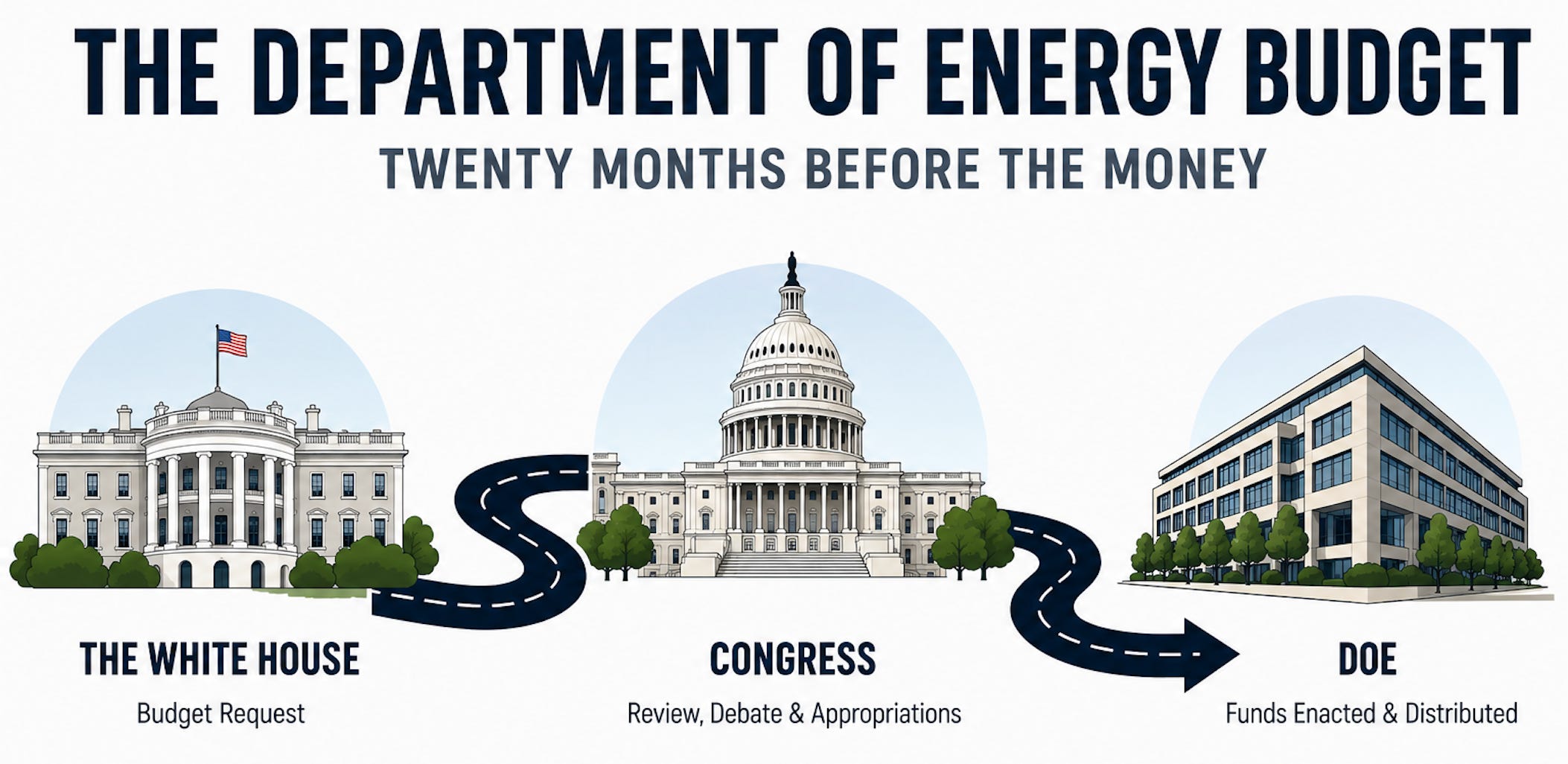
The way most people understand federal funding is simple enough. Congress passes a budget, the agency spends it. That description is not wrong, but it covers a slice of the process that can run for upwards of two or more years.
By the time the Solar Energy Technologies Office (SETO) knew what it had for fiscal year 2023, we had been planning against that year since the spring of 2021, across five mutually exclusive budget scenarios of what the number might be. Four of them were wrong. We did not find out which four until well into the first quarter of the FY23 fiscal year (December 23, 2022), which was an early year given that typically budgets these days pass well into March or halfway into a budget year.
But this process is a long, beleaguered process, and one that is filled with far more anticipatory planning and direction shifts than can appear on the outside. To illustrate how long and drawn out, and quite frankly complicated, the process is, this post walks through one real fiscal year from first guidance for budget preparation on the agency side of the house to signed bill. Our next post (Where does the money actually go?) picks up where this one ends, with what an office actually does with the money once it finally knows the number. Hopefully by shining a light on how long and arduous this process, you can understand why federal budgeting is not as easy (or straightforward) as our Constitution lays out.
This post is meant to help illustrate the budget office to people and organizations outside of the executive and legislative branches, but might also be helpful for people new into budget planning cycles within government.
Fiscal year 2023 began on October 1, 2022 (the federal budget cycle is October 1 to September 30) but work on it began seventeen months earlier.
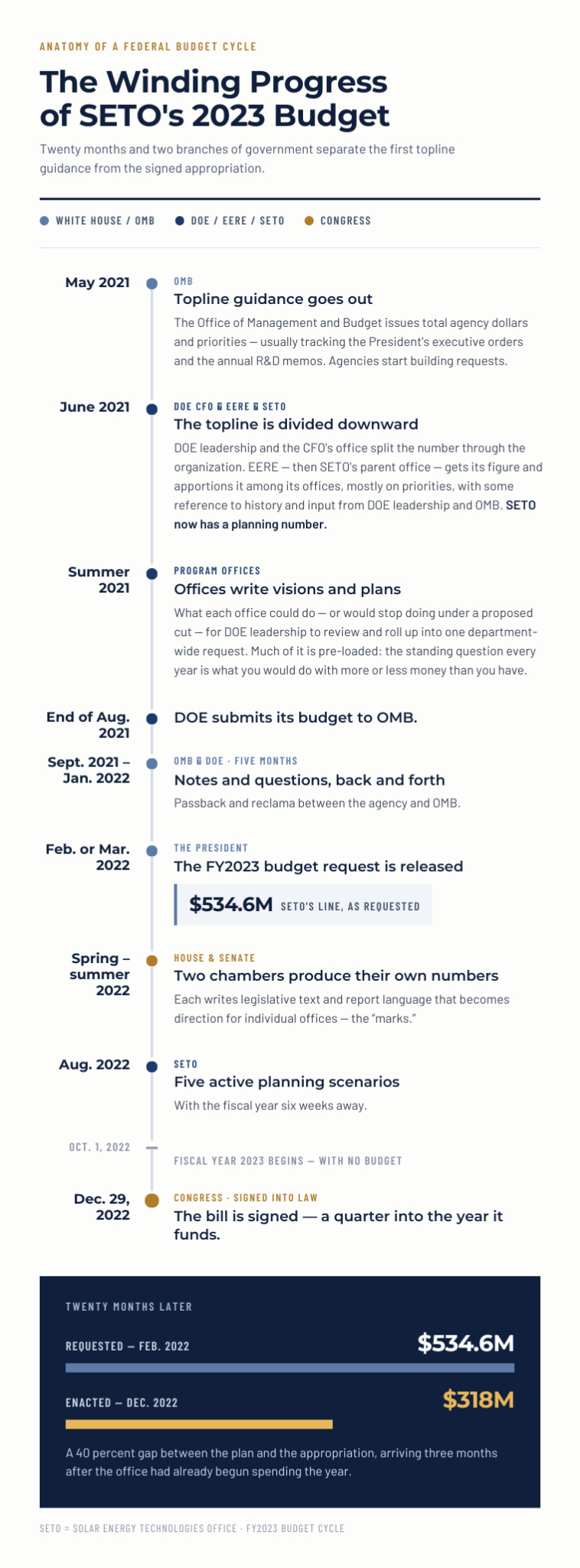
One detail makes this harder than the list suggests. These cycles overlap. In the summer of 2022, while waiting on FY2023 and executing FY2022, offices were already building the FY2024 request. At any given moment a program office is spending one year’s money, defending a second year’s request, and inventing a third year’s plan. That is the normal condition, not a bad year.
By late summer, an office is planning against five outcomes at once: the President’s request, the House mark, the Senate mark, a notional House and Senate compromise, and a continuing resolution.
These are not five versions of one plan. Each carries a different dollar figure and a different set of directions about what to spend it on, so they describe five different programs. A colleague who ran another EERE office put the practical effect well: you are constantly moving your floor while never having any visibility into your ceiling. The floor is the lowest mark.
Take Away: If you want to know what an office’s funding capacity will be, watch the lowest congressional mark, not the President’s request.
The request is still the formal starting point, and offices put real work into it. The trouble is what gets asked. When an administration wants to know what you would do with $500 million against a $290 million base, “more of what we already do” is not an acceptable answer, particularly if your office is aligned with the priorities of that current Administration. The idea is that the intent behind this document shows how a President prioritizes budgeting, often in line with any recent White House Office of Science and Technology Policy R&D priorities. What this means in practice is that the ask is for new programs, so staff get spun up to design them.
Then Congress declines to buy the vision, often because the detail behind it was never granular enough to be persuasive or the request was so high to be fiscally unviable, and the office goes back to roughly what it has always done with some changes to respond to the needs of the technology area they support. Everyone who spent months imagining the larger program absorbs that. It is worth naming plainly, because the morale cost of aspirational budgeting is real and rarely discussed. And often the visibility Congress gets is not an inaccurate reflection - most often the Request briefings to Congress is limited to maybe 10-20 minutes per office for these requests, so Congressional staff never really get enough insight into any seriousness or weight put behind these figures.
The opposite extreme demands a different exercise. When a request proposes deep cuts, an office has to tell its staff what would survive, and the honest answer usually amounts to keeping the lights on at the national laboratories and keeping researchers employed. Even if you’re a seasoned government executive, the numbers if they’re slashed can have a deeply demoralizing resonance of the staff because their perception is - the work you’re doing doesn’t matter. But again, these budget have now been reduced to a messaging exercise for the most part, so career staff will try to reassure their own colleagues that the dramatic slash will not come to pass. And ultimately, you run the exercise knowing the outcome will land somewhere in the middle of these extremes.
Both extremes have the same practical effect. You end up discarding them the way you would discard outliers in a statistical analysis, and over time the President’s request has become the outlier rather than the center of the distribution. That is a strange place for a formal budget request to occupy. The current administration has taken the opposite approach, treating the request as the true spending plan, which is a genuine departure from recent practice and changes what offices can plan against, and in contrast to how the budgetary powers were originally constructed in the Constitution.
As Congress goes through its budgetary process, two documents are produced. The bill text, which generally has the numbers associated for each office. And then an accompanying report. The House and Senate each have their own report, and then if a conference passes, another report is released alongside the bill text. And report language is where Congress tells an office what to do with the money, and offices are generally told to treat all of it as binding. Unless the final conference language contravenes something in the House or Senate report, it stands. Silence in the other documents does not void a directive. If the Senate report says to spend $5 million on something and the House and the final statement never mention it, the office still owns that instruction.
Which raises a question with no clean answer. FY2023 is a useful case. The House passed its Energy and Water bill on the floor in July 2022 as part of a six-bill package, adopted 220 to 207. The Senate never marked up its version at all; the Appropriations chair released Senate bills without committee action. So the two sets of direction reached the finish line through very different levels of legislative process, and neither the enacted omnibus nor the practice inside agencies draws much distinction between them.
It gets thinner still. Report language that clears a committee but never reaches a floor vote is, on the standard reading, direction an office is expected to follow. Whether it should be is a fair question to put to appropriators, and there is a practical remedy that more offices should use: through the Office of Congressional Affairs call the committee staff and ask whether they meant it. A short conversation resolves a surprising amount of internal hand-wringing.
Take Away: Report language binds even when only one chamber wrote it. Read the House and Senate reports, not just the final statement.
None of this language materializes on its own. Before appropriators finalize it, DOE is asked to comment on drafts, a process known internally as technical assistance, and offices get one or two windows a year to flag what is workable and what is not. Informal relationships fill the gaps. A well-timed conversation could tell you which directives the committee genuinely cared about and which were there to satisfy a persistent stakeholder, and knowing the difference changed how much attention any given sentence deserved.
VIEW FROM ANOTHER OFFICE — How language gets planted
In the Water Power Technologies Office, language that reappeared year after year: roughly $5 million for a university-led project on floating wind and wave power for aquaculture. Nobody in the office could make technical sense of it. You generally do not want floating wind and wave devices co-located, and $5 million does not demonstrate anything in the water. The mystery was resolved when the office traced it to a lobbyist whose clients had a prospective test site and an interest in aquaculture.
The lesson cuts two ways. Lobbyists do plant language, which can be helpful and important prompts for direction that offices can/should take based on stakeholder input and equities. But the deeper dysfunction is that stakeholders often feel they have no other meaningful channel for telling a program what it should work on, so they route ideas through appropriations staff instead of talking to the office, which would happily have taken the meeting.
Take Away: If you want a program to work on something very specific, talk to the program. Routing an idea through appropriations is slower, blunter, and often produces direction nobody can execute well. The exception would be Congressionally Directed Projects - or CDPs - which are discrete carveouts for individual projects.
The point of walking through all of this is not to complain about the process. It is to explain why an office’s public number tells you so little. By the time SETO had $318 million in hand, that figure had survived seventeen months, one OMB negotiation, two chambers, five planning scenarios, and a three-month delay past the start of the fiscal year. It arrived with instructions attached and most of its flexibility already spent.
What happens to it next, and why a $25 million congressional directive does not produce a $25 million funding opportunity, is the subject of the follow on post (Where does the money actually go?).
● The number is the end of a process, not the start of one. Twenty months of planning precede the figure you read in a press release.
● Offices plan against five budgets at once. Watch the lowest congressional mark if you want to know what an office can actually fund.
● Report language binds even when only one chamber wrote it. Read the House and Senate reports alongside the final statement.
● Talk to the program, not the appropriator. Language planted through lobbying often produces directives that are difficult to execute well.
Innovation Waypoints is brought to you by Waypoint Strategy Group.
Comments
Nothing yet. Say the first thing.
Sign in to join the conversation.