
As part of our work integrating technology with young children, we have always been intentional about the scope and sequence for the skills we introduce. Just as we would break down, think aloud, and model strategies and skills in content areas, we integrate routines throughout our day that include opportunities to model use and appropriate interaction with technology.
We are also purposeful about the individual experiences we offer children, focusing on open-ended creation spaces such as Google Apps that students will continue to use for years to come. In our blog post entitled Basic Tech Skills for Littles: Approaching the Trackpad we share some of the specific language and blended learning experiences we introduce early on in the year in kindergarten.
While development of tech skills remains an important instructional experience, we are also mindful to provide experiences that continuously address the increasing rigor of national and state standards for learning. With the increasing complexity and amount of data being collected globally, data literacy expectations are showing up across curricular areas and grade levels.
Data Literacy includes the ability to reason with and about data—including what data are and where data come from. This includes the ability to make good decisions based on data, to ask questions of data, and to use appropriate reasoning.
In order to be able to begin to analyze data, young children need to be able to organize collections of information in meaningful ways. Learning standards in mathematics now ask students to demonstrate understanding as they: Classify objects into given categories; count the numbers of objects in each category and sort the categories by count. (Clarification: Limit category counts to be less than or equal to 10)
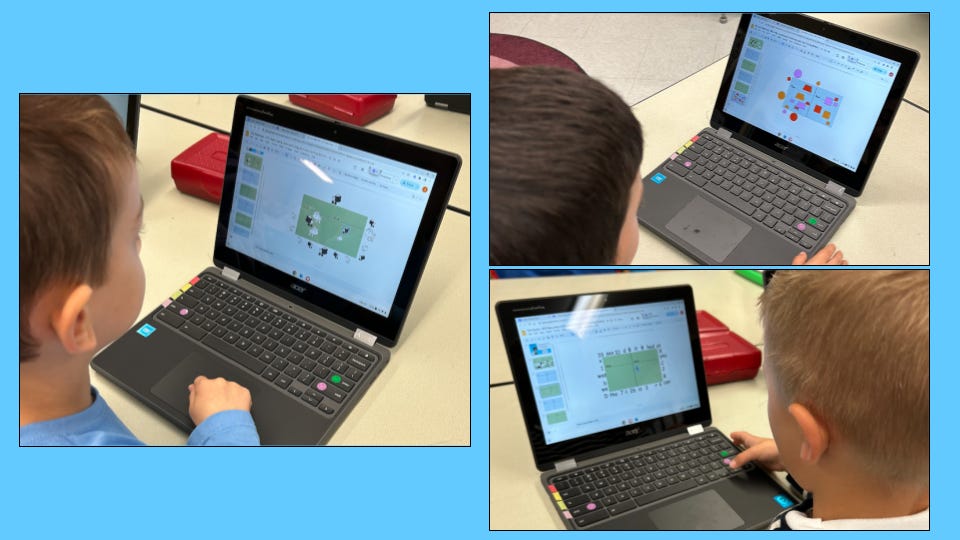
In addition to many hands-on sorting experiences in the classroom, we invite children to show their thinking through our Mary Had a Little Lamb sorting activity in Google Slides. In this activity, children use collections of visual data (lambs, letters, numbers, words, and shapes) to select and move objects as they sort information into categories. Children determine the “rule” for each collection, and communicate their thinking by organizing visual data.
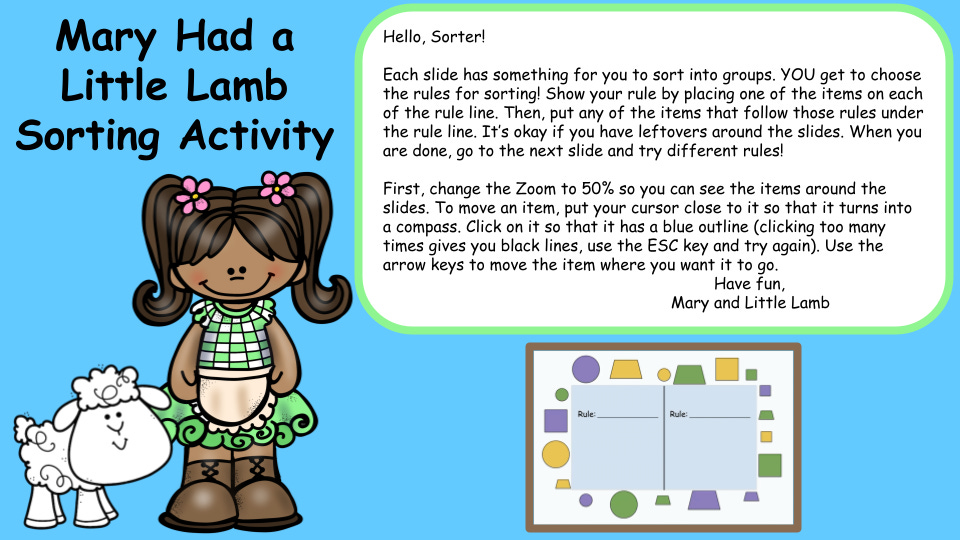
This simple activity invites young students to develop patterns of thinking including reasoning and decision making to organize and analyze information. Playful engagement with tiered sorting activities in Google Slides invites all learners to participate and demonstrate understanding that is foundational to further exploration of data literacy.
(See Nurturing Family Literacy to learn more!)
No posts
Comments
Nothing yet. Say the first thing.
Sign in to join the conversation.