

When you’re a child, the biggest obstacle to your happiness is your parents’ unhappiness. That’s because our brain has mirror neurons that absorb the feelings of those around us.
When you’re an adult, you’re shaped by childhood experience because the brain’s road-building material, myelin, is abundant before age eight and during puberty. Adolescence re-configures feelings about your parents in a way that needs more attention. Puberty sparks the mammalian urge for social dominance. It’s hard to win social recognition in real life, so dominating your parents is an attractive option. A simple way to do that is to find fault with your family and make yourself morally superior. You can gain the one-up position without leaving the couch. No wonder this thought loop is so popular.
We don’t think it consciously, of course. Our conscious verbal brain is just a layer on top of the mammalian limbic brain that controls our body. Your mammal brain rewards you with happy chemicals when you do things that promote survival in the state of nature. In the animal world, social dominance is critical to what biologists call “reproductive success.” Natural selection built a brain that rewards you with serotonin when you see yourself in the one-up position.
So we urgently seek one-up moments to enjoy serotonin and relieve cortisol. But your efforts to impress the world with your brilliance often fail. Competition is intense as you strive for recognition and the affection of a special someone. Even just trying to be the best at partying leaves you with plenty of competitors. When you see yourself in the one-down position, your brain looks for a fast way to feel one-up. Putting down your parents comes to mind.

Any serotonin you manage to spark is quickly metabolized, which is why we humans are always seeking the next one-up opportunity. But the world is full of smarter, stronger, sexier people. To keep feeling good, you have to keep applauding your superiority to your parents.
Alas, this doesn’t bring the social recognition and “reproductive success” that you really want. That special someone still doesn’t look at you. Now what?
Our brain is designed to repeat whatever worked during our years of peak neuroplasticity. If finding fault with your elders felt good in those years, you repeat that. You can end up putting so much energy into oppositionalism that you have little left for more meaningful quests. Moral superiority is like a drug because it feels great now and hurts you later. It’s not easy being a big-brained mammal.
Our conscious verbal brain tries to help. It’s skilled at finding “evidence” to “prove” that you are morally superior. If you don’t build other ways to spark serotonin, you are effectively addicted to oppositionalism.
We are not just robots who blindly repeat old patterns. We CAN blaze new trails through our jungle of neurons. But it’s hard, and we don’t do the work if we don’t know that old pathways are powerful. You just take it as fact that happiness is impossible because your family is so flawed.
You can change your wiring once you learn to notice it. It’s uncomfortable to acknowledge the power of old pathways, so it’s important to know that this is normal. Remember that every baby wires itself to speak whatever language it is exposed to. No baby has ever spoken Hungarian without exposure, regardless of genetics. It’s the same with our emotional wiring. Your happy chemicals and stress chemicals got connected to whatever contexts triggered them repeatedly.
It’s not fun. It’s like trying to learn a foreign language in adulthood – it takes so much repetition that most people give up. But you can learn a new emotional response if you do the repetitions.
Start by choosing the new response you desire. To spark serotonin, you need take a positive view of your own survival skills. If you lie to yourself, your brain won’t release the serotonin. You have to take actions that truly raise your confidence in your skills. This does not involve your parents. You don’t have to change your view of them and they don’t have to change their view of you. To see why, it helps to remember that young monkeys must rise in the social hierarchy to have “reproductive success.” You inherited your genes from individuals who did what it took to find a mate and protect the young, going all the way back. Their parents couldn’t do it for them.
Conscious interest in reproduction is not involved. The limbic brain saves the happy chemicals for action that promotes your genes in the state of nature. This is why people obsess over how they measure up, despite their best intentions.
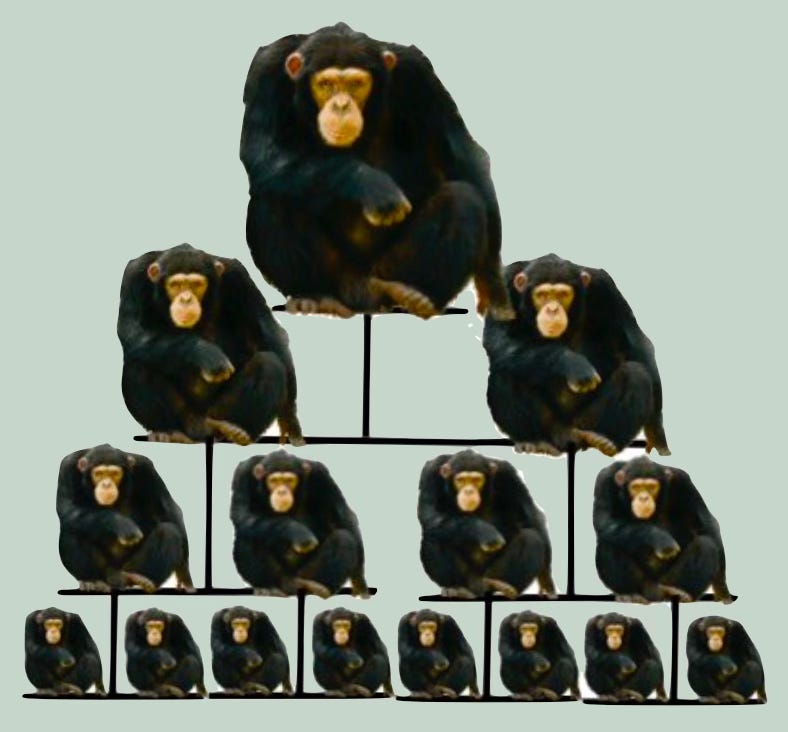
You may insist that you don’t care about social dominance, but your cortisol still surges when you think you’re one-down. If you ignore the true source of the cortisol, you take it as a real threat. Your brain tries to stop the cortisol by allowing electricity to flow into a path that stopped it before. Your verbal cortex comes up with an explanation to make it sound good. To quote Woody Allen, “I need the eggs.”
Fortunately, a tiny step forward gives you a tiny drip of happy chemicals. That makes the next step easier, so you take it. Slowly, the neurons you are activating start to connect. Each time your action gets results, you build the path to your dopamine. Each time you compare yourself favorably in some way, you build a path to your serotonin. It’s only a tiny trail once your myelin days are over, but you have the maturity to stick to the trail.
Every brain longs to be the big monkey and every brain suffers frustration and disappointment when the world fails to honor this dream. Every brain is tempted to relieve the frustration with a fast, easy one-up strategy. Moral superiority is the socially acceptable strategy of our times, but humans have seized on this crutch since the beginning of time. Each brain does it with neural pathways built when they were young.
Most people never rewire this, but you can be one who does. Three steps are all it takes:
Recognize your mammalian urge for social dominance. (My reading list on this.)
Recognize the old pathways that make you feel one-down.
Take tiny steps toward real-world competence again and again.
A new pathway will build! A simple step-by-step plan for doing this is in my books
I, Mammal: How to Make Peace With the Animal Urge for Social Power and
No posts
Comments
Nothing yet. Say the first thing.
Sign in to join the conversation.