
You might be aware that, in January, a major nature/climate story was published. The Times, the BBC, and The Guardian all covered it, and it was featured across social media platforms. A report, prepared by intelligence chiefs in the UK government, assessed the impact of climate change on biodiversity and the wider ecosystem. The reading was sobering. Threats to food supplies, geopolitical instability, the impact on migration numbers all featured. It turns out this was only half the story.
We heard back in January that people were nervous and worried about this report - the government itself had thought that it might lead to negative feelings among the public, and made the decision not to publish it. It came out after tenacious activists used Freedom of Information laws to force its publication.
It matters too that the people who wrote this report were not activists or climate scientists - as part of a national security assessment it was written by the joint intelligence committee behind MI5 and MI6. This matters not just because of the robust methodologies that they bring to work like this, but because their opinion holds more weight with governments. It is national security, and so actually the messenger becomes part of the message.
But as we know now that report missed much of the detail of the original. A new investigation by ITV News, led by the reporter Martin Stew, uncovered even more stark modelling. Language in the report includes the words ‘mass mortality events’ and it predicts huge shocks to the economic system, as well as increased nuclear tensions.
Just writing those words causes an emotional reaction in the author, and of course reading them or watching the ITV report is likely to lead people to feel a range of emotions and feelings that may feel deeply worrying or overwhelming.
We notice, in ourselves and in the people we work with, that news like this lands differently depending on whether you have somewhere to put it. We know that when something feels too big, responses can range from fear, anger, bleak vindication, or nothing at all. A numbness might arrive when something is too large to land.
All of that makes sense, and should feel normal.
But when those feelings go unprocessed - the overwhelm, the grief, the anger - something tends to happen. We end up being more prone to burnout, despair and even paralysis. Relationships and groups that get stuck or fracture. Not because people don’t care, but because caring without somewhere to put it has a cost.
This is why ICRA exists.
ICRA grew out of years of conversations with people practising inner work in response to the planetary crisis. What came up again and again was the distance between the number of people doing powerful, often underfunded work in this space, the many who could benefit from it, and the limited public awareness that such work even exists.
By inner work, we mean practices that help people to process and cope with feelings like overwhelm, fear, grief and anger in the face of climate and ecological breakdown. It helps us to be in healthier relationships with ourselves, with others, and with change and uncertainty in the world around us. Practised alone or in community, it might look like mindfulness or meditation, somatic or movement practice, grief tending, arts, nature connection, music, spiritual or faith practice, climate cafes, listening circles, work that reconnects. It goes beyond personal wellbeing and western psychology to include relational, interpersonal, social, spiritual and cultural dimensions.
Inner and relational work builds the capacity to stay present, take care of ourselves and others, navigate difference, build and repair trust, and make decisions to move forwards together even amongst uncertainty and volatility.
We’re a partnership between the Mindfulness Initiative, the Climate Psychology Alliance and the Climate Majority Project, funded by the National Lottery Climate Action Fund. We’re not here to deliver practices ourselves, but to create space for people to work together - connecting inner work practitioners with grassroots and community climate efforts, supporting groups to experiment with practical approaches, and raising public awareness of why inner and relational resilience matter.
We’re not building from the outside. We’re here to strengthen and grow with the communities already rooted in this work, and to help new connections emerge.
Since our last update in October, we’ve been mapping and connecting with community groups working on climate action and adaptation, understanding how they’re integrating inner work and what support they need. We’re preparing to run focus groups with both community groups and inner work practitioners, and continuing to build and map the practitioner network.
What keeps coming up is how many people are doing this work in relative isolation, without connection to others navigating the same territory. That’s exactly what we’re here to change.
We’ve also been busy establishing a Youth Forum as an intergenerational space where young people will shape the direction of building our network, ensuring that youth voices remain central to ICRA’s activities and community engagement.
If any of this resonates, there are a few ways you can help right now:
Do you know community groups who might need support integrating this inner dimension into their work? Are you an inner work practitioner, or do you know one? Are there gatherings, organisations or projects you think we should be connected to?
Reports like this ITV news one will keep coming out. Climate change is forcing us to have more and more difficult conversations, about coping, about adaptation and about risk. But you are not alone. There is somewhere for that caring to go.
We’d love to hear from you - comment or reply here, or email hello@innerclimateresponse.org
We’re excited to share that Climate Youth Resilience (CYR), a project of one of our partner organisations, is opening a UK chapter of their Ambassadors for Inner-Led Change programme.
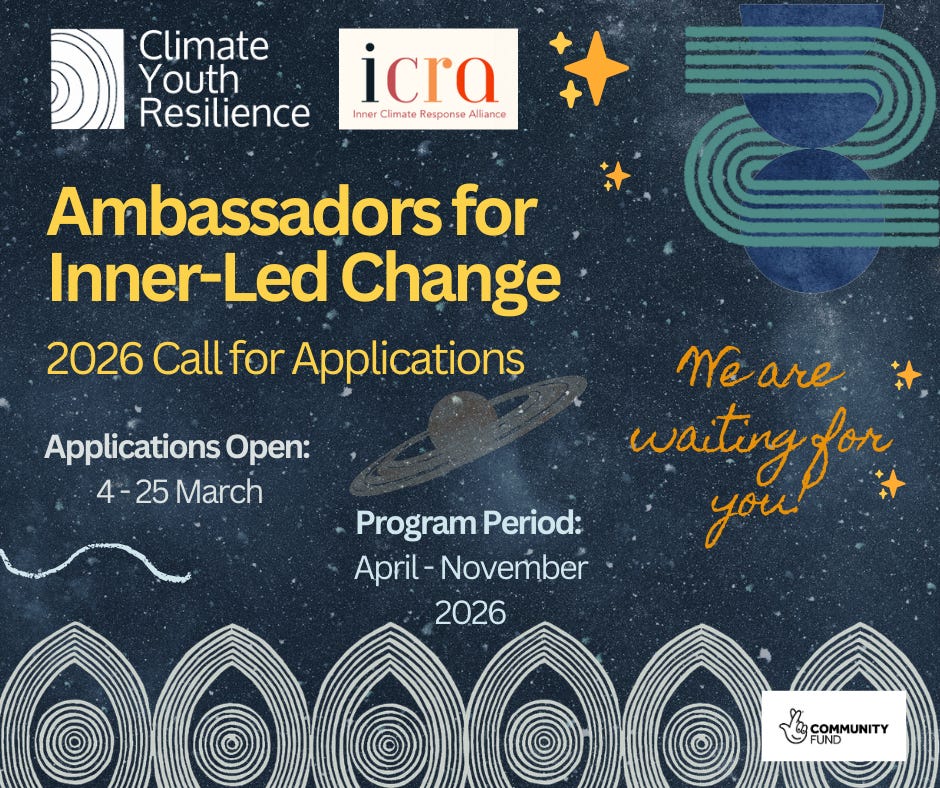
The UK cohort of this global programme is an ICRA project run by CYR and forms part of ICRA’s work of integrating emotional resilience into community climate action and adaptation.
So, if you’re a young person aged 18-35, interested in nourishing the inner worlds of young people and learning to embody leadership for a just future, while contributing to growing the UK youth climate movement… you are warmly invited to apply.
Apply by 25 March. Find out more.
If you’re outside the UK, applications for the global programme are also open at the same link.
We’re delighted to welcome the newest members of the ICRA team, who are welcoming connections on Linkedin if you see possible synergies. Here’s how they’ll be contributing to our mission of building a UK-wide network of community groups and practitioners integrating emotional resilience into climate action and adaptation:
YOUTH
Amber Amoo-Gottfried, CYR UK Regional Convenor, Ronke Ayoola, CYR UK Regional Convenor and Saleh Mohamed, CPA ICRA Youth Coordinator
Amber, Ronke and Saleh are supporting the development of our Youth Forum, fostering youth-centred collaborations and sharing learning across impact networks.
COMMUNITY
Harriet Ayliffe, CMP Inner Adaptation Community Lead and Hannah Leigh Mackie, CPA ICRA Community Resilience Coordinator
Harriet and Hannah are focussing on community engagement, stewarding community-informed strategy and integrating insights from these relationships into our evolving vision.
MEDIA AND ADMINISTRATION
Pamela Welsh, CMP Media Officer and Kam-Mei Chak, CPA Communications Coordinator
Pamela and Kam-Mei are building public awareness of the inner dimension of the climate crisis, through print and digital media to disseminate the concept of “inner climate response” and grow our community.
Katie Pitts, CPA Membership and Administration Coordinator
Katie is supporting the structure behind ICRA’s work, shaping and maintaining administrative systems.
Lastly, we’ve also been busy planning some more Community Calls - online gatherings to meet people who are already integrating inner work into climate action and resilience, or who want to. These calls will be about building community and connection, as well as hearing from you about the work you’re doing. More on this soon!
Warm wishes, The ICRA team
p.s. Has the way the information from the national security assessment reached the public affected you? We welcome your thoughts in the comments.
No posts
Comments
Nothing yet. Say the first thing.
Sign in to join the conversation.