
At The Wall Street Journal, Summer Said and Benoit Faucon cover Persian Gulf energy producers’ conclusion that Iranian control over the Strait of Hormuz will likely become permanent, disrupting oil and gas exports and global energy supplies indefinitely.
The reporters say that Gulf officials dislike a deal under consideration that would formalize Iranian oversight of inbound shipping but prefer it to a return to war with the United States.
Negotiations have stalled in recent days, with Iran demanding financial relief and a ban on US and Israeli warships in the strait, while Washington refuses to accept any agreement letting Tehran impede shipping. Brent crude has traded around $87 a barrel as talks have dragged on.
Said and Faucon detail the toll the standoff has already taken. The United Arab Emirates reported four ships hit by Iranian attacks in a single week, while Saudi Arabia’s overland pipeline workaround to the Red Sea came under fire from Iran backed Houthi forces in Yemen.
A drone strike hit a gas tanker at Egypt’s port of Damietta, showing the threat extends well beyond the strait itself. Crude exports through Hormuz have fallen to about 2.2 million barrels a day, down from 8.5 million a month earlier, and Iran’s own exports were cut in half in a week.
The reporters note that between late February and July, Iran and allied militias carried out at least 172 attacks on nonmilitary infrastructure across six Arab Gulf states, roughly half targeting energy facilities.
Analysts have described the workarounds Gulf states have built as inadequate. Eric Alter, dean of the Anwar Gargash Diplomatic Academy, said workarounds exist but that “it has not been enough to render Iran’s veto irrelevant.” Even a near term reopening deal, the reporters write, would leave Gulf exports subject to Tehran’s terms for the foreseeable future.
At The New Republic, Jonathan van Harmelen reports that the Tohono O’odham Nation has taken the Trump administration to federal court to stop new border wall construction through its Arizona reservation. The legal battle began after contractors destroyed a sacred site called the Las Playas Intaglio earlier this year.
DHS awarded a contract worth more than $1 billion to Sullivan Land Services, a Texas-based construction firm, to build two 30-foot walls stretching 62 miles across tribal land, part of a project known as Tucson 5.
Chairman Verlon Jose told reporters, “The wall does not work,” and argued that existing sensor towers and technology already secure the border effectively, pointing to the Integrated Fixed Tower system installed during the first Trump administration.
Since 2003, 1,500 migrants have died crossing Tohono O’odham land, and the tribe has spent $6 million of its own funds handling those deaths, according to the report, even as the nation continues working with Border Patrol on other security measures.
On Aug. 6, DHS said it would resume construction despite a pending ruling, prompting the nation to warn contractors against trespassing on its land.
At Mother Jones, Kiera Butler examines the case of Doug Wilson, the Idaho pastor who preached to Pentagon staff last year and serves as Hegseth’s spiritual mentor, who may be behind Defense Secretary Pete Hegseth’s push to remove women from senior military leadership tracks closely with teachings.
Wilson teaches that a patriarchal “biblical masculinity” is a religious mandate and has said women serving in the military are “loathsome” to God, a view that aligns with Hegseth’s hostility toward women in senior command.
Hegseth’s family joined Wilson’s denomination in 2018 and moved to Nashville in 2022 so his children could attend a school in Wilson’s network, crediting Wilson’s book study with shaping his views on faith and the military.
Since taking over the Pentagon, Hegseth has ended affirmative action and trans-inclusive policies, dissolved the committee supporting female troops, and blocked women and Black officers from promotion, moves that echo Wilson’s teachings on gender and authority.
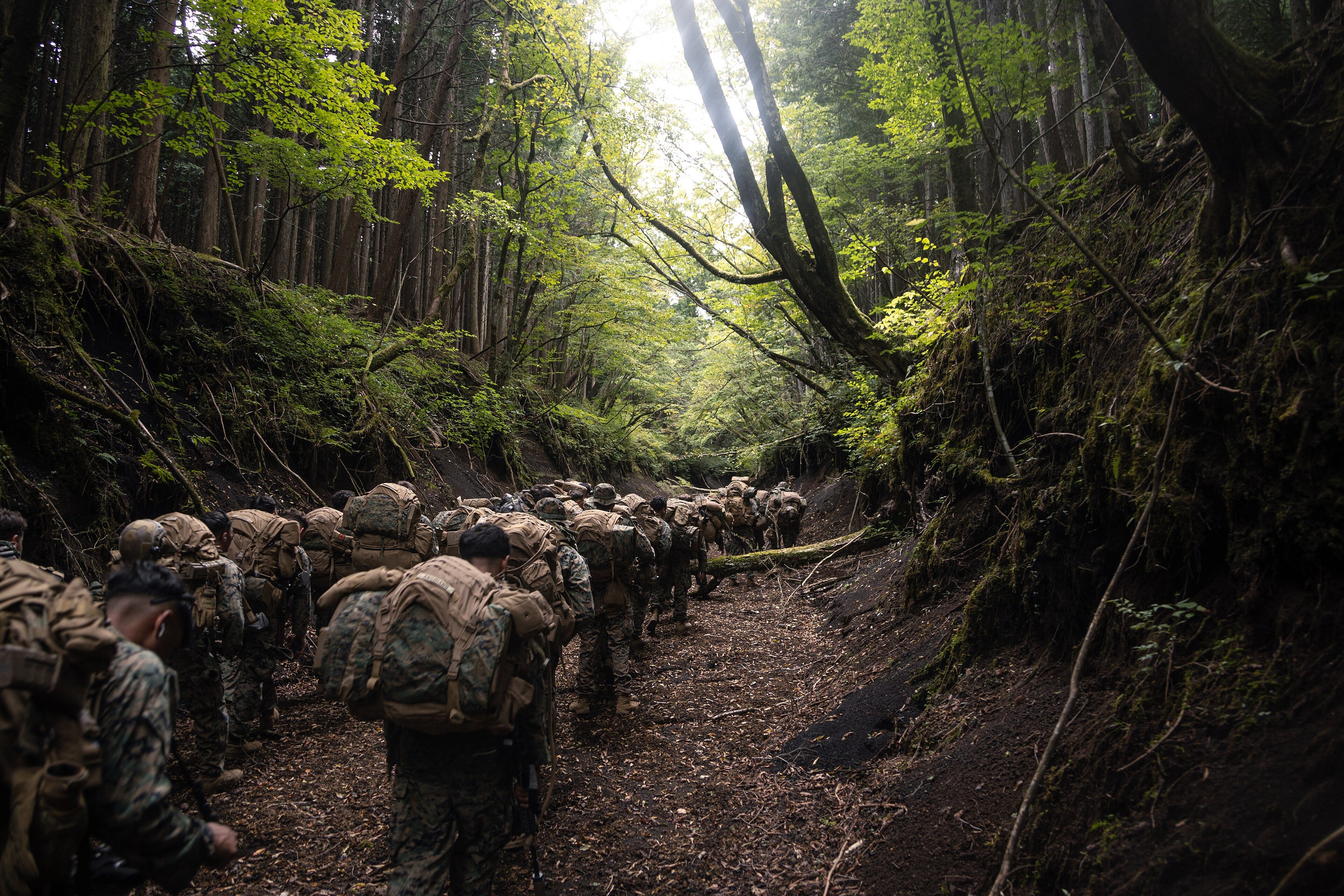
Fifteen years ago, a young Marine infantry officer named Ian Campbell arrived in Okinawa to help plan operations for the III Marine Expeditionary Force. He expected orders, exercises, and readiness drills. Instead, he found Pacific Command running what looked like a foreign policy operation, coordinating everything from disaster response to diplomatic outreach across an entire ocean. The gap between what he had trained for and what he actually saw stayed with him for more than a decade.
That experience became the seed of a new dissertation submitted to American University’s School of International Service, in which Campbell builds what he calls a Theory of Presidential Military Belief Transmission. The theory seeks to probe whether a president’s personal beliefs about how the military should be used actually flow down into the daily work of the regional combatant commands, or if those commands operate largely on their own institutional momentum regardless of who occupies the White House.
To test it, Campbell examines the roles of Southern Command and Pacific Command across the Clinton, Bush, and Obama administrations, drawing on congressional testimony, formal military reports, and more than 30 interviews with senior officials who served during those years.
The puzzle Campbell set out to solve was first laid out two decades earlier. In September 2000, Washington Post reporter Dana Priest published a three-part exposé portraying the Pentagon’s regional combatant commanders as officers who wield outsized political influence with little day-to-day oversight from civilian leadership.
Priest, who later expanded the series into a book, reported that the commands had been directed to “shape, prepare, and respond” across the globe without ever receiving clear guidance on how to do it.
The dissertation’s findings complicate a simple story of presidential control. Campbell reports that combatant command roles have varied by administration in ways that defy both structural realist explanations, which emphasize the international system’s pressures, and path dependent accounts, which assume institutions change only gradually along established tracks.
Each president arrived in office with distinct beliefs about the military’s proper role and the degree of civilian control it required, and each administration did craft policies reflecting those views. But Campbell found that presidential beliefs have not reliably or automatically translated into changes in what the commands actually did on the ground.
Instead, Campbell identifies a more tangled set of causes. Presidential beliefs carry more weight in regions where conventional security threats are already salient, meaning a president’s views matter more in a place like Korea than in one where the military’s role is largely humanitarian or diplomatic.
In regions that receive less presidential attention, combatant commands tend to keep doing what they have always done, a pattern of path dependency that outlasts changes in the White House. And in some cases, presidential beliefs themselves shift abruptly in response to external shocks rather than evolving on a fixed ideological trajectory.
Campbell’s account also pushes back on the broader claim, common in the militarization literature he reviewed, that the Defense Department has effectively taken over the conduct of US foreign policy. He writes that his own experience in the Pacific did not match the picture painted by many scholars, and that the puzzle motivating his research is precisely that gap between the academic narrative and what he witnessed firsthand inside the command structure.
Presidents, he concludes, retain the constitutional authority to direct how the military is used, and that authority continues to matter even when its effects are indirect and difficult to trace. As Campbell puts it, “Presidents, and their beliefs about the military, matter.”
The dissertation’s implications extend beyond the historical case studies. Campbell argues that his findings offer context for military policymakers navigating a period of greater uncertainty and tighter resources, suggesting that expecting a new president’s stated views on the military to produce immediate, uniform change across every region would be a mistake.
Still, where security concerns are acute, a president’s beliefs are likely to shape command activity quickly. Where they are not, existing patterns of behavior, and the institutional inertia built into commands like The Pacific Command and Southern Command, are likely to prove more durable than any single administration’s stated intentions, according to Campbell’s research.
In a piece republished by Inkstick from his Substack, Tom Engelhardt argues that US decline has accelerated under President Donald Trump as China has quietly emerged as the world’s last-remaining rising power. Engelhardt traces Russia’s downward slide since its 2022 invasion of Ukraine, noting the country’s staggering troop losses and battered energy infrastructure. He writes that Trump’s return to office, his push for a further half trillion-dollar defense budget hike, and his refusal to acknowledge climate change have all deepened US retreat. Engelhardt notes that Trump’s business empire has grown enormously, calling his financial rise “the definition of American imperial decline.” China, he argues, has risen without going to war.
Christopher Preble and Lucas Ruiz write that the question guiding US nuclear policy should not be how many weapons are enough but what those weapons are meant to accomplish. They argue that nuclear deterrence functions as “force communicated” rather than force applied, persuading adversaries only when a posture reflects genuine intent to retaliate. The authors point to Trump’s March 2026 demand for Iran’s unconditional surrender as an example of coercion unsupported by credible follow through. Preble and Ruiz propose shifting the US arsenal to a monad built entirely around submarines, paired with a formal pledge never to strike first, and argue that arms control alone offers lasting security.
At The World, Danielle Preiss reports that Nepal’s tiger recovery, once celebrated as a global conservation success, has entered a harder phase of coexistence between people and predators. Preiss traveled to Chitwan National Park, where officials say rising tiger numbers have brought more deadly encounters with villagers who depend on the surrounding forests for grass, firewood, and fish. She reports that a resident of the Madi Valley, Sarita Bhote, lost a neighbor to a tiger attack while he fished in a nearby river. Museum director Birendra Mahato recalls that his ancestors lived alongside tigers, once saying, “We live in the same area, same region. Sometimes tigers [are] harmful for us, sometimes we are harmful to the tiger.”
If you want to support our nonprofit journalism, there are several ways, but one we suggest today is snagging yourself some of the snazzy Inkstick swag available for purchase at our merch store. If that’s not your style, don’t worry: We accept one-time donations and recurring monthly support year-round.
Critical State is written by Inkstick Media in collaboration with The World.
The World is a weekday public radio show and podcast on global issues, news, and insights from PRX and GBH.
Inkstick Media reports on how security decisions shape everyday life, following the money, power, and consequences of war.
Critical State is made possible in part by the Carnegie Corporation of New York.
Comments
Nothing yet. Say the first thing.
Sign in to join the conversation.