
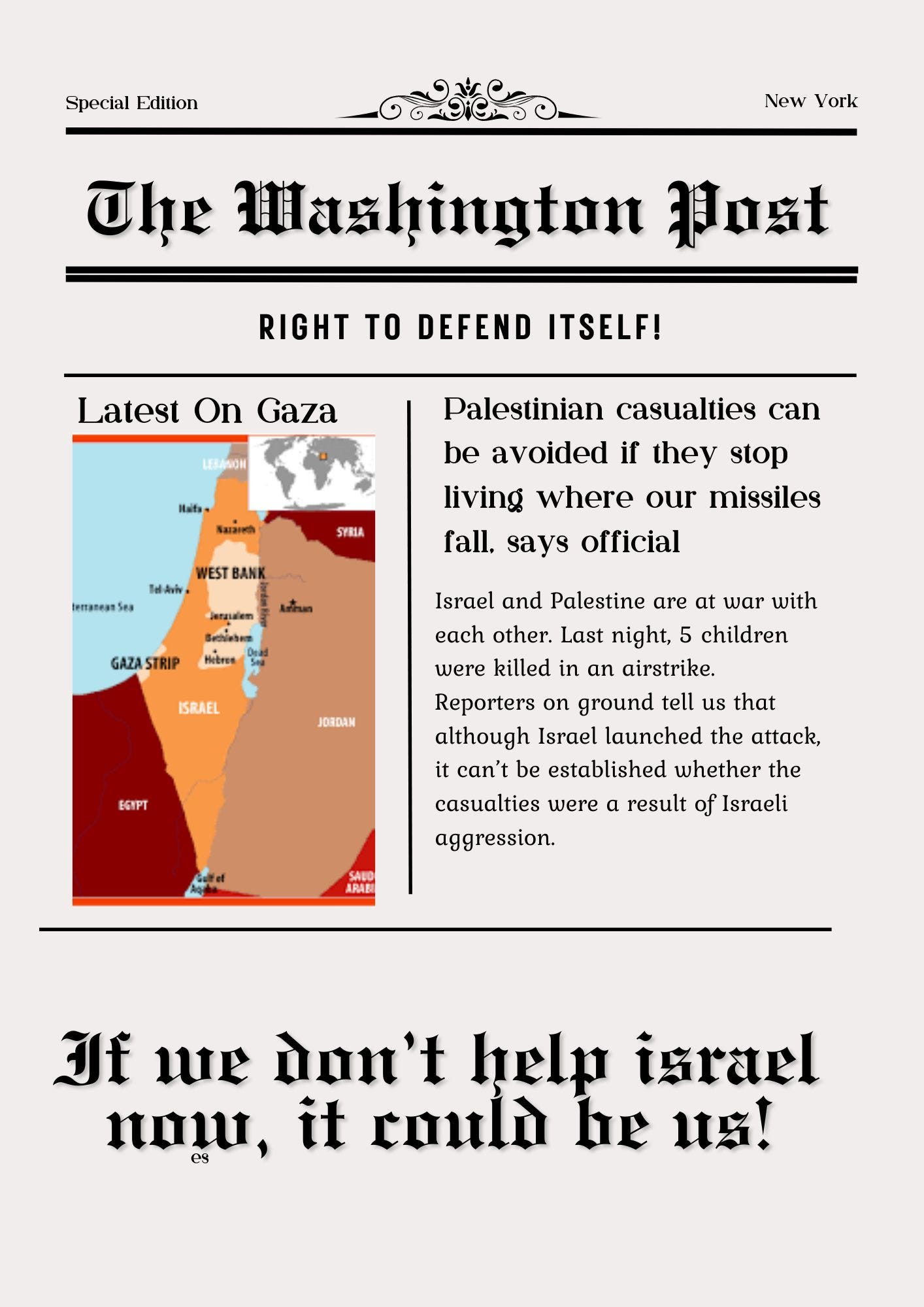
Digital media today is one of the largest sources that delivers information globally. The Internet has paved the way for viewpoints and information from all around the globe to be accessible worldwide. News is produced differently as per the political, cultural, and ideological perspectives of the societies and the newspaper corporations. This presentation of news that involves highlighting certain aspects, while shadowing others, using specific vocabulary, and painting different parties in different lights is called Framing. As per Agenda Setting theory, Framing is done to expand a narrative in society, to set an agenda, and propagate it within certain circles.
Let me lay the tracks for the point I am trying to make. The Israel-Palestine conflict has been ongoing since 1948, when the United Nations, against the wishes of the native Palestinian population, along with surrounding Arab leaders, aided in the establishment of the State of Israel. A state where the majority of the population arrived from Europe and pushed the locals out of their homes and land. After 1967, Israel gradually annexed more land and placed Palestinians under colonial rule. Later, Israel established Jewish settlements on the Palestinian land, leading to structural persecution of Palestinians. After the peace process in the 1990s, in 2005, Israel evacuated from Gaza, while holding the majority of control over the territories in the West Bank. This left Hamas in charge of Gaza, and the tensions between Hamas and Israel stayed high, with Israel targeting the Palestinian population regularly. On October 7th, 2023, all hell broke loose when Hamas attacked Israeli territories bordering Gaza and killed around 1300 Israelis and took more than 200 people as hostages. The whole world covered the event, as well as the brutal response by Israel that has killed more than 62,000 people in Gaza, the majority of them being women and children.
News reporting is highly affected by historical events, cultural norms, political agendas, and the ideological basis of a news outlet, leading to the framing of news. Media Framing Theory aims at the examination of the presentation and organization of the information provided in the content, and how it influences the perspective, understanding, and interpretation of the audience. Media provides the audience with the frames to interpret certain events and emphasize certain aspects of the news to highlight the importance of the event. These frames target definite emotions in the audience to help the interpretation towards a favorable conclusion. This is also called “manufactured consent.” This favorable conclusion puts one group over the other, one party of the conflict over the other. Media Framing is carried out to achieve a certain conclusion and align the whole society with the desired agenda, as per the agenda-setting theory. For example, during the Vietnam War, the presence of US troops in Vietnam was portrayed and perceived as an absolute blessing for Vietnam and the world, in the majority population of the United States, thanks to the new reporting.
As per Johan Galtung, the father of Peace and Conflict Studies, Western media tends to increase coverage dramatically once tensions in a region culminate. The Washington Post has proven its point absolutely with active reporting of the ongoing genocide (which they don’t classify as a genocide). The New York Times has a section dedicated to the Israel-Palestine conflict that covers every single aspect of the ongoing conflict, similar to many other news outlets such as Al-Jazeera.
The delivery of the news in the Washington Post, no doubt, presents facts and truths; however, the presentation either deliberately or unconsciously omits several defined aspects or shadows certain angles and words that could put Israel in a bad light. For example, in the Washington Post’s headline that covered the death of Hind Rajab, it says, “Palestinian Paramedics said Israel gave them safe passage to save a 6-year-old girl in Gaza. They were all killed.” Now, this news certainly leads to misconceptions and does not define killers, which is not the case with the reporting of crimes committed by Hamas. This headline can lead people to believe that if the IDF had given them a safe passage, they would not kill them, and it must be Hamas’ job; however, as the report in itself concludes that all fingers point towards Israeli troops. Even though the news report explains the events in detail and correctly, it still leads to misinformation for the majority of the audience. Moreover, the headlines fail to mention the details of “all.” The Washington Post either deliberately or coincidentally omitted the inclusion of the death of Hind Rajab in the headline; the word “they” in the headline denotes the paramedics, not Hind Rajab. As per a study conducted, around 80% of the readers do not go past the headlines; hence, the majority of the readers would assume the killing of paramedics and Hind Rajab to be an act by Hamas. Another Headline from the Washington Post downplays the gravity of the situation by labeling Netanyahu as “accused of Gaza War Crimes by ICC” rather than mentioning that he is charged with crimes and an arrest warrant is out for him. The news is from the same day as the ICC issued the arrest warrant.
To sum it all up, media framing is the deliberate formation of news in a way that favors one cause over the other to help one particular party. The phenomenon of media framing in US news outlets, such as that of The Washington Post, is evident as it favors a pro-Israeli stance in its reporting and specifically in its headlines. This leads to the formation of pro-Israel sentiments in the US public that label Israel as a saint of a nation while dehumanizing or ignoring the existence of Palestinians.
Muhammad Abdullah: The author is an alumnus of the National Defence University, Islamabad. He has various interests. He is an active voice against the Palestine-Israel conflict.
No posts
Comments
Nothing yet. Say the first thing.
Sign in to join the conversation.