
Title: THE DAY PAKISTAN RAN OUT OF CHAI!...and brewed a revolution instead.
Author: Thomas De Verne Hovercraft (aka Waqas Rabbani)
No. of Pages: 38
Publisher: Blimp
Personally, I was never a fan of tea or coffee. I tried coffee once and hated its acidic nature. Years passed. Then, somehow, I developed a taste for it, gulped down coffee insanely, and one day, I truly tasted tea. Of course, I had been drinking it for years, but never with affection. Now I do. And naturally, this infatuation never interfered with my other love affair (with coffee).
Given that context, the book intrigued me. Not because of tea, but because of its absence. Waqas’s imagination is wild; I can say that confidently, having had the pleasure of acquaintance.
The book opens with an embargo. One day, the government bans the import of all non-essential items as part of an urgent IMF-driven restructuring plan. Tea is on the list. Markets collapse. Adam Smith’s "invisible hand" — the basic assumption that if I go to the market, what I want will be there — is suddenly defenestrated.
Without some predictability to our collective human story, life as we know it wouldn’t be possible. There’s no economics without predictability. At its heart, economics is about people; how they make their way in the world, how they earn a living, how they spend. Adam Smith himself said it best:
“[Each individual] generally, indeed, neither intends to promote the public interest, nor knows how much he is promoting it...He intends only his own security; and by directing that industry in such a manner as its produce may be of the greatest value, he intends only his own gain, and he is in this, as in many other cases, led by an invisible hand to promote an end which was no part of his intention.”
—Adam Smith, An Inquiry Into the Nature and Causes of the Wealth of Nations, Book 4, Chapter 2.
Initially, I thought this was all in Bilal’s (the protagonist, and a madman for tea) head. After the ban, he describes the city like a scene from Orwell:
“Outside, the city hadn’t noticed anything yet. Traffic honked. Crows cawed. Someone was frying samosas across the street. But the absence had already begun to settle in — subtle, like a skipped heartbeat.“
Reality, it seems, depends entirely on tea. Stores were shuttered. But stores didn’t only sell tea, right? Is the entire city addicted to tea? Or perhaps the other commodities existed only to complement the experience of tea. Once the main desirable object was gone, what’s the point of selling the secondary ones?
Bilal ate not for nutrition but to sustain the taste buds that craved that magical drink. Even paracetamol became a mimicry of tea. In short, it had become “an object of ideology.” Like a banknote — something we know is just paper — tea became fetishized. There was something je ne sais quoi about it. Something beyond liquid, beyond aroma.
The book also critiques the political scaffolding we’re entangled in reactive, and myopic governance. When a minister is asked about the ban, he replies:
“Tea is a colonial hangover. Let us embrace local alternatives. Like sattu. Like lassi.”
But if it truly were a colonial hangover, why wasn’t it banned from 1947? Why now? merely at the say-so of the liquidators?
Economically speaking, the government’s decision to ban imports was illogical.
Pakistan has long struggled with its external account. The government spends too much, taxes too little (and relies heavily on indirect taxes), invests even less, imports excessively, and exports too little. Regulatory inefficiencies and rent-seeking are widespread. Ultimately, we suffer from a two-headed hydra: a fiscal deficit and a current account deficit — the latter a monster merely slumbering nowadays due to remittances.
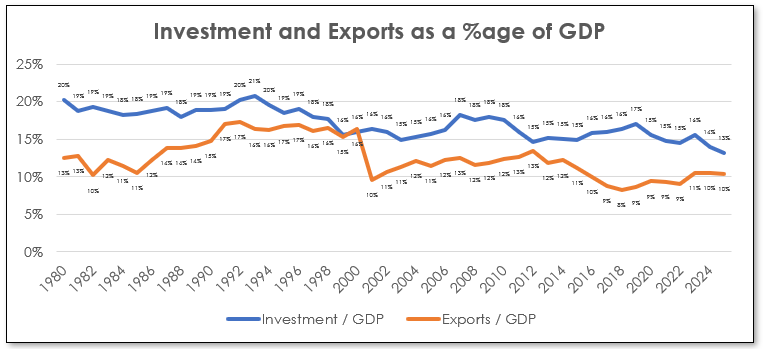
Source: PBS
To counter external account pressure, the government reaches for the easiest solution: cascading tariffs and import substitution strategies, rather than real reform. And in the book, they go even further — cutting off imports entirely! All without considering that local producers can't cope, and that such a shock could trigger both a recession and public unrest. Trumponomics 101.
Quoting myself from a commentary at Axial Consulting:
“Trumponomics, veiled in fervor economics, has driven the global economy dangerously close to the edge. Its questionable premises— weaponizing trade deficits and clinging to tariffs as a blunt policy instrument—threaten to undo decades of hard-won global economic integration.“
Pakistan’s current tariff regime is grim:
1) Distorted tax and tariff structure is evident: import taxes (including GST, FED, WHT, CD, etc.) form 46% of total tax collection, compared to a 5% world average. This screams for a wholesale reduction to bring us in line with global norms.
2) Weighted average tariff is 12.7%, the highest among the top 70 exporting countries. (Global average: 2.7%; South Asia: 5.9%; ASEAN: 2.5%; China: 3.8%; India: 5.8%)
3) Over 50% of Pakistan’s exports go to four markets: the US, EU, China, and Afghanistan. Around 70% of exports are low-tech, with textiles and clothing making up 58% of exports but only 5% of world trade.
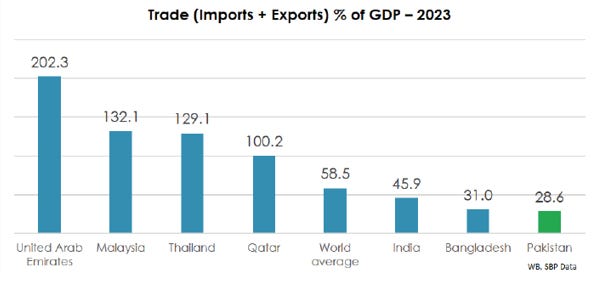
4) Export-to-GDP ratio (2023): Pakistan: 8.4%, India: 19% and Bangladesh: 15%
5) Labour productivity (1991–2021) in Pakistan rose from $3,200 to $4,700 (1.5x), compared to Vietnam’s rise from $1,200 to $6,000 (5x).
All of this results in low trade, weak innovation, increased subsidies, greater rent-seeking by local producers, and import-dependent growth (driven by liquidity — if we’re lucky enough to coax liquidators like the IMF). It all culminates in rising debt — the most lethal economic reality we face today.
The future lies in embracing liberalization, addressing fiscal imbalances, and committing to a free-market exchange rate. A floating exchange rate plays a crucial role in correcting trade imbalances by responding to market forces. When imports surge, the domestic currency weakens, making exports more competitive and imports more expensive—naturally narrowing the trade deficit.
In contrast, fixed exchange rate systems require large foreign reserves to defend the currency, leaving countries vulnerable to balance-of-payment crises. Floating rates, by allowing market-driven adjustments, not only enhance economic resilience but also reduce the risk of speculative attacks.
Coming back to the book: Bilal, driven only by his love of tea, ventures into the black market. He eventually finds a chemically enhanced “bootleg chai” from a mysterious Asma Apa, who runs a secret kitchen operation. It’s not the same, but enough to keep going.
Then comes the twist.
A long-buried government report is leaked: Project Karak, a pre-feasibility study proving that Pakistan could grow its own tea but chose not to, dismissing it as “low priority.” Outrage and hope follow. TikTokers, students, scientists — all begin experimenting with homegrown alternatives.
What began as a crisis becomes a movement.
Bilal joins a Telegram group called Tea Hackers Pakistan, where rooftops across cities—cynically alluding to the PV rush and its vicious governance cycle of decreasing demand, rising per-unit capacity payments, debilitating more demand and ipso facto escalating prices once more—are transformed into makeshift tea gardens. Karachi’s heat, Lahore’s dust all pose challenges, but the movement persists.
Eventually, scientists in Faisalabad and Karachi develop five hybrid tea strains suited to Pakistan’s climate. They release the seeds freely; no patents, no paywalls. Chai evolves into a symbol of resistance, community, and self-reliance.
And innovation solves everything.
“The first international tea expo hosted in Karachi was scheduled for October, but people started arriving in August.
By the time the gates opened, the city had transformed. Banners stretched across Shahrah-e-Faisal and Rashid Minhas Road, declaring: PAKISTANI TEA: FROM SURVIVAL TO SUPREMACY…”
The ending is absolutely fascinating and supports my earlier thesis: that this story is a fantasy of Bilal, a world shaped by his desires. A girl appears for a moment, proposes marriage and he walks away:
“Then he turned and walked off toward the garden exhibit, leaving her laughing, head shaking, already typing it into a tweet that would cross four continents before sunset.”
Throughout the story, Bilal is lonely and melancholy in tea’s absence. But here’s the nuance: Bilal has no real void. He isn’t trying to fill his emptiness with love or companionship. If he were, he would’ve said yes to her. Instead, he remains madly, irrationally devoted to tea and to tea alone.
CODA: You might pick up this book thinking it’s just a fun what-if. But by the end, you’ll find yourself rethinking how economies crumble, how revolutions are brewed (literally), and why tea, of all things, can become the last thing standing between order and collapse. If you’ve ever stood in line for chai at dhaba, muttered about IMF on your phone, or dreamed of growing something radical in your balcony pot — this book’s for you.
Furqan Ali: The writer is the co-founder of the Policy Club, a Peshawar-based researcher, and also writes fiction and poetry sporadically.
No posts
Comments
Nothing yet. Say the first thing.
Sign in to join the conversation.