
Last month in Ink & Dice, we looked back at 2025 and everything that I had released in the last year. This month, we’ll be looking ahead at 2026 and the various projects that I have in the works and on the horizon.
A few of the projects that you’ll see in the new production schedule are adventures that I am calling “Solo-Friendly.” I offer a little perspective on what I am trying to accomplish with these adventures, and how I plan to do it.
UHF Contact
Solo-Friendly Adventures
January Production Update
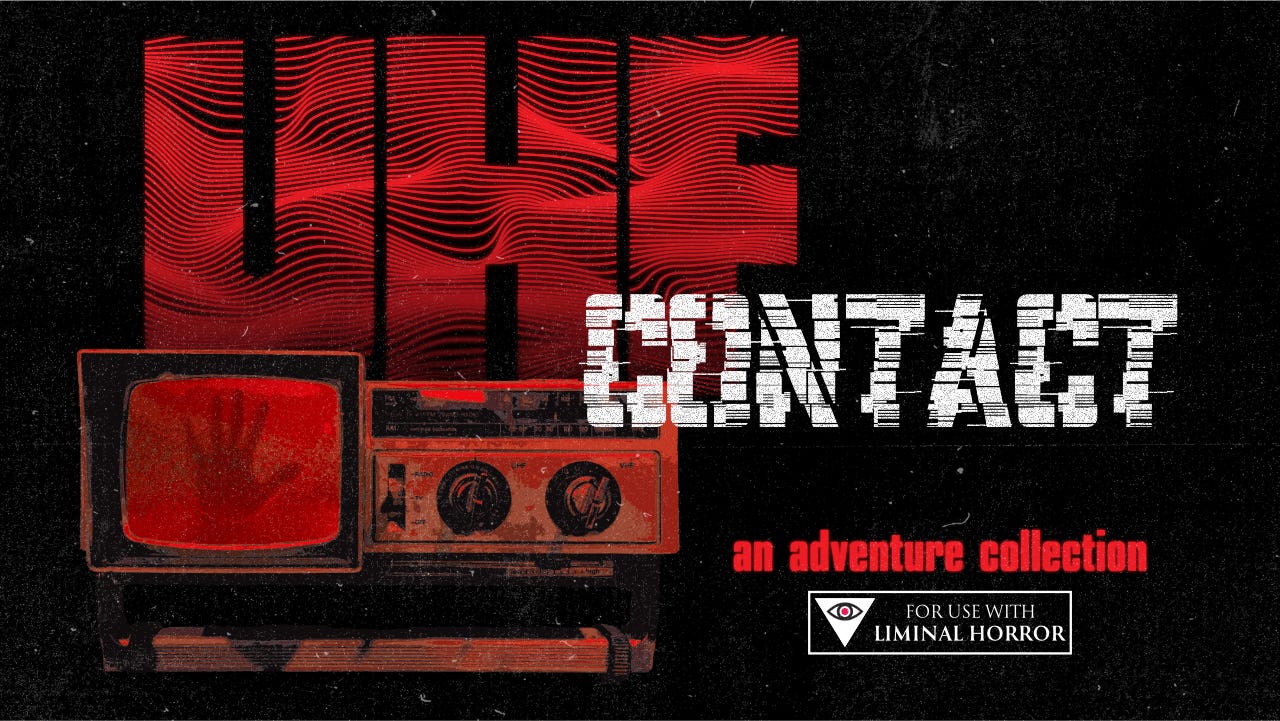
Now that The Baron’s Grip has moved into production, I’ve been able to shift my focus to writing some new games again. My first new project (and my first Kickstarter campaign) for 2026 will be UHF Contact. This is a 3-adventure campaign for Liminal Horror that is designed to be solo-friendly (see below).
This means that while the adventures work perfectly well when run by a Facilitator for one or more players, they work equally well when played GM-less by one or more players. By designing these from the beginning with this in mind, my hope is that solo TTRPG players will find them more interesting and accessible for this style of play. The zine will include all of the rules and tools that I put together for An Abbreviated Horror RPG and Alone in the Dark to help solo players and Facilitators get started with Liminal Horror.
I have been sitting on the text for these adventures for a year and a half, waiting for the inspiration to hit that would help me turn them into a cohesive campaign. I think I’ve found that, so I am going to be launching this campaign on Kickstarter for ZineQuest in February, 2026. If you’ve enjoyed my previous Liminal Horror releases, or you are interested in trying out the system solo, give the campaign a follow at the link below:
Follow the UHF Contact Kickstarter Page
At PAXU this past year, I had a chance to interact with a lot of people with varying levels of familiarity with the TTRPG hobby. They ranged from people that have popular podcasts discussing TTRPGs to people that had only ever heard of D&D. One thing that I noticed in these interactions was that while solo games were a big draw for some people, having a product defined as being a solo game was just as strong a turn-off for other people.
I feel pretty strongly that any multiplayer adventure can be played solo, and that any solo adventure can be played with multiple players. However, the amount of work to convert a module from one play style to another will often be more than a solo player or GM is interested in investing. It’s easier to just find another adventure that fits how they want to play.
So, I said to myself, “Self, how can I design an adventure that’s playable solo and also multiplayer with no conversion? What from my usual writing style do I need to add, omit, or change?” Of course, I did some research by looking at everybody’s favorite solo adventure module: Thousand Empty Light. I also looked at my own solo adventure A Night on Rose Hill.
Here are the highlights:
Introductory exposition. To help the solo player dive into the story, solo-friendly adventures take a little extra time to lay out what is happening at the beginning of the adventure. Thousand Empty Light spends several pages on a diegetic explanation of the role of the Lamplighters. Solo-friendly adventures may open with a set piece or pre-written scene to help the solo player get into the setting of the adventure, much like a GM’s opening monologue might sound when starting an adventure. A GM playing this same adventure could choose to use the exposition as it is written, or they may skip it, but having it there does not detract from their use of the module, and it adds a lot for the solo player.
Encounters separated from locations. The biggest thing to make an adventure playable solo is to avoid spoilers. To do this, solo-friendly adventures often use random tables to populate the locations of the story. In Thousand Empty Light, this is done with a d20 roll, meaning each complication has the same chances of occurring in each location. A Night on Rose Hill has a table of set encounters at each location that are rolled when the locations are visited. Most of the adventures that I have cooking will incorporate other procedures (such as depth crawls) to add a little more progression/structure to when different encounters occur. A GM can use these on the fly or ahead of time to pre-populate the locations if they so desire.
Well defined procedure(s). This is something that Thousand Empty Light does well, and (I like to think) A Night on Rose Hill also accomplishes. Just having a list of locations and a list of encounters is not enough. Even if the RPG system an adventure is written for comes with dungeon exploration procedures, it is still important to be deliberate with guidance for the solo player. For this, I really like depth crawl mechanisms, or even room generation procedures like those seen in Dark Fort. Again, a GM could use these live, or they could use them to prepare the adventure.
Guidance on NPC motivations. This is something that I admit I need to work on in my adventure writing. Sure, using Reaction rolls is useful to get an idea of what an NPC’s demeanor is, but having clear motivations for different NPCs in different situations, or even custom Reaction tables for each NPC, goes a long way to helping a solo player play out interactions with NPCs while minimizing the distraction of multiple Reaction and Oracle rolls. In my adventures, I am focusing on giving a few specific suggestions for each NPC’s actions in each situations in which they might be found.
Those are the big things that have come up during my brainstorming for UHF Contact, as well as for other solo adventures I’m working on. I’m sure there are other things out there, but I feel that if I can design these adventures with these ideas in mind, I’ll be able to write adventures that are equally useful to solo players and multiplayer tables.
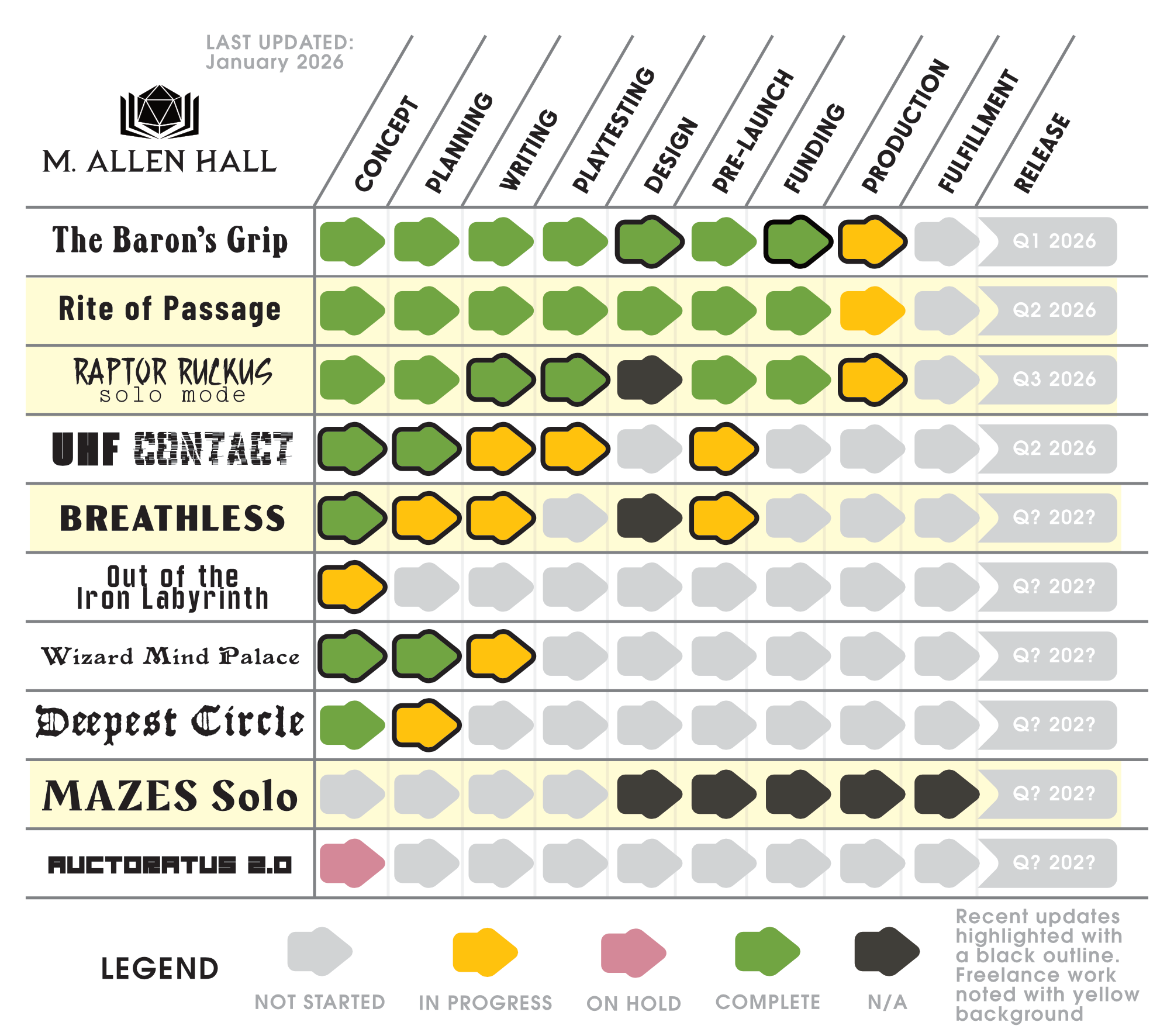
There have been quite a few changes to the production schedule since I last posted it in November. Here are the highlights for new projects:
UHF Contact, as I talked about above, is a zine of 3 solo-friendly adventures for Liminal Horror.
I am going to be writing 3 adventures for the Breathless: Frightmare Edition box set. I’ll talk more about that next month.
Out of the Iron Labyrinth is a project that I am going to be working on with Jamie Douglas for OSE Month in May. I’ll definitely be talking about that more once we have some art to show for it, as it will also be a solo-friendly adventure.
Wizard Mind Palace is a card-based solo journaling game in which you are a wizard on an epic quest whose memories have been corrupted by their enemy. That will probably be released late this year.
That’s it for the January update. I’m looking forward to sharing more of these adventures and games; I might even be getting Auctoratus back on track this year!
Until next time.
—MAH
Comments
Nothing yet. Say the first thing.
Sign in to join the conversation.