
With the completion of The Baron’s Grip, I have released my biggest collection of dungeons to date. While building the dungeons for that adventure, I had a chance to really nail down a process for designing dungeons, which I’ll lay out in this Ink & Dice.
Special note: Welcome to everyone that backed The Baron’s Grip during Mausritter Month, and thank you for your support! If you elected to sign up for my newsletter while filling out your BackerKit survey, this is it.
UHF Contact Progress
Dungeon Design
February Production Update
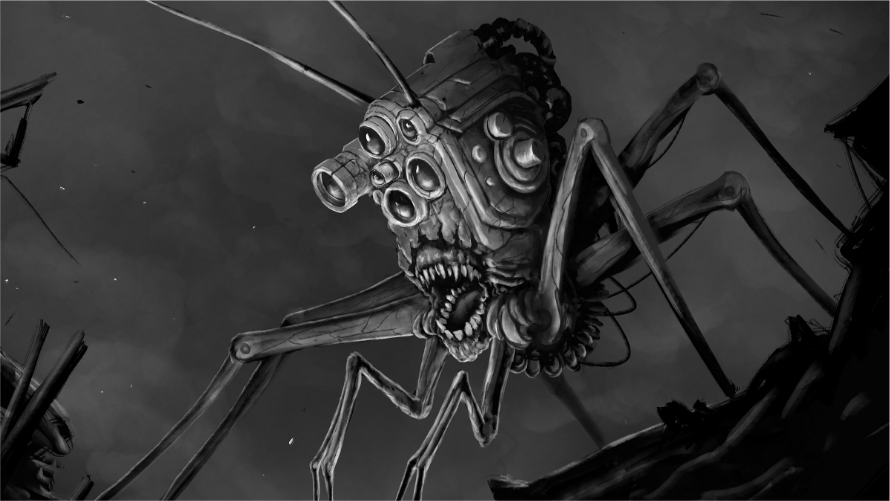
Things have been moving along for my next Liminal Horror project. The Kickstarter closed yesterday, and it was successful! All three adventures are written, and they have been sent over to Josh Domanski for developmental editing. David Szilagyi is working on art, the first piece of which is a little Camera Bug that you might come across while exploring the junkyard in the first adventure of the book, Signal.
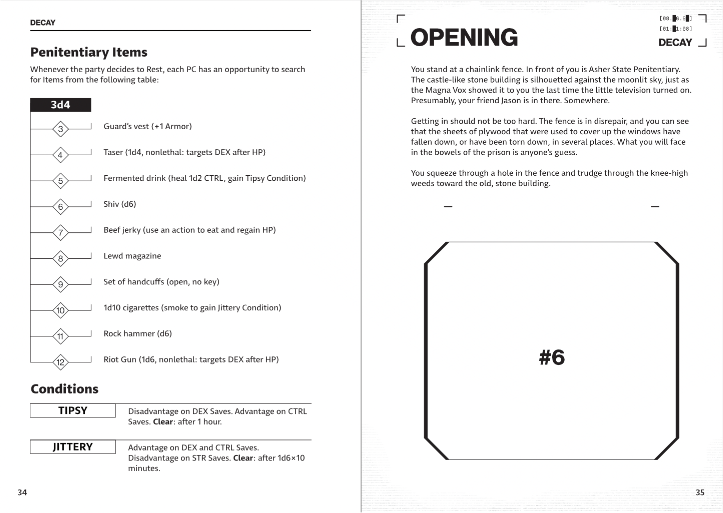
I have not been idle while David and Josh have been working, however. I have been able to sort out the layout style for the book, and I’ve technically laid out the entire text as it currently exists (though I’m sure much of that will change when Josh is done with it). What this all means is that there should be a pretty quick turnaround from Josh’s notes and David’s artwork to pulling the book together and getting it sent to the printer.
In any event, that’s the status! If you’re interested in seeing this book come to life, you can still Late Pledge for the campaign at the link below:
Let’s talk about dungeons, and making them. There were 6 dungeons in The Baron’s Grip, so I had the chance to really iron out my process for building them. Here are the general steps that I’ve been using:
Why does this space exist? Who built it, and for what purpose?
List the rooms that the dungeon has. Has their use changed over time?
Map the rooms. Ideally no more than 4 doors per room.
Establish connections between rooms. A lever here opens a door there. Keys hidden in one room open the lock in another room.
Fill in the rest of the rooms with stuff like:
NPCs (monsters are NPCs)
traps
loot
lore
rarely: nothing (Though, try to make Nothing rooms Lore rooms. Turn the fact that the room is empty into something interesting.)
To demonstrate this process, here’s a peek at what I’ve been working on for Junk Food Games’ Lean Green Zine Jam.
The Green Ooze King is an adventure for Cairn set on an offshore island. Among other things, there is a dungeon on this island. Here’s how I applied the above approach to writing this dungeon.
There is a wizard’s tower on this island, but the wizard hasn’t been seen in months. The people from the nearby, mainland town are in the process of tearing down the wizard’s tower to replace it with a lighthouse. The dungeon is below the wizard’s tower, so it is pretty easy to see it as a wizard workshop, built by Ilfen, the wizard who once lived in the tower above.
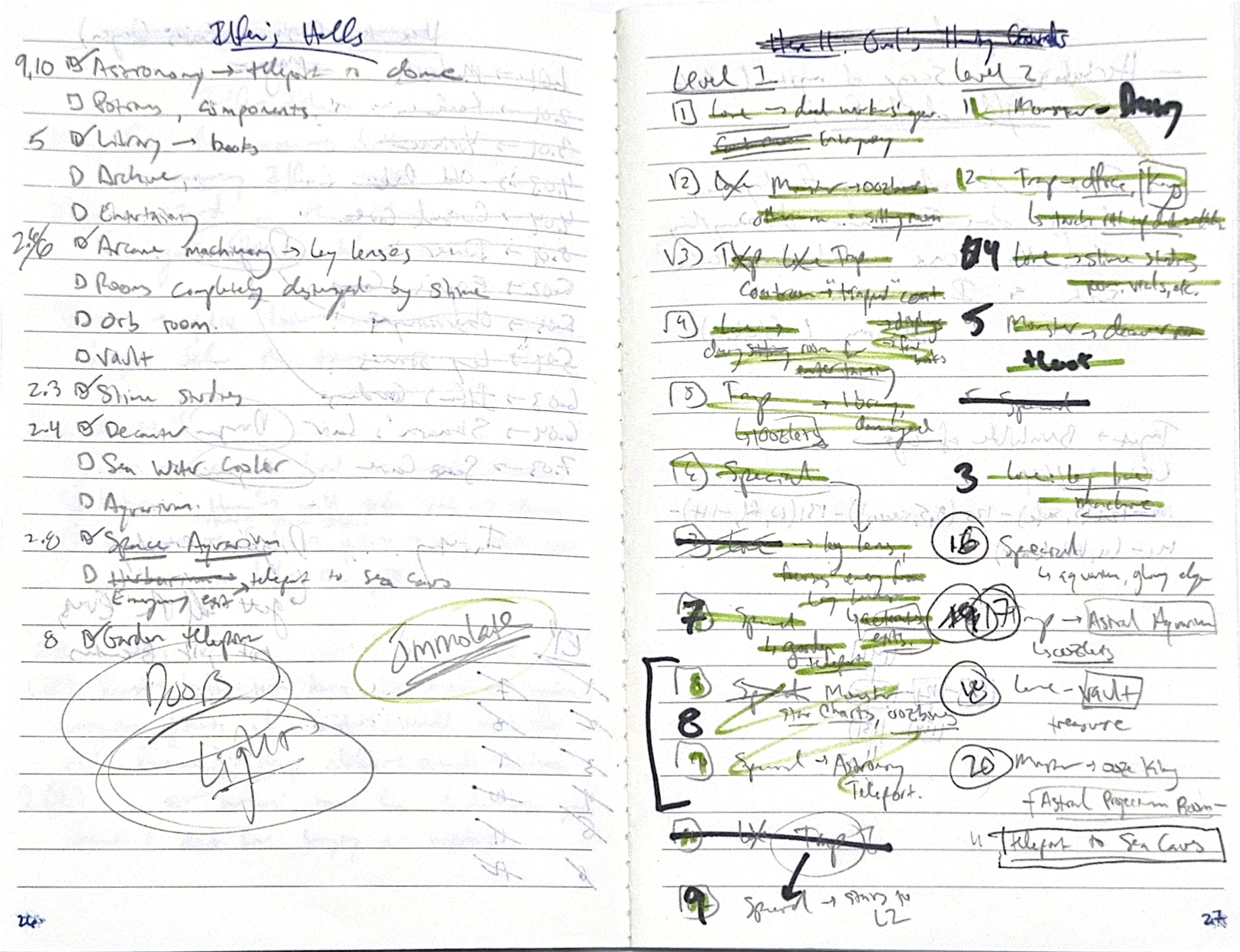
A list of rooms, as seen on the left side of Exhibit A (I swear those are room names). Examples:
Astronomy
Decanter
Space Aquarium
Slime Studies
Orb Room
Some of these are a little more compelling than others at the moment, but there’s still a lot you can do with just those short room titles.
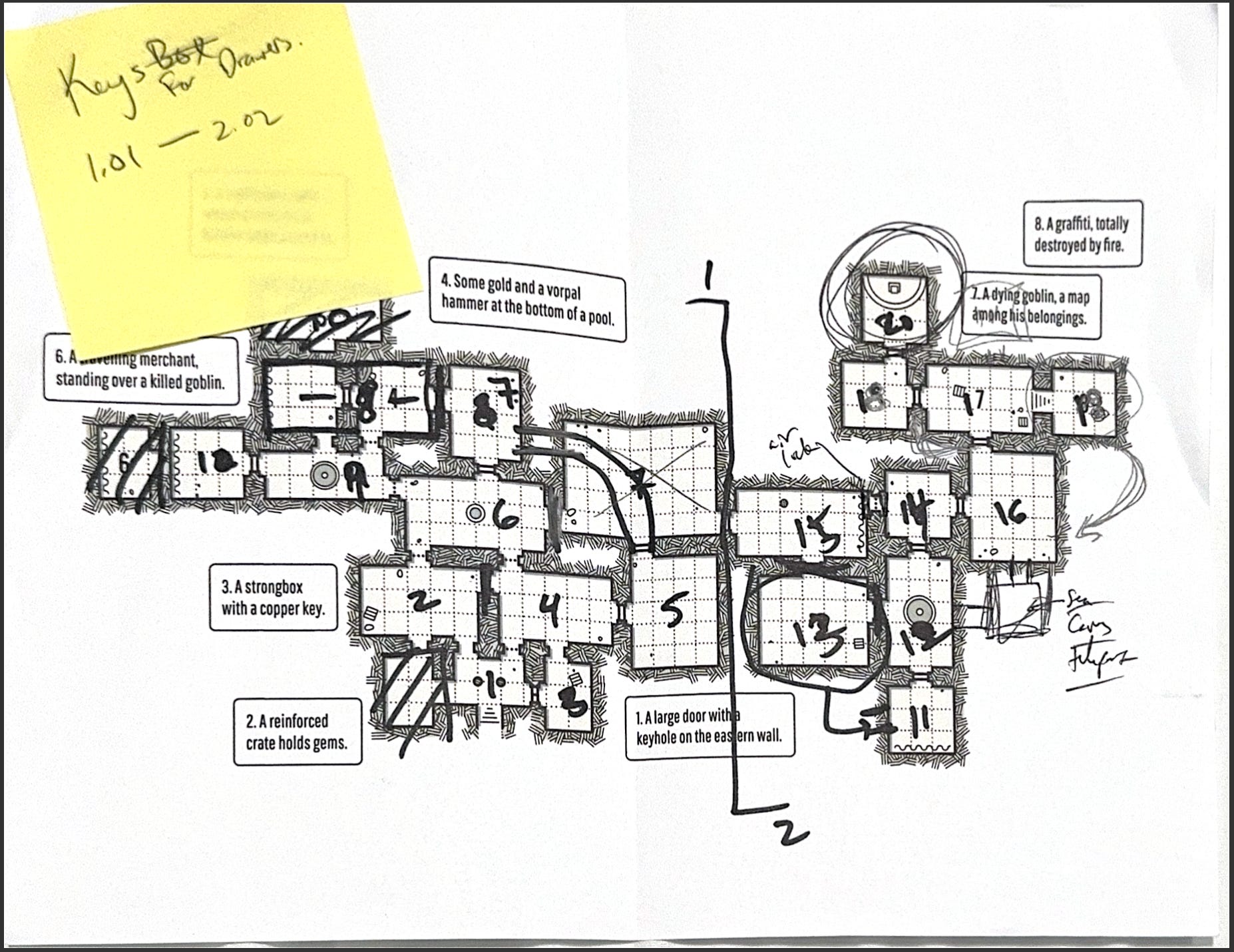
Here’s the closest thing to a “trick” that I use for this process. Head on over to Watabou’s Procgen Arcana and mess around with the generators to create something that vaguely resembles the dungeon you want to make. I find this cuts out massive amounts of blank-page-staring-time when it comes to turning a list of rooms into a map.
As you can see in Exhibit B, I do not use the map as it gets spit out of the generator. In this case, I have split the dungeon into 2 floors, gotten rid of some rooms, combined rooms, changed the connections of rooms, and added rooms where I needed them. I also started making some notes on other entrances/exits in the dungeon, as well as some of the room connections. The final map will be redrawn by hand to show the final organization of the dungeon.
Next up are the connections, things that tie the rooms together and make the dungeon feel like one cohesive space. A simple example is seen on the sticky note in Exhibit B.
In Room 1, there is a desk with locked drawers.
In Room 12, there is a ring of keys. Get the keys, go back and open the drawers, and be rewarded with a couple of spellbooks for the time and risk.
As a more involved example, in this wizard workshop there are two magical machines that provide power to the dungeon. However, they are currently broken on account of the wizard’s absence and the presence of certain malicious forces within the workshop. With this machine, many connections can be made in the dungeon:
The first machine is in Room 6, and the main lens of the machine is out of alignment.
Without additional information, a PC cannot fix this machine. It is like handing me a smartphone that won’t turn on despite adequate power. Not in 1,000 years would I be able to “figure it out.”
However, there is a painting of this machine in Room 3, and a functional miniature model of the machine in Room 4. If a PC were to study either of these, they would notice the misalignment of the lens and be able to repair it.
Once repaired, not only do the lights turn on, so does the fireplace in Room 5, which is important when considering the slimes in this dungeon are immune to damage not done by fire or hot steel.
It also turns on the teleportation discs in Room 8 and Room 9, which allow PCs to enter and leave as they choose.
Yeah, this is clearly a big one, but hopefully by the time you gone through naming and connecting all of your rooms, you’ve got plenty of ideas for what else you could put in the dungeon to make it interesting. Things to interact with. People to talk to. Quests to achieve.
I should have The Green Ooze King ready for a digital release by the next time I send one of these newsletters. If the ideas I’ve been laying out sound interesting, follow me over on itch.io to be notified when it gets released:
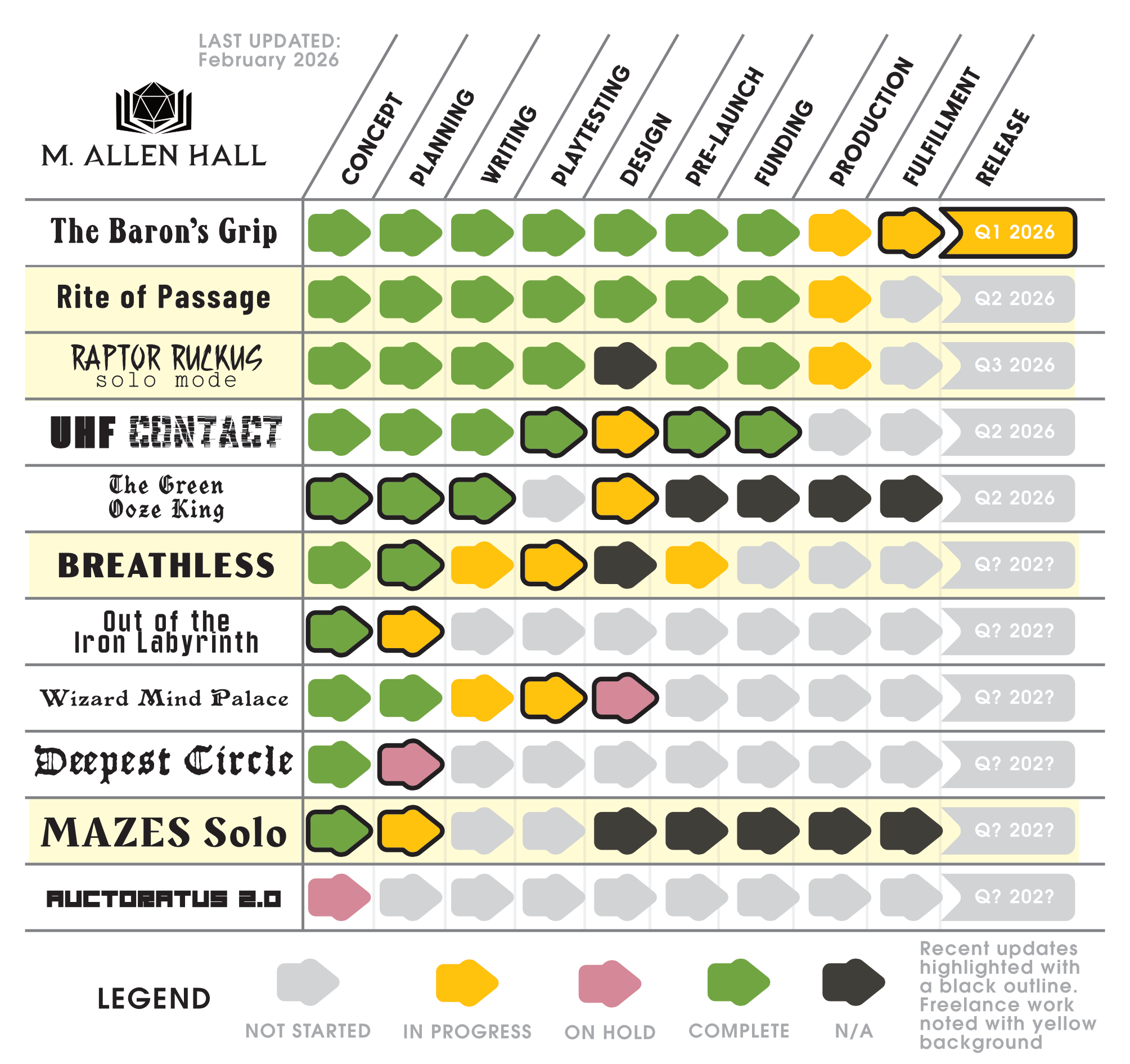
The only thing new on the grid this month is The Green Ooze King, but there are some other project updates:
The Baron’s Grip: we’ve seen the digital release for my Mausritter Month campaign, with itchio codes delivered to all backers. The books are currently on a boat, and we are on schedule to ship those out in early April.
Out of the Iron Labyrinth: my OSE Month project will be my next big focus once I finish up The Green Ooze King, UHF Contact, and the adventures for Breathless. I’m going to be using a little different structure for this adventure, and I’ll be sure to talk about it in an upcoming Ink & Dice.
Breathless: I am chipping away at 3 pamphlet adventures for the upcoming Frightmare Edition of Breathless by Fari RPGs. This is a different kind of horror game, and it’s been interesting pulling together these adventures for a new system.
MAZES solo: I’ve been contracted by 9th Level Games to write a book for solo players for their MAZES game system. I am still getting a hold on MAZES, but I think it will be a very nice system for solo players. I’ll be working on this as Out of the Iron Labyrinth comes together.
That’s it for February (got in just under the wire here didn’t we?). Next month should see the release of The Green Ooze King, and who knows what else? We’ll just have to see what kinds of jams pop up in the next few weeks.
—MAH
Comments
Nothing yet. Say the first thing.
Sign in to join the conversation.