
In this issue:
Stand for Health Freedom Endorses Two More Washington Candidates
Pulmonary Embolism in Washington following COVID-19 Shots
Could the Rise in Washington Disability Trends be from COVID-19 Shots?
Rep. Schrier Urges Vitamin K Shot Surveillance
Guest: Erica Comerford, Director of Political Affairs for Stand for Health Freedom, discusses their state-specific voter guides, including for Washington state’s 2026 primary election on August 4. The guide sets forth SHF’s endorsements of candidates whose survey responses and public records have been carefully vetted for their positions on health freedom, informed consent, parental rights, privacy, school-based health centers, agency power, and a few other related issues.
Erica explains SHF’s candidate survey and how the vetting process has evolved over multiple election cycles to help guide citizens alongside their own research. She also shares her own path into health freedom advocacy, including her experience leaving the healthcare field after her medical sovereignty was not honored.
Children’s Health Defense does not endorse candidates, make candidate recommendations, or otherwise participate in electioneering. This episode is shared for educational purposes so listeners can review the issues, candidate responses, and available resources for themselves.
Watch replay on CHD-TV, and CHD-WA chapter’s: Website, Rumble, X
Listen to replay: KKNW AM 1150, SoundCloud, Apple Podcast, Spotify
Resources:
Vote for Health Freedom – Washington voter guide
Vote for Health Freedom - Candidate Survey
Health Freedom Institute: healthfreedominstitute.com: online course and articles, including animal vaccines and specific shots and targeted illnesses. $25/year.
Book on Amazon: The Vaccine Decision: Every Shot has a Story
Book on Amazon: A Mother’s Guide to the Vaccine Decision
SHF Substack: The Health Freedom Advocate
Guarding Liberty, twice-monthly emails to legislators, currently a nine-part series that explores why protecting medical freedom is essential to the promise that government exists to secure the rights of the people–and why every state should enact the Medical Freedom Act to preserve those liberties for future generations.
Ask Governor Hobbs to Support the Arizona Medical Freedom Act - STAND FOR HEALTH FREEDOM
Smith v. Seibly 1967 :: Washington Supreme Court Decisions :: Washington Case Law :: Justia
One Dream Podcast with Dr. Nick and Leah Wilson - Video Podcast
(As an Amazon Associate, ICWA earns commissions from qualifying purchases at no extra cost to you.)
Since ICWA Weekly News’s last reported on the Washington candidates endorsed by Stand for Health Freedom, two more have been added to the list:
Joshua Thompson for Washington House District 13, position 2
Misty Flowers for Washington House District 42, position 1

Candidate Joshua Thompson’s website states that he has been interviewed and highlighted by both podcaster Brandi Kruse and KIRO conservative radio host John Curley for his courageous and principled defense of citizens’ 1st Amendment rights. All this while having his house attacked and his family harassed online.
His website also states, “The COVID era exposed the disdain many legislators have for faith-based groups. People of faith deserve to know that government will not interfere, and that their right to worship will be protected.”
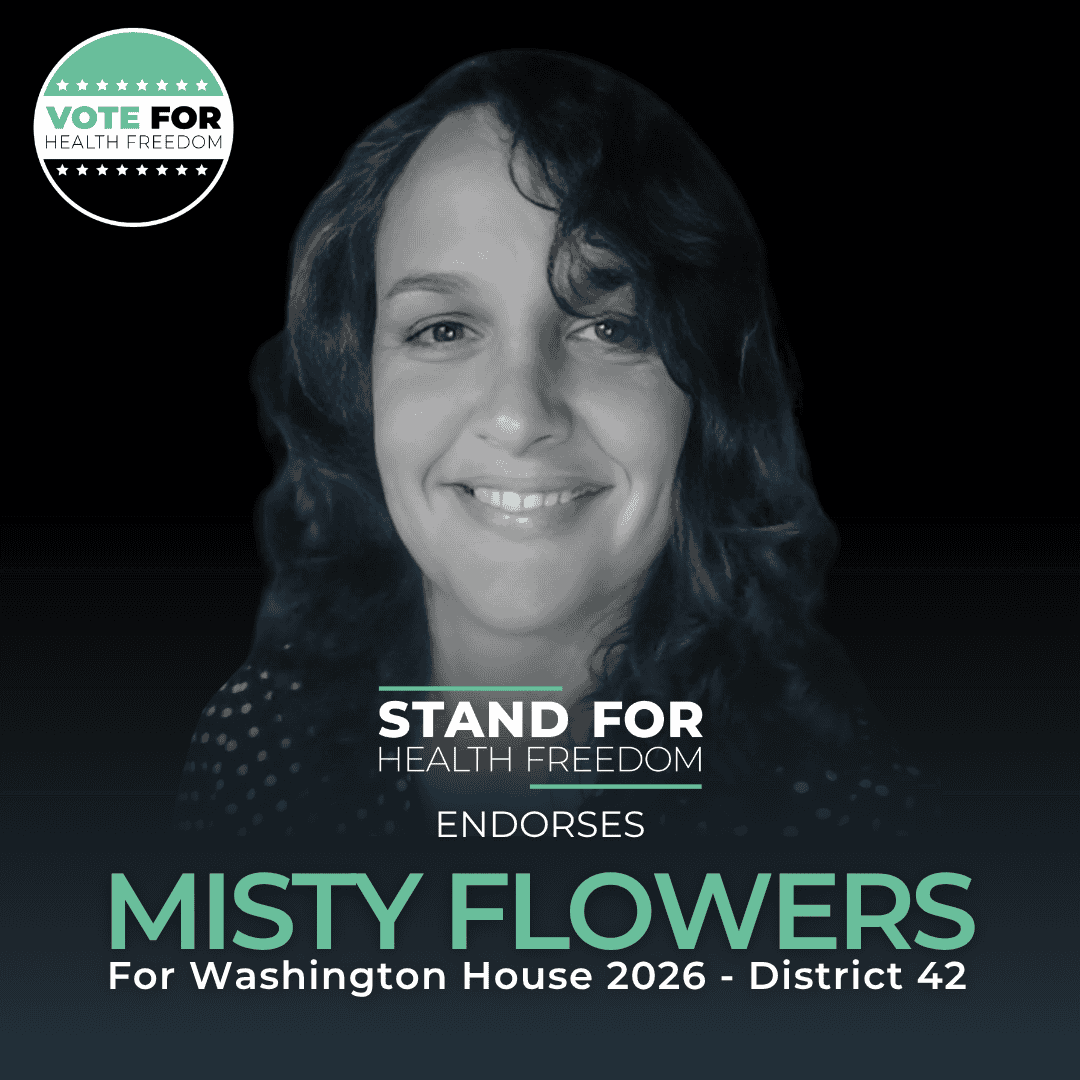
Misty Flowers has been associated with Informed Choice Washington as a Regional Coordinator and more recently as a Be Brave Washington leader in Whatcom County. The Capitol was honored to have her perform at an ICWA rally in Olympia to kick off the 2023 legislative session.
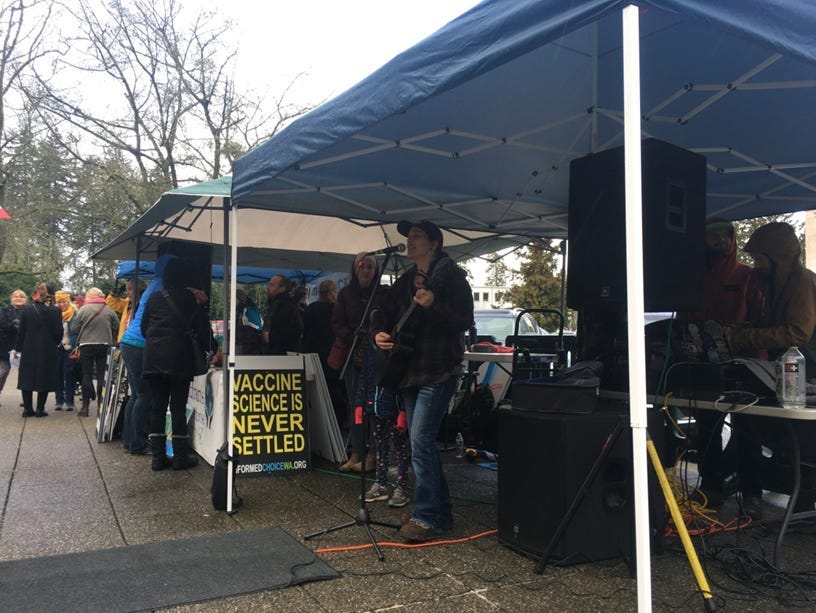

…and in April 2024 at the Children’s Health Defense event in downtown Seattle as well.
When Misty stood up and applied for the Whatcom County Health Advisory Board in 2023, she was label-lynched galore by the mainstream press.
In a February 1 Bellingham Herald article, the headline resorted to this tactic by calling Misty an “anti-vaccine applicant.”
The first paragraph in the article went on to call her a “vaccine opponent.” The second paragraph called her “an anti-vaccine activist.” Not to be undone, the Cascadia Daily News published an article the same day in which the introductory paragraph labeled Flowers as a vaccine skeptic:
“The Whatcom County Health Board got into a heated dispute Jan. 31 over vaccine skeptics who sought positions on the county’s Public Health Advisory Board.”
ICWA Weekly News - February 2023
Nevertheless, Misty has shown the tenacity to keep on fighting for our medical freedom. And the Whatcom area press might not realize that health freedom advocacy is a voting blok nowadays.
Last Wednesday, Dr. Peter McCullough reported on a Hughes et al. paper in BMJ Open that laid out a crisis hiding in plain sight.
Between 1998 and 2022, hospitalizations for venous thromboembolic events (VTE) in England rose by 62.6% — from 109.5 to 178.1 per 100,000 population. “But that headline figure masks the real story,” McCullough said. “This was not a broad, gradual rise across all clot types. It was a pulmonary embolism (PE) pandemic.”
McCullough provided this evidence:
This is where the paper gets interesting — and where the authors’ restraint becomes conspicuous.
Look at the PE hospitalization rate trajectory:
1998/99: 40.4
2019/20: 104.2 (steady climb over 21 years)
2020/21: 115.6 (+11.4 in one year)
2021/22: 122.2 (+6.6 the next year)
And as a proportion of all-cause admissions:
2019/20: PE was 0.28% of all hospital admissions
2020/21: PE jumped to 0.40% — a 43% relative increase in a single year
2021/22: Still elevated at 0.35%
The authors acknowledge that “PE is a recognized complication of COVID-19” and that the pandemic contributed. But what they don’t discuss — what no BMJ Open paper would dare discuss — is the other mass intervention that began rolling out across England in late 2020 and continued through 2021: thrombogenic SARS-CoV-2 vaccination.
McCullough makes the connection between the COVID-19 jabs and pulmonary embolism:
The 2020/21 spike in PE hospitalizations coincides precisely with both the COVID-19 waves and the mass vaccination campaign. Disentangling the two is impossible with aggregate data. But ignoring the vaccine contribution entirely — as this paper does, without a single mention — is either cowardice or complicity.
This is the puzzle the paper can’t solve. If spike protein pathology were driving clots, why would PEs triple while DVTs decline?
The answer may lie in where the endothelial damage occurs. The pulmonary vasculature receives the entire cardiac output and has an enormous endothelial surface area rich in ACE2 receptors. Inhaled virus hits the lungs first. Intravenously injected LNPs from vaccines have been shown to distribute systemically, with significant accumulation in the lungs, liver, and spleen. The lungs are ground zero.
A DVT forms in the legs and may or may not travel. A PE is often the end result of a systemic pro-thrombotic state — microclots forming throughout the vasculature, coalescing, and lodging in pulmonary arteries. The 202% PE surge isn’t a detection artifact. It’s a signal.
(DVT = deep vein thrombosis)
Actually, it’s more of a conspicuous signal when one looks at a December 17, 2022, story in the Epoch Times in which the article stated that researchers at the United States Food and Drug Administration (FDA) found that pulmonary embolism met the initial threshold for a statistical signal in elderly individuals and continued meeting the criteria after a more in-depth evaluation.
At that time, the Vaccine Adverse Event Recording System (VAERS) on the Center for Disease Control and Prevention’s (CDC’s) website supported the FDA’s finding that the COVID-19 shots were linked to blood clotting in the lungs in the elderly. VAERS had reported 13,187 cases of pulmonary embolism with nearly half of those cases – 6,309 – occurring in the eighty-plus age range. VAERS also reported 954 deaths from pulmonary embolism with nearly half of those deaths – 439 – occurring in the eighty-plus age range. To bring matters up to date, VAERS currently shows 15,141 cases of pulmonary embolism following the COVID-19 shots with 1,068 of those cases resulting in death.
On the other hand, the current VAERS table below shows that the 119 cases of pulmonary embolism in Washington following the COVID-19 shots have been distributed evenly across the age ranges. For example, those under forty-nine years old constitute more than one quarter (33) of the cases.
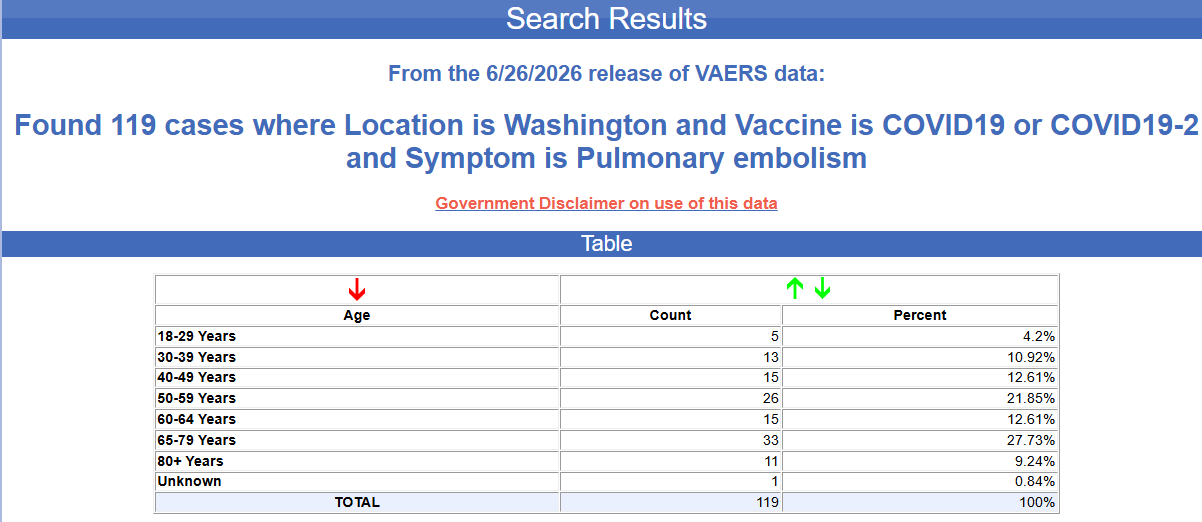
Seven of those cases have resulted in death and are listed below:
VAERS ID: 1411290. Write-up for this 94-year-old female after two doses of the Pfizer shot: Death due to PEs in bilateral lungs caused by DVTs in bilateral legs.
VAERS ID: 1459461. Write-up for this 84-year-old male: From EMR: Immediate cause of death: acute hypoxemic respiratory failure (2 days from onset to death) Secondary conditions leading to death: pneumonia (2 days from onset to death) COVID-19 (2 weeks) Other conditions present at time of death: coronary artery disease, Parkinson dementia, pulmonary embolism Was smoking a factor: no COD listed as COD listed as CARDIAC ARREST, COVID-19 PNEUMONIA, HYPOXIC ISCHEMIC ENCEPHALOPATHY, ASPIRATION PNEUMONIA Died of COVID-19 illness on 06/13/2021
VAERS ID: 1936717. The submitted write-up for this 60-year-old male reads as follows: Per the County Medical Examiner’‘s Office: “This 60-year-old male with chronic ethanolism and recent 1st dose COVID-19 vaccination was witnessed to collapse on the commode at home. Cause of death is pulmonary thromboembolism due to deep vein thrombosis. Hypertensive and atherosclerotic cardiovascular disease, ethanolism and recent COVID-19 vaccination are contributory conditions. The manner of death is natural.”
VAERS ID: 1326764. Submitted write-up for this 57-year-old male after a first dose of Moderna: First vaccine dose administered on 4/20/21. Patient was admitted on 4/29/21 with shortness of breath and pleuritic chest pain. CT scan revealed pulmonary embolism and doppler showed vascular access (Hero graft) thrombosis. Patient was treated with heparin and warfarin, and was discharged on 5/5/2021 after being converted to apixaban. Patient missed scheduled dialysis treatment (no call/no show) on 5/8/21 and 5/11/21. Subsequent welfare check found the patient expired at home.
VAERS ID: 1214500. Submitted write-up for this 42-year-old pregnant female after a first dose of Pfizer: Patient at 27 weeks of pregnancy, reported to midwife at regular visit on 4/14/21 that she was experiencing SOB but all blood work normal - assumed normal SOB with pregnancy. Night/morning of 4/15 started seizures, transported to ED. Diagnosed with massive pulmonary embolism. Emergency C-section performed by Dr. Pt. did not survive.
VAERS ID: 2062827. Submitted write-up for this 84-year-old female: Patient received Moderna COVID vaccine on 3/22/21 and 4/19/21. On 1/22/22, patient admitted to our inpatient facility with acute left lower extremity ischemia, acute pulmonary artery emboli, and COVID-19 with acute respiratory failure. Patient underwent unsuccessful revascularization procedures on 1/22/23 and 1/23/22 and was in CCU from 1/22/22 to 1/25/22. As of today (1/25/22), patient is still admitted in our med/surg unit and will be undergoing BKA/AKA soon (left leg no salvageable).
VAERS ID: 2724299. Submitted write-up lists the patient as 53-year-old female, but the write-up refers to a male: Around Mid-May, 12-13th, patient started not to feel well. Tired, stomach was a little bloated, and a little dizzy. He said he felt he was getting a cold. End of May beginning of June, his symptoms had not gone away. He was bloated, had cramping in legs and tired. End of June he had sharp pains in ribs, thought he pulled a muscle. July 5 he was so dizzy he thought he was going to pass out, couldn’t walk up the stairs. Called 911 and they took him to ER. He had submassive pulmonary embolism; doctor believed it was from Janssen vaccine, gave him heparin and 45 seconds later he had a heart attack and died right in front of me in the ER. After 40 minutes of CPR he had a heartbeat but was in non-induced coma. July 11th I had his breathing tube removed because he was brain dead.
This month, the Epoch Times published an opinion piece by Jeffrey Tucker titled, “Why Have So Many Americans Stopped Working?”
Eventually, he discussed disability from the COVID-19 jabs:
Essentially, we have one in three working-age men who have left the labor force, mainly because of disability, the rates of which have skyrocketed by an additional seven million people since 2021.
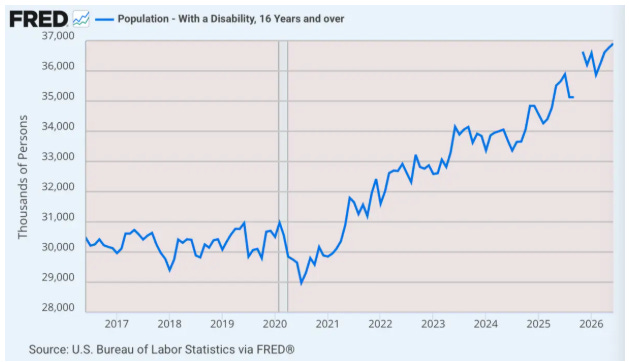
Nor can this be attributed to greater degrees of benefits or the rise of fraud, because they are surveys independent of benefits. These are people who are reporting themselves as disabled. At this point, journalistic convention requires that I not mention that 2021 was the year of the COVID-19 shot that turned out to be enormously dangerous to the population.
That said, we are not obeying convention here. The shot surely has something to do with it, but it is difficult to prove because the numbers and connections are extremely hard to find. They are mostly hidden behind walls in industry vaults. Not even government agencies have had full success in gaining access.
We might have a silent mass injury on our hands here. If not, it would be nice to know either way.
Unfortunately, the FRED website does not provide its disability reports by state.
A source for disability trends for our state of Washington comes from the CDC.
Disability and Health Data System Explore by Location | NCBDDD | CDC
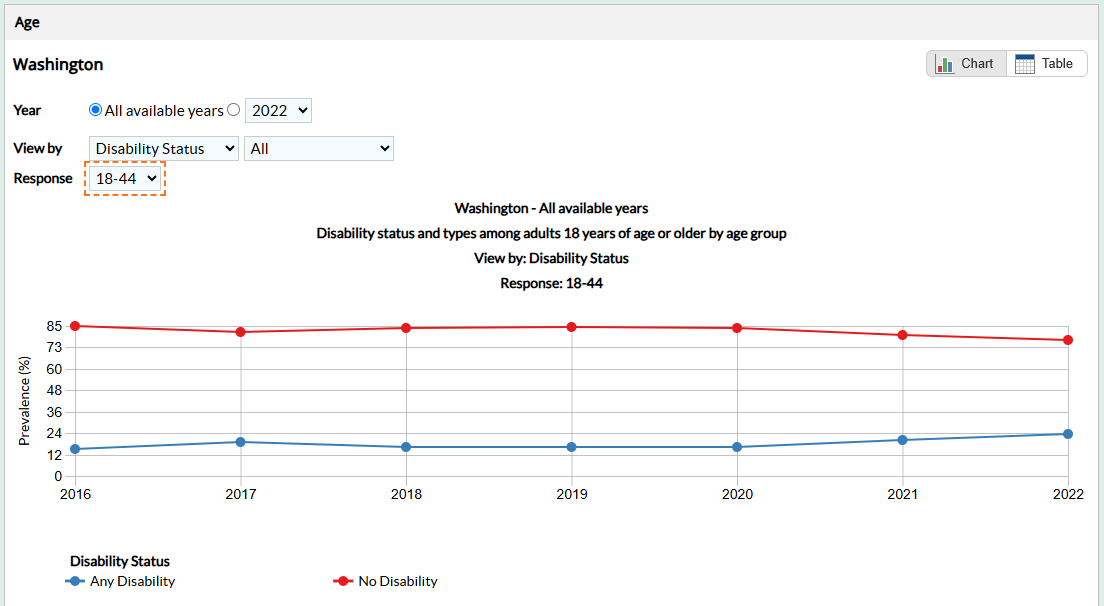
The following graph for ages fourteen through forty-four here in Washington shows an increase in “any disability” reports for 2020 (introduction of the COVID-19 jabs) through 2022, up to a high of 24%, while also showing an expected decrease in “no disability” during that period.
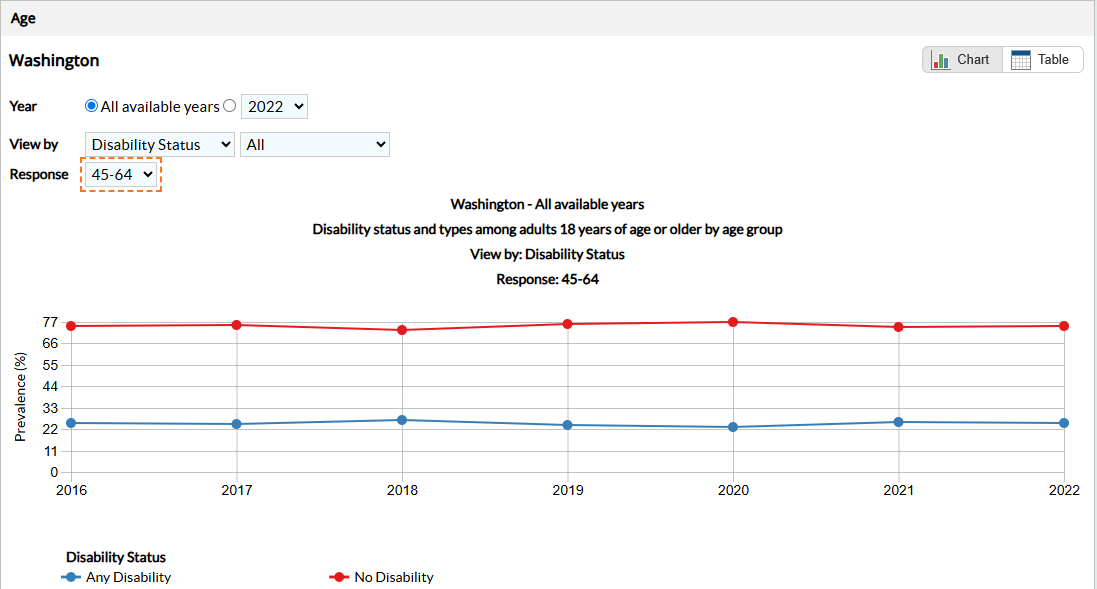
There were similar changes since 2020 for Washingtonians aged forty-five to sixty-four age range:
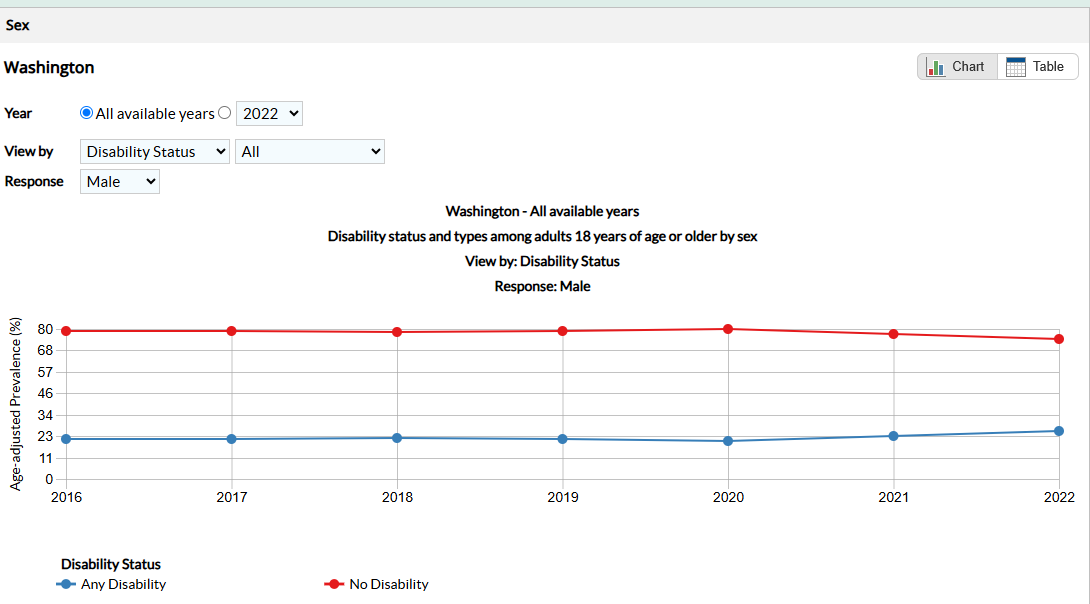
Following Mr. Tucker’s observation that this is happening more in men, the following graph shows a more pronounced increase in “any disability” reports in Washington for 2000 through 2022.
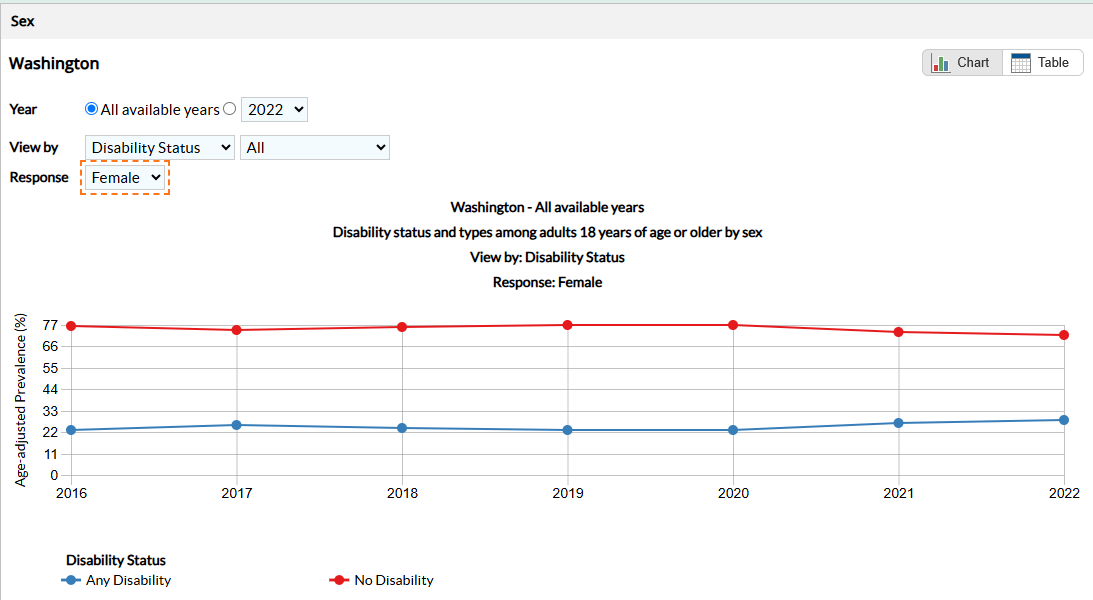
Yet, the same trend holds true for females in Washington as well:
Unlike FRED, the CDC does not provide statistics for 2023 and beyond. In other words, the CDC is basically four years behind schedule.
This is also holds true for cancer rates, as reported by ICWA Weekly News last April 29.
Jeffery Jaxon had said on the Highwire, “We’re talking four years old now.” As to the data not being more recent, Del Bigtree was exasperated. “Now how hard is that to monitor, right? That is data that every hospital has. While trying to rush ‘Tony’ out of the hospital and pull the plug on him, why don’t you put a little time into forwarding your cancer research to the CDC to let us know how many patients you had this year. This can’t be difficult to track this stuff. We’re supposed to be the greatest nation in the world. We’re supposed to have something called a computer.” Bigtree then held up his laptop to the camera.

“Right, doesn’t that do this now,” Bigtree continued. “I mean come on. It’s so ridiculous.”
“Ridiculous” can also be said for the CDC’s revealing of its disability statistics to the public.
Representative Kim Schrier from Washington’s eighth congressional district is in the news again.
First, in the winter of 2024, she heavily promoted the need for passing H.R. 3633, which would have created a taxpayer-funded marketing campaign for HPV vaccination and testing to the tune of $5 million annually for the next four years and increase funding for breast and cervical cancer testing, despite the problems with this product. (Informed Choice WA Weekly News 2-14-24)
Then on April 21 of this year, she introduced to the United States House of Representatives the bill H.R. 8425, which would use billions of dollars in Medicaid funding to pressure states into adopting federally-approved vaccine messaging and expand the U.S. government’s surveillance of children’s vaccination records.
And now her most recent action dealing with vaccines, as reported by The Defender, last week she sent a letter to CDC Acting Director Jay Bhattacharya, urging the agency to establish surveillance for vitamin K shot refusals, cases of vitamin K deficiency bleeding and related infant deaths. The request followed a ProPublica investigation that raised concerns about increasing refusal rates and gaps in public health monitoring.
“The CDC has the tools to better understand the burden of vitamin K shot refusal, VKDB and VKDB-related deaths,” the lawmakers Schrier and Sen. Alsobrooks wrote. “We urge you to use them, and to share that data with the public, so that we can prevent tragic illness and death in infants.”
Though a database would compile patient information, experts suggest that federal and state privacy laws prohibit the disclosure of any personal details.
Deven McGraw, chief regulatory and privacy officer at Citizen Health, said routine data collection is used to monitor tracking and deployment of recommended public health interventions.
“Typically data like this are reported in a de-identified way, or with identifiers removed, as the purpose is for surveillance and to inform policy and not for punishment,” McGraw told The Defender.
The Vitamin K shot is not a vaccine, but it has increasingly become caught up in broader debates surrounding childhood immunizations and medical misinformation, according to pediatricians and public health experts.
Physician and researcher Dr. Suzanne Humphries recently told CHD.TV’s “Good Morning CHD” that media coverage of the issue relies more heavily on fearmongering than empirical data.
Citing figures extrapolated from European populations, Humphries stated that if babies were not given the vitamin K shot, their death from brain bleeding would occur at a rate of approximately 0.26 to 0.9 per 100,000 births.
Humphries said that because studies of carcinogenicity, genotoxicity and fertility impairment have not been conducted for the vitamin K shot, “there is no such thing as zero risk.”
“We don’t have safety studies that can assure us that there’s going to be no long-term problems,” she said.
Researcher Marcella Piper-Terry told CHD.TV last year that both available options for vitamin K shots administered in the U.S. are problematic.
For example, Hospira has a black box warning due to its 9 milligrams of benzyl alcohol, which can damage the liver and may contribute to jaundice and gasping syndrome.
Phytonadione, the other vitamin K shot used in the U.S., contains polysorbate 80. Piper-Terry pointed to a statement by the American College of Pediatricians citing concerns that the use of polysorbate in the HPV vaccine may lead to infertility from premature ovarian failure.
In a Substack post, Piper-Terry wrote that parents must decide themselves whether to give their children the vitamin K shot.
“Those parents who want to make the best decisions for their children need to research this issue from all points of view in order to make informed choices and birth plans,” she wrote.
A nationwide study of more than two million live births from 2003 to 2021 found infants who skipped the injection had 52% higher odds of bleeding within the first six months of life, according to findings published in JAMA Pediatrics.
The proportion of Swedish newborns who did not receive the vitamin K shot more than doubled between 2006 and 2021, according to the study.
Additional research cited by the lawmakers and pediatric experts indicated infants who do not receive the injection face a substantially higher risk of developing late VKDB, a condition that can cause internal bleeding, including hemorrhages in the brain.
However, attorney Greg Glaser, who helped with a peer-reviewed paper published in the International Journal of Vaccine Theory, Practice, and Research, stated the study’s data confirmed with “99% statistical significance” that “those who avoid the Vitamin K shot and vaccines are over 10-times (1,000%) healthier than the population injected with these pharmaceuticals.”
“Rather than focusing on a database (as ProPublica pushes) to monitor parents who chose to decline these interventions, we should be asking why there is such a desperate attempt to suppress independent comparative data,” he said. “The push to track these families looks less like a public health initiative and more like an attempt to discourage bodily autonomy and lifelong good health as unvaccinated Americans. Fortunately, the future is bright, and more families than ever are choosing to join the excellent health enjoyed by the noninjected control group.”
Pediatrician Paul Thomas, in his recent book Vax Facts, says about this shot recommended for newborns:
Since most of the vitamin [K} shots carry a black box warning that the product can cause fatal reactions, oral vitamin k is a reasonable option. Hundreds of my families chose to give their newborns oral vitamin K, which has been used safely in Europe for decades, despite remaining controversial in the United States.
Stay with us and stay informed.
Comments
Nothing yet. Say the first thing.
Sign in to join the conversation.