
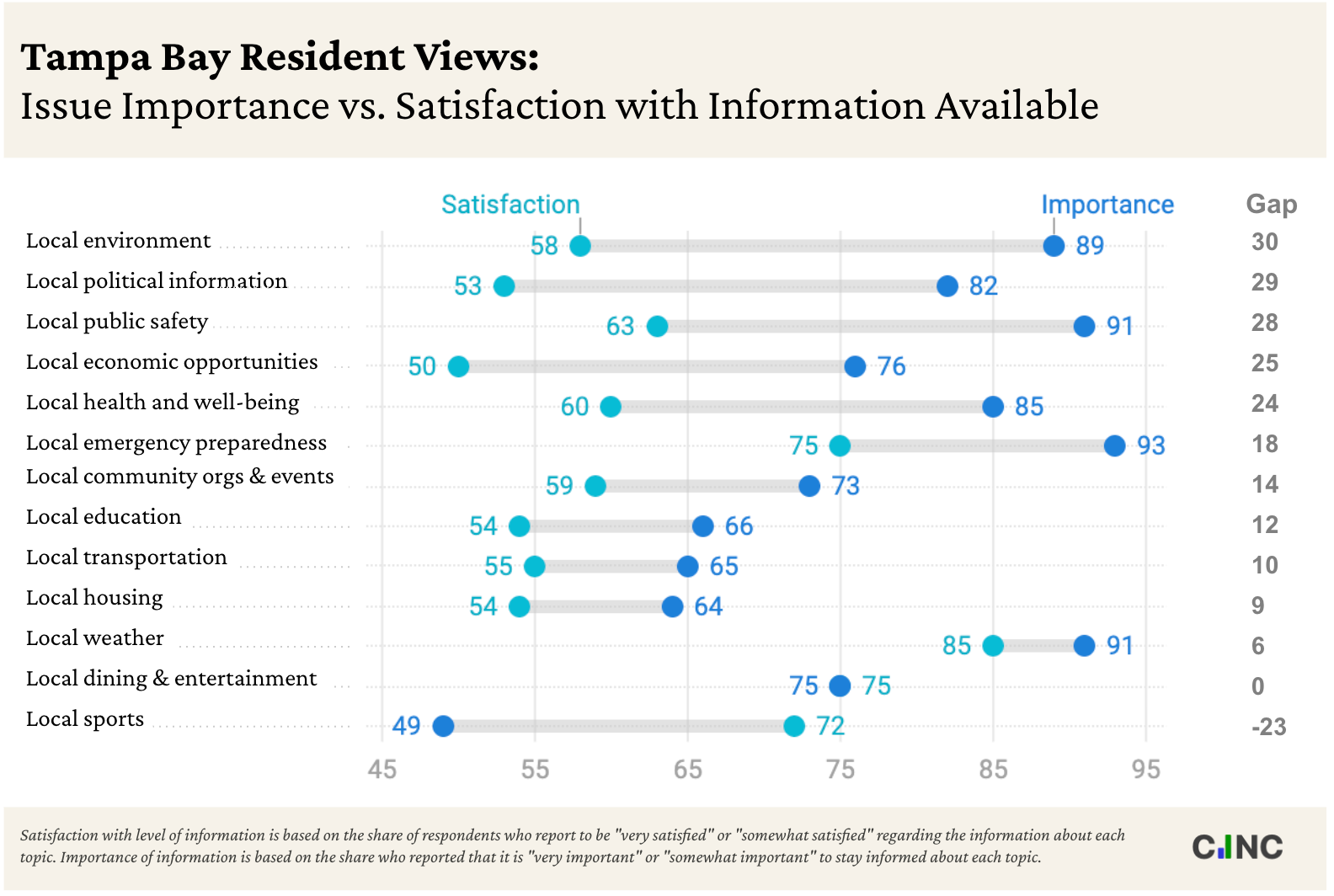
Nine in ten residents of Tampa Bay, Florida believe it’s important to stay informed about the environment and public safety. But only about six in ten said they are satisfied with the information they actually have on those issues. Residents’ views show similar gaps between importance and satisfaction on information about local politics, economic opportunity, and health.
Those gaps are among the findings in a new study of the Tampa Bay region done by the Civic Information Needs Census (CINC) in collaboration with the American Journalism Project. For the study, Embold Research conducted a survey of 1,006 adults in Hillsborough, Pinellas, and Pasco counties between May 15th and May 26th.
For nine of thirteen local topics, the survey showed double-digit gaps between importance and satisfaction:
The full report and crosstabs for the 2026 Tampa Bay CINC can be found here, along with past CINC studies.
The Civic Information Needs Census (CINC) is a research tool and initiative housed at Civic News Company and done in partnership with Embold Research.
It is designed to equip the civic information field — newsrooms, funders, libraries, government, and community organizations — with essential shared data on local information needs, media habits, and civic engagement. It is both a community survey and a coalition-building practice, designed to bring practitioners and funders together around a common set of facts so they can prioritize their work and track their impact over time.
CINC started in 2024 with a national baseline survey followed by pilots in Chicago and New York City. This year, we’re releasing results from four new studies done with local partners in each community: Chicago, Marin County, California, this new study of Tampa Bay, Florida, and Arkansas.
You can find the full reports and crosstabs for all CINC studies at infocensus.org.
Asked how they most often see, hear, or read local news, Tampa Bay residents cite social media (48%) and local TV (46%) more than any other sources.
But when the question shifts to where local residents turn for the most useful, high-quality local news, the picture changes: local TV remains prominent but social media creators fall far down the list.
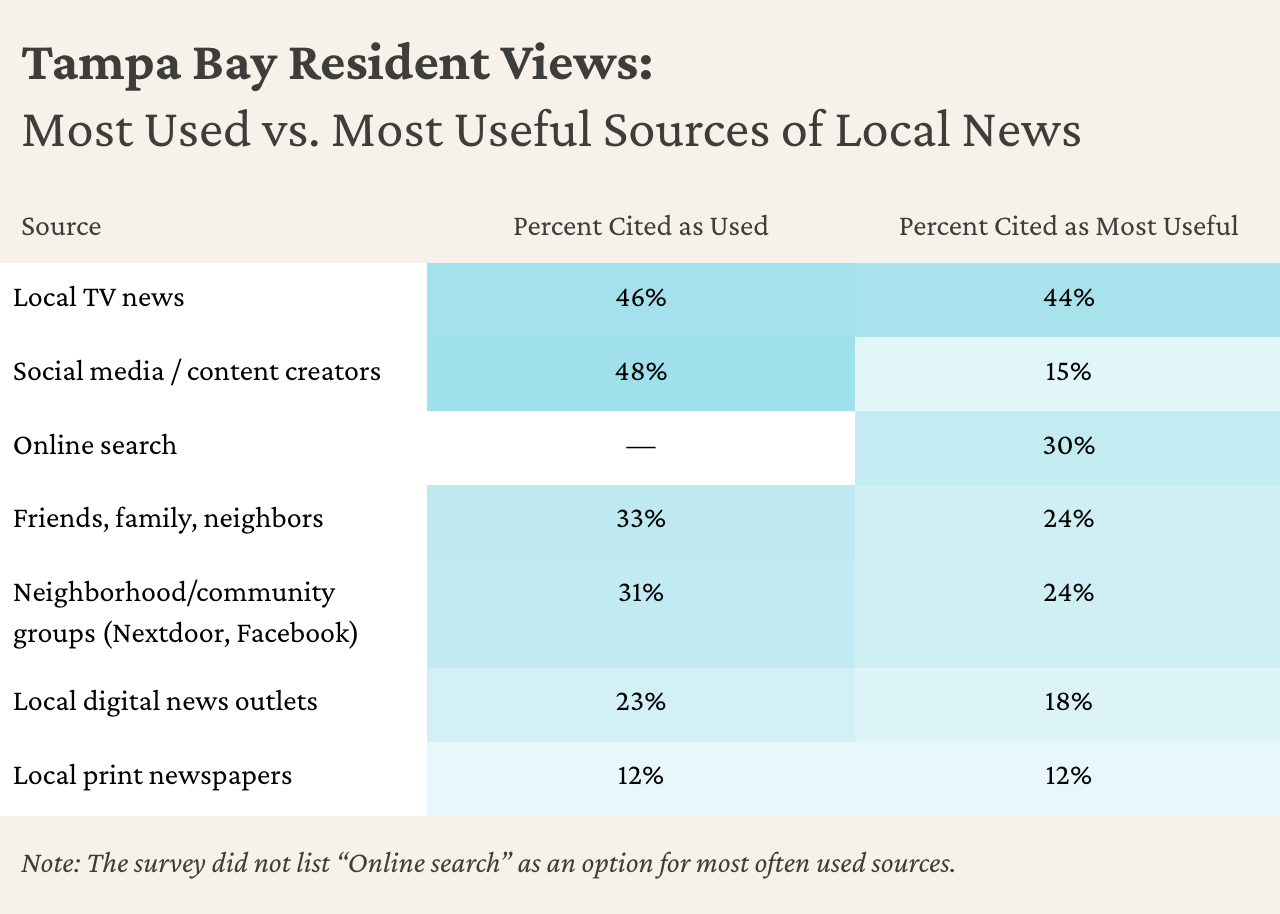
The finding mirrors similar trends seen across other CINC studies: audiences, especially younger ones, are increasingly turning to social media with their time and attention. But they don’t yet find it as trustworthy or useful as more traditional sources of news.
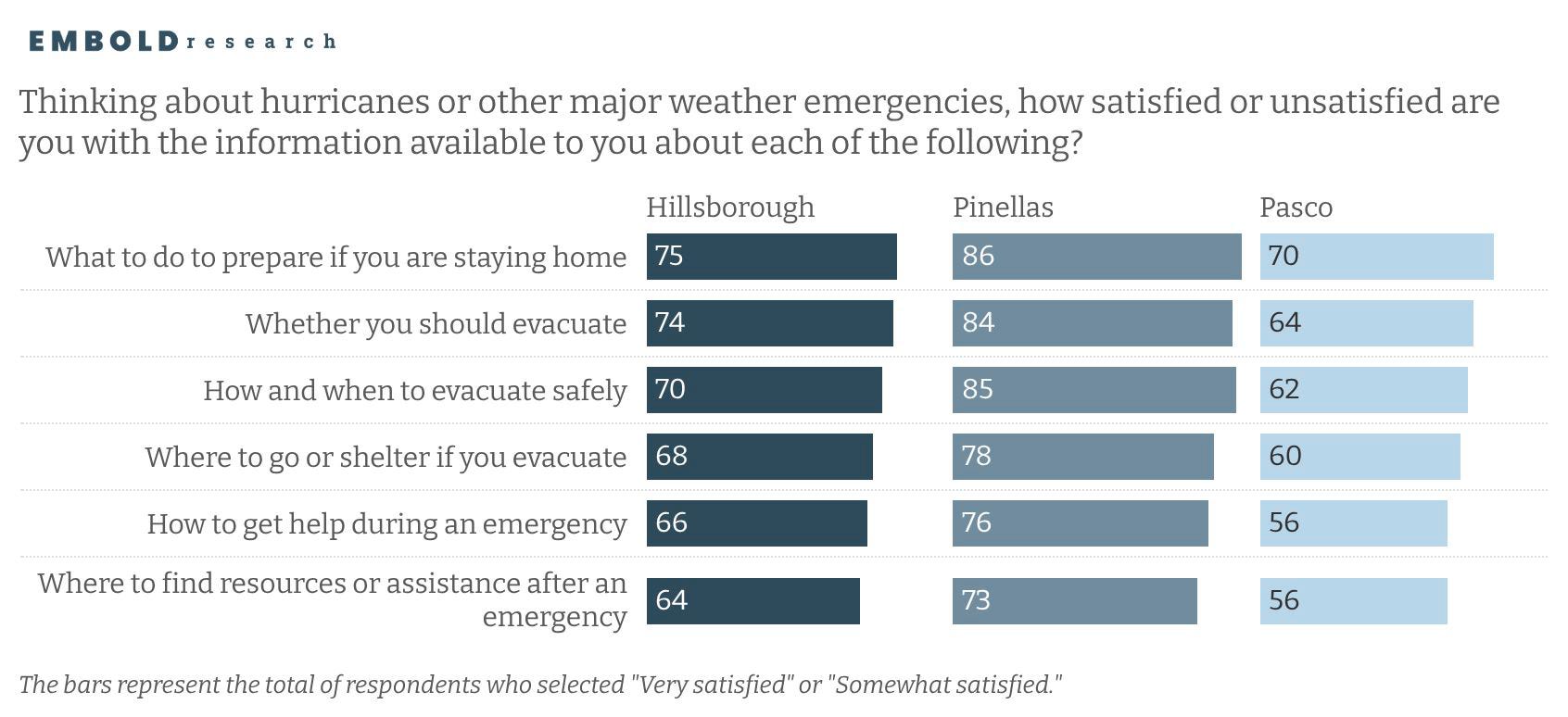
Given the history and persistent risk of severe weather in the region, the survey explored some specifics of emergency preparedness. Overall, 78% of respondents said they were satisfied with their ability to get information during an emergency weather situation. That satisfaction level was higher than information related to other local situations inquired about including a crime occurring nearby, making decisions about where to live or work, and navigating road closures.
But that high satisfaction rate varied significantly among residents of Tampa Bay’s three counties. On overall satisfaction in that scenario, and on specific kinds of information that might be necessary, residents of Pinellas County were more likely to be satisfied and residents of Pasco County were less likely to be satisfied:
Volunteering with an association or organization (31%), contacting an elected official (29%), and advocating for change (21%) are the most common forms of civic participation region-wide. But those toplines mask sharp differences by age and race.
Residents 65 and older contact elected officials at nearly twice the rate of the region as a whole (47% vs. 29%) — the single largest gap of any civic activity measured. Black residents, meanwhile, lead the region in volunteering (46% vs. 31% overall) and in participating in community organizing efforts (32% vs. 18% overall), even though they contact elected officials at a rate similar to the overall population (26% vs. 29%).
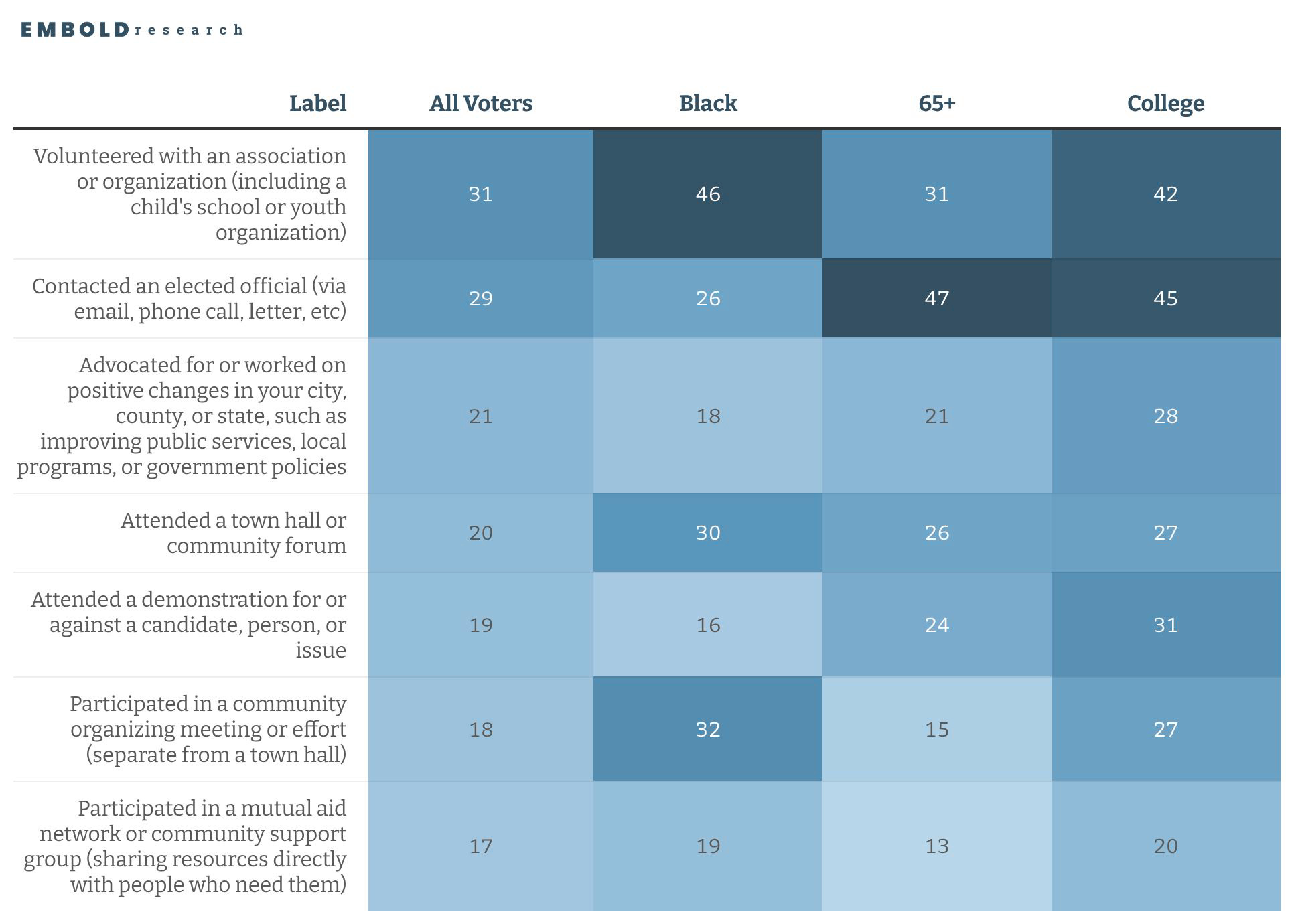
Older residents and Black residents represent two distinct paths into civic life — one built around formal engagement with government, the other around organizing and mutual support within community networks. Both groups report engaging at meaningfully higher rates than Tampa Bay overall, even as the region’s information gaps (on politics, in particular) remain wide across the board.
As we shared last month, we’re publishing CINC studies from four communities this summer. Chicago was the first. This Tampa Bay study is the second. Still to come: the reports and crosstabs for Marin County, California and the state of Arkansas. Also to come: some additional analysis of key trends across the surveys, including a look at how these data compare to what we found in the pilot surveys in 2024.
Subscribe to get all that and more:
—
Figures show the share of respondents who said it is “very” or “somewhat” difficult to get information, in response to the question: “How difficult is it for you to get information about each of the following in your day-to-day life?” Surveys were conducted by the Civic Information Needs Census with Embold Research.
The Tampa Bay survey was fielded May 15–26, 2026, with a sample size of 1,006 (weighted) and a margin of error 3.1%.
No posts
Comments
Nothing yet. Say the first thing.
Sign in to join the conversation.