
Welcome to Episode 28 of Next in Line by Infinyte - a data-first, investor-focused series where we unpack India’s most exciting IPO-bound companies with crisp, data-backed drops.
It’s everything you need to stay one step ahead of the bell-no fluff, no noise, just smart, visual storytelling.
Because the best stories don’t start at the IPO-they start just before it.
Stay tuned, stay curious!

Across rural India, hundreds of drones deployed under the Government's ₹1,261 crore Namo Drone Didi scheme have begun facing a common challenge. While the programme has significantly improved access to precision agriculture by providing agri-spray drones to women's self-help groups with an 80% subsidy, many of these drones are now seeing reduced utilisation as their batteries degrade. Despite strong demand from farmers for spraying services, limited budgets for battery replacement and maintenance have left several drones grounded, highlighting that long-term operational reliability depends as much on lifecycle support as it does on the initial deployment.
This is not a story about Garuda Aerospace specifically. Namo Drone Didi is run through Lead Fertiliser Companies, not through drone manufacturers directly, and there’s no evidence tying in stalled drones to any particular OEM. But this is the story beneath the story Garuda is telling public market investors. Its growth thesis rests on three powerful tailwinds: over 100 million smallholder farmers, strong government subsidies, and India’s push for domestic manufacturing. On paper, it’s a compelling narrative.
On the ground, however, policy alone isn’t enough. A drone is only valuable if it keeps flying. Without reliable maintenance and affordable battery replacements, even the strongest policy tailwinds can leave drones sitting idle.
Five years ago, Garuda Aerospace was a near-death startup that COVID accidentally saved, when its agriculture spraying drones found a second life as disinfection machines for panicked local governments. Now it has pre-filed a confidential Draft Red Herring Prospectus with SEBI, is chasing a ₹4,000 to 5,000 crore valuation, and wants to become the third pure-play Indian drone company to list.
The obvious version of Garuda’s story is well worn by now: founded in Chennai in 2016, 500-plus clients spanning Tata, Reliance, Adani, L&T, ISRO and DRDO, an MS Dhoni brand ambassadorship, a claimed 25% share of India’s drone manufacturing, and four straight years of accounting profit in a sector where most peers are still burning cash chasing scale. None of that is wrong. None of it is what should actually make an investor lean in, either. Brand recognition is not a moat. Neither is a celebrity’s name on the cap table.
The more interesting case sits one layer down, in three moves that read less like marketing and more like an actual attempt at strategy:
1. The dual DGCA certification. Garuda holds both manufacturing type certification and Remote Pilot Training Organisation authorisation for small and medium class drones, the only company claiming to hold both at once. That matters because it means Garuda gets paid twice on the same customer relationship: once for the hardware, again for the mandatory pilot training that has to happen before the drone can legally fly. Most of its peers cede that second revenue line to a separate training outfit.
2. The Zuppa stake. In March 2025, Garuda took a minority position in Zuppa, a defence-focused drone startup. An agri-drone company buying into a defence-tech startup is a different signal than an agri-drone company simply announcing a defence “vertical” on a pitch deck slide. It looks like Garuda trying to purchase optionality into a segment where it does not yet have deep technical credibility, rather than trying to out-engineer Raphe mPhibr or NewSpace Research on their own turf.
3. The Airbus, Flexrotor and reported Lockheed moves. The partnership with Airbus Helicopters, the plan to acquire up to 18 Flexrotor systems, and a reported collaboration around a Lockheed Martin-linked defence drone platform all point the same direction: Garuda knows the ceiling on an agri-DaaS business and is trying to buy its way toward a higher-multiple story before the IPO prices it as a spray-drone company.
Here’s the honest caveat none of this changes: none of the three has shown up in disclosed revenue yet. They are options, not outcomes. An investor paying an aerospace-and-defence multiple for what is still, on the numbers, mostly an agricultural hardware company is paying for the option to be right about optionality that hasn’t been priced by an actual order book yet.
Four straight years of profit is the headline. The more useful exercise is to sit inside the numbers themselves.
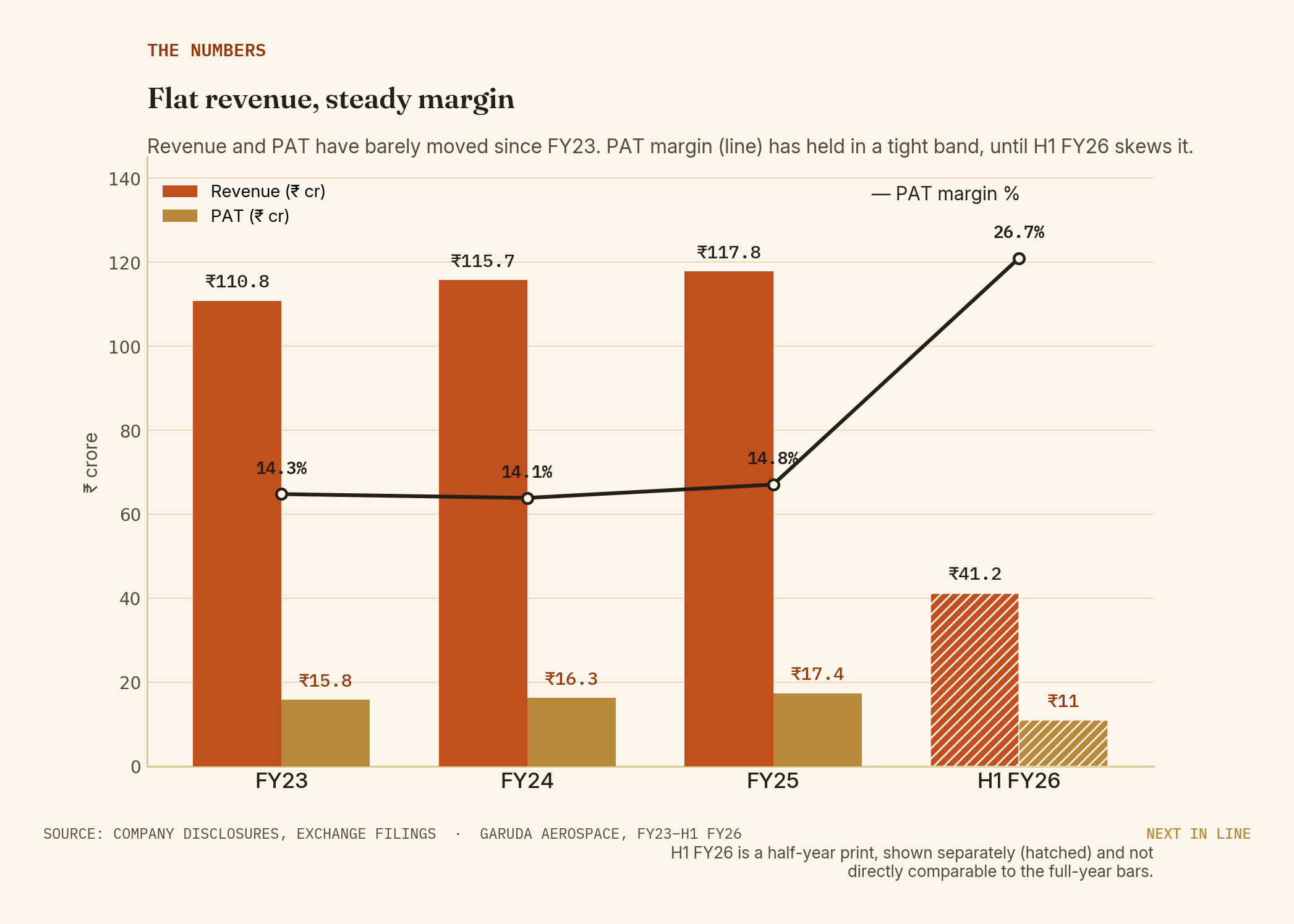
Revenue has moved from ₹110.8 crore to ₹117.8 crore across two years, a CAGR of roughly 3%. PAT has grown a little faster than revenue, from ₹15.8 crore to ₹17.4 crore, which is why the PAT margin line has actually held up, sitting in a tight 14.1% to 14.8% band across all three years. That stability is the real story on the profitability side: whatever else is happening in the business, Garuda has kept its bottom line margin essentially flat while the top line barely moved, which points to disciplined cost control rather than operating leverage doing the work.
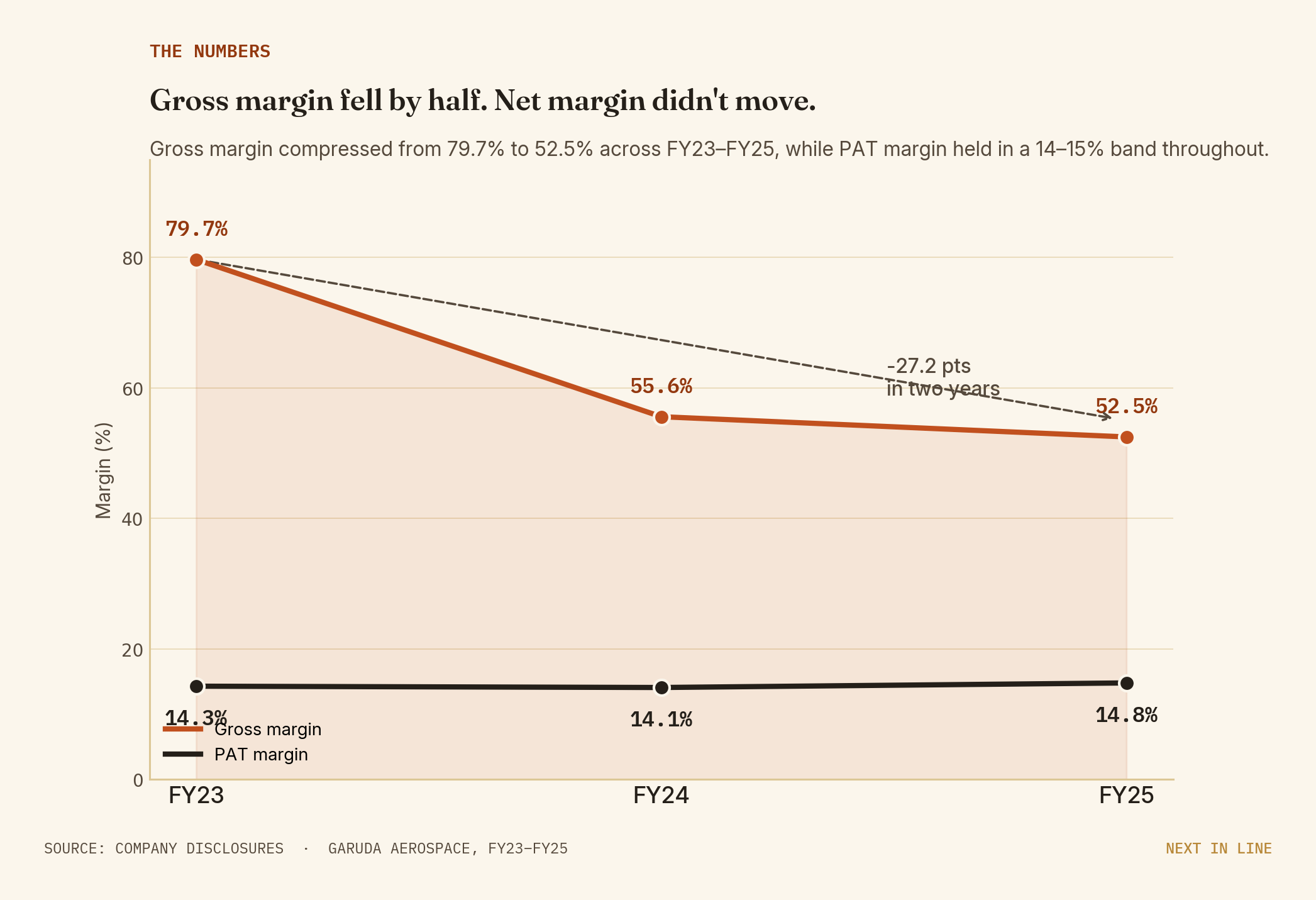
The gross margin line is the one that moves, and it moves a lot: from 79.7% in FY23 to 55.6% in FY24 to 52.5% in FY25, a drop of roughly 27 percentage points in two years. Losing that much gross margin while PAT margin stays flat means opex as a share of revenue must have come down to compensate, which is worth sitting with on its own. It could mean the FY23 gross margin was unusually light-asset (more services, less hardware in the mix) and FY24 onward reflects a more hardware-heavy, lower-margin sales mix as manufacturing scaled. It could mean input costs rose faster than pricing.
Then there’s cash. Receivables have grown faster than revenue, expanding from roughly ₹37.7 crore to ₹114.8 crore over the same period, a threefold increase against revenue growth of about 6%. Operating cash flow has been negative for three consecutive years, at roughly ₹25 crore, ₹41 crore and ₹34 crore. A business reporting steady accounting profit while burning operating cash for three straight years is not automatically a red flag on its own, government and PSU-heavy customer bases typically carry longer payment cycles than private-sector contracts, but it does mean the ₹17.4 crore of FY25 PAT and the cash actually available to the business are two very different numbers, and an investor pricing the equity off the first number should know how far it sits from the second.
The most recent print available is H1 FY26: revenue of ₹41.2 crore and PAT of ₹11 crore. Annualised flat, that run rate sits below the full FY25 revenue figure, not above it. Agri-drone demand in India is seasonal, weighted toward the rabi spraying season in the second half of the fiscal year, so a soft H1 doesn’t automatically mean a soft full year. But set against a three-year revenue CAGR that was already close to flat, a first-half print that undershoots the prior full year is not a number that should be waved past. Growth here isn’t modest. On the numbers as they stand, it’s close to zero, and the business has been compensating for that with margin discipline rather than scale.
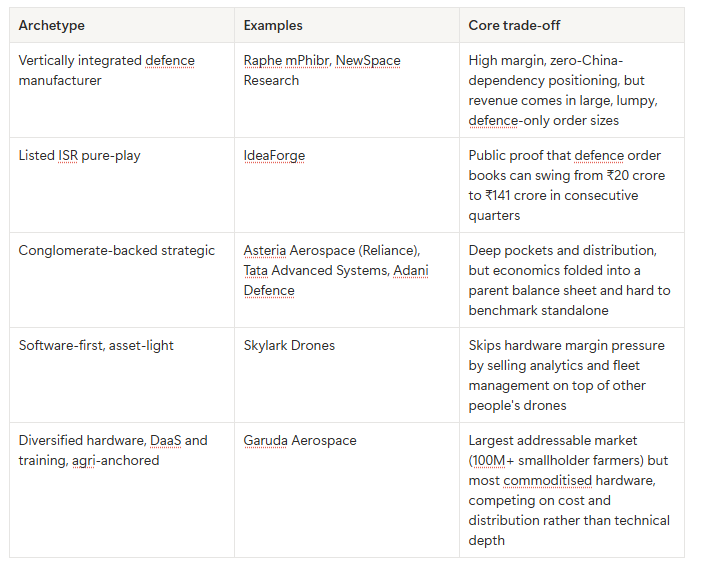
Zoom out and Garuda isn’t one story, it’s one bet among at least five distinct business models currently competing for the same policy tailwind and the same government rupee, each with a different risk profile that the “India’s drone decade” framing tends to flatten into a single narrative.
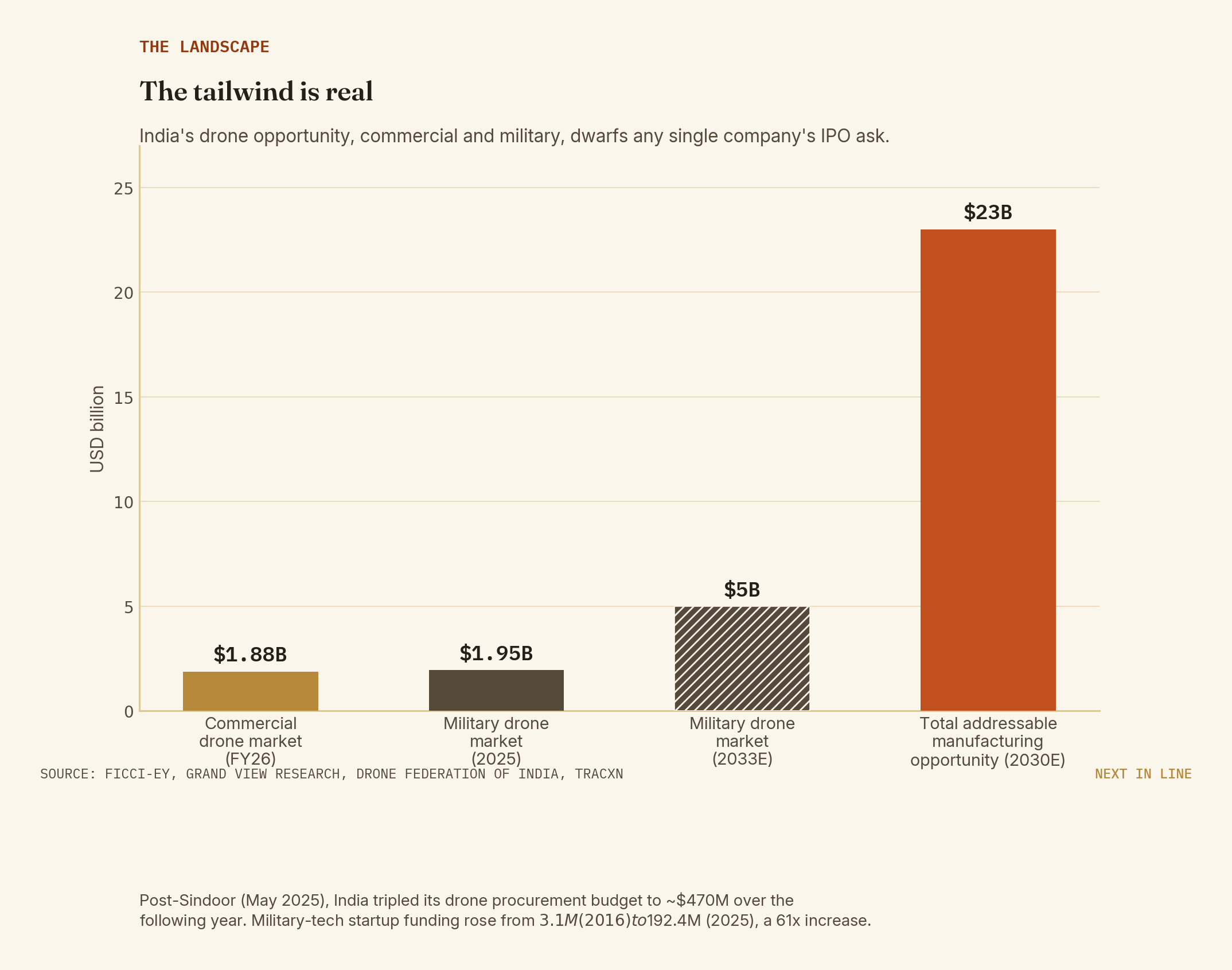
The opportunity is enormous. FICCI-EY estimates India’s drone manufacturing market at $23 billion by 2030. Commercial drones, already a ₹17,000 crore ($1.88 billion) market in FY26, are expected to grow at 18% CAGR, while the military drone market is projected to expand from $1.95 billion in 2025 to $5 billion by 2033. Following the India-Pakistan conflict in May 2025, the government tripled its drone procurement budget to $470 million. Defence-tech startup funding has similarly exploded, from $3.1 million in 2016 to $192.4 million in 2025, driven largely by Raphe mPhibr’s $100 million raise. The proposed Drone Shakti Mission is expected to extend this momentum through domestic manufacturing.
Yet these tailwinds hide very different business models. IdeaForge illustrates the volatility of defence-led companies: despite Q4 FY26 revenue surging to ₹141 crore from ₹20.3 crore a year earlier, it still reported a ₹17 crore full-year loss. Defence businesses scale in bursts as contracts are executed.
Garuda’s steady 14-15% PAT margins reflect a different strategy. Its larger exposure to agriculture, enterprise services, and Drone-as-a-Service creates more predictable earnings, but also explains why revenue growth has been more measured than defence-focused peers.
The comparison with Raphe mPhibr is equally telling. Raphe raised $100 million in 2025 at an approximate ₹7,650 crore valuation, backed by rapid growth, profitability, and a fully integrated domestic manufacturing stack. Garuda is asking public markets to underwrite a similar premium despite a meaningfully slower growth profile, a question investors are unlikely to ignore.
Finally, one issue hangs over the entire sector: indigenisation. Following the scrutiny around IdeaForge’s component sourcing in 2025, investors will increasingly expect companies to substantiate their “Make in India” claims with transparent supply chains rather than marketing narratives.
A few concrete things have moved for the company:
Manufacturing capacity guidance has gone from roughly 12,000 units in FY25 to a claimed 25,000 for FY26, a doubling that will need to show up in utilisation, not just guidance, given the gross margin compression already visible above.
Garuda has secured export licenses for the US, Australia and Middle Eastern markets for its agri-drone business, an actual step toward the international ambitions every Indian dronetech pitch deck claims.
The DRHP was pre-filed confidentially in April 2026, putting Garuda in the same 2025-26 vintage of confidential filers as Rediff, OYO, Zepto, PhonePe and PhysicsWallah. Listing is expected by December 2026.
Not whether drones are the future. Regulation, procurement policy and capital allocation have already answered that question for the sector as a whole. The specific questions that matter for this specific listing are narrower, and more answerable, than the ones usually asked about this IPO:
Whether H2 FY26 numbers, whenever the updated DRHP makes them public, show the seasonal agri recovery the H1 print needs, or confirm that the top line has genuinely stalled rather than merely dipped.
Whether the updated DRHP breaks revenue out by vertical (agri, defence, training, government), which current disclosures don’t do, and which would clarify how much of the flat top line is agri-hardware pricing pressure versus something else.
Whether the defence-adjacent bets, the Zuppa stake, the Flexrotor acquisition, the Airbus and reported Lockheed collaborations, generate any disclosed revenue before listing, or remain option value that the valuation ask is already pricing as if it had.
Whether receivables and operating cash flow, the one part of the story that hasn’t visibly improved, get addressed with anything more concrete than “government customers pay slowly.”
Garuda’s listing is less a bet on drones than a bet on transformation: whether an agri-drone company can successfully cross the gap from selling hardware today to owning a higher-value defence technology narrative tomorrow.

Comments
Nothing yet. Say the first thing.
Sign in to join the conversation.