
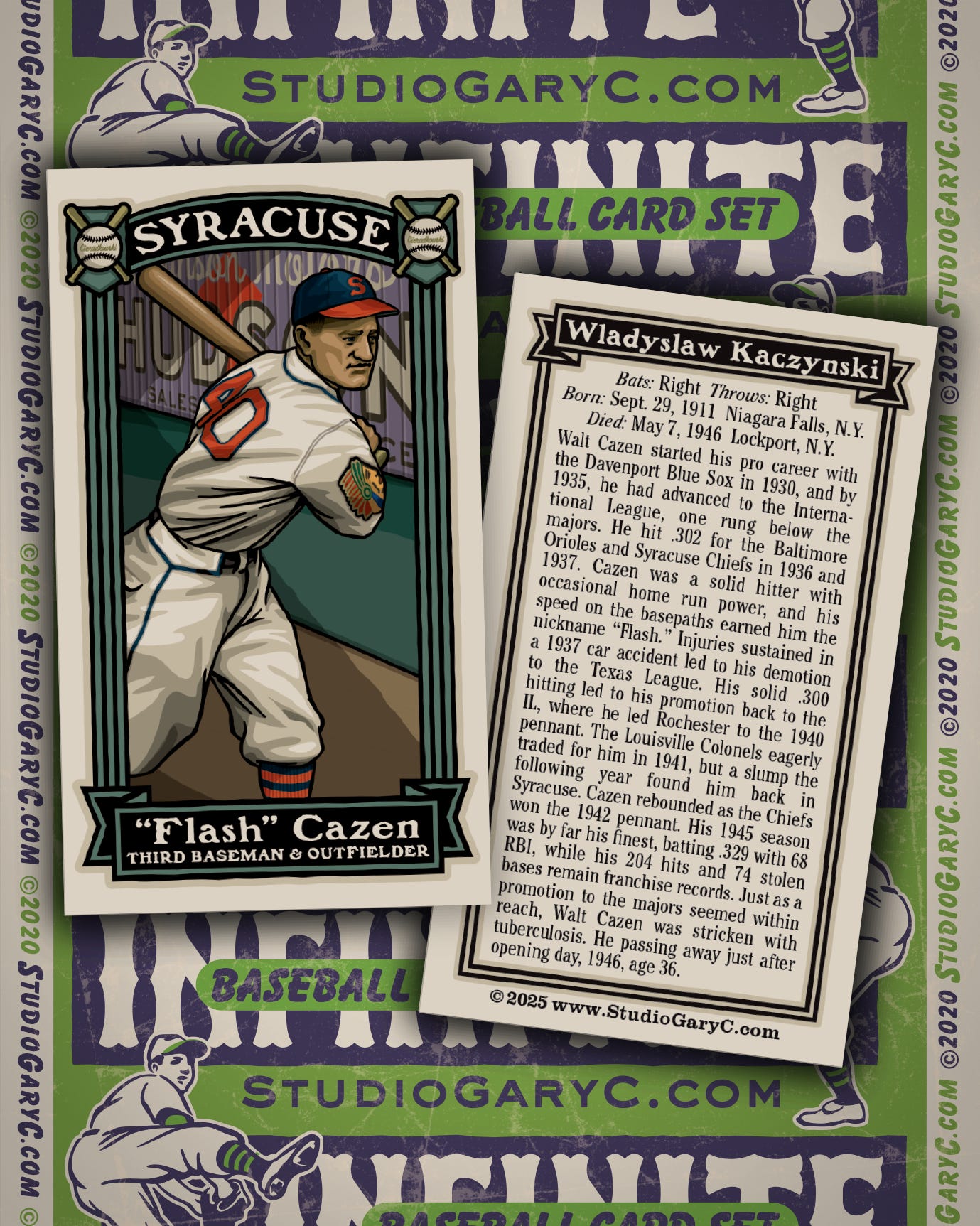
I’m going to tell you the story of Walter “Flash” Cazen. Don’t feel bad if you’ve never heard of him – I sure hadn’t – until I did. How I first came across him, I can’t say; maybe it was his impressive number of stolen bases that caught my attention, or perhaps it was his nickname. Whatever the reason, every time I ran across an article about him while doing other research, I made a copy and tossed it into my “Walt Cazen” file. For an “unknown” ballplayer, Walt Cazen sure got around, and his file eventually grew to a hefty inch and a half thick. Playing from 1928 to 1945, Walt Cazen’s career took him from Dallas to Rochester and all points in between. He found himself in the middle of a couple of obscure baseball records, and his name is the answer to a few trivia questions. There were a pair of contract squabbles that required the intervention of Kenesaw Mountain Landis to settle and even dueling “Walter Cazen” signature model gloves on store shelves produced by two rival sporting goods companies.
He never played an inning in the majors, but, as a sportswriter once poetically prosed, “Cazen always gave what he had and a little something extra, and it was that little extra something that sometimes won a game.”
BEFORE HE RAN the basepaths as “Flash” Cazan, he was Władysław Edward Kaczyński, the middle child born to Wiktor (Victor), and Konstancja (Constance) Kaczyński. The family was rounded out by older sisters Wiktorja (Victoria), Cecylja (Cecilia), and younger brothers Franciszek (Frank) and Stanisław (Stanley). Victor worked as a butcher, and the family lived on Cudaback Avenue in the heart of the city’s “Polish Triangle.” During his baseball career, Walt would change his birth date to shave a few years off his age, but official documents show Walt’s actual birthday is September 29, 1908.
In high school, Walt was a two-sport star, playing third base on the ballfield and backfield on the gridiron. Physically, the teen was more suited to the latter; he was a stocky 5’-11” and tipped the scales at 180 pounds. Of the two sports, he preferred football and was even offered a scholarship to play for the University of Nebraska. However, in the 1920s, if you were an athlete who wanted to make serious money playing a sport, professional baseball was the way to go.
After high school, Walt played semipro ball around Niagara Falls with the White Eagles and the International Paper Company teams. But what he really wanted was to play ball professionally. Walt packed his bat, glove, and spikes and set about finding his own place in organized ball.
THE SPRING of 1928 found Walt deep in the Corn Belt, vying for a spot on the Waterloo Hawks of the Mississippi Valley League. How he wound up in faraway Iowa is unknown, but it is possible that he read the May 3, 1928 article in The Sporting News about the eight Mississippi Valley League teams holding open tryouts. One passage would have been of particular interest to the aspiring professional:
“Because of the league’s rookie rule, which prescribes that each club must employ no less than seven inexperienced players, it is assured that many strange faces will be found on the various teams.”
With at least 56 spots open across all teams, the odds weren’t bad that Walt could fill one of them.
Now going by the last name “Cazen,” the rookie gave a good account of himself. However, veteran “Spot” Grant already had Waterloo’s hot corner locked down, and Cazen was handed his release. Fortunately, the manager of the semipro Sioux City Stock Yards Cowboys remembered the third baseman from a spring training game and offered him a job.
The newcomer was an instant sensation, but his time with Sioux City was short. As so often happened in the semipro world, Cazen moved on to another outfit in Marshall, Minnesota, before drifting back to Niagara Falls, where he resumed playing under the “Katy” name.
NINETEEN TWENTY-NINE would have a shaky start, for on New Year’s Day, Walt and two of his pals were picked up on an auto theft rap. In the wee hours of January 1, 1929, Niagara Falls Patrolman Charles Jordan claimed to have witnessed Walt, John Buja, and Charles Yagman bailing out of a stolen car in the Polish Triangle neighborhood. By that afternoon, the three suspects were rounded up and charged with second-degree auto theft. However, a raft of witnesses came forward to testify that the trio was at a Holy Trinity Hall church dance when Patrolman Jordan said they alighted from the stolen car. Charges were later dropped. It’s hard to say what the circumstances were, but Walt’s two buddies were indeed a couple of bad seeds; Buja would later be nabbed for rum running in 1931, and Yagman was shot by the border patrol in 1932 while presumedly doing the same.
Apparently, there was no bad blood between Sioux City and Cazen because he was back for the 1929 campaign, bringing White Eagles first baseman Pete King with him. Cazen commenced tearing up the opposition, hitting .429 through June and recording a 13-game hitting streak.
Sioux City had a tremendous team that summer and was invited to compete in the Denver Post Tournament of semipro baseball in August. A full-page Denver Post profile on the Sioux City team featured a panoramic photo of the entire team in uniform, with each player, including Cazen, mounted on a horse. The article singled out their third baseman for special praise, writing, “Winners of ten straight games on the trip the Cowboys have larruped the ball at a terrific clip, Wallie Cazen, the club’s Babe Ruth, hit seven homers in ten games.” Sioux City finished third in the tourney, but Cazen wasn’t with them. Just like the previous summer, Walt Cazen jumped ship, this time taking Pete King along for the ride, and joined a semipro team from Creighton, Nebraska.
BACK HOME in the Polish Triangle, Walt found himself in trouble once again. This time, his two alleged “accomplices” were also local ballplayers: Pete Mitchell and Bob Troupe. According to Ruth Nicholas, she met the three men at “a place in 24th street,” most likely a speakeasy, as the neighborhood was packed with illegal booze joints. Miss Nicholas claimed the three offered to drive her to her apartment, where they proceeded to punch her in the face and relieve her of a watch and $82.20 in cash she had stashed in her stocking. The three were arrested the next day and charged with first-degree robbery. But charges were soon dropped when witnesses failed to materialize.
So, what was the story this time? Was Walt seriously teetering between a life of mid-level crime and a career in professional baseball? Interestingly, the arresting officer was Patrolman Jordan, the same flatfoot who picked up Walt and his pals eight months earlier. Was this a case of “round up the usual suspects” by a cop who had it out for Walt and his pals? The names Walter Kaczynski and Bob Troupe never appeared again in the newspaper police blotter, but the same can’t be said of Pete Mitchell. He already had a history of breaking and entering and would later go down for misdeeds as varied as hijacking a truckload of wire and burgling a hotel haberdashery.
FOR 1930, Walt inked a contract with the Davenport Blue Sox. The team played in the same league as the Waterloo Hawks, and he was likely signed on the Hawks’ recommendation, since “Spot” Grant was still manning third base. The Davenport sports pages were full of expectation of their new third sacker, but they’d have to wait. Walt underwent an appendectomy and would not be fit to play until the season was underway.
When he did eventually arrive in Davenport, Walt made an immediate impact. Though hitless and not impressive at third in his first game, he soon went on a hitting tear and was batting north of .300 in the first week of July when the Washington Senators purchased his contract for $1,500. Not bad for his first full year in professional baseball.
Walt finished out the season with Davenport, then reported to Washington. Though he did not appear in a major league game, he was assigned to the team’s Chattanooga affiliate for spring training in 1931.
As the Great Depression spread mass unemployment throughout the country, spring training camps were inundated with desperate young men trying to land a job on a ballclub. The Chattanooga camp was no exception – the Atlanta Constitution reported that over 100 players, seventy of them amateurs, were vying for one of the 17 roster spots.
With the Chattanooga camp overflowing with recruits, Walt was reassigned to the Hagerstown Hubs in the Middle Atlantic League. He only managed to hit .267, but there may have been extenuating circumstances – he was learning to play the outfield and his team moved not once, but TWICE during the season! On June 28, the team uprooted to Parkersburg, West Virginia, and played as the Parkers, and on July 12, the team resurfaced in Youngstown, Ohio as the Tubers. Believe it or not, there was one other team in the league that changed towns three times as well; such was the challenges of Depression-era baseball.
Walt Cazen’s contract was shifted to the Charlotte Hornets, another Washington Senators affiliate. Though he was batting .333 with 13 doubles for Charlotte, Cazen was returned to Youngstown in May. A May 9, 1932, letter from Senators owner Clark Griffith to the owner of the Harrisburg Senators club explained that Cazen “would have remained in Charlotte only the fellow down there did not have the money to pay for him.” Though Griffith gave the young ballplayer a glowing recommendation, he remained with Youngstown for the season. With the club rooted in one place all summer, Cazen batted a resounding .346 with 47 extra base hits.
Walt Cazen capped off his breakthrough season by marrying Adolpha “Dorothy” Jacok in October. The couple soon had two children and the family would faithfully follow Walt as he traversed the country playing ball.
So, what kind of ballplayer was Walt Cazen? I guess the best way to describe him is that he played a very physical game. Throughout his career, newspapers made sure to highlight his size and described the 5-foot-11-inch, 200-pound ballplayer as “hefty” or simply called him “The Polish Strong Boy.”
He had “wrestler’s shoulders,” and although he was often billed as a “slugger,” Cazen had mediocre home run power. Instead, he specialized in long fly balls that fell for extra base hits. But it was when he got on base that the secret to his success was unveiled.
Despite his mass, Walt Cazen was an “exceptionally fast and a daring base runner.” A 1936 article states, “He covers the bases in 13.5 seconds consistently, just 2-5 of a second slower than Evar Swanson’s record.” Considering Swanson’s 1930 record has never been beaten, “Flash” must have had some wheels on him.
While his bulk would have been a hindrance to other ballplayers, Cazen used it to his advantage. To his opponents, he must have been the embodiment of someone who liked to “throw his weight around,” often choosing to lower his shoulder and barrel through a fielder to take a base. In the 1930s, base stealing had become somewhat of a lost art. The advent of the lively ball led many managers to forego risking valuable baserunners on steal attempts, instead relying on the team’s home run hitters to drive in runs. But when Walt Cazen played for a non-conformist skipper, he ran wild on the bases. This led some sportswriters to call the stocky speedster “Flash Cazen.”
Walt Cazen’s lone weakness was his fielding. He divided his career between third base and the outfield, often playing both in the same season. Some teams valued his versatility, while others considered him a defensive liability. Still, wherever he played, newspapers highlighted his daring fielding, especially in the outfield. And despite his defensive lapses, his strong arm was seen as a plus, whether it was the long throw from third to first or from deep center field to catch a careless baserunner.
DESPITE AN OUTSTANDING stat line, Cazen was demoted to the Class C Springfield Chicks the following season. The reason was likely that the Washington Senators were juggling a huge stable of minor league players and needed to shift them around their farm system to prevent them from being signed by other major league teams.
In June, Walt Cazen, was tearing up the Middle Atlantic League to the tune of .380, and the Senators decided to promote him to their Class AA International League affiliate in Albany. But the Springfield management balked, claiming they owned Cazen’s contract. The ballplayer appealed to Baseball Commissioner Kenesaw Mountain Landis. When an investigation revealed shenanigans in his Senators’ contract, Cazen was awarded $1,000 and free agency to attend a tryout with his hometown Class AA Buffalo Bisons. However, if he failed to make good with the Bisons, Cazen’s contract would be reverted back to Springfield.
Buffalo passed on signing Walt Cazen, but surprisingly, so did Springfield. Luckily, the Dayton Ducks, in the same league, scooped up the loose slugger. The acquisition immediately paid off when, on July 7, 1933, Cazen had seven hits in seven at-bats, tying the professional record for consecutive hits in a single game. Of the seven, three were doubles and two were home runs. He knocked in nine runs and scored three in the 21-6 shellacking of his former Johnstown teammates. Despite hitting .320 through July, Dayton traded Cazen to the Huntington Boosters of the same league for a more defensively solid outfielder. On August 8, Cazen got to show what he could do against the big leaguers when the Cincinnati Reds came to town for an exhibition game. He went a perfect 3 for 3 with a double and a stolen base against Reds pitcher Allyn Stout.
For some reason, perhaps because he felt his career was stalled at the Class C level, or he just wanted to stay close to home with his wife, Cazen remained in Niagara Falls when the 1934 baseball season started. After graduating from high school, Cazen had worked as a clerk in the International Paper Company’s Buffalo Avenue mill and played ball for its company team. He had continued to work for the company during the off-seasons, and it appears he decided to try clerking full-time while playing for their baseball team. But the pull of pro baseball was too strong, and in August, Cazen was back with the Johnstown Johnnies.
The Class C club was able to lure Cazen back for two reasons. The first was that there was a guaranteed third base spot all his own, and the second was that the Johnnies were now affiliated with the Baltimore Orioles, an independent team in the International League, one rung below the majors. If he turned in a good season in Johnstown, there would be a direct path for advancement.
Making up for lost time, Walt Cazen waged an offensive war on the other Middle Atlantic League teams. In the August 18 game against Wheeling, Cazen stole three bases, an achievement noted by The Sporting News. In 39 games, he pounded the ball to the tune of .407 and received an invite to the Orioles’ 1935 spring training camp.
WALT CAZEN made a big impact in the O’s camp. “I haven’t been able to see any flaws in the fellow yet,” Orioles manager Guy Sturdy told the Baltimore Evening Sun, “Cazen can hit fast-ball pitching, he can run, he can bunt, he can throw and he can field.”
When the season started, Cazen proved to be a valuable utilityman who came through when needed most. A July 11, 1935, Baltimore Evening Sun article attests, “Cazen was largely responsible for the 8-to-5 Bird victory as any other member of the Sturdy cast. He was strong afield and at bat. Walter made a triple and home run. He batted in three runs. He stole a base. He used his fleet legs to dash across the country and spear five long fly balls.” He finished the year by batting .302 in his first season in the highest minor league.
The next season, something was off. Though he showed home run power, it was erratic at best, with the Baltimore Evening Sun succinctly noting, “Walter Cazen is not the ball player of last season.” At the end of June, Cazen was traded to Syracuse of the same league. Playing close to home, Cazen exploded for the Chiefs. Within two weeks, he pulled his average up from the .200 he was hitting with Baltimore to a more than respectable .320.
Reflecting on his remarkable upsurge, Cazen told sportswriter Jack Durkin, “I was trying too hard to hit the ball over the short field fence at Baltimore every time at bat when I was with the Birds,” he explained. “Here I have been batting more naturally, because the longer distances to the fences aren’t such a temptation to belt the ball out of the lot with every swing.”
In August, it was reported that the Boston Red Sox were very interested in the versatile power hitter and that his trade to Syracuse was in part to allow the Sox to observe him up close. Besides hitting .302, once on base, Cazen showed off his speed and baseball smarts by successfully swiping 26 bases in 28 tries.
By chance, Walt Cazen became something of a baseball trivia answer when his 1936 stat line showed that he appeared in 164 games. The thing was, the International League played a 154 game schedule – so how did Cazen wind up playing in ten more games? Well, it turns out that Syracuse had a spate of rainouts during the early part of the season. These games needed to be made up, and the Chiefs had to play a good many double-headers at the tail end of the season to make them up. Thus, Walt Cazen appeared in 164 games.
Cazen slumped a bit in ’37, hitting just .275. The Chiefs were now part of the Chicago White Sox organization, and he was demoted to the Dallas Steers of the A1 (today’s AA) Texas League. He started off well, but in the beginning of May, an overly-aggressive Cazen tried stretching a single into a double and crashed into Tulsa’s second baseman, “Goober” Crawford. The collision left him unable to raise his arm higher than his shoulder without stabbing pain. After three weeks on the disabled list, Cazen reinjured his shoulder reaching for a fly ball in his first game back. Doctors judged the injury so severe that he was placed on the voluntary retired list and sent home to New York to recuperate.
He recovered enough to make the team out of spring training but was only hitting around .250 through June. Part of the problem was that Cazen felt stifled under manager Hap Morse’s conservative approach to the game. The Dallas skipper dictated that his batters must lay off the first pitch and always take on a 3-ball, 1–strike pitch. Morse also did not go in for base stealing, robbing Cazen of a key component of his offensive game.
Mid-season, Walt Cazen was once again in the center of contract hijinks when Dallas tried to sell him to the Little Rock Travelers of the Southern Association. According to Texas League rules, before a player could be waived out of the league, another league team could claim the player, which is exactly what the Fort Worth Cats did, purchasing Cazen’s contract outright from Dallas. When it came to signing a new contract, Cazen called foul about his not receiving the extra $200 a month that Dallas president George Schepps paid the slugger above his regular $250 salary. Although Texas League newspapers initially painted Cazen as a snitch, Schepps came to his defense by admitting that he had told the ballplayer to tell the Fort Worth club about the extra dough, believing it to be above board. Schepps was fined $500 and put on a two-year probation, but the bigger punishment was that Cazen’s hitting would eventually cost Dallas the Texas League Championship.
Unlike Hap Morse, Fort Worth Cats manager Bob Linton turned Walt Cazen loose. His big bat powered the Cats up the standings and put them in a position to vie for a place in the four-team playoffs. In the last four games of the season, Cazen was outstanding, going 10 for 14 with 2 doubles, two triples, and three walks to push the Cats into the playoff spot.
In the first round, he hit .368 to put Fort Worth into the finals. Now Walt Cazen really made Dallas regret letting him go. He won Game 4 with a 2-RBI single in the eighth and then hit a game-clinching home run in Game 5 to clinch the championship for Fort Worth. Cazen was .583 against his former teammates and shone even brighter when the Cats met the Southern Association champs in the Dixie Series. In the 7-game series against Nashville, Cazen hit .429 and drove in a record-setting 16 runs to make the Cats the Champions of the South.
Walt Cazen was back with Fort Worth the next summer, but in August, he finally got his promotion back to the International League when Rochester purchased his contract. His acquisition sparked the Red Wings to an 8-game winning streak, and he personally drove in 13 runs in his first 14 games. The outfielder proved to be just the spark plug Rochester needed, as the Red Wings won the International League pennant by one game over the Newark Bears.
The Red Wings were the top farm club of the St. Louis Cardinals, and that proved to be bad news for Cazen. The Cardinals ran the largest farm system in baseball, with 600 players across 31 teams. Despite playing the best ball of his career, the outfielder was 31, and even though he adapted a “baseball age” of 28, he was still over the hill for the youth-flush Cardinals. No matter how well he would do in 1941, advancement to St. Louis was almost impossible.
Fortunately, a few days before Christmas, Walt Cazen received the best gift of his career. The Louisville Colonels, the top farm team of the Boston Red Sox, purchased his contract. Back in the Red Sox fold, Cazen hit just under .300 for the Colonels and helped lead the team to a second-place finish.
Moreover, he was a hit with both his teammates and fans. Colonels first baseman Tony Lupien later recalled, “In the outfield we had Walter Cazen, who was a veteran minor league ball player. He had come over from Rochester in a deal, but he had played a long time in the International League and in the Texas League and he was a character in his own right. A funny man. Lot of characters that he could talk about and he knew a million old Texas League stories that would entertain you on the trains. He was full of hell and practical jokes and, of course, when you live that intimately on the trains for a full year and in the hotels, you have time on your hands to do the work of the devil.”
Perhaps the best tribute to Walt Cazen’s place on the team was penned by Louisville Courier-Journal sportswriter Tommy Fitzgerald:
“Cazen tried to win with every ounce and every inch of his 200-pound 5-foot-11-inch might. He took risks to win in daring, vicious exploits. Brick walls didn’t stop him if there was a chance to catch a ball, flashing spikes didn’t shrink his fury, cranial pitches didn’t loosen him at the plate. Cazen didn’t come to the Colonels heralded as a great ballplayer, and he really isn’t a great ballplayer, but he played great.”
Unfortunately, it would be that same hard-nosed drive that would end his days in Louisville – and his chance to reach the Red Sox. In a late-season game, Cazen broke up a double play that scored the game-winning runs, but he injured his leg, already tender from a hard slide a few nights before. The injury ended his season and severely hampered his play when the 1942 season began.
In June, the Syracuse Chiefs acquired the struggling outfielder’s contract from Louisville. The gamble paid off, as Cazen’s big bat powered the Chiefs to win consecutive Governor’s Cup titles in 1942 and 1943. Syracuse was the Cincinnati Reds’ top farm club, and as the war dragged on, it was a real possibility that “Flash” Cazen would finally reach the majors. Two rival sporting goods manufacturers believed so, as Ken-Wel and Wright & Ditson each released their own “Walter Cazen” signature-model gloves.
1945 would be his finest season. With the talent pool depleted by four years of war, Walt Cazen looked better and better. Against the inexperienced pitchers and catchers, Cazen’s aggressive base-running style was on full display. After 39 steals in 1944, Cazen ran roughshod in ’45, pushing past the old franchise record of 52 in August. He stole five bases in one game against Toronto and was bashing the ball at the .350 level.
Going into the last day of the season, Cazen was still four swipes shy of beating the post-Dead Ball era record of 73 stolen bases, set three years earlier by George “Snuffy” Stirnweiss. In the first game of the Sunday double-header against Jersey City, “Flash” got on base twice and each time stole second and third to eclipse the old record. He ended the season as the Chiefs’ best hitter with .328, 25 points better than the next highest, and his 204 base hits remain a franchise record.
It was one helluva year, and one that should have been rewarded by at least a spring training invite by Cincinnati. But that would never happen.
Shortly after the season ended, Walt Cazen took sick. He was diagnosed with tuberculosis, and in December, he was admitted to the Niagara County Sanitarium. He never left. On May 7, 1946, Walt Cazen passed away at the age of 37, leaving behind a wife and two kids.
In 2002, Walt Cazen was named to the Syracuse Baseball Wall of Fame, and in 2009, he was inducted into the International League Hall of Fame.
* * * * * * * * * * * * * * * * * * * * * * * * * * * * * * * * * * * * * * * * * * * * * * * * * * * * * * * *
So that’s the story of Walter “Flash” Cazen. You’ll probably live the rest of your life without ever hearing his name again, but I hope you remember him from time to time as I do.
About a year ago, I happened to find a nice example of a Walt Cazen model glove. I’m not a big memorabilia collector, but I kept thinking about someone getting a hold of it, looking at the name “Walter Cazen” embossed in the leather, and tossing it away because they had never heard of him. I felt I needed to have it, and it sits on a shelf behind me as I write these words. Picking it up in my hands, my thoughts go to that sportswriter’s poetic prose:
“Cazen always gave what he had and a little something extra, and it was that little extra something that sometimes won a game.”
* * * * * * * * * * * * * * * * * * * * * * * * * * * * * * * * * * * * * * * * * * * * * * * * * * * * * * * *
This story is Number 92 in a series of collectible booklets
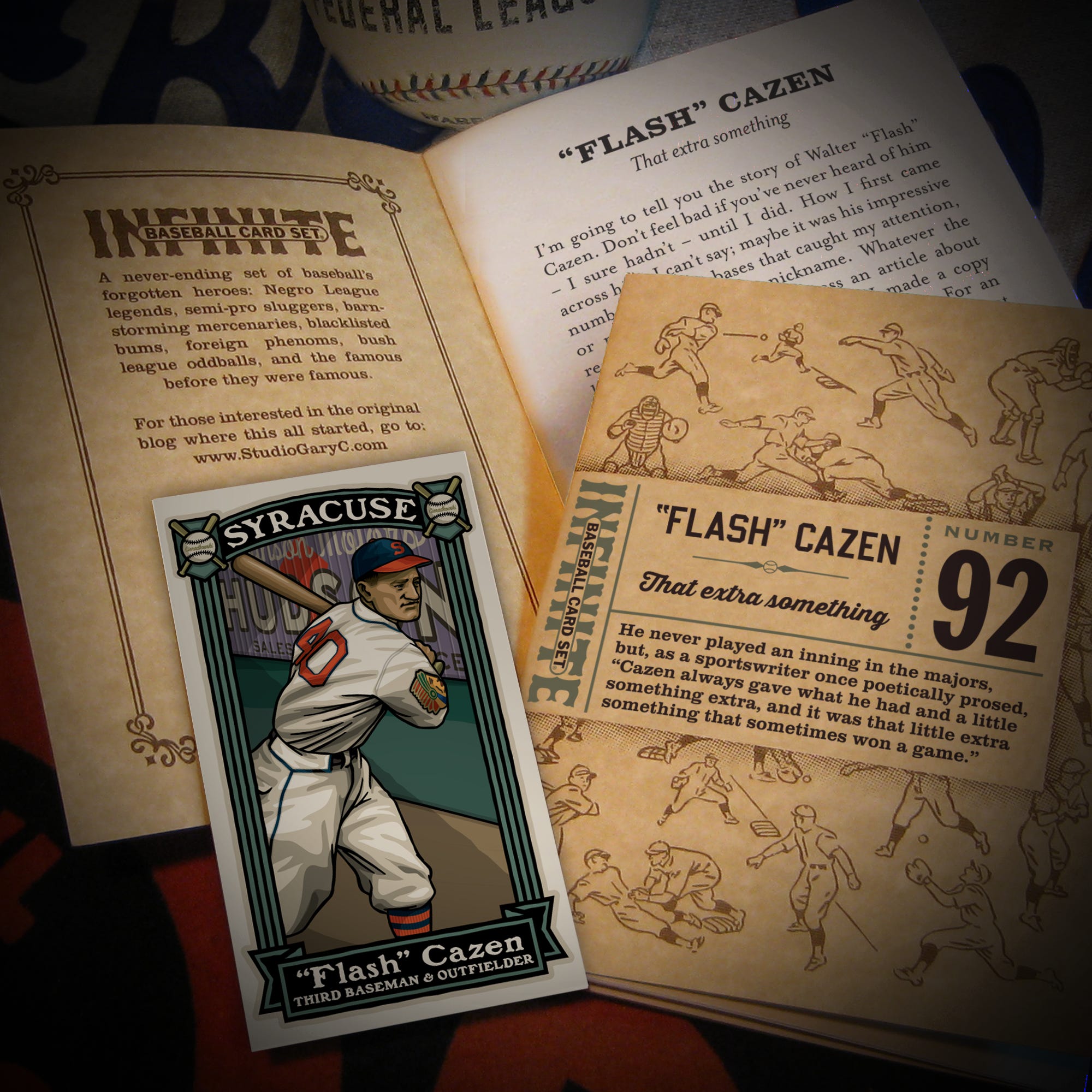
Each of the hand-numbered and signed 4 ¼” x 5 1/2″ booklets feature an 8 to 24 page story along with a colored art card attached to the inside back cover. These mini-books can be bought individually, thematically or collected as a never-ending set. In addition to the individual booklets, I envision there being themed sets, such as the series I did on Minor League Home Run Champions. You can order a Subscription to Season 8 as well. A year subscription includes a guaranteed regular 12 issues at a discounted price, plus at least one extra Subscriber Special Issue. Each subscription will begin with Booklet Number 090 and will be active through December of 2026. Booklets 1-89 can be purchased as a group, too.
No posts
Comments
Nothing yet. Say the first thing.
Sign in to join the conversation.