
Last summer, I attended the Society for American Baseball Research (SABR) conference in Dallas. Among the interesting presentations I saw was one given by Jason Schwartz, co-chair of SABR’s Baseball Card Committee. The annual BB Card Committee meeting is one I always make sure to attend because the presentations are top-notch, and Jason’s was exceptional that year. I thought that the subject would make a perfect post for The Infinite Baseball Card Set, but the problem was that I didn’t think I could top what Jason already did with his. So, I asked him if he would consider being a “Guest Author” on my site. This would mean that he writes the story, and I provide the illustration of the subject. He graciously agreed, and, I set about creating the art.
Unfortunately, somehow I erased or deleted the 90% finished drawing. For some reason, I couldn’t get back into the drawing. I cannot simply re-do an exact duplicate of the original drawing; each of my pieces are created in the moment, and capturing that primary inspiration is impossible. I had to wait until the spark hit again, so, I had to put the story on the shelf.
Finally, a couple days ago, the inspiration returned and I was able to create a whole new drawing. I actually like this one better than the first, one reason being that the background is actually the ballpark where the beginning of the story takes place. So, without further ado, here’s “The Savior Does Not Answer Letters” by Jason Schwartz…
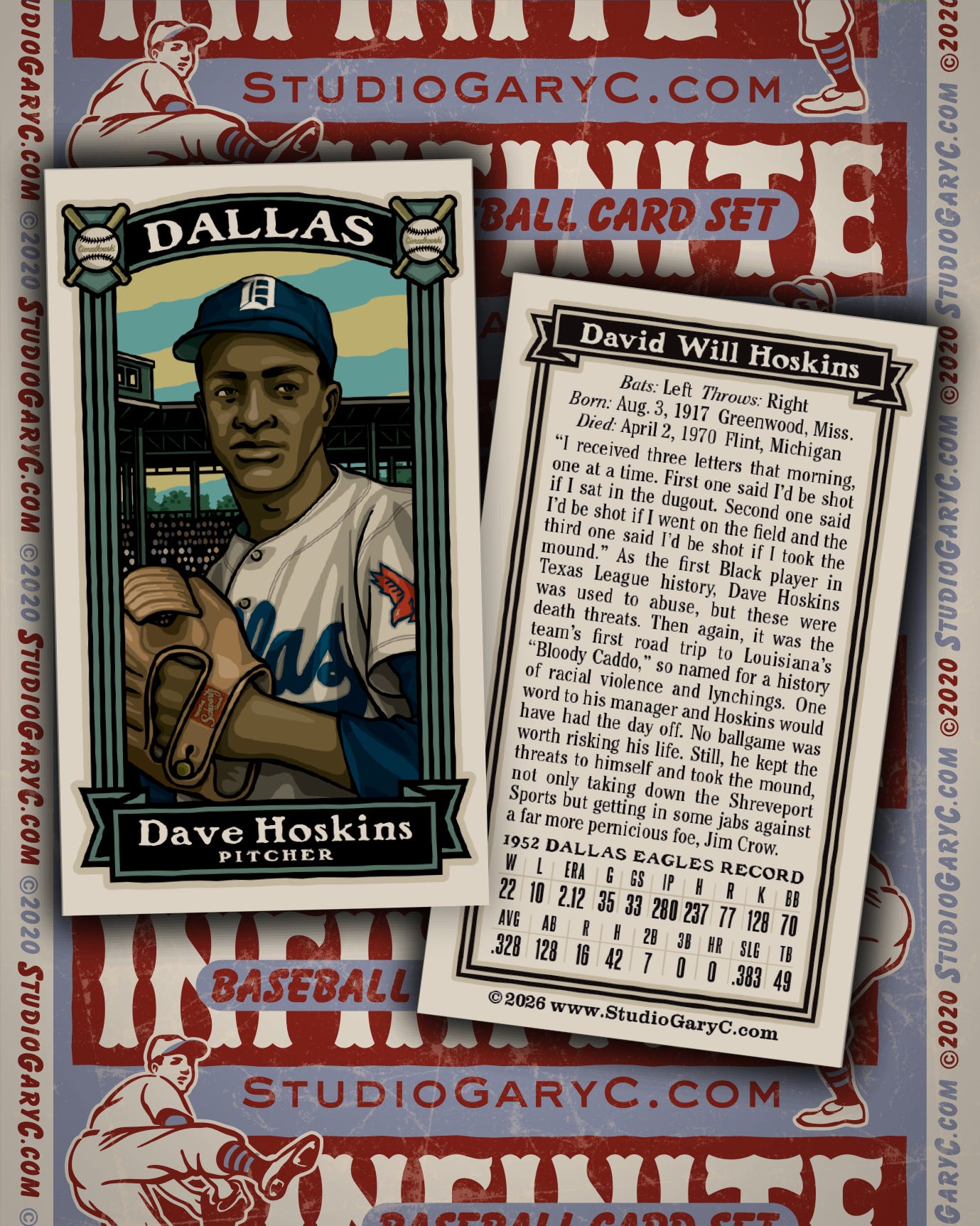
“I received three letters that morning, one at a time,” Dave Hoskins recalled eight months later. “First one said I’d be shot if I sat in the dugout. Second one said I’d be shot if I went on the field and the third one said I’d be shot if I took the mound.”
Under such circumstances, most ballplayers would have done the sensible, if not obvious, and taken the day off. However, Hoskins was not like most ballplayers. On the contrary, he was signed by Dallas Eagles owner Dick Burnett in 1952 specifically to face adversity head on and overcome it at every turn. The death threats on June 9 were just one test among many.
Hoskins, after all, was the first Black player in the history of a league that traced its origins all the way back to 1888. True, Jackie Robinson and Larry Doby had integrated the National and American Leagues five years earlier, but that was up north. This was the Texas League, where an entrenched Jim Crow system remained law of the land.
The path that brought Hoskins to the Eagles was hardly a straight line. Upon announcing his intentions to integrate the Dallas team, owner Burnett first held a tryout. Of the 200 players who attended, none were deemed Eagles material. Rather than give up, however, Burnett invited two former Negro League all-stars, Othello Renfroe and Ray Neil, to camp. Neither panned out. With the season fast approaching, Burnett placed a call to Hank Greenberg, general manager of the Eagles’ parent club, the Cleveland Indians. The Indians, after all, were the first American League team to integrate and had a farm system rich in Black talent. Certainly a “lone star” could be found.
Sure enough, Greenberg had just the player in mind. Originally recommended to Greenberg by Satchel Paige, Dave Hoskins had come off a successful 1951 season in Wilkes-Barre where he went 5-1 on the mound and hit .286 at the plate. Hoskins also had plenty of success with being “the first” in that he had previously integrated the Central League in 1948. Though he batted nearly .400 that season as a Grand Rapids Jet, Hoskins most definitely took his lumps, quite literally. The target of numerous beanballs, he ultimately shifted to mound duties in an act of self-preservation. “I was tired of having pitches thrown at me,” he said. “I made up my mind that I would start throwing at other guys.”
Interestingly, Hoskins had been pegged as a great candidate for integration even before Grand Rapids. No less than Wendell Smith of the Pittsburgh Courier had identified Dave Hoskins, Jackie Robinson, and Sam Jethroe as the three Black ballplayers most likely to succeed in integrating the major leagues. He knew that these three men had the courage and the character to parry the worst blows a hostile fan base might throw their way.
As if the playing field for Hoskins wasn’t uneven enough in Dallas, his first opponent as an Eagle was no mere AA team. It was the Boston Red Sox, who were traveling through the South to play some exhibition games. In four innings, How did Hoskins do against this big league lineup? He limited Sox bats to a single run on two hits. Still, this was only an exhibition game. How would Hoskins fare when the games really meant something?
Hoskins answered that question quickly enough. Three starts into the official Texas League schedule, Hoskins was 3-0 with a 1.33 ERA. Moreover, he was batting an ungodly .615! In addition, he was quickly emerging as the league’s top draw, filling segregated seating sections that had remained largely empty in prior years. In fact, his impact at the gate earned Hoskins the nickname “Savior of the Texas League.”
The June 9 game was different, however. This was the first time Hoskins would be pitching in Shreveport, known league-wide as the most antagonistic toward integration. Never mind that Hoskins arrived in Louisiana with an 8-3 record and 2.15 ERA. Never mind that Hoskins was batting .415. And never mind that Hoskins was certain to triple, if not quadruple, gate receipts for the Monday evening affair. As a matter of fact, these successes only made things worse.
To see a Black man given a chance, only to fail, might have been tolerable to the racists in the crowd that day. Heck, they might have even cheered for it. But to see a Black man excel when given the chance, that was a different matter altogether, an irrefutable challenge to their fragile and fraudulent ethos. For many, it was a deathblow to their very identity.
Still, excel is precisely what Dave Hoskins did that night, surrendering only two runs in a complete game victory. If there was any victory for the critics, it was only that Hoskins went hitless in three at-bats. Also 0 for 3, thankfully, was the miscreant who sent the letters. Hoskins did sit in the dugout, Hoskins did step out onto the field, and Hoskins did take the mound. Still, not a shot was fired in Shreveport. In reference to Ted Williams, John Updike once wrote, “Gods do not answer letters.” Evidently, neither do saviors. They let their pitching do the talking, sinners be damned!
Epilogue: Dave Hoskins finished the 1952 season with a league best 22 wins, a 2.12 ERA, and a .328 batting average. His success earned him an immediate promotion to the Cleveland Indians where he went 9-3 in 1953. More importantly, his success with Dallas led to the rapid integration of every team in the league, save one: Shreveport.
Note: The Society for American Baseball Research is a terrific source of additional information about Dave Hoskins and his groundbreaking 1952 season. Card collectors may particularly enjoy the SABR Baseball Cards blog, which features member-authored pieces on all things baseball card-related.
The ‘Savior’ Does Not Answer Letters: Dave Hoskins and the Uneven, Unheralded, and Unfinished Integration of the Texas League (The National Pastime, 2025)
SABR Biography: Dave Hoskins (SABR Bio Project)
August 28, 1952: Dave Hoskins wins 20th game for Dallas Eagles on night held in his honor (SABR Games Project)
Uncommon Common: Dave Hoskins (SABR Baseball Cards blog)
Player Collection Spotlight: Dave Hoskins (SABR Baseball Cards blog)
Click here to become a SABR member.
No posts
Comments
Nothing yet. Say the first thing.
Sign in to join the conversation.