
↓↓ Your weekly UX digest is below ↓↓
Hey friends,
While I still struggle with my burnout (more here), I felt I couldn’t ignore the most pressing question I receive: how to start in UX in this new world we live in now.
The old way of “study hard → finish a bootcamp → get hired” is broken.
I’m not saying this to be dramatic.
I’m saying it because I see the reality every day.
As a Principal Product Designer (and hiring manager) at Zalando, I see smart, hardworking people struggling to get any UX job — even after years of serious effort.
So if I had to start over in 2026, with no UX background and no bootcamp, here’s the roadmap I’d follow.
Before you invest months (or years), I’d validate the job itself.
Not “do I like pretty interfaces”.
But:
What does a UX designer do day to day?
What parts are boring / political / repetitive?
What does progress look like after the junior stage?
How I’d do it:
watch real “day in the life” content
talk to people who work in UX (not just creators)
ask direct questions about the boring parts
Because after the struggle of transitioning, you want to be sure you’re landing in the career you actually wanted.
Also: assume it will take time.
So you need a financial plan for the “in-between” stage (savings, part-time job, calmer role, whatever keeps you stable).
Yes, Figma still matters.
But in 2026, it’s often the tool we use later — when we already know where we’re going, and we need a clean handoff.
What’s changed: many designers now start the process with “vibe coding” tools — fast prototyping, quick iterations, exploring directions.
If I were starting today, I’d pick:
Figma (baseline)
one modern prototyping / vibe-coding tool to ship something end-to-end
The point isn’t to become a tool nerd.
The point is to stop being blocked by tools while you learn everything else.
And honestly: I wouldn’t pay for a course just to learn tools.
You can learn 90% of it on YouTube.
If anyone can generate a prototype, taste becomes the actual job.
Taste = the ability to judge what’s good, what’s not, what fits the user, what looks refined, what feels coherent — and to guide a model (or a team) toward that.
Nobody is born with taste.
It’s trained.
What I’d do:
study great design (UI, graphic design, editorial, branding)
go to museums (seriously)
flip through design books (even for free in bookstores, I did it in my university times)
learn basics of typography, layout, composition
Hiring manager’s tip: candidates with a graphic design base often stand out immediately, even when they apply to UX heavy roles.
Not because they “make things pretty”.
But because they know the basics of the visual art: what colours, typography, and spacing to use for design to convey the intended message.
So I’d definetely invest in the graphic design taste too.
In 2026, one or two case studies just simply won’t cut it.
I’d aim for:
4 high-quality portfolio projects
plus 3–5 smaller experiments (quick vibe-coding explorations, UI iterations, prototypes)
It’s a lot, I know. Tough times.
And if I had a budget, I’d spend money to speed up feedback and increase the quality by hiring a mentor or getting into a program like a bootcamp.
But I would not treat any program as a “golden ticket to UX”.
Bootcamp, degree, mentor, self-study — none of that matters as much as:
how your final four projects look like.
The portfolio is your sales pitch.
The program is just one way to produce it.
This is the part most people hate when I tell them.
But it’s the most important one.
In 2026, junior roles are limited (if at all existent). Many “junior” jobs ask for years of experience.
So I would stop relying on endless job applications as my main strategy.
Instead, I’d go aggressively for real clients:
former colleagues and friends
small businesses with outdated websites
gyms, cafes, local services
startups that need design help
anyone who has a product problem and no designer
Yes, it’s uncomfortable.
Yes, it’s not as fancy and secure as a real corporate tech job.
But real clients teach you the thing bootcamps can’t:
stakeholder communication
messy constraints
negotiation
priorities
handling feedback when it hurts
delivering despite uncertainty
And that’s exactly what employers mean when they ask for “experience”.
I bet my money that showcasing this actual, bumpy, raw client experience, not being afraid to start from the bottom, is what will differentiate candidates in the age where anyone can vibe code something decent in 10 minutes with Figma Make.
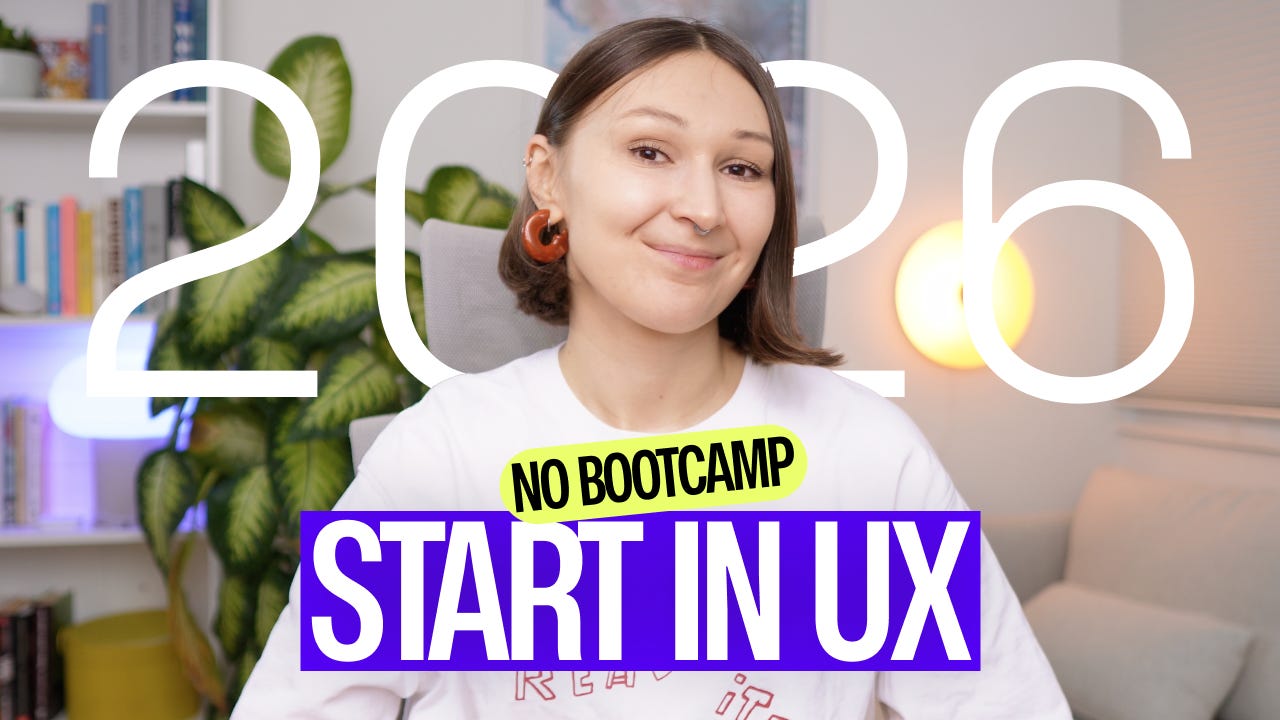
I broke this down in a video with more context, examples, and how I’d sequence it in real life.
🎥 Watch the video here.
And if you’re trying to start UX right now, I’m curious:
Which step feels hardest for you — tools, taste, portfolio, or real projects?
BTW ☝️
Soon, I will be starting a new cohort for my best program: UX Breakthrough.
Portfolio. CV. Advanced job search. 100+ lessons — everything to start hearing the replies.
This time I will add more live classes!
Join the waitlist to hear about the updates.
01 How to Stop the Stakeholder Swirl
Uber Design on a very real problem — when feedback comes from everywhere and nowhere at the same time. Practical ways to regain clarity and momentum. Link
02 UX Metrics and Goals
NN/g explains how to connect UX metrics to actual goals instead of tracking numbers just to feel productive. Clear and grounding. Link
03 Mentoring Is Not What You Think
A refreshing take on mentoring — less advice, more responsibility and trust. Especially relevant if you’re mentoring juniors or stepping into leadership. Link
04 Management Values I Didn’t Expect to Learn
Personal reflections on leadership lessons that don’t usually make it into management books. Honest and relatable. Link
05 How to Measure the Impact of Features
Smashing Magazine breaks down how to think about feature impact beyond vanity metrics — useful if you work closely with product and stakeholders. Link
See you next time,
Inés Mir
🩶
No posts
Comments
Nothing yet. Say the first thing.
Sign in to join the conversation.