
“Look!” they said. “Isn’t this amazing?! I trained it to look just like your work! It’s so cool!”
They showed the illustrator examples of AI-generated artwork in her own style.
They showed the outdoor adventure blogger examples of AI-generated posts in her own style.
“Wait, why are you reacting that way?!” they asked, truly surprised at how hurt and upset the illustrator and the blogger felt.
One category of AI use is entertainment.
In the examples above, “they” were surprised the reactions of the artist and blogger because they did not think about consequences. They just went ahead with their idea, driven by excitement.
The blogger in the example was genuinely crafting something from her heart for others to reflect upon. And yes, she has had sponsors over the years. But it’s not a get-rich kind of a thing. So if AI takes over her blog posts, then:
What outlet will she have?
And what kind of experience are her readers going to have?
What does either party gain? (And what does the planet lose?)
I don’t think the AI-trainers in the example even thought of these questions. They were more excited about the wow factor.
Broadly, people who asks AI to create something like these examples seem to just want a response from their fellow humans. They want to show someone a thing and get an “OH COOL!” in reply.
Example: I just spent the weekend with my cousin and our spirited, salty 87-year-old Tevis-trail-horse-rider aunt. (The Tevis is the original 100-mile horseback race across the Sierras, following native American and early-state era trails.) My cousin was playing with ChatGPT as we listened to our aunt’s stories, so she generated a digital painting in the style of a certain artist, featuring her dog in the center. She showed our aunt. “Oh, cute!” said our aunt, appreciatively. My cousin wasn’t going to do anything with the image except show our aunt.
Our aunt is a talker. She has decades worth of stories about making trouble. The dog painting occupied her mind for maybe three seconds, then she dove back into a story about one of her ex-husbands in military detention.
I know my cousin was not bored with our aunt’s stories. But she was equally fascinated with the ChatGPT image-making to give it another prompt. “Make an image of a woman riding a horse in a cartoon style.”
The spinner appeared. “Huh,” my cousin said. “This one is taking longer. Maybe it won’t work.” She set aside her phone. We unboxed a few real-life paintings, including temple rubbings on rice paper of horses that our aunt’s mom got in Thailand in the 1950’s. We considered how to describe them for eBay. My cousin reached for her phone—and there was the finished digital image from ChatGPT. It was a K-pop girl with big eyes on a rainbow pony unicorn with rainbow-colored background objects. Our aunt didn’t even give it half a second of her attention, and declined to comment.
I was not amused, so I admit I hinted to my cousin about how much carbon, energy, and water the planet paid to create the throw-away image. In her defense, she honestly had no idea what happened behind the screen. And that led to a discussion about AI-created things.
“I do NOT want to read books written by AI,” my aunt declared. “Even if the books are entertaining, I don’t want to do it.”
My cousin prefers video to reading, and mentioned the videos she’s seen that were AI-generated. She does not like them. “You can always tell. Something is off—some detail that my mind picks up. And then,” she continued, “there are the videos with abhorrent content.”
We wished out loud for a tag that would let us know when the content was AI-generated. Then I remembered the Author’s Guild Human Authored Certification program. I’ve got a logo that I can put in my books so potential readers can verify their preference for non-AI-generated books.

To answer this question, we need to know what kinds of AI-created things there are.
Tey Bannerman and Stefanie Hutka have been musing about this from the machine perspective. What is a machine good at versus a human?
I want to look at it from the perspective of people. What things are people trying to accomplish when they reach for AI?
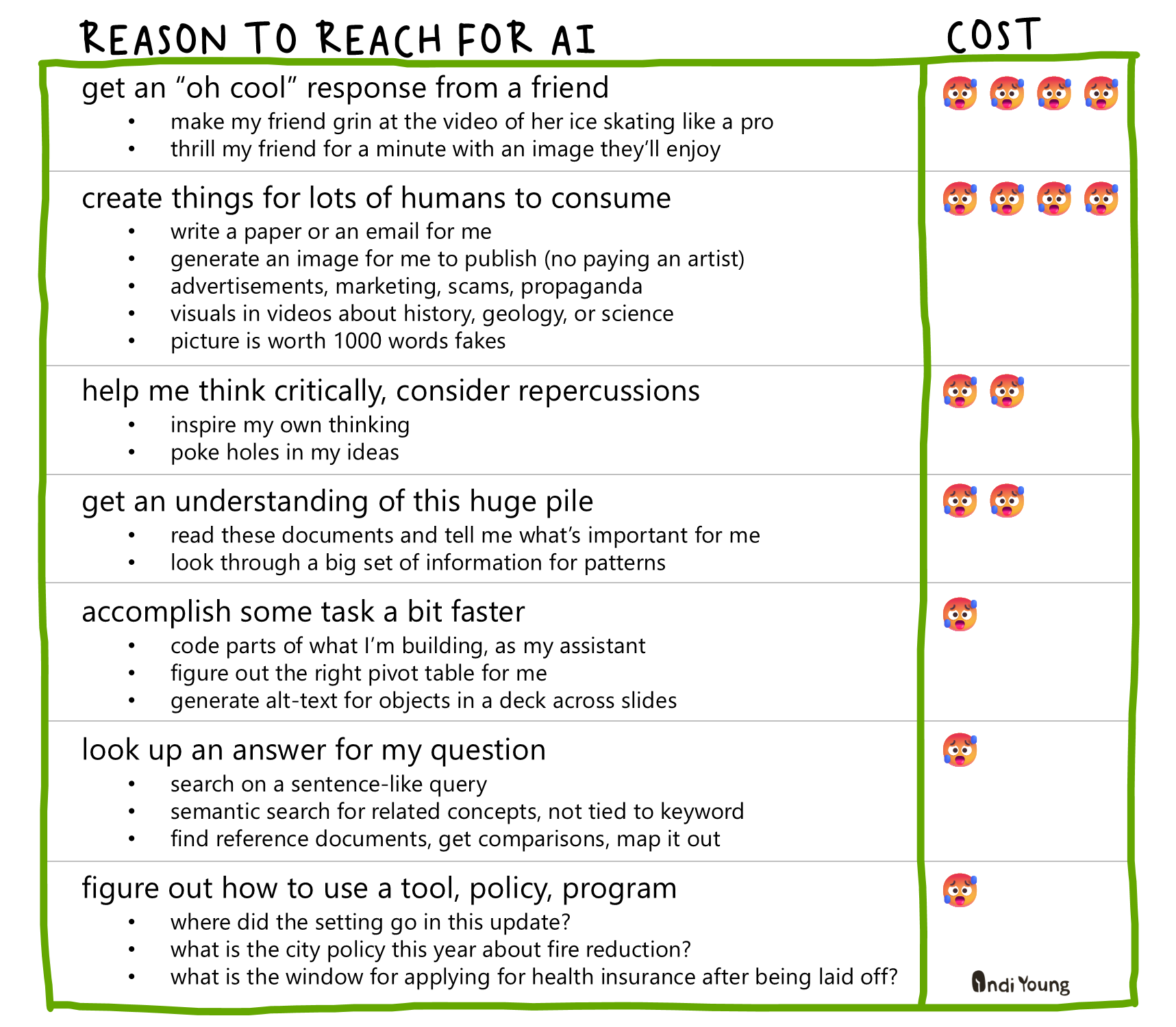
In the table below, I’ve started with seven broad buckets. The “cost to the planet & people” shows a number of “hot face” icons after each bucket label, restaurant price-range style. (The number of icons are my guess. (It’s 86F/30C outside as I write this, and it’s still winter.) It’s a first draft.
The single-hot-face 🥵 rows in the table below have a maybe-reasonable cost to the planet in exchange for the outcomes.
The quadruple-hot-face rows 🥵🥵🥵🥵 are where people and the planet lose. I argue that there is no ethical gain.
In the first row, the cost is too much for a few seconds of entertainment.
In the second row, it’s basically a spam machine. People want to earn money for little effort.
Back to the starting example. There were three questions the AI-user could have asked about outcomes of their mimicking:
What outlet will the creator have?
And what kind of experience are their viewers going to have?
What does either party gain?
People never wanted spam or scams. Now, with the glut of content being generated, people still don’t want spam or scams. They have to spend extra time to fend off the glut. There are already endless ways to entertain yourself. Adding 10,000 time the content, generated by AI, pretty much only supports addiction and escapism, at even greater cost. People only have so many hours in a day to consume, so the consumption will be spread thinner over more AI-using creators. The only people who gain are the platforms hosting the content and the ads.
People are already unsubscribing from real human writers that they trust. I’ve reached out to my peers about the state of their work. Everyone is overwhelmed--even people who are not employed. We’re all trying to “do more.” We’re finding ways to not lose. One person said, “Running fast just to run faster.”
We are short-circuiting our humanity. We crave time to think straight.
As an antidote, join me for a five-week exercise in humanity—in listening deeply and carrying those skills to our teams. The Listening Deeply cohort is coming up, 25-March - 29-April. We’ll be in a cocoon together for two hours a week. It’s beautiful, you deserve it, and there are four price tiers. (Contact me if none of the prices work for you.)
The next cohort for Listening Deeply will run in 2027.
🥰 If you enjoy my newsletter, you can now contribute $1 a month. Or 80 cents. Or 50 cents — the lowest bank threshold. (None of this money goes to Substack or LinkedIn or Medium, or any of those platforms. Nope.)
(To cancel your contribution at any time, reach out to me via indiyoung.com)
Get an “oh cool!” response from a friend 🥵🥵🥵🥵
make my friend grin at the video of her ice skating like a pro
thrill my friend for a minute with an image they’ll enjoy
Create things for humans to consume 🥵🥵🥵🥵
write a paper or an email for me
generate an image for me to publish (no paying an artist)
advertisements, marketing, scams, propaganda
visuals in videos about history, geology, or science
picture is worth 1000 words fakes
Help me think critically, consider repercussions 🥵🥵
inspire my own thinking
poke holes in my hypothesis
Get an understanding of this huge pile 🥵🥵
read these documents and tell me the what’s important to me
look through a big set of information for patterns
Accomplish some task a bit faster 🥵
coding assistant for what I’m building
figure out the right pivot table for me
generate alt-text for objects in a deck across slides
Look up an answer for my question 🥵
search on a sentence-like query
semantic search for related concepts, not tied to keyword
find reference documents, get comparisons
Figure out how to use a tool, policy, program🥵
where did the setting go in this update?
what is the city policy this year about fire reduction?
what is the window for applying for health insurance after being laid off?
Comments
Nothing yet. Say the first thing.
Sign in to join the conversation.