

I am using example data in the courses that I teach. The example is about people’s inner thinking, emotional reactions, and personal rules during and after a near-miss accident. I would love your help.
The course I’m creating now is about finding thinking styles. Thinking styles are archetypes (from patterns of distinctive essential cognition), and I am about to write the lesson called Check Your Work, to see what we need to change in the labels or descriptions. I’d love input from anyone who has 100 seconds to give me.
(“Distinctive essential cognition.” What does that mean??! What are thinking styles for? Skip to the bottom. 😄 There’s also a comic down there.)
Do you remember a near-miss accident? An accident doesn’t have to be in a car. You can be walking, riding a bike, in a pool, going down stairs. You can have a near-miss accident anywhere. Also, the danger could have happened to someone else, like maybe your running buddy fell down a very steep gulch.
The one thing is that you need to remember your cognition.
If you can’t remember, find another near-miss. Or, if the near-miss is vivid in your mind, but you did not have much inner thinking nor emotions, then think of another near-miss. (The brain often gets shocked in accidents and resorts to intuition or very core training. Not having much cognition is common.)
Check out what we found, in the two sections below.
This first set of thinking styles is about DURING the accident. The accident basically starts when you realize there is danger and ends when you “feel relieved” or need to “calm myself down,” according to the patterns we see. So, what was the essential cognition that went through your mind while you were in danger?
Here are six possible thinking styles.
NOT SURE: I think something dangerous is about to happen, but maybe not. If I am suspicious about a *person*, it might be the result of their behavior, demographic assumption, or bias. If I am suspicious of a *situation*, it might be based on intuition, experience, or a related story I heard. So, I am alert, watching to see what is unfolding. I might prepare myself (and others) to react when things shift into true danger.
REMAIN CALM & DO THE THING: Don't panic. My brain wants to panic but I must keep a clear head so that I can do the thing that will get me out of danger. Maybe I don't even feel anything. I know what needs to be done. I am careful and do my best in order to have success. I might have to avoid a stalled car or use an epi pen. I cannot be stupid. Panic and high emotion will distract or freeze me, making the accident more likely or worse. I need to be calm in this dangerous situation. My brain needs to be clear and focused.
GET SOMEWHERE SAFE: Get out of here! There is a dangerous person, insect, event, moving vehicles, or something here that can hurt me. I know this intuitively, from experience, by the behavior of people around me, or from a source of news. Since I am in danger here I'm moving away to a place that is safer. If I am unable to move away, I might switch to hiding or blending in.
SAVE MYSELF: I have to do something! I can really get hurt or die! I keep trying things to get myself out of this danger. If something does not work, I think of another idea to try. I keep thinking of different ideas until I am finally safe. My mind is filled only with finding something that will work. I'm doing this while feeling terrified or dazed.
FIND HELP: I need help. I can't get out of this danger on my own. I might have tried or thought of options, none of which I can achieve without someone strong enough or competent enough. I might wish I had better training or that I had strengthened myself or taken lessons in advance. I need to find someone to help.
HOPE: There is nothing I can do to affect the outcome. I might have tried something, but it didn't work. I have to surrender to this. I can only hope that it turns out okay. I might wish I knew something that can help.
Click one of the answers on this LinkedIn poll for DURING the near-miss accident.
A. Yes, my thinking style is listed. (Or maybe I had two.)
B. Not quite; one of them is close. (Please comment how it should change.)
C. No, my thinking style is missing. (Please comment on what it was.)
D. Null ... I really wasn't thinking that much.
This second set of thinking styles is about AFTER the accident. Many folks had certain distinctive things they did shortly after the accident, in addition to “feel relieved” and “calm myself down.” Some people think about the accident for days or weeks. Some of the stories people told us were a decade past and still haunted them.
Here are six more thinking styles. See how different they are. (It’s a total coincidence that there are six in each part of the near-miss. It’s not on purpose.)
MAKE THEM CHANGE: Make sure they change their ways, so they won’t do it again. Teach them a lesson. I might worry they will endanger someone else later, so I want to prevent them from harming or scaring others. Maybe they harmed me or my vehicle. Maybe they just came close, and they should know what horrible thing could have happened. I might inform them myself because it is my public service. It's tricky to figure out how because they might get mad or defensive. If I feel it’s risky, or if I can’t reach them, I might report their license or ask an authority to tell them to follow the rules.
BETTER NEXT TIME: I want to plan or learn how to do better. Next time I’m in this situation, I want to be safer. I might be upset with myself because I know better. I should have paid attention. I will think of a better approach. I may need to sit down and learn how to do something differently.
NEVER AGAIN: I want to avoid putting myself in this situation ever again. If I don't change, someone is really going to get hurt. Perhaps I vow to avoid the type of location where the accident could occur, like icy slopes. Or maybe I make a big lifestyle change, like giving up driving or taking a job in a different state. I am willing to upset someone close to me in order to make sure this danger doesn't ever happen again.
TAKE MY MIND OFF IT: Do something so I can stop thinking about it. I want it resolved so I can move on. Or maybe I need to circumvent a system that isn't working well for me. I decide what to do now that will get me off this track.
WHY DID THEY DO THAT? Puzzle over why it happened, why they did that. It was such unusual or unreasonable behavior. I keep turning it over in my mind. Why would someone do that? It haunts me.
REGRET WHAT I DID: What was I thinking? There is no reason for what I did or said. This scenario might occur to me again and again, even years later. I know better. I don’t need more training. I just made the wrong assumption, interpretation, or response.
And now here is a second LinkedIn poll for AFTER the near-miss accident. Same answers, different set of thinking styles.
A. Yes, my thinking style is listed. (Or maybe I had two.)
B. Not quite; one of them is close. (Please comment how it should change.)
C. No, my thinking style is missing. (Please comment on what it was.)
D. Null ... I really wasn’t thinking that much.
Thinking styles are hats that people wear when they are addressing a specific intention or purpose. In our case, this intention is to get out of danger as safely as possible. We are after a method to see how to support people in new ways, from their point of view regarding an accident—without making decisions based on assumptions or an “average person.”
Specifically in this case, we imagine an insurance organization who wants to reduce the number of or consequences of car accidents, an organization like the car-insurance department of the province of British Columbia. Or it could include more than cars, such as insurance providers for gyms or public pools. There are organizations who also push the envelope, potentially caring for situations that are typically not covered currently. Reduce costs, reduce accidents, and grow the solution set.
Thinking styles is the only strategic practice that makes human variety visible and actionable — before ideation begins. It is similar to market segmentation except that it surfaces the cognitive diversity that demographics and preferences miss. Thinking styles give you a powerful way to see opportunities to follow your own unique path.
Applied over decades, a car-insurance organization will build solutions that easily reach more people because they are designed for each thinking style. They can imagine a new system for helping a pair of organizations work together to improve safety habits of the drivers they insure because of the Make Them Change contexts. The organization can respectfully work with the people involved who want to change their own habits. It can help people aiming for bigger lifestyle changes to avoid the situations in which they feel vulnerable or less capable. At a higher level, it could be a way to support societies to improve all sorts of transit options or smooth out technical change such as self-driving cars.
Over decades, teams will measure people’s outcomes by thinking style in addition to only measuring the solution and business outcomes. This is an ultimate goal of organizations. Being able to understand people’s minds in terms of their intentions is knowledge that market research has been after for decades. Thinking styles gives organizations a reasonable way to see how their solutions are supporting people. Instead of trying to serve each person uniquely, with probabilistic assistance from AI, organizations can stabilize and track their progress by training AI models on their thinking styles.
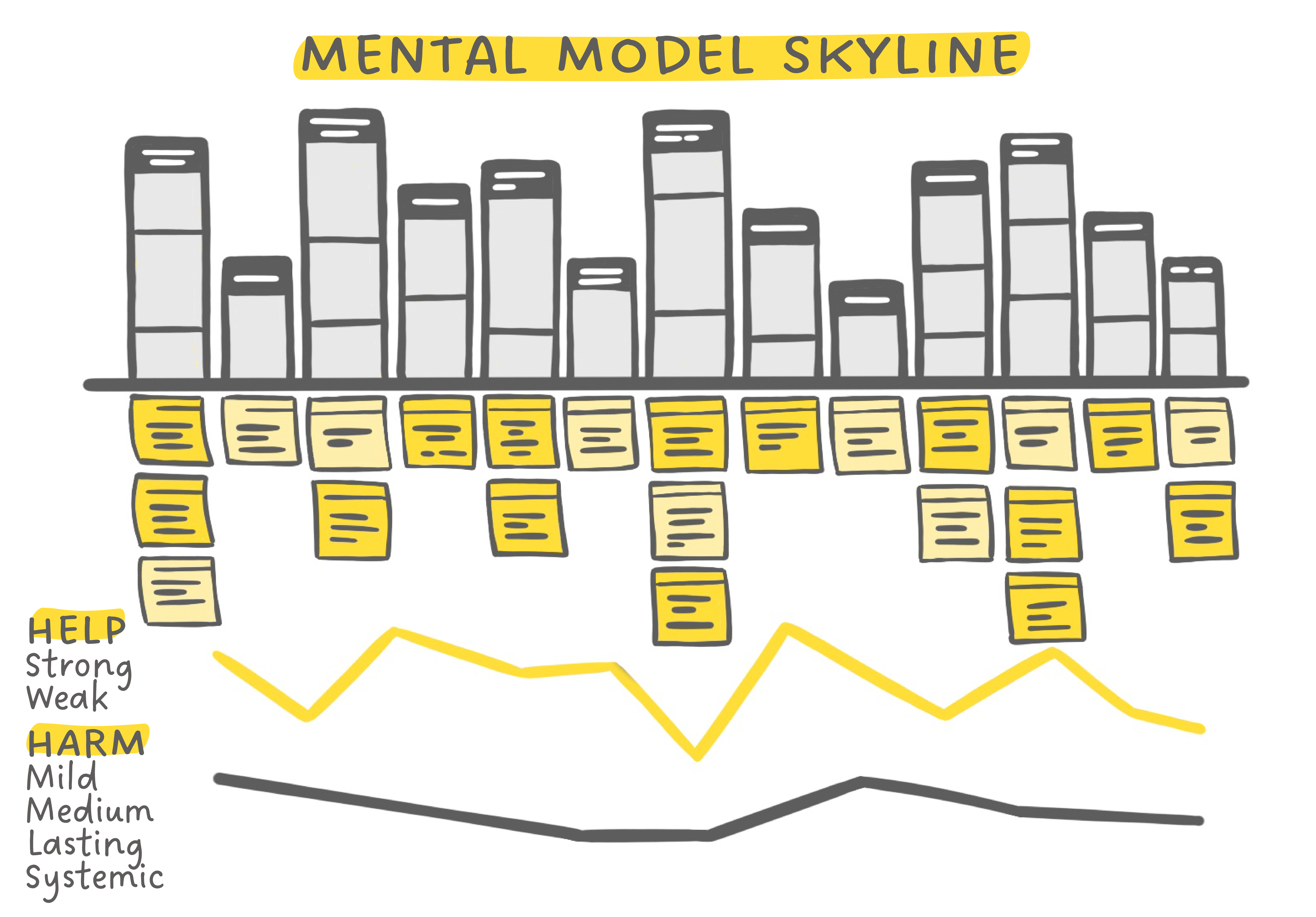
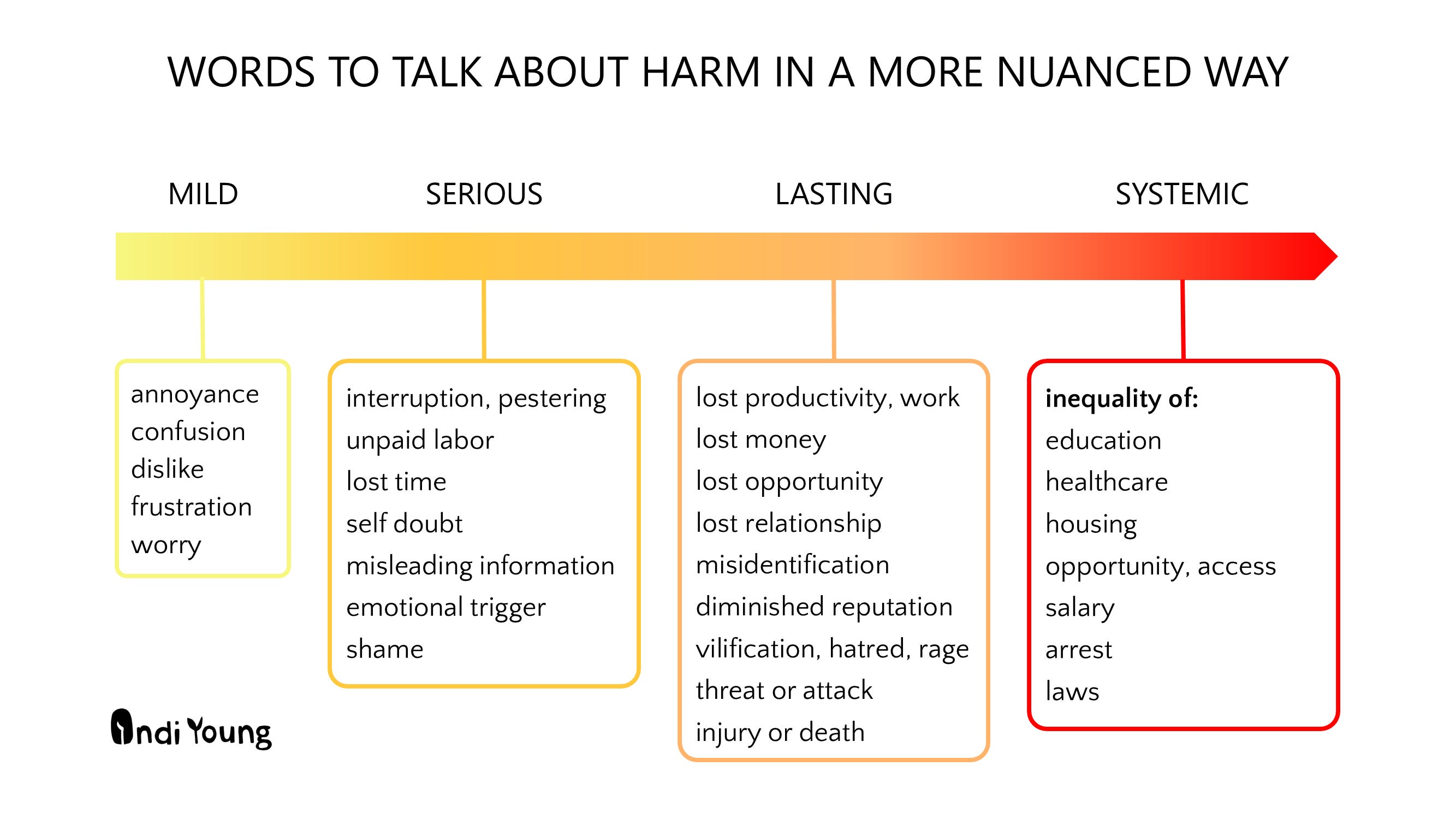
For people themselves, an organization who is designing and measuring by thinking styles directly reduces unintentional harm. People feel heard and supported. More specific systems and support are in place for them. People have less frustration, less confusion, and most of all, less unpaid labor demanded of them. There is a much-improved relationship between the organization and the people it supports.
Finding Thinking Styles involves working with a lot of ambiguity. As a part of the process, we seek people who can tell us their interior cognition. We skip stories where people have no essential cognition to report. But we don’t know what cognition is essential at the start. So we go through the process exploring everything we heard, then we “throw out” any stories where the thinking and emotion is quite instinctual or common. For example, almost everyone is shocked and scared during an accident. Almost everyone is relieved after, and many people need to calm themselves down. We did not know this in the beginning—we identified it during the process of finding thinking styles. The groups that we end up with are distinct and thought-provoking in a way that is bounded, not infinite. Teams who use thinking styles love this characteristic.
Additionally, thinking styles help teams turn away from rote assumptions about people and mundane solutions. Teams can still use characters and stories, but these characters wear one thinking style hat per story. I encourage teams to make a stable cast of characters and write episodes, just like writers do for TV shows. One character might use one hat most of the time, but put on a different hat for an interesting context. The one rule, “Do not change a person’s thinking style; support it,” is the guideline that really changes how new ideas are created.
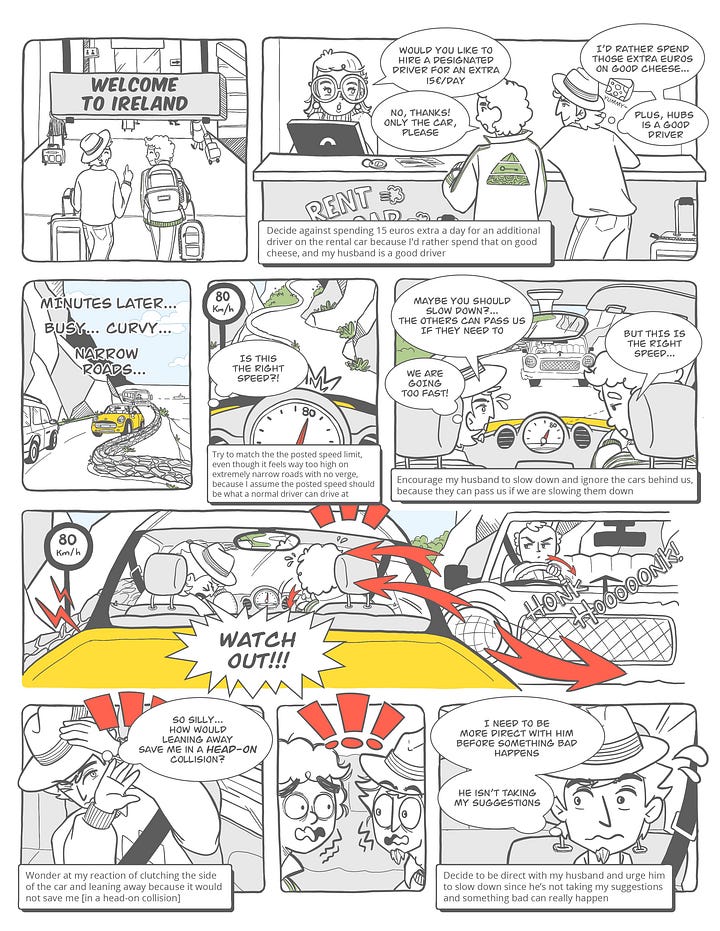
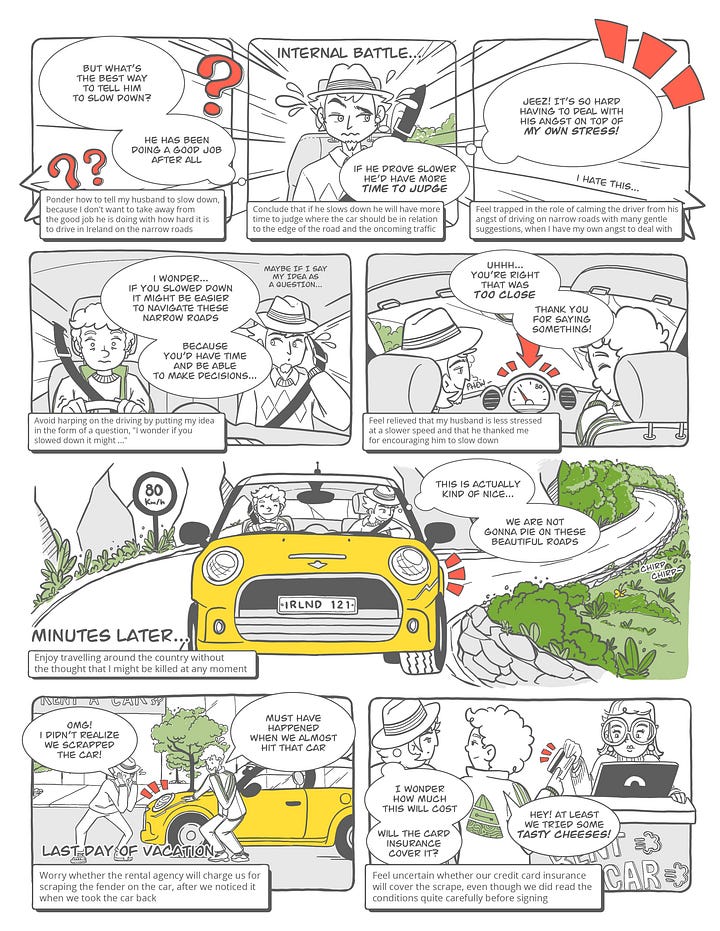
(Here is the whole story that the leading image comes from, just so you know it turns out okay.)
🥰 If you enjoy my newsletter, you can now contribute $1 a month. Or 80 cents. Or 50 cents — the lowest bank threshold. (None of this money goes to Substack or LinkedIn or Medium, or any of those platforms. Nope.)
(To cancel your contribution at any time, reach out to me via indiyoung.com)
Comments
Nothing yet. Say the first thing.
Sign in to join the conversation.